2024-11-07 12:50
Nov 7 (Reuters) - Oilfield services provider Halliburton (HAL.N) , opens new tab missed analysts' estimates for third-quarter profit on Thursday, weighed down by a slowdown in drilling activity in North America and the impact of a previously disclosed hack. The company's shares slipped 1.5% to $30.05 in premarket trading. Halliburton in August disclosed a cyberattack where an unauthorized third party accessed and removed data from its systems. The incident had caused disruptions and limited access to portions of its business applications. The company recorded a pre-tax charge of $35 million in the quarter linked to expenses from the attack. "We experienced a $0.02 per share impact to our adjusted earnings from lost or delayed revenue due to the August cybersecurity event and storms in the Gulf of Mexico," said Halliburton CEO Jeff Miller. The Houston-based firm posted an adjusted profit of 73 cents per share for the three months ended Sept. 30, missing analysts' average estimate of 75 cents, according to data compiled by LSEG. Meanwhile, Halliburton's North America revenue fell 8.5% to $2.39 billion. The decline was primarily driven by decreased pressure pumping services in U.S. land, in addition to lower activity across product service lines in the Gulf of Mexico partly due to hurricanes Francine and Helene. In contrast, revenue from international markets rose 3.6% to $3.31 billion. Exploration and drilling in international markets such as the Middle East and Asia have driven increased demand for oilfield services, as producers seek to secure new oil and gas deposits. Halliburton's rivals Baker Hughes (BKR.O) , opens new tab and SLB (SLB.N) , opens new tab posted third-quarter profit beat on sustained demand from international markets. Sign up here. https://www.reuters.com/markets/commodities/halliburton-misses-quarterly-profit-estimates-north-america-drilling-demand-2024-11-07/

2024-11-07 12:40
MOSCOW, Nov 7 (Reuters) - Russia's central bank on Thursday rebuffed complaints from businesses about high interest rates pushing up financing costs, stating that labour shortages were the reason why investment growth was slowing across the economy. The Bank of Russia last month hiked its key rate by 200 basis points to 21%, the highest level since the early years of President Vladimir Putin's rule, as heavy state spending for the conflict in Ukraine tightens the labour market, pushing up wages and inflation. More and more industrial firms are saying that product investment and development may suffer. Kirill Tremasov, head of the bank's monetary policy department, acknowledged at a forum in the Urals city of Chelyabinsk that investment growth had slowed. But he added: "In principle, there are no available labour resources." Most manufacturing and engineering firms say that trying to compete with the military-industrial complex, which has been put into overdrive to equip Russia for the conflict in Ukraine, is futile. "The majority are putting the development of new production capacity ... on pause precisely due to the lack of staff," Tremasov said. Steelmaker MMK (MAGN.MM) , opens new tab disputed that. "If we continue our investment programme at the volume we have now, then the money will run out in six months," said Maria Ovechkina, MMK's head of financial resources. The major business union RSPP said last week that late payments had been the leading factor hampering Russian businesses in the third quarter, as companies grapple with high interest rates and logistics challenges. But RSPP head Alexander Shokhin did acknowledge a labour shortage. "The special (military) operation is diverting people, and this problem cannot be solved quickly," he said. Tremasov repeated the central bank's stance that high borrowing costs will be needed for a long time to cool economic overheating. He expected the key rate to average 17-20%, next year, warning that even more hawkish policy may be required. Sign up here. https://www.reuters.com/markets/rates-bonds/russian-central-bank-blames-labour-shortages-not-high-rates-investment-slowdown-2024-11-07/

2024-11-07 12:30
NAPERVILLE, Illinois, Nov 6 (Reuters) - It is all but certain that U.S. corn producers churned out a new record yield in 2024, but this year’s crop could hit yet another milestone that has not been seen in 20 years. The U.S. Department of Agriculture on Friday will publish fresh estimates for the 2024 U.S. corn and soybean harvests, and on average, analysts see corn yield dropping to 183.7 bushels per acre from 183.8 in October. But nearly 40% of the polled analysts think corn yield could come in above 183.8 bpa. If it does, the 2024 crop will join ranks with 2004 and 1994, the last two times that U.S. corn yield estimates rose in every month from August to November. Long-time market watchers are well acquainted with 1994 and 2004, two “unicorn” seasons where ideal weather boosted corn yield significantly above prior records. Final yields rose 14% and 11%, respectively, above USDA’s trendline yields. Despite a drier August, the 2024 U.S. corn crop enjoyed a wet July and near-normal temperatures, though distinctly cool weather during July and August is what often separates great crops from truly exceptional ones. Yield at 183.8 bpa is 1.5% above USDA’s 2024 trendline, not exactly mimicking the stellar 1994 and 2004 results. But it would be the first time since 2018 that final corn yield exceeds trendline, somewhat validating USDA’s lofty trend calculations of recent years. A 183.8 bpa would also be nearly 4% above the previous national record. The last three times corn yield was 4% or more above the prior high were 1994, 2004 and 2014, perhaps implying something special about years ending in four. While it will be a long wait for 2034, advances in seed technology and management strategies have set up for yield successes even amid imperfect weather, and many U.S. producers are as confident as ever in their ability to produce strong corn yields. DOWNSIDE SOYBEAN RISK? Recent history suggests a November soybean yield surprise could manifest in an unexpectedly low number. USDA’s U.S. soybean yield estimate has fallen below the range of trade estimates in three of the last six Novembers (2021, 2020, 2018). On average, analysts peg soy yield at a record 52.8 bpa ahead of Friday’s report, down from 53.1 in October. The 1.7-bpa estimate range is typical and includes a low end of 52.1, just above the 51.9-bpa record from 2016. The 2018 case is interesting because yield fell to 52.1 in November from 53.1 in October, though the trade had been looking for 52.9. That was despite a favorably wet August, unlike this year, which featured the Midwest’s driest August in 11 years. Commodity brokerage StoneX on Monday reduced its soy yield forecast to 52.6 bpa from 53.5 last month, perhaps a 2018-like feel. Final 2018 yield ended much lower at 50.6 bpa, and something similar would need to happen this year to have a shot at generating a bullish storyline for soybeans, especially with U.S. stockpiles pushing six-year highs. Karen Braun is a market analyst for Reuters. Views expressed above are her own. Sign up here. https://www.reuters.com/markets/commodities/us-corn-crop-could-join-an-elite-club-friday-2024-11-07/

2024-11-07 12:28
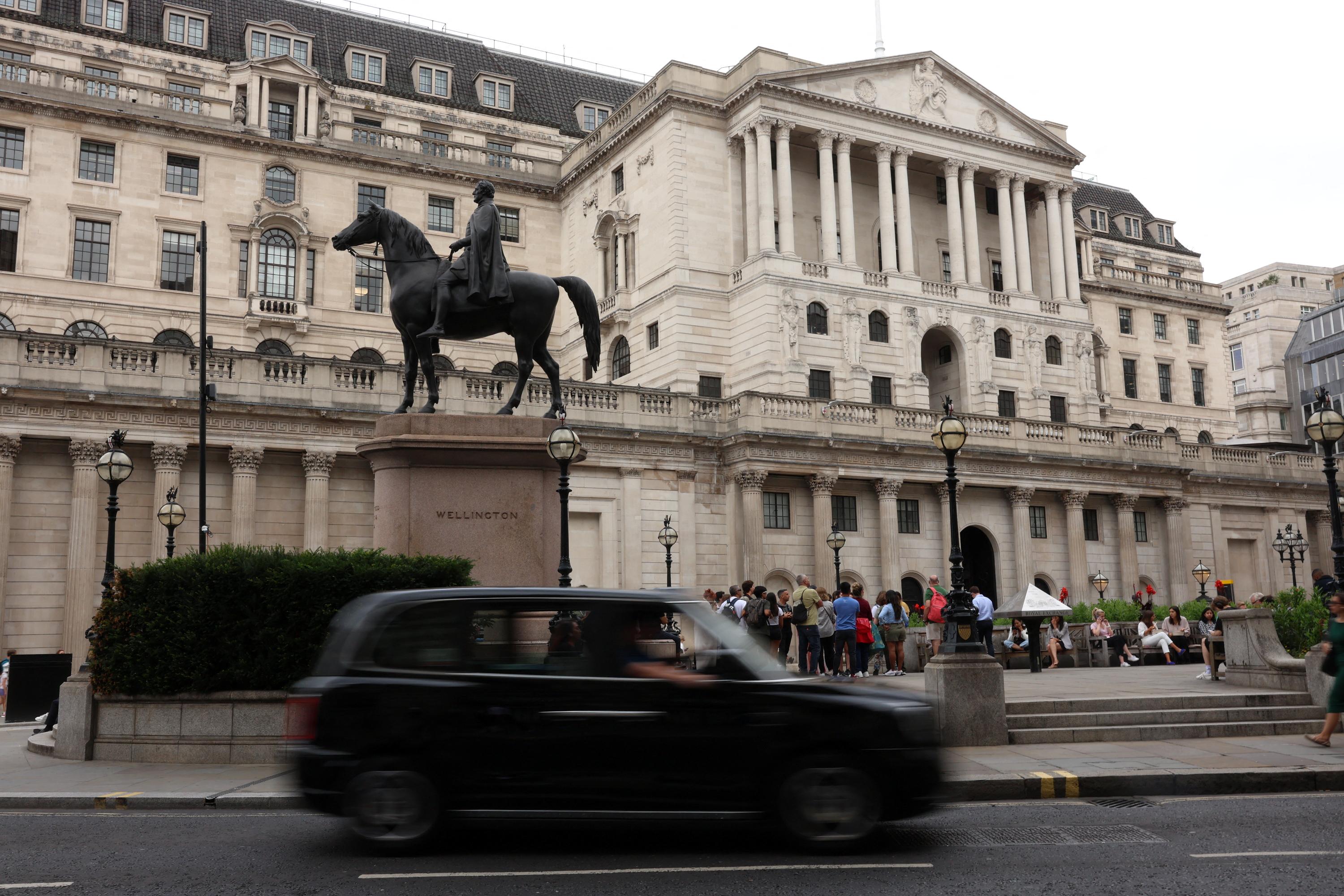
LONDON, Nov 7 (Reuters) - The Bank of England cut interest rates on Thursday for only the second time since 2020 and said future reductions were likely to be gradual, seeing higher inflation and growth after the new government's first budget. Its Monetary Policy Committee (MPC) voted 8-1 to cut rates to 4.75% from 5%, a stronger majority than expectations in a Reuters poll for a 7-2 vote in favour of a cut. Sterling rose after the decision to $1.2932 from around $1.2906 before the decision and was last trading at 83.22 pence per euro versus 83.36 pence earlier . Britain's gilt yields dipped, with rate-sensitive two-year yields at 4.47% versus 4.48% just before the decision. London's blue-chip FTSE stock index was just 0.12% lower on the day (.FTSE) , opens new tab, while the domestically-focused FTSE 250 index was 0.6% higher (.FTMC) , opens new tab. COMMENTS: HUSSAIN MEHDI, DIRECTOR, INVESTMENT STRATEGY, HSBC ASSET MANAGEMENT: "The bigger question for investors is how far can rates be cut? A cooling labour market should help maintain downward pressure on services inflation in the coming months. But the latest UK budget is likely to add to inflationary pressures over the longer-term. We are in an era of “forever deficits” reflecting political priorities to boost growth and productivity. "This “fiscal activism” is a significant policy change versus the 2010s when austerity was counterbalanced by monetary policy on steroids. The multi-polar world of economic fragmentation is also consistent with a higher inflation environment." "What likely follows, in our view, is a fairly shallow easing cycle for the BoE and upward pressure on bond yields. Policy rates could settle comfortably above 3%, contrasting with the sub 1% period before the pandemic." MICHAEL METCALFE, HEAD OF MACRO STRATEGY, STATE STREET, LONDON: "I think there’s going to be a lot of focus on the forecasts, probably more than normal, to see the impact of the budget. I don’t think it’s that different to the Office for Budget Responsibility’s (OBR) assessment of a short-term boost to growth and a modest boost to inflation. "The interesting thing to tease out in the press conference is that the (bond yield) curve has shifted up a lot since the budget, which isn’t incorporated into the forecast." "If you take a much higher assumption for rates which is where we are now, does that now mean that the market is still too pessimistic for rate cut expectations? "If you take the monetary policy report at face value it looks quite hawkish. But then it becomes quite reflexive quite quickly in the sense that markets have already priced in some of that hawkishness. And that we have the new risk of a weaker international backdrop if tariffs come in." ZARA NOKES, GLOBAL MARKET ANALYST, JP MORGAN ASSET MANAGEMENT, LONDON: "The Bank of England (BoE) made the correct decision to deliver what markets were expecting and cut interest rates today. However, the pace of cuts from here has been muddied by recent political developments. The UK economy is now contending with a number of cross-currents which make the growth and inflation outlook highly uncertain. "Last week’s UK budget revealed plans for front-loaded fiscal stimulus which – at a time when the supply side of the economy is constrained – risks stoking inflation next year. The return of President (Donald) Trump to the White House adds another layer of complexity. While there is still a high degree of uncertainty as to what the next Republican administration will enact when in office, tough protectionist measures could be a headwind for global growth and the UK may be vulnerable given the openness of its economy. For these reasons the Bank should be very wary of giving concrete forward guidance on the pace of further cuts. In our view, with the underlying dynamics of the domestic economy pointing to inflation lingering for some time, the Bank should resist cutting too quickly." SIMEON WILLIS, CHIEF INVESTMENT OFFICER XPS GROUP, UK: "Given the boost to public spending and upwards pressure on inflation resulting from Rachel Reeves’ Autumn budget, the markets had factored in a less rapid easing of the Bank rate. "This MPC announcement is in keeping with that revised expectation, although as is often the case, it is the longer-term rate of easing that is of greatest interest. Movements of 0.25% in themselves are relatively inconsequential. The path of expected rate reductions likely remains cautious particularly given the OBR's inflation outlook for 2025 being above target." RUPERT WATSON, GLOBAL HEAD OF MACRO AND DYNAMIC ASSET ALLOCATION, MERCER, PORTSMOUTH, UK: "We expect rate cuts are likely to continue however the central bank will want to take account of the fiscal position following the budget and may adjust their pace accordingly. "The BoE will also want to consider the impact of the election of a new U.S. President for the domestic economy. The overall picture in the UK is one of slow growth with a slight boost in 2025, but with inflation coming down to the 2% target the BoE has maintained its gradual easing stance." SHAMIL GOHIL, PORTFOLIO MANAGER, FIDELITY INTERNATIONAL, LONDON: "Going forward, the Monetary Policy Committee has a tough job balancing the future impact of the UK budget and government’s fiscal policy. Cost increases for companies from higher taxes, national insurance and national minimum wage will likely be at least partially passed on to consumers via price hikes next year. Fiscal stimulus should also have a positive impact on growth allaying any recessionary fears. Therefore, the sensible path continues to be for a gradual and cautious easing process as these affects are slowly realised over time. "Looking ahead, the implications of the U.S. election and potential for higher global tariffs may offset some of this growth and may also feed into higher inflation as the second order impact of these tariffs take hold across Europe and China, potentially muddying the waters." Sign up here. https://www.reuters.com/markets/rates-bonds/view-bank-england-cuts-rates-again-sterling-higher-2024-11-07/
2024-11-07 12:18
Nov 7 (Reuters) - Germany's chemical sector needs regulation changes and an easing of burdens that weigh on the industry as it aims for climate neutrality and to remain competitive, industry lobby VCI said on Thursday. The crises of the past few years have left their mark on the balance sheets of chemical and pharmaceutical companies, but they are also influencing the industry's climate transformation, VCI said in a statement as it published two studies it commissioned. In one study focused on the mood in the industry, the Boston Consulting Group said nearly three quarters of respondents currently consider it unlikely they will invest in new plants and sites in Germany, citing bureaucracy, high energy costs and long approval procedures. In the other study by VCI's platform Chemistry4Climate, focused on the industry's energy usage, it noted the decline in production was reducing the industry's demand for electricity and hydrogen. "However, this does not automatically make the path to climate neutrality any easier," VCI official Wolfgang Grosse Entrup said. "On the contrary: the climate will not be helped by the decline in German production, and our location will become more susceptible to supply chain problems." The chemicals sector, Germany's third-largest industry that employs roughly half a million workers, continues to struggle with tepid demand and higher prices for raw materials and energy. "In our industry, the problems of the location are like a magnifying glass. But they affect all sectors. We now need a comprehensive and long-term innovation and growth agenda at full speed," Entrup said. "Nothing less than the German model of prosperity is at stake. This should be the top priority across party lines," he added. Sign up here. https://www.reuters.com/world/europe/germanys-chemicals-lobby-calls-regulatory-reform-growth-agenda-2024-11-07/

2024-11-07 12:17
LONDON, Nov 7 (Reuters) - The pound rose, while UK government bond prices pared gains on Thursday after the Bank of England delivered a widely expected rate cut, but signalled future reductions could be gradual, as it forecast higher inflation and higher growth ahead. Sterling rose to $1.29405 immediately after the decision, from around $1.2905 earlier, while yields on the two-year gilt were at 4.478%, down 3 bps on the day, compared with 4.475% right before the BoE's announcement. Investors were waiting for Governor Andrew Bailey's press conference at 1230 GMT for more clarity on the decision. Sign up here. https://www.reuters.com/markets/pound-up-gilts-ease-after-boe-cuts-rates-flags-inflation-outlook-2024-11-07/