2024-11-04 04:49
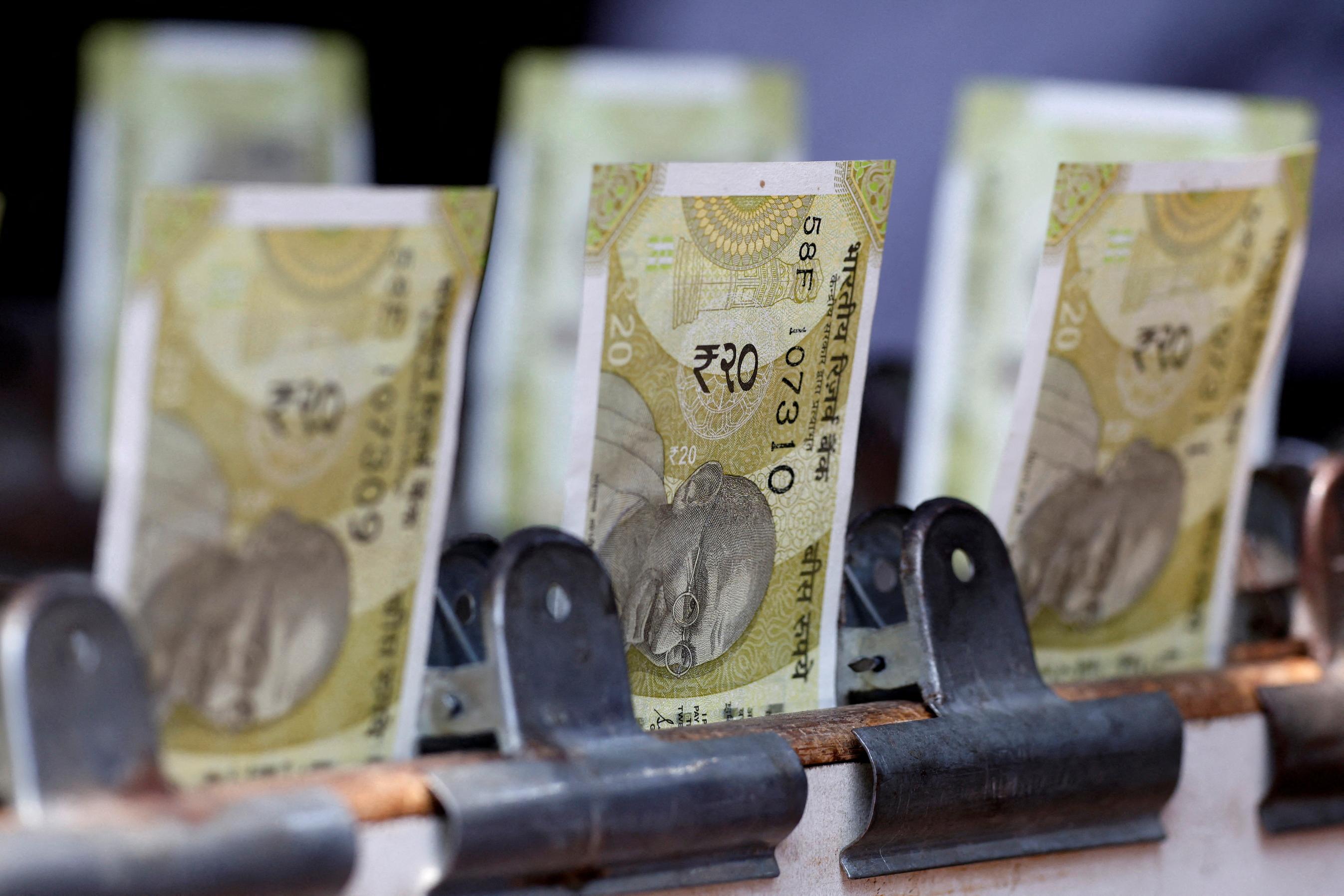
MUMBAI, Nov 4 (Reuters) - The Indian rupee was nearly unchanged on Monday as the weakness in local equities blunted the impact of a rise in most Asian currencies, as the dollar weakened ahead of the outcome of the U.S. presidential election later this week. The rupee was at 84.0675 against the U.S. dollar as of 10:10 a.m. IST, compared to its close at 84.0750 in the previous session. The benchmark Indian equity indices, the BSE Sensex (.BSESN) , opens new tab and Nifty 50 (.NSEI) , opens new tab, were down more than 1% each. Persistent selling by foreign investors and a tepid earnings season have hurt local stocks, with the benchmarks declining about 8% each from their record highs hit in late September. "Major events are lined up this week, so most traders may avoid heavy positioning. But continued equity outflows may keep the rupee under pressure," a trader at a foreign bank said. Overseas investors had net sold local stocks worth $11 billion in October. Routine interventions by the Reserve Bank of India, though, have ensured that the rupee doesn't suffer sharp losses. Traders expect the central bank to remain on vigil amid the looming uncertainty about the outcome of the U.S. presidential election. "The outcome of the closely contested race remains uncertain, raising the potential for significant market volatility," DBS Bank said in a note. The dollar index was down 0.2% at 103.6 on Monday after a well-respected poll showed that Kamala Harris had taken a surprise 3-point lead in the state of Iowa, a reversal from a September poll that had Trump with a 4-point lead. Asian currencies were mostly higher, with the offshore Chinese yuan touching a three-week high of 7.1064. In addition to the U.S. elections, the rupee will also be influenced this week by the Federal Reserve's policy decision and monetary policy commentary on Wednesday. The Fed is widely expected to cut policy rates by 25 basis points. Sign up here. https://www.reuters.com/markets/currencies/rupee-flattish-weak-local-equities-offset-gains-asian-peers-2024-11-04/
2024-11-04 02:55
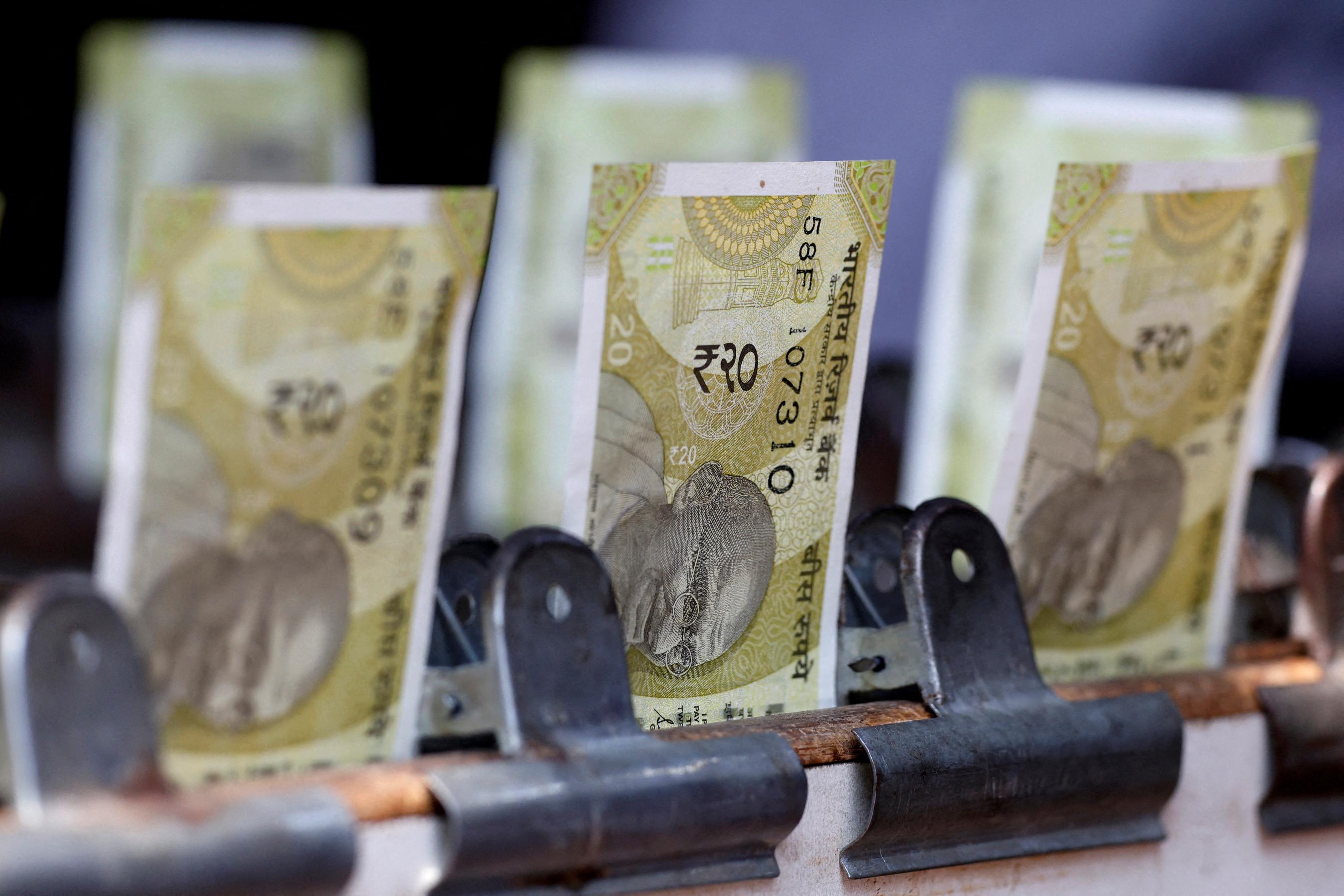
MUMBAI, Nov 4 (Reuters) - The Indian rupee is expected to open higher on Monday, on the back of a decline in the U.S. dollar amid likely unwinding of long positions in the lead up to the U.S. presidential election. The 1-month non-deliverable forward indicates that the rupee will open at 84.04-84.06 to the dollar, compared with its previous close of 84.0750. Last week, the rupee traded in a narrow 3.5 paisa range, thanks largely to the Reserve Bank of India's repeated interventions. "We are definitely going to have a much larger range this week. The U.S. elections and the Fed meeting are both big events," a currency trader at a bank said. The dollar index was down 0.2%, while Asian currencies rallied. The offshore Chinese yuan, considered a direct play on the Nov. 5 U.S. election, rose to the highest in two-and-a-half weeks. The dollar's decline was likely spurred by a poll released over the weekend, which prompted a drop in the odds of Republican Donald Trump winning the elections. A Trump win is expected to be a boost to the dollar, according to analysts. A high-profile poll released on Saturday showed that Vice President Kamala Harris was leading Trump 47%-44% in the state of Iowa, a turnaround from a September poll that had Trump with a 4-point lead. Trump had convincingly won in Iowa in 2016 and 2020. Prediction markets have tightened the odds of the race over the past week, with "meaningful shifts over the weekend", MUFG Bank said in a note. While markets are focused squarely on the U.S. elections, it’s important to keep the broader macro context in mind, MUFG said, pointing to the U.S. jobs report out on Friday. Meanwhile, the Federal Reserve is widely expected to cut rates by 25 basis points in its Nov. 6-7 meeting. KEY INDICATORS: ** One-month non-deliverable rupee forward at 84.15; onshore one-month forward premium at 9.5 paisa ** Dollar index down at 103.75 ** Brent crude futures up 1.3% at $74.1 per barrel ** Ten-year U.S. note yield at 4.3120% ** As per NSDL data, foreign investors sold a net $261.4 mln worth of Indian shares on Oct. 30 ** NSDL data shows foreign investors bought a net $50.9 mln worth of Indian bonds on Oct. 30 Sign up here. https://www.reuters.com/markets/currencies/dollar-decline-help-rupee-kick-off-big-week-positive-note-2024-11-04/
2024-11-04 01:29
RBI ready to use forex reserves to defend rupee if any post-US election volatility, sources say Steep U.S. tariffs on China could affect India with imported inflation, sources say Central bank has intervened this month after rupee hit record lows MUMBAI, Oct 31 (Reuters) - India's central bank is well-equipped to deal with a potential sudden outflow of foreign funds and any steep fall in the rupee if Republican candidate Donald Trump wins next week's U.S. presidential election, two sources familiar with the bank's thinking said. The Reserve Bank of India would be able to tap its large foreign exchange reserves to defend the domestic currency in the event of global market volatility and an outflow of foreign funds, the sources said. They spoke on condition of anonymity because of the sensitivity of the matter. "The reserves have been built up to take care of excessive volatility. If there are sharp outflows, RBI will step in to manage it, as it has been doing," one of the sources said. The RBI did not reply to an email requesting comment. The sources also warned that any steep rise in U.S. tariffs towards China could trigger knock-on effects in India and other emerging economies, including imported inflation and fallout from China's policy responses that could affect India's monetary policy. Republican candidate Donald Trump and his Democratic opponent, Vice President Kamala Harris, are effectively tied going into the Nov. 5 election, according to the latest Reuters/Ipsos poll published on Tuesday. Trump has vowed to impose 60% duties on imports from China. The U.S. treasury yield has risen about 50 basis points this month and the dollar index strengthened 3.3% as election day approaches. There has been a record outflow of more than $10 billion in foreign funds from India stocks, while foreigners pulled $700 million from the debt market. The rupee has hit a series of record lows this month, prompting central bank intervention, although it has been one of the least volatile major Asian currencies, holding to a narrow range of 83.79-84.09 per dollar. India's foreign exchange reserves (INFXR=ECI) , opens new tab dropped for a third week to $688.27 billion as of Oct. 18, their lowest in more than a month, the latest RBI data showed, although they remain the world's fourth-largest, sufficient to cover its entire level of external debt and nearly a year of imports. The RBI is also closely monitoring the prospects for new tariffs that the next U.S. administration might impose on imported goods, as this could fuel a fresh round of U.S. inflation that indirectly affects emerging market economies, the second source said. "If there's imported inflation pressures, then monetary policy will remain in a restrictive mode for longer," the source added. India's retail inflation accelerated in September to its highest in nine months. The RBI has held rates steady for 10 straight meetings but changed its stance to "neutral" from "withdrawal of accommodation" in October. Central bank officials have not committed to or signalled any timing for a rate cut. The sources said the central bank will be watching how post-election developments play out for China, which is considering more than 10 trillion yuan ($1.4 trillion) in extra debt issuance in the next few years to revive its fragile economy. China's stimulus efforts, which could intensify if U.S. tariffs further hurt its economy, have been a factor driving foreign funds out of India and other emerging markets into China. "At the current time, we are actually bleeding to China, all EMs are losing money to China, so if Trump wins, a new source of spillover will be created," the second source said. Sign up here. https://www.reuters.com/business/finance/india-central-bank-well-equipped-post-us-election-volatility-sources-say-2024-10-31/
2024-11-04 00:45
SEOUL, Nov 4 (Reuters) - SK Innovation Co Ltd (096770.KS) , opens new tab, owner of South Korea's top refiner SK Energy, said on Monday it expects a floor for oil prices and robust refining margins in the fourth quarter due to improved heating demand, solid U.S. economic growth and China's proactive economic stimulus policies. The company posted an operating loss of 423 billion won ($307.99 million) for the July-September period, versus a 1.56 trillion won profit a year earlier. Third-quarter revenue fell 11% to 17.7 trillion won. Shares in SK Innovation were trading down 1.6%, versus the benchmark KOSPI's (.KS11) , opens new tab 0.2% rise in early trade. ($1 = 1,373.4000 won) Sign up here. https://www.reuters.com/markets/commodities/sk-innovation-expects-robust-refining-margins-q4-2024-11-04/
2024-11-04 00:38
OPEC+ agrees to delay December output hike for one month Harris, Trump race to get out the vote on eve of historic election New tropical storm forecast threatens US Gulf production US Fed decision, China NPC meets this week Nov 4 (Reuters) - Oil prices climbed nearly 3% on Monday on OPEC+'s decision for a month's delay in plans to increase output, while investors also focused on the U.S. presidential election. Brent futures were up $1.98, or 2.7%, at $75.08 a barrel. U.S. West Texas Intermediate (WTI) crude rose $1.98, or 2.85%, to $71.47. Last week, Brent declined about 4%, while WTI fell around 3%. On Sunday, OPEC+ said it would extend its output cut of 2.2 million barrels per day (bpd) for another month in December, with an increase already delayed from October because of falling prices and weak demand. OPEC+, the Organization of the Petroleum Exporting Countries plus Russia and other allies, had been due to increase monthly output by 180,000 bpd from December. The extension through the entire fourth quarter of 2024 "casts doubt on the group's commitment (or wherewithal) to return supply at all" in 2025, said Walt Chancellor, an energy strategist at Macquarie, adding that the announcement may allay some fears of a renewed OPEC+ "price war." OPEC remains very positive on demand for oil in both the short and long term, Secretary General Haitham Al Ghais said on Monday. French oil major TotalEnergies forecast global oil demand will peak after 2030 in its two most likely energy transition scenarios in its annual energy outlook report. Meanwhile, the CEO of Italian energy company Eni (ENI.MI) , opens new tab said that OPEC+ oil supply cuts and recent efforts to unwind them had increased volatility in energy markets and hampered investment in new production. OPEC oil output rebounded in October as Libya resolved a political crisis, a Reuters survey found. In the previous month output was at its lowest this year. A further Iraqi effort to meet its cuts pledged to the wider OPEC+ alliance limited the gain. Iran has approved a plan to increase oil production by 250,000 barrels per day, the oil ministry's news website Shana reported on Monday. Libya's oil production is nearing 1.5 million bpd, the country's National Oil Corporation (NOC) said. POLITICAL CRISIS U.S. Democratic presidential nominee Kamala Harris and Republican Donald Trump remain virtually tied in opinion polls ahead of Tuesday's Election Day, and the winner might not be known for days after voting ends. Investors also watched for any escalation in Middle East tensions. On Thursday, U.S. news website Axios said Israeli intelligence suggested Iran was preparing to attack Israel from Iraq within days, citing two unidentified Israeli sources. "Middle East tensions are once again on the forefront as traders await the Iranian response attack," said Dennis Kissler, senior vice president of trading at BOK Financial. Analysts expect draws this week in gasoline and distillate inventories, while crude stocks are estimated to rise. U.S. gasoline stocks fell to their lowest in two years in the week to Oct 25. Markets were also watching a new tropical storm that was forecast to form on Monday in the Caribbean and threaten offshore oil production along the Gulf of Mexico. Shell said it was moving non-essential personnel from six platforms, adding it currently expects no other impacts on its production across the Gulf of Mexico. Investor focus this week will be on the U.S. Federal Reserve as economists expect interest rates to be cut by 25 basis points on Thursday, and on China, where the Standing Committee of the National People's Congress meets and is expected to approve additional stimulus to boost the slowing economy. Sign up here. https://www.reuters.com/markets/commodities/oil-prices-rise-by-over-1-opec-output-hike-delay-2024-11-04/
2024-11-04 00:21
LAUNCESTON, Australia, Nov 4 (Reuters) - Geopolitical uncertainty will probably garner the lion's share of the blame for OPEC+'s decision to once again delay raising crude oil output, but weak demand, especially in Asia, is more significant. Eight members of OPEC+, which groups the Organization of the Petroleum Exporting Countries plus Russia and other allies, pushed back their planned increase of 180,000 barrels per day (bpd) in December by another month, they said in a statement on Sunday. The group had been due to raise output in December as part of a plan to gradually unwind a total of 2.2 million bpd of production cuts over 2025. The decision to delay raising output was largely expected, given the crude oil price is still trending lower, albeit with increased volatility because of the conflict in the Middle East, which has seen major players Israel and Iran trade attacks on each other. Global benchmark Brent futures ended last week at $73.10 a barrel, having dropped as low as $71.08 earlier in the week. Brent opened higher in early trade in Asia on Monday, rising as much as 2.5% to $74.94 a barrel, before easing to trade around $74.16. However, the contract is still down almost 10% from its most recent peak of $81.16 on Oct. 7, and has been in a weakening phase since the high this year of $90.92 on April 11. The main reason for the declining oil price trend is that demand in Asia has disappointed the bullish forecasts made earlier this year by OPEC and other forecasters. The run of soft numbers from Asia, the top crude importing region, with LSEG Oil Research estimating October arrivals at 26.74 million bpd, down from 27.05 million bpd in September. For the first 10 months of the year, Asia's crude imports were 26.78 million bpd, down 200,000 bpd from the same period in 2023, according to LSEG data. OPEC FORECASTS The weakness in Asia's imports stands in contrast with OPEC's forecasts for the region's demand growth, even though the producer body has been trimming its expectations in recent months. OPEC's October monthly report forecast that Asia's crude oil demand growth would be 1.2 million bpd in 2024, led by 580,000 bpd in China and 270,000 bpd in India. But the decline in Asia's imports for the first 10 months of the year makes it extremely unlikely that demand growth will be anything near OPEC's forecast, and this is perhaps the key reason why crude oil prices have trended softer in recent months. While the risks of escalation in the Middle East remain heightened, so far there has been no real threat to the region's crude oil infrastructure and exports, with the only exception being limited missile attacks on shipping in the Red Sea by Yemen's Iran-aligned Houthi militants. There is also the risk of the potential return of Donald Trump to the U.S. presidency, which may raise tensions with Iran as well as harm the global economy through his planned imposition of tariffs on all imports to the United States, with especially punitive rates against China. Given the backdrop of geopolitical uncertainty and weak crude imports in Asia, the only logical step for OPEC+ was to delay increasing output. The ideal situation for the group would be for the tensions to ratchet lower, while at the same time China's economy responds positively to Beijing's stimulus measures, and the rest of the global economy shows increasing signs of recovery. This will lead to higher crude demand and allow for OPEC+ to unwind its production cuts. But for now the positive scenario remains an unrealised possibility, while the reality is geopolitical risks and weak demand in Asia. The opinions expressed here are those of the author, a columnist for Reuters. Sign up here. https://www.reuters.com/business/energy/opecs-again-delayed-output-hike-shows-soft-demand-reality-russell-2024-11-04/