2024-11-01 05:46
BEIJING, Nov 1 (Reuters) - China aims to step up supervision of government debt and plans to revise the law to do so, a spokesperson of the legislative affairs committee of the National People's Congress (NPC) said on Friday. The changes proposed by the NPC's standing committee will require annual progress reports on debt management work from the cabinet and local governments, the spokesperson, Huang Haihua, told reporters. The committee "should supervise government debt and establish a sound reporting system for government debt management," Huang said. Draft amendments are set to be discussed when the standing committee meets from Nov. 4 to Nov. 8, Huang added, aiming to expand its oversight authority over government debt management, as well as financial and economic work. Last month, Finance Minister Lan Foan said China would "significantly increase" government debt and support consumers and the property sector, but gave no details of the scale or timing of the fiscal measures. Reuters reported that China is considering approving next week new debt issuance of more than 10 trillion yuan ($1.4 trillion) to tackle hidden local debt, fund buybacks of idle land and reduce a giant inventory of unsold flats, with decisions expected by the end of next week's meeting. The standing committee of the National People's Congress, or China's parliament, will also supervise the financial and economic work of the cabinet and local governments and review reports on fixing problems identified in audits, Huang added. ($1 = 7.1220 Chinese yuan renminbi) Sign up here. https://www.reuters.com/world/china/china-revise-law-tighter-scrutiny-govt-debt-2024-11-01/
2024-11-01 05:32
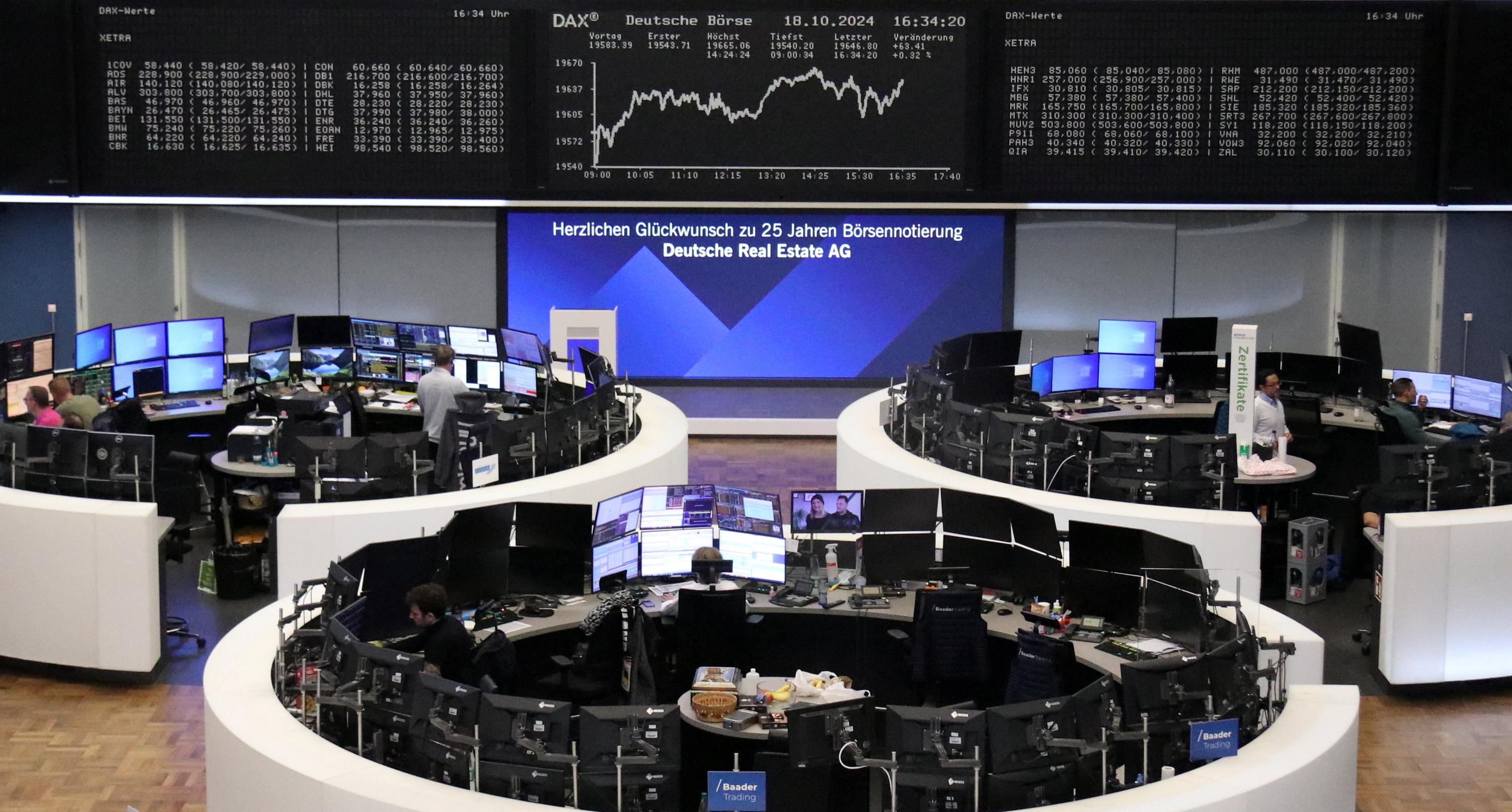
A look at the day ahead in European and global markets from Stella Qiu Asian markets started what promises to be a momentous month on the cautious side, with investors shunning risk assets ahead of Friday's U.S. jobs data and next week's presidential election. Most Asian shares were down, led by a 2.3% drop in the Nikkei. Chinese stocks were an outperformer, with Hong Kong's Hang Seng index (.HSI) , opens new tab up 1.6% after a private survey showed that China's vast manufacturing sector returned to expansion in October. The Caixin/S&P Global manufacturing PMI for China reinforced upbeat findings the day before in an official survey and suggests that the slowdown in the world's second-largest economy may have troughed, as a series of government stimulus measures begins kicking in to boost growth. Oil extended its latest rally into a third day, up almost 2% on Friday after reports that Iran was preparing a retaliatory strike on Israel from Iraq in the coming days. The dollar recouped some of its losses on the yen, but currencies were range-bound overall. Looking ahead to Europe, investors found some solace in an earnings beat by Amazon, which jumped 5.3% after the bell and added $104 billion to its market cap. Both EUROSTOXX 50 futures and FTSE futures inched up 0.1%. Investors will be watching if UK gilts extend their sell-off and whether the pound would break its 200-day moving average as markets hand down their judgment on Chancellor Rachel Reeves' debut budget. Analysts fear the spending-heavy budget could put upward pressure on inflation and had investors betting that the Bank of England may have to slow the pace of future rate cuts. Two-year gilt yields have surged 27 basis points so far this week to the highest since May, although that seems tame compared with the 89-basis-point rout that followed Liz Truss' 2022 effort. In the U.S., earnings are due from Exxon Mobil and Chevron, along with the high-profile ISM manufacturing survey and the non-farm payrolls report. Hurricanes and strikes have made it tricky to read the jobs data. Forecasts are centred on a rise of 113,000 new jobs in October but a strong ADP report and lower jobless claims data suggest the risks are to the upside. The unemployment rate likely stayed at 4.1%, so barring a major surprise, markets will likely stick to wagers that the Federal Reserve will cut by a quarter-point next Wednesday. That is more than 94% priced in. Of course, the day before that there is the U.S. presidential election, with candidates Donald Trump and Kamala Harris running neck and neck. Some investors have been trading on expectations that a Trump win could bring inflationary policies. Key developments that could influence markets on Friday: -- UK manufacturing PMI -- U.S. non-farm payrolls -- ISM Manufacturing survey -- Exxon Mobil, Chevron earnings Sign up here. https://www.reuters.com/markets/europe/global-markets-view-europe-2024-11-01/
2024-11-01 05:32
NEW DELHI, Nov 1 (Reuters) - New Delhi topped charts on Friday as the world's most polluted city after revellers defying a ban on firecrackers to celebrate Diwali, the Hindu festival of lights, helped drive air quality to hazardous levels. Thick smog wreathed the Indian capital, shrouding the presidential palace in the central district and the surrounding gardens popular with joggers and cyclists, after Thursday's celebrations. The air quality index stood at 348, said Swiss firm IQ Air, taking pollution into the hazardous category, pushing Delhi to the top of a real-time list as the world's most polluted city. Local government officials have banned use of firecrackers during Diwali and the winter over the last few years, in line with Supreme Court directives, but have had difficulty enforcing the measure despite the threat of jail. Some Hindu groups say the ban interferes with observance of the festival, a position the Delhi government has previously countered by saying the ban aims to save lives. Friday's smog also coincided with waste burning on farms in northern India that aggravates air quality at the beginning of winter each year as cold, heavy air traps pollutants from a variety of sources. Sign up here. https://www.reuters.com/world/india/firecracker-ban-defiance-makes-new-delhi-worlds-most-polluted-city-2024-11-01/

2024-11-01 05:22
Strikes, hurricanes impact labor market data Traders firm bets on Fed interest-rate cuts Sterling set to snap 5-week losing streak NEW YORK, Nov 1 (Reuters) - The dollar rose against the euro and rebounded against most major currencies on Friday after traders digested data showing U.S. job growth slowed sharply in October amid disruptions from hurricanes and strike action by aerospace factory workers. Nonfarm payrolls rose by 12,000 jobs after a downwardly revised 223,000 in September, the Labor Department's Bureau of Labor Statistics said. Economists polled by Reuters had forecast October payrolls rising 113,000. The U.S. unemployment rate, however, held steady at 4.1%, offering assurance that the labor market remains on a solid footing. Hurricane Helene devastated the Southeast in late September and Hurricane Milton lashed Florida a week later. A total 41,400 new workers were on strike, including machinists at Boeing (BA.N) , opens new tab and Textron (TXT.N) , opens new tab, an aircraft company, when employers were surveyed for October's employment report. "The dollar index has fully recovered since this morning's data release, shifting focus towards the uncertainty surrounding the upcoming (U.S. presidential) election," said Uto Shinohara, senior investment strategist at Mesirow in Chicago. "Current polls continue to depict the race as a toss-up, with a potential risk of delayed results, making next week a busy one, since the (Federal Reserve) is also meeting just days later." The subdued jobs report, he added, maintains the Fed's trajectory for a 25-basis-point interest-rate cut this month. The euro was down 0.40% against the dollar at $1.084. The dollar index (.DXY) , opens new tab, which tracks the greenback against six major currencies, was up 0.36% at 104.24. "It's important when looking at the downward revisions, especially that most of that wildly negative figure came in August rather than in September, so the picture for the end of the year still doesn't seem too grisly," said Helen Given, associate director of trading at Monex USA. Traders of futures that settle to the Fed's policy rate were pricing about a 99% chance of a quarter-point interest rate cut on Nov. 7, to 4.5%-4.75%. That Fed bets haven't changed much either indicate "traders are treating this as more of a fluke" and the healthy labor market is keeping the greenback afloat, Given said. "There's also a big contingent of the market that's likely going to stay quite cautious until all of the risk events of next week are off the table, keeping USD range-bound," she added. The Labor Department's closely watched employment report was the last major economic data before Americans head to the polls on Nov. 5 and face a choice of Democratic Vice President Kamala Harris or Republican former President Donald Trump as the country's next president. Opinion polls show the race is very tight. The Fed announces its policy decision two days after the election. The dollar was on pace to snap a three-session losing streak against the yen, rising 0.60% to 152.94, ahead of a three-day weekend in Japan. Less dovish comments from Bank of Japan Governor Kazuo Ueda following the central bank's decision to stand pat on Thursday had lifted the yen earlier this week. "We think the chances of a December rate hike have somewhat increased after Gov. Ueda's press conference," Morgan Stanley MUFG economists Takeshi Yamaguchi and Masayuki Inui wrote in a report on Thursday. Their base case remains for the BOJ to raise rates again in January to 0.5%. Sterling was up 0.26% at $1.29632 on Friday, and set to snap a five-week streak of weekly losses against the dollar. Short-term British government borrowing costs headed for their biggest weekly jump in over a year on Friday, as Labour's tax-and-spend budget raised inflation expectations. In cryptocurrencies, bitcoin, the world's largest cryptocurrency by market cap, was up 0.57% on the day at $69,531. Sign up here. https://www.reuters.com/markets/currencies/dollar-steady-investors-eye-us-jobs-report-election-2024-11-01/
2024-11-01 04:28
Trade tensions loom with upcoming U.S. election China diversifies farm imports to reduce dependency on U.S. U.S. soybean exports to China down significantly from 2016 BEIJING/SINGAPORE, Nov 1 (Reuters) - China's push to shift its food import sources since 2018 has put it in a better position to impose tit-for-tat tariffs on U.S. farm goods with less harm to its food security if trade friction with Washington flares after the U.S. presidential election. The threat of a trade war looms for China, the world's top importer of farm products such as soybeans and corn, with Republican candidate Donald Trump floating blanket 60% tariffs on Chinese goods in a bid to boost U.S. manufacturing. His opponent Kamala Harris, a Democrat, is also expected to confront China on trade. Since Trump was in the White House, China has slashed its dependence on U.S. farm goods in a concerted effort to beef up national security, including food self-sufficiency. The pivot began in 2018, when Beijing slapped 25% tariffs on imports of U.S. soybeans, beef, pork, wheat, corn and sorghum, retaliating against duties imposed by the Trump administration on $300 billion worth of Chinese goods. The move led to a reshaping of global agriculture trade flows, despite Trump and then-Chinese Vice Premier Liu signing a pact in January 2020 under which Beijing promised to boost purchases of U.S. goods and services, including farm products. Instead, China has decreased U.S. purchases, buying more grain from Brazil, Argentina, Ukraine and Australia, even as it boosts domestic production. "Beijing feels much safer knowing the U.S. has less leverage over China's food security in the event of a major conflict," said Even Pay, agriculture analyst at Beijing-based consultancy Trivium China. "That reduction is by design," she said. This year, the share of China's soybean imports from the U.S. has dropped to 18%, from 40% in 2016, while Brazil’s share has grown to 76% from 46%, according to Chinese customs data. For corn, Brazil overtook the U.S. as China's top supplier in 2023, just one year after Beijing approved purchases from the South American agricultural powerhouse. Meanwhile, Chinese livestock companies have been reducing use of soymeal in feed - a move to ease reliance on imported soybeans - while Beijing has approved genetically modified soybean and corn varieties to boost output. China's agriculture ministry did not immediately respond to a request for comment. A spokesperson for Trump did not directly comment on the drop in China's reliance on U.S. farm exports, but pointed to Trump's comments that tariff is "a beautiful word" and "we will take in hundreds of billions of dollars into our treasury and use that money to benefit the American citizens." Harris' campaign website says the Democratic candidate "will not tolerate unfair trade practices from China or any competitor that undermines American workers". STOCKING UP In anticipation of post-election tensions, Chinese buyers have boosted agricultural imports, including American soybeans and corn, traders and analysts say. Imports of soybeans, used mainly for animal feed, are up 8% in the first nine months of the year, with barley purchases increasing 63% and sorghum shipments climbing 86%. "This time is different. China is well stocked up on most of its needs," said a trader at an international trading company in Singapore which sells grains and oilseeds to China and declined to be named as they were not authorised to speak with media. "There won't be any supply shock immediately and it will give China time to plan and redirect purchases," he said. U.S. soybean export premiums are at their highest in 14 months, as grain merchants race to ship a record harvest ahead of the election. While Beijing would prefer to avoid targeting food staples in a tit-for-tat trade war, it may be forced to do so, said Wendong Zhang, an assistant professor and agricultural economist at Cornell University in Ithaca, New York. "China's retaliation would be proportional in terms of trade value and with the goal to inflict economic and political cost, which tends to lead to retaliation on agricultural products." China's overall trade surplus with the U.S. totalled $33.33 billion in September alone, limiting its options to retaliate. "China ... can reduce its exposure to U.S. goods only to some extent. There are only limited places where you can get these products from," Dennis Voznesenski, an analyst at Commonwealth Bank of Australia. US FARMERS VULNERABLE Polls show Harris and Trump to be neck and neck, although Trump leads in most agricultural heartland states even though the last trade war was a blow to U.S. farmers and led Trump's administration to pay them about $23 billion in compensation, according to the Government Accountability Office. About half of American soybeans, the top U.S. export to China, are shipped to the country, accounting for $15.2 billion of trade in 2023, according to the U.S. Census Bureau. Soybean and corn prices are trading near four-year lows amid ample world supplies, fuelling worry among U.S. farmers. "We are very concerned. We are not the only soybean producer in the world. South America is producing an awful lot of soybeans," said Mark Tuttle, a soybean farmer in northern Illinois. "If we were to institute more tariffs, that would be very detrimental to our situation." Sign up here. https://www.reuters.com/markets/commodities/china-pivot-us-farm-imports-bolsters-it-against-trade-war-risks-2024-11-01/

2024-11-01 04:16
BENGALURU, Nov 1 (Reuters) - The Indian rupee will trade in a tight range around current levels against the dollar over the coming year as the Reserve Bank of India (RBI) routinely dips into its FX reserves to manage the currency's stability, a Reuters poll found. Abandoning its earlier policy of intervening only during periods of heightened volatility, the RBI over the past couple of years has used its vast FX reserves to keep the currency in a narrow range. The U.S. dollar has charged ahead of most other currencies in recent years but the rupee has stood its ground, losing just over 1% this year. That resilience has come despite $11 billion of foreign portfolio investment leaving India in October. At the same time, the central bank drew its massive currency reserve pile (INFXR=ECI) , opens new tab from a peak of $704.89 billion in late September to $688.27 billion as of October 18. "The (FX) intervention has been an ongoing affair and it's not just this year, it's been continuing post-COVID so we would expect two-sided interventions to continue," said Vivek Kumar, an economist at QuantEco Research. The currency was forecast to trade around 84/$ in one and three months, virtually unchanged from Tuesday's close of 84.05/$, with a slight appreciation of around 0.5% to 83.75/$ in six months and 12 months, according to an Oct. 25-31 Reuters poll of 38 strategists. In an early October poll the rupee was expected to strengthen mildly over the forecast horizon. The latest data from the RBI's monthly bulletin showed the rupee's trade-weighted real effective exchange rate was 105.17 in September, implying the currency was overvalued by around 5%. (Other stories from the November Reuters foreign exchange poll) Sign up here. https://www.reuters.com/markets/currencies/rbis-routine-interventions-halt-major-movements-indian-rupee-2024-11-01/