2024-10-21 12:41
BENGHAZI, Oct 21 (Reuters) - The presidency of Libya's eastern-based parliament approved on Monday the appointment of a new board of directors of the central bank, after a new governor and his deputy were agreed last month, a parliament spokesman said. Spokesman Abdullah Belhaiq posted the decision on social media platform X. The decision shows that the new board of directors includes six members. Naji Issa was approved last month by Libya's two legislative bodies, the House of Representatives in eastern Benghazi and the High State Council in Tripoli, as the new central bank governor replacing Sadiq al-Kabir, who was ousted by the head of Tripoli-based Presidential Council, Mohamed Menfi. Mari Muftah Rahil Barrasi was approved as deputy governor. Menfi's move led to a crisis that has slashed the country's oil output when the parallel administration in the east announced in Aug. 26 the closure of production and exports in a protest. After Issa's approval by the two bodies, the parallel administration announced the reopening of all oilfields. Then the state oil firm, National Oil Corporation (NOC), said in a statement it had lifted force majeure at all oilfields and terminals as of Oct. 3. NOC said on Sunday the country's crude oil and condensates output over the previous 24 hours reached 1,327,646 barrels per day. Libya's oil output has been disrupted repeatedly in the chaotic decade since the country divided in 2014 between two administrations in its east and west following the NATO-backed uprising that toppled Muammar Gaddafi in 2011. Sign up here. https://www.reuters.com/world/africa/libyas-eastern-parliament-approves-new-central-bank-board-directors-2024-10-21/

2024-10-21 12:18
MUMBAI, Oct 21 (Reuters) - The Reserve Bank of India (RBI) sold $6.49 billion, on a net basis, in the spot foreign exchange market in August, according to data released on Monday as part of the central bank's monthly bulletin. In July, it had bought a net of $6.93 billion in the spot market. The RBI said it purchased $16.14 billion and sold $22.64 billion in the spot forex market in August. While most Asian currencies rallied between 2% to 6% in August, the rupee weakened 0.2% to log its second consecutive monthly decline. The central bank intervenes in the spot and forwards market to curb exchange rate volatility. The RBI's net outstanding forward dollar sales stood at $18.98 billion as of end-August, compared with a net sales of $9.1 billion at the end of the previous month, the data showed. The currency settled at 84.0725 to the dollar on Monday. Sign up here. https://www.reuters.com/markets/currencies/india-cenbank-sold-649-bln-spot-forex-market-august-bulletin-shows-2024-10-21/

2024-10-21 12:18
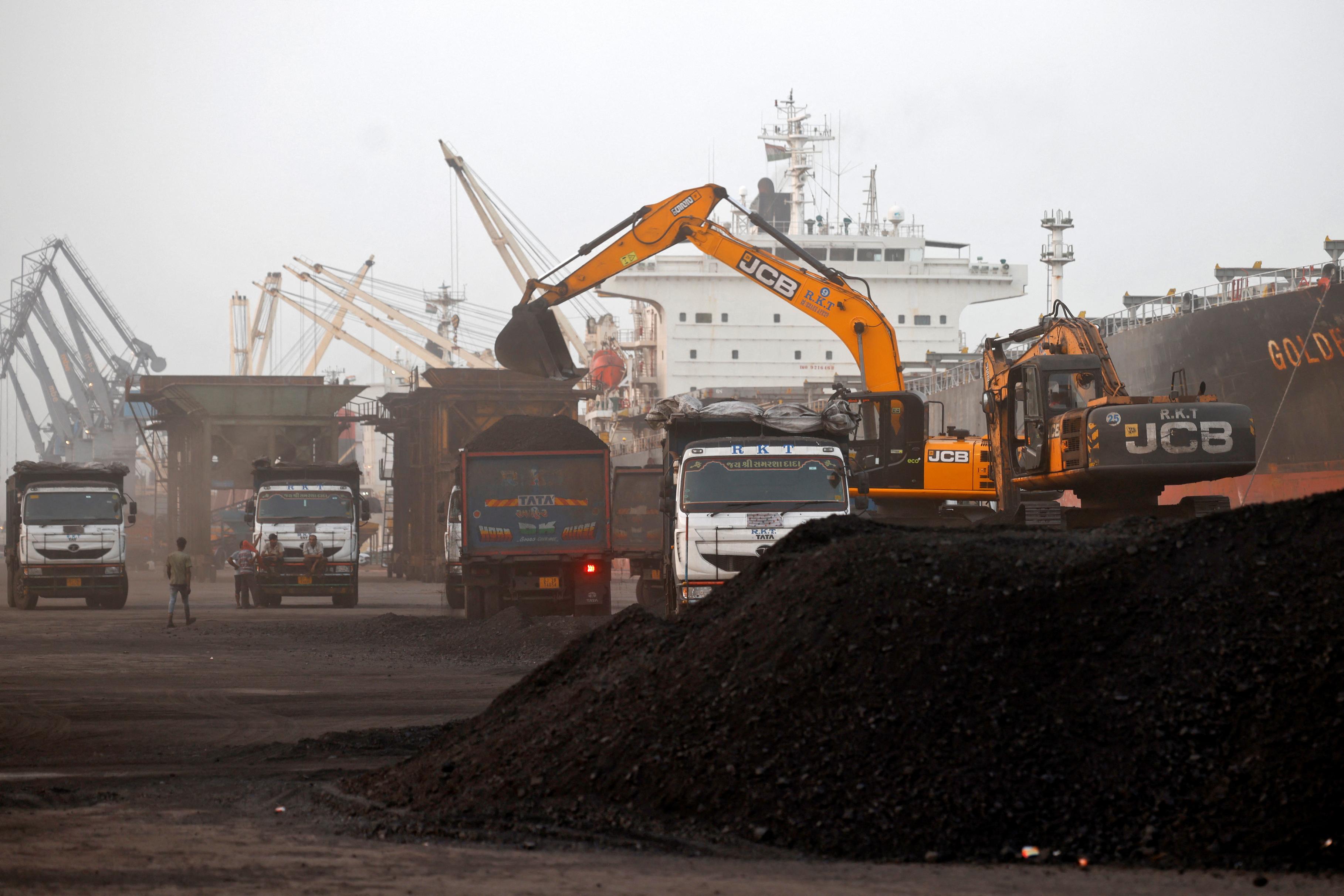
NEW DELHI, Oct 21 (Reuters) - India is exploring ways to import regular supplies of Mongolian coking coal by way of Russia, a senior government official with direct knowledge of the matter said, as New Delhi seeks to avoid over-reliance on transit through China. Mills in India, the world's second-biggest producer of crude steel, grappled with volatile Australian supplies of coking coal last year, and the government sent delegations to Mongolia in an effort to diversify sources of the fuel. Despite a longer route, Indian steel companies will now consider importing Mongolian coking coal by way of Russia, said the official, who spoke on condition of anonymity, as the deliberations are not public. "There are strategic issues about sourcing via China, and the route is much longer if it has to come from Russia," the source said. India's steel ministry did not immediately reply to an email from Reuters to seek comment. After the Australian supply disruptions, Indian mills asked the government to step in and help work out routes to ensure regular supplies of coking coal from Mongolia. Landlocked but resource-rich Mongolia can offer superior grades of coking coal, say industry officials. Its product is about $50 a metric ton cheaper than the Australian equivalent, the government source said. Although some supplies have come to India by way of China, Indian authorities feel New Delhi should not entirely rely on Beijing for steady supplies of coking coal from neighbouring Mongolia, however. Ties between the Asian giants have been tense since the biggest military confrontation in decades on their disputed Himalayan border killed 20 Indian and at least four Chinese soldiers in June 2020. Thousands of troops remain mobilised on each side. India and China reached a deal on Monday to patrol their disputed border in a bid to de-escalate tensions. Unlike China, India has traditionally maintained close ties with Russia. Indian steel companies consume about 70 million metric tons of coking coal a year, with 85% of the need filled by imports. Australia usually accounts for more than half of India's annual imports of coking coal. In addition, India imports coking coal from Russia, the United States and a few other countries. India imported 29.4 million metric tons of coking coal during the first half of the current fiscal year from April, up nearly 2% on the year, says commodities consultancy BigMint. Sign up here. https://www.reuters.com/markets/commodities/india-considers-imports-mongolian-coking-coal-via-russia-source-says-2024-10-21/
2024-10-21 12:06
ABUJA, Oct 21 (Reuters) - Nigeria has failed to approve the sale of Shell's (SHEL.L) , opens new tab entire onshore and shallow-water oil and gas in the Niger Delta region to Renaissance, the country's upstream regulator said on Monday. A presentation by Nigerian Upstream Petroleum Regulatory Commission (NUPRC) CEO Gbenga Komolafe at an event in the capital Abuja showed "consent declined," referring to the Shell-Renaissance deal. Shell said in January that it had reached an agreement to sell the assets to the consortium of five companies for up to $2.4 billion, allowing it to focus on deepwater and integrated gas investments. The assets hold a combined estimated volume of 6.73 billion barrels of oil and condensate and 56.27 trillion cubic feet of associated and non-associated gas. Sign up here. https://www.reuters.com/business/energy/nigeria-fails-approve-shell-asset-sale-renaissance-2024-10-21/

2024-10-21 11:59
LAUNCESTON, Australia, Oct 21 (Reuters) - The weak position of China's crude oil sector was underlined by September data showing a sixth consecutive monthly drop in refinery processing, leading to nearly 1 million barrels per day of oil being available for storage. China's refineries processed 14.29 million bpd of crude in September, up slightly from 13.91 million bpd in August, but down 5.4% from the same month in 2023, according to official data released on Friday. The softness in refinery throughput followed earlier data showing crude imports fell 0.6% in September from a year earlier, slipping to 11.07 million bpd, the fifth straight month that imports were less than in 2023. The frailty of China's oil sector meant that the ongoing pattern of this year of significant volumes of surplus crude were available to be added to either commercial or strategic storages. China, the world's biggest crude importer, doesn't disclose the volumes of oil flowing into or out of strategic and commercial stockpiles, but an estimate can be made by deducting the amount of crude processed from the total of crude available from imports and domestic output. Domestic production in September was 4.15 million bpd, up 1.1% from the same month last year, according to data from the National Bureau of Statistics. Putting domestic output together with imports gives a combined total of 15.22 million bpd available for processing. Refinery throughput was 14.29 million bpd, leaving a surplus of 930,000 bpd. For the first nine months of the year the total volume of crude available was 15.25 million bpd, while refinery throughput was 14.15 million bpd, leaving a surplus of 1.1 million bpd. It's worth noting that not all of this surplus crude has likely been added to storages, with some being processed in plants not captured by the official data. But this will only be a relatively small volume, meaning that overall China has been importing crude at a far higher rate than it needs to meet its domestic requirements. The question for the market is why Chinese refiners have continued to import more crude than they actually require? PRICE MOVES The answer is most likely to be found in price movements, with the recent pattern being that China imports more crude when refiners believe prices are low, while arrivals are trimmed when they view prices as too high, or as rising too quickly. It's worth noting that in September last year Chinese refiners were actually drawing on inventories, processing 15.48 million bpd against available crude 15.24 million bpd, resulting in a deficit of 240,000 bpd. At the time this happening, crude prices were surging, with Brent futures rising from $73.39 a barrel at the end of June to a high of $97.06 by the end of September last year. However, this year has seen a different pattern in crude prices, with Brent trending weaker since its high so far in 2024 of $92.18 a barrel on April 12, to a low of $68.68 by Sept. 10. The price has since recovered to around $73.16 a barrel in early Asian trade on Monday, but at this level it's probably likely that Chinese refiners deem prices reasonable. It's also the case that China's refiners are looking to build a cushion of inventories just in case the tensions in the Middle East escalate to the point where there is an actual disruption of crude shipments, or a sustained threat that keeps a risk premium in the price. However, there is little doubt that China's oil sector is weak, and would look considerably more so if refiners weren't buying crude surplus to their needs. The data also makes even the lower forecasts for China's demand growth made by OPEC look wildly optimistic, with the producer group estimating demand will rise by 580,000 bpd this year, even though imports are down 350,000 bpd for the first nine months of the year. The opinions expressed here are those of the author, a columnist for Reuters. Sign up here. https://www.reuters.com/business/energy/chinas-surplus-crude-oil-hits-nearly-1-million-bpd-september-russell-2024-10-21/

2024-10-21 11:56
NEW DELHI, Oct 21 (Reuters) - Indian buyers do not expect supplies of Canadian lentils and potash to be affected by the diplomatic row between New Delhi and Ottawa, trade, industry and government officials said. Lentils and potash supplies from Canada have been steady, they said. Ties between India and Canada deteriorated sharply after New Delhi and Ottawa ordered six diplomats to leave in tit-for-tat moves over Ottawa's allegations that New Delhi was targeting Indian dissidents on Canadian soil. The worsening relations raised concerns over the supplies of lentils and potash from Canada. India is a leading importer of protein-rich lentils - a pulse variety used to make daal curry - a staple for millions of people. India also imports potash for its huge agriculture sector, which employs about half of its 1.4 billion people and accounts for nearly 15% of the $3 trillion economy. "Indian traders have already placed orders for shipments scheduled for October and November, and these are expected to arrive as planned," Bimal Kothari, chairman of India Pulses and Grains Association, said referring to lentil imports from Canada. India imports red lentils from Canada, Australia, Russia and Myanmar. India also imports yellow peas, another pulse variety, from Canada. "There has been no disruption in the trade of pulse between Canada and India," Kothari said. Consumption of lentils in India has risen to around 3 million metric tons, but output remains stagnant at about 1.3 million tons. India is the world's biggest producer of pulse varieties, with a production around 29 million metric tons, but it's not enough to meet local demand, making New Delhi the biggest importer of pulse. India has sufficient stocks of pulse and there are no supply disruptions, said a senior government official who didn't wish to be named. A senior fertiliser industry official said: "We are continuing to import potash as per contracts. There has been no change in policy, and we have not received any orders or instructions from the government to stop potash imports from Canada." To fertilise crops, India depends on imports for its entire annual consumption of 4 million to 5 million tonnes of potash. Other than Canada, India ships in potash from Belarus and Russia. Israel and Jordan are other important suppliers of potash to India. Sign up here. https://www.reuters.com/markets/commodities/indian-buyers-expect-no-disruption-canadian-lentil-potash-supplies-2024-10-21/