2024-10-08 00:39
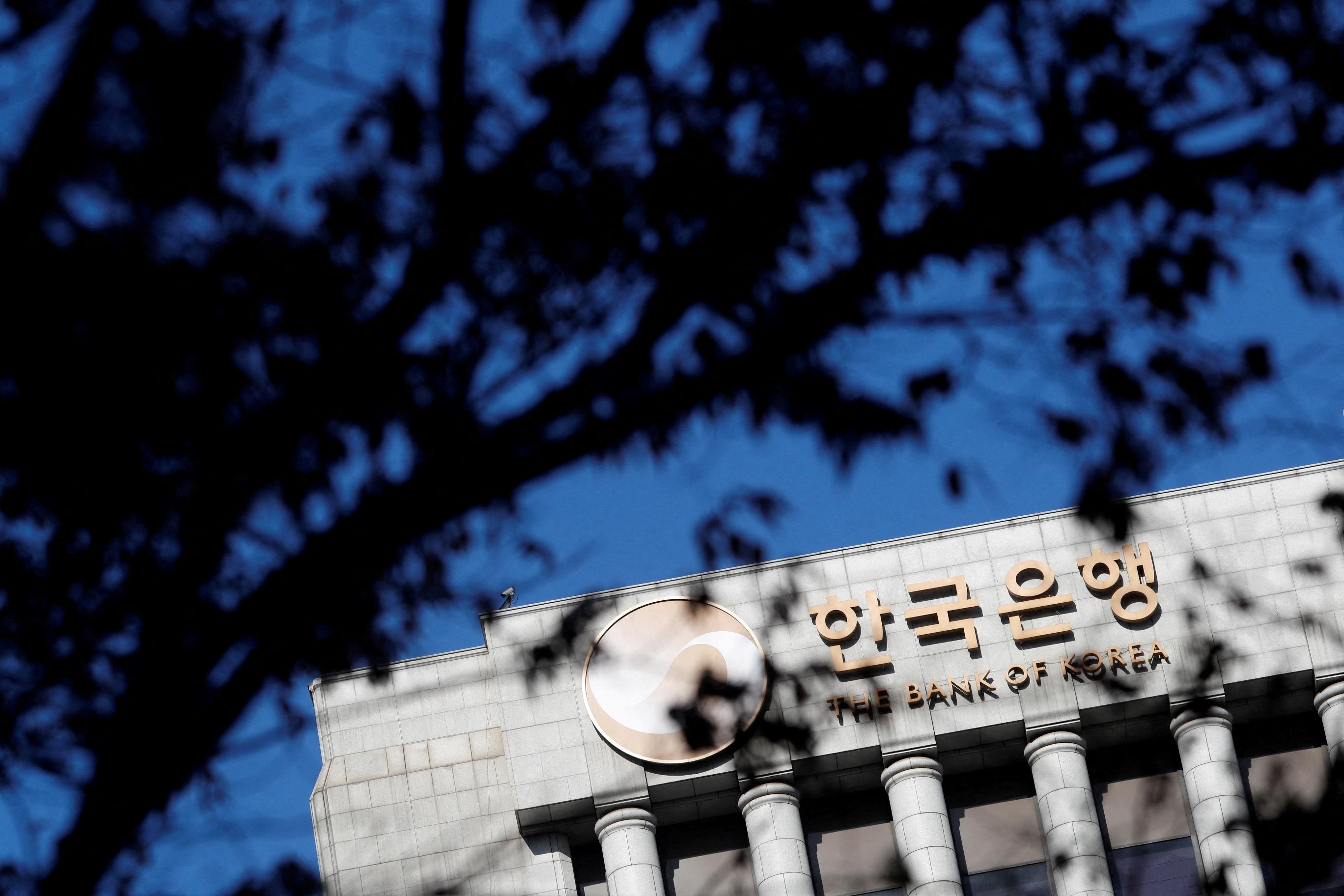
BENGALURU, Oct 8 (Reuters) - The Bank of Korea will cut its key interest rate by 25 basis points to 3.25% on Friday, according to a majority of economists polled by Reuters who expect that to be the only reduction this year as it attempts to balance growth and financial stability. Inflation eased rapidly to 1.6% in September from 2% in August, the lowest since early 2021 and below the Bank of Korea's (BOK) medium-term target of 2%. Since its last meeting in August, the central bank has shifted its focus to economic growth, which unexpectedly contracted last quarter. However, the BOK is likely to proceed cautiously when cutting rates as growth in household debt and a heated property market pose risks to financial stability. All but three of 37 economists polled Oct. 1-7 forecast the central bank would cut its base rate (KROCRT=ECI) , opens new tab by 25 basis points on Oct. 11, bringing rates to 3.25%. The rest said no change. If realised, the BOK will join Asian peers Bank Indonesia and the Philippine central bank which began cutting rates before the U.S. Federal Reserve started its own easing campaign with a 50 basis point cut last month. Suktae Oh, chief Korea economist at Societe Generale, said the Fed's large rate cut and South Korea's growth and inflation data supported the case for a BOK rate cut this month, but added that further cuts in the near term were unlikely. "Persistent concerns around the housing market will make it difficult for policymakers to explicitly propose an additional rate cut in the near future, in other words, this would reduce the likelihood of a back-to-back rate cut in November," he said. Among economists who provided a forecast for year-end around 84%, or 27 of 32, said 3.25%. Five predicted one more 25 basis point rate cut. This outlook was largely unchanged from an August survey and in line with market expectations. Poll data showed the BOK will cut rates more slowly than some of its regional peers, with a total of 50 basis points of cuts next year, taking rates to 2.75% by end-2025. "We are expecting the BOK to end the year at 3.25%, followed by two more 25bp cuts in 2025 to 2.75%...and is likely to take a breather there," said Kelvin Lam, senior economist at Pantheon Macroeconomics. "However, the BOK may speed up or slow down the pace of cuts depending on external factors, since they do not want the Korean won to fluctuate or depreciate too much." Following the U.S. Fed's September rate cut and expectations for two more this quarter, the Korean won has gained around 4% after touching its weakest level so far this year in mid-April. Korea's economic growth will improve this year, averaging 2.4% from 1.4% last year, before slowing to 2.1% in 2025, poll medians showed. (Other stories from the October Reuters global economic poll) Sign up here. https://www.reuters.com/markets/asia/bank-korea-kick-off-easing-cycle-with-25-bps-cut-october-11-2024-10-08/
2024-10-08 00:08
Oct 7 (Reuters) - U.S. natural gas futures fell about 4% to a one-week low on Monday on expectations Hurricane Milton will cut the amount of gas power generators need to burn later this week by knocking out electricity service to potentially millions of homes and businesses in Florida. The U.S. National Hurricane Center projected Milton will slam into the west coast of Florida as a major storm late on Wednesday before sweeping across the central part of the state by Thursday morning. Those Florida outages will add to the over 200,000 homes and businesses still without power in the Carolinas and Georgia since Hurricane Helene moved inland after slamming into Florida on Sept. 26. Front-month gas futures for November delivery on the New York Mercantile Exchange fell 10.8 cents, or 3.8%, to settle at $2.746 per million British thermal units (mmBtu), their lowest close since Sept. 26. But with gas futures up in five of the past six weeks, speculators boosted their net long futures and options positions on the New York Mercantile and Intercontinental Exchanges for a fifth week in a row to their highest since June, according to the U.S. Commodity Futures Trading Commission's Commitments of Traders report. One factor that has supported prices in recent weeks - the front-month has gained about 41% over the past six weeks - was a drop in the amount of fuel utilities have injected into storage for the 2024-2025 winter heating season. Storage builds in July, August and September were at record lows, according to federal energy data going back to 1997. That is because many producers reduced their drilling activities so far this year after average spot monthly prices at the U.S. Henry Hub benchmark in Louisiana fell to a 32-year low in March. Prices have remained relatively low since then. Even though storage injections have been lower than usual in 20 of the past 21 weeks, the amount of gas in inventory was still about 5% above normal levels for this time of year due to low heating demand during the mild winter of 2023-2024. SUPPLY AND DEMAND Financial company LSEG said average gas output in the Lower 48 U.S. states fell to 101.0 billion cubic feet per day (bcfd) so far in October, down from 101.8 bcfd in September. That compares with a record 105.5 bcfd in December 2023. LSEG forecast average gas demand in the Lower 48, including exports, will ease from 96.4 bcfd this week to 96.2 bcfd next week. Those forecasts were higher than LSEG's outlook on Friday. Gas flows to the seven big U.S. liquefied natural gas (LNG) export plants fell to an average of 12.2 bcfd so far in October, down from 12.7 bcfd in September. That compares with a monthly record high of 14.7 bcfd in December 2023. That reduction was due mostly to the planned Sept. 20 shutdown of Berkshire Hathaway Energy's 0.8-bcfd Cove Point LNG export plant in Maryland for around three weeks of annual maintenance, which will likely end later this week. Sign up here. https://www.reuters.com/business/energy/us-natgas-prices-drop-4-one-week-low-ahead-hurricane-milton-2024-10-08/

2024-10-07 23:50
NEW YORK, Oct 7 (Reuters) - It is time to get professional and give governments a role regulating voluntary carbon markets and corporate climate targets, the chief executive of the grant-giving Bezos Earth Fund told the Reuters Impact conference on Monday. Trading in voluntary carbon credits, a relatively new and unregulated instrument generated by projects that aim to reduce greenhouse gas emissions, which companies can then buy to off-set their own environmental footprints, has shrunk as studies found some of those projects were not effective. Companies, investors and activists are debating whether those credits should count towards "net-zero" targets which proliferated after the 2015 Paris Agreement on climate change. Andrew Steer, head of the $10 billion Earth Fund set up with the personal fortune of Amazon (AMZN.O) , opens new tab founder Jeff Bezos to invest in tackling climate change this decade, told the conference there was not much time left to make those markets more efficient. Steer listed a number of "self-appointed" voluntary groups which had contributed in the past 15 years to corporate climate efforts. These included emissions reporting platform CDP, and the World Resources Institute research organization, which he personally headed for several years and said he was proud to have been part of. "It's time for moving on, I was going to say to the adults coming into the room, that's not fair because the NGOs are pretty good too. It's now time to get truly professional and regulated in the best sense," Steer said. The Earth fund was an early backer of the Science-Based Targets initiative, a non-profit group now used by over 6,000 companies to audit their climate targets. SBTi said this year that offsets were largely ineffective, but delayed until 2025 a final decision on whether to approve companies' using them. Biden administration officials wrote rules on carbon credits earlier this year, and the Commodity Futures Trading Commission set guidelines for trading derivative contracts last month. Steer also mentioned new laws in California which will oblige companies to account for emissions starting in 2026. Sign up here. https://www.reuters.com/sustainability/sustainable-finance-reporting/reuters-impact-it-is-time-carbon-markets-got-professional-bezos-earth-fund-ceo-2024-10-07/

2024-10-07 23:11
LONDON, Oct 8 (Reuters) - Britain's electricity and gas grid operators expect sufficient supplies this winter, with more power imports and domestic generation available than last year and high gas storage levels in Europe, they said on Tuesday. Britain's National Energy System Operator (NESO) and National Gas publish annual reports about the supply and demand picture for the coming winter to help business and government prepare. "It is positive to see that (electricity) margins forecast for this winter are the highest since 2019/20," said Craig Dyke, director of system operations at NESO. NESO said its base case for de-rated margin, which is a measure of the amount of excess capacity expected above peak electricity demand, is currently 5.2 gigawatts (GW) for winter 2024/25, or 8.8% the peak average cold spell demand, up from 4.4 GW, or 7.4% last winter. The improved margin comes despite the closure of Britain's last coal plant last month. More interconnection with Europe, after the opening of a 1.4 GW power link between Britain and Denmark at the end of 2023, more generation and battery capacity had led to the increase, NESO said. Wholesale energy costs have stabilised since Russia's invasion of Ukraine sparked record high prices in 2022 but NESO warned there is a still a risk geopolitical events could impact the market. "While the overall energy system is showing greater resilience, disruptions in global energy markets remain a possibility," the report said. NESO expects peak electricity demand at 44.4 GW this winter, similar to the 44.9 GW peak seen last winter. GAS SUPPLY Britain uses gas for around a third of its electricity production while around 75% of the country's homes are also heated by the fuel. Sufficient gas supplies expected with solid supply from Norway, imports of Liquefied Natural Gas and Europe's gas storage sites almost full, National Gas said in its winter outlook. With escalating tensions in the Middle East however, it is also monitoring global events. "Factors beyond our control such as the weather, global market developments, and the wholesale cost of gas will all influence the gas supply and demand situation in GB," Ian Radley, National Gas System Operator Director said. Demand from homes is expected to be higher than last year due to slightly lower energy prices while demand from power plants is expected to dip as increased renewable generation comes online. Peak day gas demand this winter is expected at 474 million cubic metres (mcm)/day versus a peak supply capacity of 601 mcm/d, National Gas said. Sign up here. https://www.reuters.com/business/energy/britain-have-sufficient-energy-supplies-this-winter-grid-operators-say-2024-10-07/
2024-10-07 23:00
LONDON, Oct 7 (Reuters) - The global energy transition was the dominant theme at this year's London Metal Exchange (LME) Week, the annual gathering of the world's metals producers, users and traders. True, the metallic path to net zero is proving much bumpier than expected. Prices of battery metals such as lithium, cobalt and nickel have bombed over the last year. Too much supply has been brought on too quickly just as electric vehicle sales have hit a slow patch. But the promise of a future boom is undiminished. Many key energy transition metals are expected to face supply shortfalls this decade, some as soon as this year, according to BloombergNEF. The research house predicts the world will need three billion metric tons of metals between 2024 and 2050 to meet global emissions targets. The figure doubles to six billion in a net zero scenario. It's an enticing bull narrative, particularly when the current reality is one of weak metals demand as China's growth engine misfires and Europe's manufacturing sector contracts. And it's one that is starting to attract much broader interest. The fund industry, which has been underweight metals for over a decade, is now eyeing up the opportunities offered by the energy transition. A potential return of heavyweight investment flows to the sector could be as powerful a price driver as physical supply shortages. LOST DECADE Fund allocations to the commodity sector have declined from around 10% to 2% over the last decade, according to Aline Carnizelo, managing partner at fund manager Frontier Commodities, who spoke on the investment panel , opens new tab at the LME's Monday seminar. The last great money surge came in the late 2000s, when investment funds, including giants such as The California Public Employees' Retirement System, bought into the idea that commodities could serve as an effective inflation hedge. The strategic allure was overlaid by the bull narrative surrounding China's rise as an industrial powerhouse and the accompanying explosion in demand for industrial metals. Things didn't work out as expected. The global financial crisis caused metals demand and prices to slump. A massive Chinese stimulus program fed one last bull surge but this was followed by years of decline. LME copper hit what was then an all-time high of $10,190 per ton in February 2011. The ensuing downtrend played out for five years before the price finally bottomed out at $4,318 per ton in January 2016. Meanwhile, successive rounds of quantitative easing by central banks during this period crushed interest rates, undermining the case for commodities as an inflation offset. METALS REVISITED Inflation expectations have changed significantly in recent years and fund managers are once again looking at commodities as a way of generating an inflation-adjusted return. The ideal ratio of hard assets in an investment portfolio should be between 4% and 9%, according to Jigna Gibb, head of commodity index products at Bloomberg, who also spoke on the LME Monday seminar panel. That's at least double current allocations in a sector that is valued in the trillions of dollars. Metals are the clear stand-out in the commodities sector thanks to their pivotal role in decarbonisation. Funds have so far sought exposure to the energy transition theme by buying equities in the mining and industrial technology sectors rather than the raw inputs, according to Michael Stewart at Legal & General Investment Management, one of Europe's largest asset managers. However, that's changing, he told the seminar. "We're having conversations with our investors that we would not have had three or four years ago about considering energy transition commodities," he said. The opportunity for more investment in metals is "tremendous" and spans a wide spectrum of players from sophisticated pension and insurance funds to mass market retail investors, he added. And the energy metals story dovetails neatly with the renewed interest in inflation-proofing fund returns. In a greener economy metals such as copper, aluminium and lithium have the potential to be just as powerful future drivers of inflation as oil and gas are in today's carbon-intensive economy. DOUBLE-EDGED SWORD A major reallocation of pension fund money to commodities in general and metals in particular might be welcome news for producers, traders and exchanges. But the scale of potential global fund flows risks swamping what are small markets relative to equities or bonds. Copper's turbo-charged rally earlier this year may be a harbinger of the volatility to come. Funds stampeded into copper amid much hype about limited supply at a time of accelerating demand from new energy applications such as solar, wind and electric vehicles. Investors' fear of missing out drove LME copper to a new nominal high of $11,104.50 per ton in May. What followed was a buyers strike and aggressive de-stocking, including unprecedented exports of refined copper from China, normally the world's largest importer of the red metal. Funds sold out their long positions just as quickly as they had bought them and copper fell below the $9,000 level in early August. The bull narrative, however, hasn't lost any of its resonance. Copper was the top pick for attendees at last week's LME seminar for the third year running. If enough investors agree, copper's potential for further price gains will become a self-fulfilling prophesy. But that was how things looked in the 2000s as well. The reality proved very different. The opinions expressed here are those of the author, a columnist for Reuters. Sign up here. https://www.reuters.com/markets/commodities/energy-transition-story-rekindles-fund-interest-metals-andy-home-2024-10-07/

2024-10-07 22:54
CBOE Volatility index hits one-month high Amazon off 3%, Apple falls 2% after analyst research Alphabet falls 2% after court order Pfizer gains on report Starboard Value takes $1-billion stake Oil stocks track crude prices higher Oct 7 (Reuters) - Wall Street's three major indexes closed down around 1% on Monday while Treasury yields rose, as traders tamped down bets for Federal Reserve interest-rate easing and worried about the Middle East conflict's impact on oil prices. While waiting for quarterly earnings season and fresh economic data, investors also braced for another big hurricane, Milton, which is expected to hit the United States this week. Relief efforts are under way after Helene, a Category-4 hurricane, killed more than 200 people across six states. Further dampening sentiment on Monday was an order from a U.S. judge for market heavyweight Alphabet's GOOGL.O Google to overhaul its mobile-app business to give Android phone users more options. Analyst reports also spurred selling of Amazon.com (AMZN.O) , opens new tab and Apple Inc (AAPL.O) , opens new tab. After Friday's stronger-than-expected jobs report, traders pulled back from bets for a 50-basis-point rate cut in November. They were pricing in an 86% chance of a 25-basis-point cut and a roughly 14% chance the central bank would not cut rates at all, according to the CME's FedWatch tool. The change in rate-cut expectations caused U.S. Treasury yields to rally, with the yield on benchmark 10-year notes exceeding 4% for the first time in two months. Besides next month's Fed meeting, investors are waiting for the Consumer Price Index inflation reading for September and the kickoff of third-quarter earnings season with reports from banks, both due this week. "It's a combination of things over the last couple of days: the jobs report, the hurricane damage, the elevated energy prices and negative comments about some of the large-cap tech names," said Michael James, managing director of equity trading at Wedbush Securities in Los Angeles. "All of that combined just makes for a nervous day, and the Google headlines tipped things over to more aggressive selling in the last hour." James pointed to the Middle East conflict as a concern for U.S. investors who are worried about the war's economic impact, including rising oil prices. Investors continue to fret about how Israel would respond to Iran's missile strikes. On Monday, Lebanon's armed group Hezbollah fired rockets at Israel's city of Haifa while Israeli forces looked poised to expand ground raids into south Lebanon. The Dow Jones Industrial Average (.DJI) , opens new tab fell 398.51 points, or 0.94%, to 41,954.24, the S&P 500 (.SPX) , opens new tab lost 55.13 points, or 0.96%, to 5,695.94 and the Nasdaq Composite (.IXIC) , opens new tab lost 213.94 points, or 1.18%, to 17,923.90. The CBOE Volatility index (.VIX) , opens new tab, Wall Street's fear gauge, closed up 3.4 points at 22.64, marking its biggest one-day points gain in more than a month and its highest closing level since Aug. 8. Among the S&P 500's 11 major industry indexes, only energy (.SPNY) , opens new tab advanced, finishing up 0.4%. U.S. crude futures settled up 3.7% in their fifth-straight advance on concerns about Middle East supply disruptions. The biggest industry laggard was utilities (.SPLRCU) , opens new tab, down 2.3%, followed by communications services (.SPLRCL) , opens new tab, which was under pressure from Alphabet's 2.5% drop. The benchmark S&P 500's biggest drag from a single stock was from Apple, after Jefferies assumed coverage with a "hold" rating, sending the stock down 2.3%. Amazon.com finished down 3% after a Wells Fargo downgrade. Among the benchmark's biggest gainers was Generac Holdings , which added 8.52% as investors bet on solid demand for backup power generators because of the pending hurricane. Shares of Pfizer (PFE.N) , opens new tab rose 2% after a report that activist investor Starboard Value has taken a roughly $1-billion stake in the drugmaker. Air Products and Chemicals (APD.N) , opens new tab closed up 9.5% on a report that activist hedge fund Mantle Ridge has built a position in the company. Declining issues outnumbered advancers by a 2.73-to-1 ratio on the NYSE where there were 222 new highs and 55 new lows. On the Nasdaq, 1,292 stocks rose and 2,988 fell as declining issues outnumbered advancers by a 2.31-to-1 ratio. The S&P 500 posted 34 new 52-week highs and two new lows while the Nasdaq Composite recorded 83 new highs and 118 new lows. On U.S. exchanges, 11.39 billion shares changed hands compared with the 12.06-billion average for the last 20 sessions. Sign up here. https://www.reuters.com/markets/us/wall-street-futures-slip-markets-reprice-rate-path-ahead-busy-week-2024-10-07/