2025-12-18 12:41
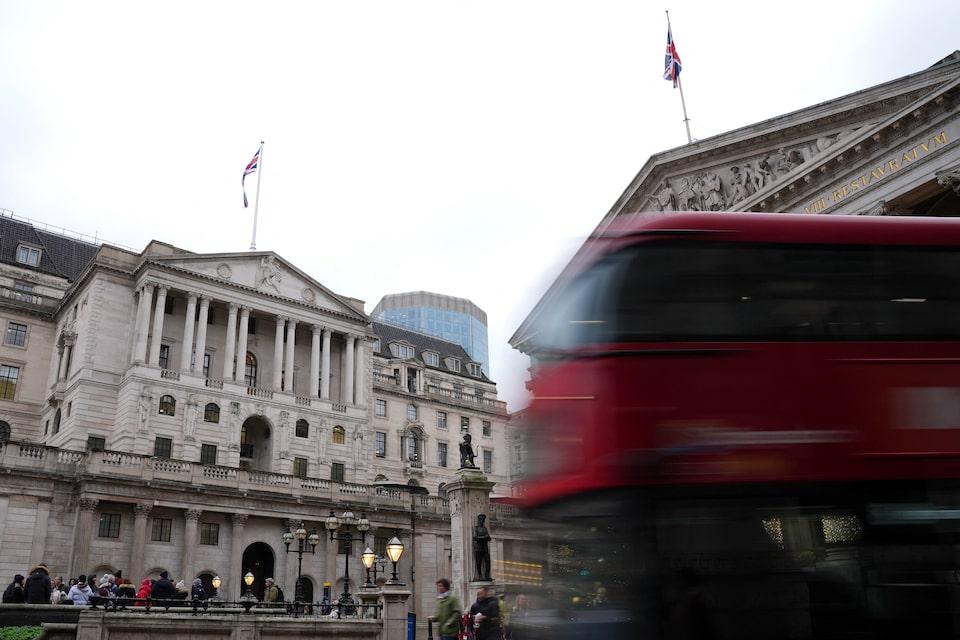
LONDON, Dec 18 (Reuters) - The Bank of England cut interest rates on Thursday after a narrow vote by policymakers, but it signalled that the already gradual pace of lowering borrowing costs might slow further. The pound jumped as much as 0.16% to a session high of $1.34 immediately after the decision, while two-year gilt yields , the most sensitive to shifts in expectations for British monetary policy, rose by as much as 5.4 basis points to a session high of 3.771%. Sign up here. UK retreated from the day's highs, leaving both the blue-chip FTSE 100 (.FTSE) , opens new tab and the mid-cap FTSE 250 (.FTMC) , opens new tab flat. COMMENTS: GEORGE VESSEY, LEAD FX & MACRO STRATEGIST, CONVERA, LONDON: "We had warned that the bigger risk was not the cut itself, but that a narrow split would disappoint doves and leave scope for sterling to strengthen. With pessimism already embedded in GBP, stretched short positioning and sterling’s still-attractive carry profile, the setup was ripe for markets to be caught off guard — and today’s post-decision rally in the pound reflects exactly that dynamic. Bottom line: The cut was no surprise, but markets latched onto signs of a resilient hawkish contingent on the MPC, which has kept GBP buoyant, highlighting that the bigger story lies in positioning and market expectations rather than the headline decision." KENNETH BROUX, HEAD OF CORPORATE RESEARCH, FX AND RATES, SOCIETE GENERALE, LONDON: "There was a bit of speculation that it could be a bigger majority for a cut after the CPI late yesterday, which was below forecast. But I think there are some lines in the statement that are quite dovish for me. They recognise that inflation has fallen, and it's (now) expected to fall back more quickly towards the target in the near term. So that's quite dovish. And they're also saying that judgments around further policy easing will become a closer call. So it tells you that the hawkish opposition is kind of weak. And so on balance, it increases the likelihood that we'll get another rate cut earlier in early 2026. So for me, it's more of a dovish read. It's certainly not a hawkish read." CHRIS BEAUCHAMP, CHIEF MARKET ANALYST, IG MARKETS, LONDON: "I know we expected the vote to be fairly tight, but certainly I think after yesterday's inflation, we thought maybe there would be more of an impetus to cut. But clearly there's enough people thinking: 'actually, I don't want to jump on this too soon. I would rather hang around and wait to see if it's turning into a trend.'" "I think the rationale is there probably, but it needs some patience to give you that green light. And I suppose you've only got the amber light at the moment." NEIL PARKER, HEAD OF ECONOMICS AND MARKET STRATEGY, MONEYCORP, LONDON: “It wasn’t the huge surprise that some were hoping for." "Markets have pared back their pricing for interest rate cuts from here. We don’t get another cut fully priced until the June meeting, whereas previously it had been expected in April. If there is a reaction in sterling to rally, it will be perfectly predictable.” JEREMY BATSTONE-CARR, EUROPEAN STRATEGIST, RAYMOND JAMES INVESTMENT SERVICES, FRANCE: "Today's decision by the Bank of England’s rate-setting Monetary Policy Committee to cut the base rate by a further 0.25%-points to 3.75% has come as little surprise. While the MPC’s job is to set the UK base rate with regards to the future, the decision was taken with the clarity provided by confirmation of the contents of the Chancellor’s Budget package, a softening economy and lower than anticipated inflation data. All of which meant that earlier arguments against policy loosening were on increasingly thin ice. Today’s rate cut is unlikely to be the last, and confirmed in the accompanying statement providing encouragement for businesses and further relief for households grappling with a relentless cost of living crisis." KALLUM PICKERING, CHIEF ECONOMIST, PEEL HUNT, LONDON: "My hunch is this is somewhat doveish in language, not doveish in the vote, though. Markets are taking it a bit hawkish, sterling is up a bit, yields have jumped. I think some people in markets, including me, were hoping that we would get a 6-3 (vote split), that one of the hawks would have abandoned the hold and gone for a cut. For me, the key points are that inflation is falling back a bit faster than the Bank of England had expected and what you have here is a strong signal that the Bank Rate is likely to fall a little bit faster, which means it opens the door for successive cuts. I don’t think the Bank of England is going to be willing to tolerate slow growth under its potential estimate once inflation is clearly on track to hit 2% and we're getting to that point faster due to these downside surprises to inflation." https://www.reuters.com/world/uk/view-bank-england-cuts-rates-tight-vote-sterling-rises-2025-12-18/
2025-12-18 12:40
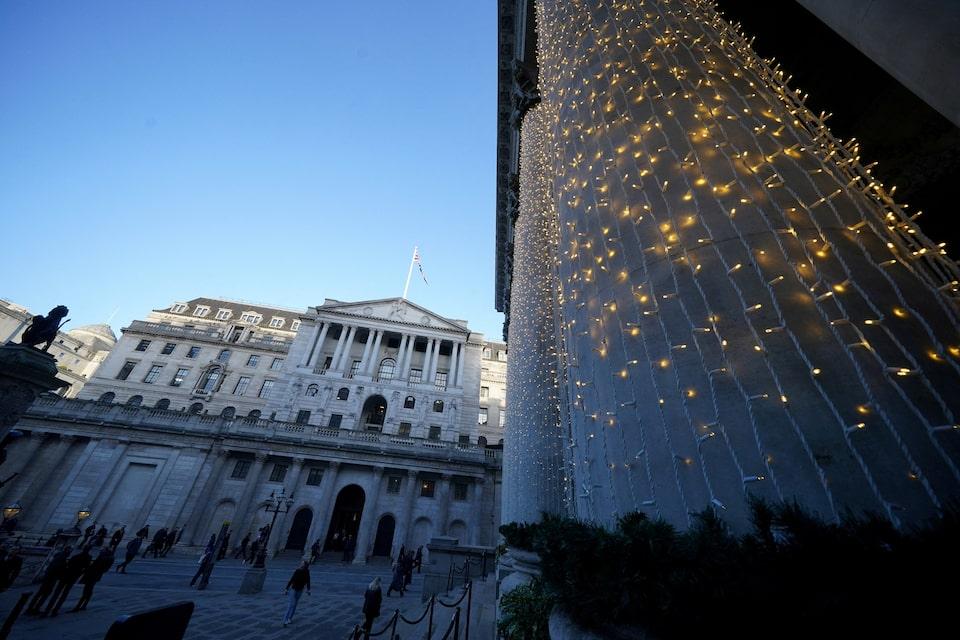
LONDON, Dec 18 (Reuters) - The Bank of England cut interest rates on Thursday after a narrow vote by policymakers but it signalled that the already gradual pace of lowering borrowing costs might slow further. After a sharp drop in inflation in data this week and a new forecast from BoE staff that growth will stagnate in late 2025, five Monetary Policy Committee members voted to lower the BoE's benchmark rate for the fourth time in 2025 to 3.75% from 4.0%. Sign up here. The four other members supported no change as they worried about the potential for Britain inflation's rate - still the highest among the Group of Seven economies - to remain too high. Governor Andrew Bailey changed his view and voted for a cut, tipping the balance on the committee. "We still think rates are on a gradual path downward," Bailey said in a statement. "But with every cut we make, how much further we go becomes a closer call." He said he did not yet see proof of a sharper downturn in the jobs market but he also noted inflation expectations had not dropped significantly so far. Analysts polled by Reuters last week had mostly expected a 5-4 vote for a rate reduction. The MPC echoed Bailey's words in its end-of-meeting statement. But some senior policymakers who voted against the rate cut made clear their worries. Deputy Governor Clare Lombardelli said she remained more concerned about the risk of inflation proving stronger than expected and the recent data had only softened "at the margin." Chief Economist Huw Pill said he saw a bigger risk of inflation getting stuck too high than too low. The quarter-point cut took Bank Rate to its lowest level in nearly three years, although it is still almost double the equivalent rate of the European Central Bank. British inflation remains higher than among peer economies - in part because of finance minister Rachel Reeves' decision last year to raise taxes on employers - even after it fell unexpectedly sharply to 3.2% in data released on Wednesday. The BoE said inflation was "now expected to fall back towards target more quickly in the near term" and the risk that it would persist at high levels had "become somewhat less pronounced." The possibility of weaker demand pushing it too low remained, the post-meeting statement said. Data on Tuesday showed a weakening jobs market including the highest unemployment rate since 2021 and a slowdown in private sector pay growth. The BoE said it now expected zero economic growth in the last three months of 2025, down from a forecast of 0.3% growth made as recently as last month, although it thought underlying growth was stronger at about 0.2% a quarter. Britain's economy shrank by 0.1% in the three months to October amid reports that businesses put investment projects on ice in the run-up to Reeves' budget on November 26. The BoE said it expected the budget would bring down inflation in 2026 by about half a percentage point due to one-off measures which would then push it up a bit in the following two years. The budget measures would add at most 0.2 percentage points to the size of the economy in 2026 and 2027. Other major central banks are believed to be close to halting their rate cuts - the U.S. Federal Reserve last week signalled one more in 2026 while the ECB has probably already come to the end of its monetary loosening cycle. The ECB was expected to keep rates on hold later on Thursday. (([email protected] , opens new tab)) Keywords: BRITAIN BOE/ https://www.reuters.com/world/uk/bank-england-lowers-rates-after-tight-vote-signals-caution-about-further-cuts-2025-12-18/
2025-12-18 12:38
Deal adds fusion power to Trump family's diverse ventures Trump Media to be holding company housing both firms' divisions To start building world's first utility-scale fusion power plant in 2026 Fusion industry reps recently met with US Energy Dept reps Dec 18 (Reuters) - U.S. President Donald Trump is getting into the fusion power business through a $6 billion merger of his social media firm and Google-backed TAE Technologies, announced just days after industry leaders met with U.S. Energy Department representatives to urge federal funding. The all-stock deal announced on Thursday is an ambitious bet on the power boom spurred by artificial intelligence data-centers and adds to the Trump family's growing roster of diverse ventures from cryptocurrency to real estate holdings and mobile services. Sign up here. After his return to office this year, Trump's close relatives have pursued ventures leveraging his political power and policy shifts. The Trump family has, for instance, amassed billions in crypto-related wealth as Trump throws his support behind digital financial assets. Greater support from the federal government could potentially boost the value of this investment, as well. The news put a charge into shares of the money-losing Trump Media (DJT.O) , opens new tab on Thursday, sending them up 35%. The stock, popular with retail traders, had lost more than 70% of its value over the last 12 months following a big surge during the 2024 campaign. "At face value, this is a Barbenheimer mashup. Trump Media gets a dramatic new growth story tied to the AI power crunch and data-center (hyperscaler) electricity demand, while TAE gets a fast lane to being publicly traded via an all stock merger valued above $6 billion," said Michael Ashley Schulman, partner and chief investment officer at Running Point Capital Advisors. EFFORTS IN FUSION The growing electricity needs of the technology industry have in recent months revived interest in nuclear power, including restarting fully shuttered reactors, expanding existing plants and signing contracts for future small modular reactors. Despite decades of global efforts, nuclear fusion, often seen as a cleaner and reliable power source, has yet to produce a commercially viable reactor. Shareholders of both companies will own about 50% of the combined entity after the deal closes in mid-2026. Trump Media and Technology Group (DJT.O) , opens new tab will be the holding company for businesses including Truth Social platform, TAE Power Solutions, and TAE Life Sciences. Trump has 114 million shares in Trump Media, roughly 40% of the company. In the new merger, his ownership stake would be roughly 20%. The company, which mainly generates revenue from advertising on the Truth Social platform, has consistently clocked losses since its inception, including a loss of $54.8 million in its September-end quarter. Thursday's rally was a salve for some retail investors who have watched the stock's price fizzle for most of 2025. Chad Nedohin, an Edmonton-based pastor and mechanical engineer in the energy sector, leads one of the largest Trump Media retail investor groups on Truth Social, which has more than 190,000 followers. Up until the past year, Nedohin had been one of Truth Social’s most influential hype men - but has been frustrated as the stock slumped all year. “I can’t sit here and just be excited about a stock that’s done nothing but stupid stuff until today," he said. "But today was awesome, I think it’s a brilliant move.” WAVE OF THE FUTURE? Companies and physicists at national laboratories have been trying for decades to foster fusion reactions, in which light atoms are forced together under extreme temperatures to release huge amounts of energy, a process that fuels the sun. Big hurdles to commercialize fusion include getting more energy out of a reaction than what goes into it and developing plants that can withstand streams of fusion reactions to power the grid. TAE CEO Michl Binderbauer and other fusion company leaders met with U.S. Energy Department officials this month, weeks after the department formed its first ever fusion office. Trump Media agreed to provide up to $200 million in cash to TAE at signing and $100 million more upon initial filing of the registration. The deal has been approved by the companies' boards. DEMOCRAT CAUTIONS ON DEAL U.S. Representative Don Beyer, a Democrat and advocate for fusion, said on X the deal raises "significant concerns about conflicts of interest and avenues for potential corruption." The merger will need congressional oversight, Beyer said, to ensure that U.S. and public funds are directed toward ways that benefit Americans and not of Trump, his family, and allies. The companies did not immediately respond to requests for comment. They plan to build the world's first utility-scale fusion power plant beginning next year. Trump Media CEO Devin Nunes said in a brief, eight-minute investor call that the companies plan to "quickly seek approvals" after the deal closes, with siting for the plant expected to begin by 2026 end. He will be co-CEO of the new company, along with Binderbauer. The two, along with Donald Trump Jr., will sit on the merged company's board. https://www.reuters.com/business/trump-media-tae-technologies-combine-6-billion-deal-2025-12-18/

2025-12-18 12:15
West African crude faces competition from Middle East and Latin America China and India shift to cheaper, alternative oil grades Dangote refinery maintenance reduces Nigerian oil imports LONDON, Dec 18 - West African crude oil sellers are struggling to find buyers for up to 26 December- and January-loading cargoes due to stiff competition from plentiful and cheaper alternative supplies, traders and analysts told Reuters. The amount of unsold Nigerian and Angolan crude, analysts say, is a symptom of a wider oil market surplus. It drove selling on the international futures market that pushed Brent crude below $60 per barrel to the lowest since May this week. Sign up here. "The overhang of West African cargoes partly reflects the broader global crude supply surplus emerging in Q1," said Victoria Grabenwoger of analytics firm Kpler. Approximately 20 million barrels of Nigerian oil for December and January loading remained unsold by Thursday, according to two traders, while Angola's December-January programmes still had as many as five to six cargoes available. These cargoes have slowed the start of the trading cycle for February cargoes even though Angola's loading schedule and term nominations have already been released. Such a large amount of unsold oil is unusual, especially for the current month, given the West African trade cycle is typically closer to two months ahead. Estimates for both countries' overhang were as high as 40 million barrels earlier this week. "Current market softness appears to be partly seasonal and partly due to shifting buying patterns in response to freight costs and alternative supply options," said OilX analyst Francisco Gutierrez, adding that Angolan January trade is 20% behind its long-term average pace because the world's biggest commodities buyer China has switched to cheaper, or nearer alternative grades. Supplies from the Middle East are displacing medium and heavy West African grades in Asia as lowered official selling prices in January and shorter voyages give those grades a competitive edge, the analysts said. India's oil imports from Russia have remained resilient despite tightening Western sanctions, displacing medium-heavy density West African crudes, while light to medium-density West African grades are struggling to compete with supplies from Argentina and Brazil, two traders said. Nigeria has also been left to market more oil because of reduced imports by Africa's largest oil refinery, the 650,000 barrels-per-day Dangote plant, which will in January undergo maintenance, Kpler's Grabenwoger said. https://www.reuters.com/business/energy/west-african-oil-struggles-find-buyers-global-surplus-builds-2025-12-18/

2025-12-18 12:14
JAKARTA, Dec 18 (Reuters) - Indonesia will issue investment instruments for earnings from the export of natural resources, a finance ministry official said on Thursday, to try to improve exporters' compliance with rules to keep their foreign currency proceeds in the country. The new regulation, intended to increase onshore U.S. dollar liquidity and stabilise the rupiah exchange rate, will require natural resource exporters to retain all foreign currency earnings from January 1 in state banks for at least a year and limit their use. Sign up here. The new instruments will include new competitive series of domestically issued FX bonds, Febrio Kacaribu, a senior official at the finance ministry, told a press conference. Indonesia is the world's biggest exporter of palm oil, thermal coal, nickel and tin and a major seller of rubber, coffee and other commodities. "What has happened is the earnings are converted into rupiah and they end up offshore," Febrio said. The planned rule has received complaints from the palm oil and mining associations as the new regulation will cap the conversion of their FX earnings to rupiah at a maximum of 50%. Under the current regulations, exporters can keep earnings in any Indonesian bank. They can also get a waiver for the length of the retention if the proceeds are converted into rupiah. "We need funds for our operation, mostly in rupiah ... We hope they will reconsider," Hadi Sugeng, the secretary general of palm oil producers association GAPKI, told Reuters on Thursday. Hendra Sinadia, executive director of the Indonesian Mining Association, said miners also hoped the government would keep the current rules. Asked about the industry complaints, Febrio said exporters should get a loan from banks if they required more rupiah funds beyond the 50% limit. Febrio also said there should be limited liquidity impact for non-state banks because they could still cater for exporters outside of natural resource sectors. https://www.reuters.com/world/asia-pacific/indonesia-will-issue-investment-instruments-export-earnings-natural-resources-2025-12-18/

2025-12-18 11:50
MADRID, Dec 18 (Reuters) - Spanish police searched a state-funded laboratory near Barcelona on Thursday as part of an investigation into the origin of the African swine fever outbreak in the same area, regional police said. The court-ordered move follows concerns raised this month that the outbreak detected in wild boars could have been caused by a laboratory leak. Genome sequencing showed the strain is similar to that used in research and vaccine development and different from other cases in Europe. Sign up here. African swine fever is harmless to humans but can be fatal to pigs and wild boars, and spreads rapidly. Spain is the European Union's largest pork producer, accounting for about a quarter of the bloc's output, and the outbreak has threatened exports, prompting authorities to impose movement restrictions and step up efforts to reassure trading partners. Police said the search at the Centre for Research in Animal Health (Cresa) was ordered by a local investigating judge and forms part of preliminary proceedings that have been declared secret. The centre did not immediately respond to a request for comment. Cresa has told the news verification website Maldita.es it had found no evidence of being the source of the outbreak. The outbreak, Spain's first since 1994, has been detected only in wild animals in the Collserola hills outside Barcelona, with no cases reported on farms. Authorities have discovered the virus in 26 wild boar carcasses in the six km (four-mile) confinement area imposed by authorities after the outbreak. Cresa is located within the same area. https://www.reuters.com/business/healthcare-pharmaceuticals/spanish-police-search-laboratory-african-swine-fever-probe-2025-12-18/