2025-11-24 17:07
BRASILIA, Nov 24 (Reuters) - Brazil's central bank remains dissatisfied with progress toward bringing inflation back to its target, its governor said on Monday, stressing that policymakers will maintain a data-dependent approach. Speaking at an event hosted by banking lobby Febraban, Gabriel Galipolo said the bank is "clearly moving in the desired direction to fulfill our mandate" of returning inflation to target, but emphasized that there is still work to be done. Sign up here. "We are still dissatisfied because we are not yet where we would like to be, which is why interest rates remain at a restrictive level," he said. "The central bank made it very clear that it will do whatever is necessary to fulfill its mandate," he added. Earlier in November, the central bank held interest rates steady for the third consecutive meeting at 15%, the highest level in nearly 20 years, and signaled it is now confident that keeping them unchanged for a prolonged period is enough to guide inflation back to the 3% official goal. BANCO MASTER LIQUIDATION Galipolo also said on Monday the institution "followed the rulebook" and acted strictly in line with its legal mandate on financial stability following the recent liquidation of Banco Master. The central bank tied the move to a "severe liquidity crisis" at the Master conglomerate, a "sharp deterioration" in its finances, and "serious violations" of financial-system rules. Galipolo praised the central bank's technical staff and "the diligence of the whole team," especially the supervision department led by director Ailton Aquino. Master, which had grown rapidly through an aggressive strategy built on high-yield debt sold through investment platforms, had struggled in recent months with mounting liquidity pressures. https://www.reuters.com/world/americas/brazil-central-bank-still-uneasy-inflation-outlook-governor-says-2025-11-24/

2025-11-24 16:42
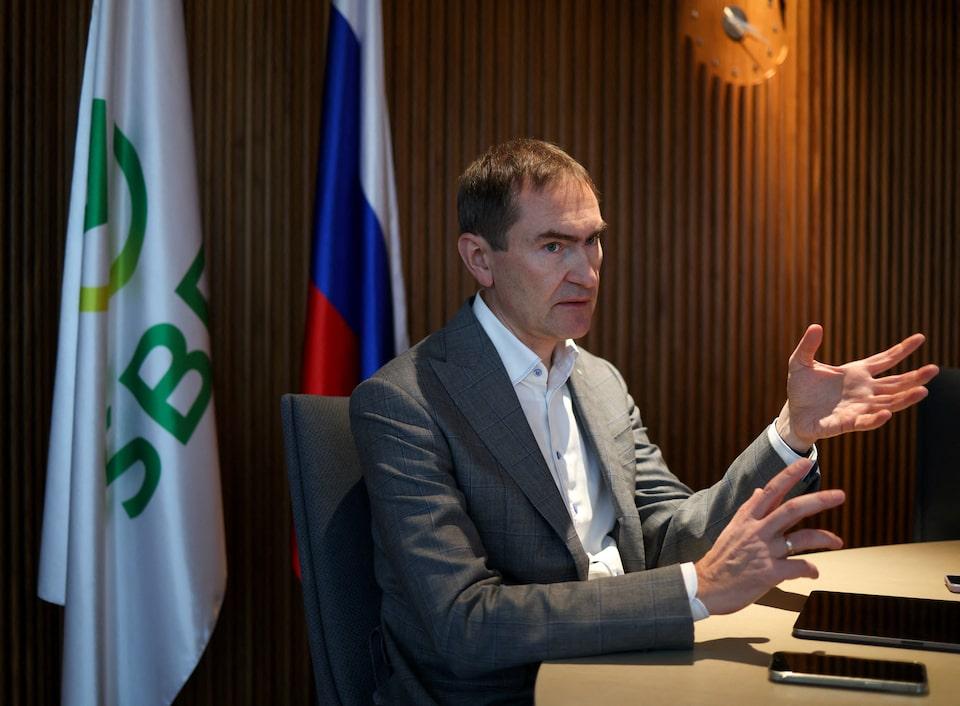
MOSCOW, Nov 24 (Reuters) - Russia's economy is seeing "continued cooling" with growth likely to remain at around 1% next year and business activity remaining weak for four to five quarters, a senior executive at Sberbank, the country’s largest lender, told Reuters. "In reality, we are seeing a continued cooling of the economy, quite a noticeable one," Sberbank First Deputy CEO Alexander Vedyakhin said. Sign up here. The economy slowed sharply this year after robust growth of 4.3% in 2024, mainly due to high interest rates set by the central bank to curb inflation and cool activity. The central bank sees GDP growth at between 0.5% and 1.5% in 2026. Vedyakhin said that at its December board meeting, the central bank will decide whether to keep the key rate at the current 16.5% or cut it by 50 basis points — a move he said would not be enough to spur growth. He noted that some loan growth in October and November was driven by companies raising funds for operational expenses rather than investment. "Investments will not revive until the key interest rate reaches 12–14%," he said, adding that even resource exporters, the most prosperous companies, are under pressure from high rates, an overvalued rouble, and Western sanctions. "Until the rate reaches this level, the period of managed cooling will continue," Vedyakhin said. Sberbank now expects the rouble to weaken to 85 per U.S. dollar by year-end from the current 78.6, and to 95 in 2026. In June, Sberbank CEO German Gref said that 100 roubles per dollar was a fair exchange rate. "A slight weakening of the rouble is possible — there are factors for that. But in any case, it's no longer 100 roubles per dollar, rather somewhere around 90 and above," Vedyakhin said. He added that reduced foreign currency sales from the National Wealth Fund, expected next year, along with shrinking imports and high interest rates, will support the rouble in 2026. Vedyakhin also pointed out that Russia’s currency market has become thin and volatile as demand for foreign currency falls, meaning even relatively small transactions can move the exchange rate. "Right now, if a large ticket of $100 million appears, it can sometimes make the market shake. Even $10 million can already influence the exchange rate,” he said. https://www.reuters.com/business/finance/russias-largest-lender-sees-economy-cooling-another-year-2025-11-24/
2025-11-24 15:53
Tech debt issuance could change profile of US debt debt market Investment firm DoubleLine cautious about adding AI-related debt exposure AI data center bonds may reach $1.5 trillion in five years, JPMorgan estimated NEW YORK, Nov 24 (Reuters) - A rush of bond sales by major tech firms to fund artificial intelligence expansion is creating a high-stakes bet for the $9 trillion U.S. corporate bond market, prompting caution from prominent investors like DoubleLine over the sector's growing debt load. Over the past two months, four major cloud and AI "hyperscalers" have sold nearly $90 billion in public bonds. Google owner Alphabet (GOOGL.O) , opens new tab sold $25 billion in bonds, Meta (META.O) , opens new tab $30 billion, Oracle (ORCL.N) , opens new tab $18 billion and Amazon (AMZN.O) , opens new tab, the most recent, $15 billion. Sign up here. Several analysts forecast higher amounts of hyperscaler debt issuance next year as big tech firms race to finance AI-ready data centers. High-grade bond markets may need to absorb $1.5 trillion of AI data center bond sales over the next five years, with that type of debt potentially representing over 20% of the investment-grade bond market by 2030, J.P. Morgan analysts estimated recently. "The potential for this data center capacity spend to come to the investment-grade market means you could have a significant re-levering in a new sector, and it could become a material risk to the high-grade market," said Robert Cohen, director of global developed credit at DoubleLine, a bond-focused investment firm managing $90 billion in assets. "You've got a large new sector that's clearly unproven, and that would change the risk profile of investment-grade credit quite substantially from where it is today, that's my concern," he said in an interview. Rising debt at tech companies has added a new layer of concern to broader financial markets that, despite being fueled by the promise of high AI returns, remain wary that the technology has yet to deliver the profits needed to justify such large capital spending. Meanwhile, although U.S. investment-grade credit spreads remain near historic lows, they have edged wider in recent weeks, reflecting growing unease over the surge of new bond supply coming to market. Spreads widened to 86 basis points on Friday, their widest since the end of June, the ICE BofA US Corporate Index showed. The U.S. investment-grade bond market is worth about $9.2 trillion, according to the ICE BofA US Corporate Index. Cohen said the corporate bond market remained in good shape due to several factors including a strong economy, healthy corporate balance sheets, lower interest rates than over the past few years, and expectations of an accommodative Federal Reserve going forward. But, while not an imminent risk, he said he was "on alert" about bond issues from tech companies flooding the market and cautious about adding exposure to their debt. "They are building capacity to provide support for, ultimately, a product where the end use is not super clear," he said. https://www.reuters.com/business/retail-consumer/doubleline-wary-ai-funding-wave-that-could-alter-us-high-grade-debt-market-2025-11-24/

2025-11-24 15:49
MEXICO CITY, Nov 24 (Reuters) - Mexico's annual inflation rate stood above expectations at 3.61% in the first half of November, official data showed on Monday, affected by sticky core inflation. Economists polled by Reuters had forecast an annual rate of 3.56%. Sign up here. Mexico's central bank board members expect the current weakness of Mexico's economy would reduce inflation, but underlying price pressures pushing core inflation have been a pressing worry. The closely watched core price index, which strips out some volatile food and energy prices, reached 4.32% in the 12 months through early November, from 4.24% in the same period last month. "Core inflation, which determines the trajectory of headline inflation in the medium and long term, shows no clear signs of slowing down," Banco Base economic analysis director Gabriela Siller said in a post on X. Despite persistent core inflation, Citi expects Mexico's central bank to cut their benchmark interest rate 25 basis points in December, but "rate cuts afterwards will be more data dependent," analysts said in a note. Month-on-month, official data showed core inflation at 0.4%, helped by "downside pressure in core inflation associated to the discount campaign 'El Buen Fin'," according to Citi. The so-called El Buen Fin offered shopping promotions in Mexico and took place from November 13 to 17. https://www.reuters.com/world/americas/mexicos-persistent-core-inflation-fuels-annual-price-rises-early-november-2025-11-24/

2025-11-24 14:26
MUMBAI, Nov 24 (Reuters) - The Indian central bank sold a net of $7.91 billion in the foreign exchange market in September, data released on Monday showed, as the Reserve Bank of India stepped up efforts to curb a slide in the currency. The RBI said it purchased $ 2.2 billion and sold $10.11 billion, as it stepped in to support the currency which fell to its then all-time low of 88.80. In August, the central bank had sold a net of $7.7 billion. Sign up here. Trade tensions between India and the United States alongside a jump in gold and silver imports exerted pressure on the currency in September. The pressures have since lingered as a trade deal between New Delhi and Washington has remained elusive, pushing the rupee to fresh all-time lows. The currency hit a record low of 89.49 on November 21, down 4.5% year-to-date. The RBI's net outstanding forward and futures dollar sales stood at $59.4 billion as of end-September, marking its first rise in six months. The central bank intervenes in the spot and forwards market to curb exchange rate volatility. The rupee's recent depreciation has occurred due to penal tariffs on Indian exports and a good trade deal should help relieve pressure on the country's current account, Reserve Bank of India Governor Sanjay Malhotra said at an event last week. https://www.reuters.com/world/india/india-cenbank-net-sold-79-billion-september-halt-rupees-slide-bulletin-shows-2025-11-24/
2025-11-24 13:43
WARSAW, Nov 24 (Reuters) - Poland must prioritise curbing the rapid increase in its public debt, the International Monetary Fund said on Monday, adding that it sees rising fiscal vulnerabilities over the medium term. Strong growth in central Europe's largest economy, driven by wage gains and loose fiscal policy, has come partly at the expense of a sharply worse fiscal position, the IMF said, with Poland running one of the highest budget deficits in Europe. Sign up here. "Staff now assesses Poland's risk of sovereign debt stress to be at medium compared to low in our previous assessment," the IMF said in a statement. It said a widening in Poland's deficit was largely due to a surge in expenditure, which was now on a par with levels in advanced European economies, while revenues remained closer to those of peers in Central and Eastern Europe. It said Poland's economic outlook was strong, with growth likely accelerating to 3.4% next year from the 3.2% expected in 2025, driven by faster EU-funded investments. Even so, the deficit would ease only marginally amid political gridlock. "We see rising fiscal vulnerabilities over the medium term, despite a relatively strong growth outlook," the IMF said. "Arresting the rapid rise in public debt should be a priority. Specifically, we recommend a cumulative fiscal adjustment of 4% of GDP by 2030, which is 2% of GDP more than in our baseline projection." It said the recommended fiscal path would bring the medium-term deficit to 3% of output and stabilise public debt at what it called a "relatively high" 70% of gross domestic product. The IMF also said that, after rate cuts worth 150 basis points this year, Poland's central bank should consider slowing the pace of monetary easing. "We would advocate a wait-and-see approach to allow time to observe incoming data and seeing sustained disinflation towards the target. If core inflation continues to moderate, further easing might be possible." https://www.reuters.com/business/imf-says-poland-must-prioritise-curbing-increase-debt-2025-11-24/