2025-11-23 23:51
TOKYO, Nov 24 (Reuters) - Japan can actively intervene in the currency market to mitigate the negative economic impact of a weak yen, Takuji Aida, a private-sector member of a key government panel, said in a television programme on public broadcaster NHK on Sunday. "Japan has excessive foreign reserves, so it can become active in tapping them to conduct (yen-buying) intervention," said Aida, an adviser to Prime Minister Sanae Takaichi. Sign up here. "It can therefore be active in mitigating the side effect of a weak yen with intervention." Aida advocates stimulating the economy by keeping interest rates low and boosting spending even at the cost of ramping up debt issuance. In an interview with Reuters on October 9, Aida had said the yen's weakness benefits the economy and the hit to households from rising import costs can be offset by aggressive spending. While a weak yen boosts exports, it has become a headache for Japanese policymakers fretting about the inflationary impact such as pushing up import costs. The yen is down around 6% since Takaichi was elected leader of her party last month due to market concern that her administration could issue more debt to fund a big spending package, casting doubt on Japan's grip on finances. As the yen fell to 10-month lows against the dollar, Finance Minister Satsuki Katayama threatened last week to intervene, in a shift away from the administration's initially sanguine approach over the demerits of a weak currency. Aida, who is chief Japan economist at Credit Agricole, sits on Takaichi's advisory panel which reviews and implements the administration's growth strategy. https://www.reuters.com/world/asia-pacific/japan-can-actively-intervene-prop-up-yen-says-govt-panel-member-aida-2025-11-23/
2025-11-23 23:01
BHP move comes ahead of Anglo and Teck shareholders vote BHP says potential tie-up had strategic merit Shares of BHP rise 0.4%, Anglo's open 2% higher MELBOURNE/LONDON, Nov 24 (Reuters) - BHP (BHP.AX) , opens new tab on Monday abandoned a last-ditch effort to buy rival Anglo American (AAL.L) , opens new tab and bolster its dominance in copper, just two weeks before Anglo and Teck Resources' shareholders were set to vote on a $60 billion merger. BHP said it would no longer pursue a potential combination with Anglo after preliminary discussions with the board. It made the announcement in a release to Australia's securities exchange after news broke of the talks on Sunday. Sign up here. The world's biggest listed miner said it still believed a tie-up with Anglo would have delivered "strong strategic merits", but added it was confident in its own growth plans. A source close to the companies said BHP made its latest approach late last week, offering a deal consisting largely of shares and a small cash component. After Anglo rejected the proposal, both parties agreed to keep the details confidential. "It's a last throw of the dice for BHP," said portfolio manager Andy Forster at Argo Investments in Sydney, which holds BHP shares. "I'm a bit surprised that, given the relative performance that they thought they're in a position to come back and do another deal and extract value for shareholders." The failed approach underscores a broader trend in the mining sector, where major players have been pushing to consolidate amid rising demand for metals critical to the energy transition. Copper, in particular, has become a prime target as producers seek scale and efficiency in the face of tightening supply and the costly hunt for new deposits. Anglo's shares, which have rallied around 16% this year, opened 2% higher in London, before clawing back gains. BHP shares rose 0.4% on Monday. COPPER GIANT BHP saw Anglo as a way to shore up its dominance in copper. While it remains the world’s top producer, its lead is narrowing in the years ahead without significant new projects. Its decision to walk away comes ahead of votes by Teck (TECKb.TO) , opens new tab and Anglo shareholders set for December 9 to create Anglo Teck, a copper giant with big development projects in Chile and Peru. "A BHP bid for Anglo would have frustrated that deal, but with BHP now stepping away, it appears that the interloper risk for Anglo has materially reduced and the Anglo/Teck Resources deal is likely to go ahead, assuming approvals are received," said Berenberg analysts. Under UK securities rules, BHP's statement means it cannot make another bid for Anglo for six months. "There's probably a handful of times when assets like this are up for sale, so BHP may as well assess if the option is open. But it does look a little messy," said Kaan Peker, analyst with RBC Capital Markets. BHP'S ORGANIC GROWTH After Anglo rebuffed three approaches from BHP last year, the Melbourne-based miner pivoted to smaller projects, including in Argentina, where it said it saw better value. As recently as August, CEO Mike Henry dismissed the idea of another tilt at Anglo. "Frankly, in current markets, it's hard to see the right combination of the commodities that we like, the asset quality that we like, at a price where we can still unlock attractive value for BHP shareholders," he said on a results call. One investor said BHP's focus on capital discipline under former chairman Ken MacKenzie was the main reason the company did not pay more for Anglo, which had led to some internal reflection. The latest approach came under BHP's new chair, Ross McEwan. OTTAWA WANTS NATIONAL CHAMPIONS The Anglo Teck deal still needs approval under the Investment Canada Act. While the merged company will be headquartered in Canada, Ottawa wants Anglo American to redomicile - that is, change its country of incorporation - to Canada, a shift that Anglo CEO Duncan Wanblad has firmly ruled out. Anglo, which had no immediate comment, has worked hard to improve its share price since it rebuffed BHP's final $49 billion offer in May last year. It has unveiled a sweeping restructuring plan that Wanblad said would deliver stronger returns for shareholders, despite its failure to offload its Australian coal assets. https://www.reuters.com/sustainability/sustainable-finance-reporting/bhp-abandons-anglo-american-approach-says-own-growth-plan-compelling-2025-11-23/

2025-11-23 22:07
BAGHDAD, Nov 23 (Reuters) - Iraqi Kurdish security forces opened fire at a drone to prevent it from reaching the Khor Mor gas field in Iraq's Kurdistan region late on Sunday, two security sources told Reuters. There was no damage to the field, one of the sources said. Sign up here. A drone approached the Khor Mor field, one of Iraq's largest gas fields, prompting air defenses to open fire to prevent it from reaching the site. It was not yet known whether the drone was shot down, said the sources. Sirens sounded at the field and employees moved into secure areas. https://www.reuters.com/world/middle-east/security-forces-open-fire-drone-near-major-iraq-gas-field-officials-say-2025-11-23/

2025-11-23 21:08
ATHENS, Nov 23 (Reuters) - The torch-lighting ceremony next week for the Milano-Cortina 2026 Winter Olympics will be relocated from the ancient stadium in Greece's Olympia to an indoor hall at a nearby museum due to bad weather, organisers said on Sunday. The torch is traditionally ignited using the sun’s rays and a parabolic mirror in an elaborate outdoor ceremony at the site of the ancient Games, with actresses playing priestesses and appealing to sun god Apollo for his help. Sign up here. But the area in the western Peloponnese has seen consecutive days of heavy rain, with more on the way ahead of Wednesday's ceremony, forcing organisers to change their plans. "Due to expected bad weather conditions... the torch-lighting ceremony for the Milano-Cortina Winter Olympics will be moved to the interior of the Olympic museum," Greece's Olympic Committee, in charge of the event, said in a statement. Organisers will use a backup flame, lit during one of the many rehearsals, to light the flame on the day. It is not the first time that the weather has affected the torch-lighting ceremony or its dress rehearsal but it is the first time in decades that the event itself has been moved to an indoor location. Following Wednesday's ceremony and after a week-long Greek relay, the flame will be handed over to Milano Games organisers in Athens on December 4 and flown to Italy for the domestic torch relay stretching more than 12,000km across the country. It will pass through Rome and Venice before reaching Cortina on January 26 for the opening ceremony at Milan's San Siro stadium -- exactly 70 years after the opening ceremony of the 1956 Games in Cortina. The Italian relay will take in famous landmarks including the Colosseum in Rome and the Grand Canal in Venice, with stops in southern cities such as Palermo and Naples to spark excitement in areas where winter sports are not as prominent. The journey will conclude in Milan, entering the San Siro stadium on the evening of February 6. https://www.reuters.com/sports/expected-rain-ancient-olympia-forces-milano-games-torch-ceremony-indoors-2025-11-23/

2025-11-23 17:22
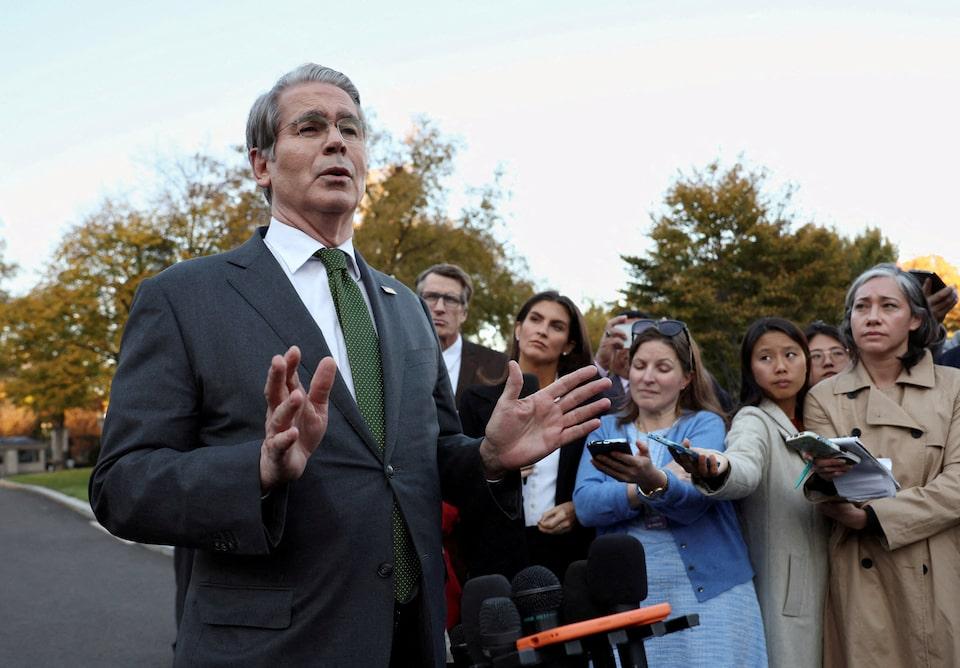
Bessent says inflation due to services economy, not tariffs Treasury secretary says Republicans should end filibuster in event of another shutdown Bessent says administration working to lower prices where it can WASHINGTON, Nov 23 (Reuters) - Treasury Secretary Scott Bessent on Sunday said the 43-day government shutdown caused an $11 billion permanent hit to the U.S. economy, but he was optimistic about growth prospects next year given easing interest rates and tax cuts. Bessent told NBC's "Meet the Press" program that parts of the U.S. economy that are sensitive to interest rates, including housing, had been in recession, but he did not see the entire economy at risk of negative growth. Sign up here. He blamed the services economy, not U.S. President Donald Trump's sweeping tariffs, for inflation - repeating the Trump administration's longstanding take - and added that he expected lower energy prices to drive down prices more broadly. Trump has focused intensely on affordability in recent weeks after Democratic wins in state and local elections and his declining approval ratings - now at 38% - the lowest since his return to power, according to a recent Reuters/Ipsos poll. Bessent struck an upbeat tone, despite recent data showing a slowdown in U.S. factory activity as higher prices caused by tariffs on imports restrained demand. The University of Michigan's consumer survey released on Friday also showed frustration among consumers about higher prices. "I am very, very optimistic on 2026. We have set the table for a very strong, non-inflationary growth economy," Bessent said. Energy prices dropped in October while home sales rose, Bessent said, adding that the administration was continuing to work hard to bring down inflation, now running at 3% annually. The Treasury secretary said inflation was 0.5% higher in Democratic-controlled states than those run by Republicans, attributing the difference to increased regulation. HASSETT SEES BLOCKBUSTER 2026 National Economic Council Director Kevin Hassett told Fox News's "Sunday Morning Futures" that he expected 2026 to be "an absolute blockbuster year," although there would be a "hiccup" in the fourth quarter of this year because of the longest government shutdown. Expectations for the fourth quarter have been halved, he said, forecasting growth of 1.5% to 2%, with an expected rise in manufacturing jobs to boost the scenario for 2026. Last week's moves to cut tariffs on food imports like bananas and coffee were the result of trade deals that had been negotiated for months, Bessent said. "Inflation is a composite number and we look at everything, so we are trying to push down the things we can control," he added. Trump on Wednesday signed legislation ending the longest government shutdown in U.S. history, extending funding through January 30, and setting the stage for another potential showdown between Democrats and Trump's Republicans next year. Bessent said Republicans should immediately vote to end the filibuster if Democrats closed the government again, something Trump has also demanded, but dodged a question on whether there were enough votes to do so. Policy changes that cap taxes on overtime, cut taxes on tips and Social Security for some individuals, and make auto loans deductible would boost real income levels for working Americans and help offset higher costs, Bessent said. Taxpayers would see substantial federal tax refunds in the first quarter of 2026 given the changes in tax rates, he added. The Trump administration also plans an announcement this week aimed at lowering healthcare costs, Bessent said, echoing similar remarks from a senior White House official last week, but giving no details. A rash of trade deals would also help boost the economy, Bessent said, predicting new plant openings across the country. https://www.reuters.com/world/us/no-recession-risk-us-economy-whole-bessent-tells-nbc-2025-11-23/
2025-11-23 15:28
BELEM, Brazil, Nov 23 (Reuters) - This year's U.N. climate change summit ended with a tenuous compromise for a deal that skipped over most countries' key demands but for one: committing wealthy countries to triple their spending to help others adapt to global warming. Here are some of the takeaways from the COP30 climate summit held in Brazil's Amazon city of Belem: Sign up here. HOOKED ON HYDROCARBONS Brazil's President Luiz Inácio Lula da Silva had launched the summit calling for countries to agree on a "roadmap" for advancing a COP28 pledge to shift away from fossil fuels. But it was a road to nowhere at this summit, as oil-rich Arab nations and others dependent on fossil fuels blocked any mention of the issue. Instead, the COP30 presidency created a voluntary plan that countries could sign on to - or not. The result was similar to Egypt's COP27 and Azerbaijan's COP29, where countries agreed to spend more money to address climate dangers while ignoring their primary cause. Nearly three-fourths of the world's greenhouse gas emissions since 2020 have come from coal, oil and gas. Demand for these fuels is likely to rise through 2050, the International Energy Agency said in a report midway through the COP30 summit that reversed expectations of a rapid shift to clean energy. GLOBAL CLIMATE UNITY ON THE BRINK The need to show global unity in climate talks was the main thing countries agreed, along with the idea that long-polluting wealthy countries should do most to tackle the problem. But to get to a final deal, they ditched nearly all ambitions they'd brought - including mandatory tightening targets for reducing climate-warming emissions. Brazil's COP30 presidency lamented the United States' snubbing of the talks. The absence of the world's biggest economy - and biggest historical polluter - emboldened countries with fossil fuel interests. Rumbling concerns about a process that allows only a few to effectively veto collective deals grew louder, stoking calls for reform. After Brazil had promised a 'COP of Truth' that would set countries on course for action, the omission of any agreed implementation plans was glaring. CHINA IN POLE POSITION China played a leading role at the summit - but from behind the scenes. President Xi Jinping skipped the talks as he typically does. But his delegation carried a strong message that China was prepared to deliver the clean energy technology the world needs to cut emissions. Executives from Chinese solar, battery and electric vehicle companies were featured at the country's exhibit pavilion - one of the first things delegates saw on entering the sprawling venue. China was not the only fast-developing nation in focus this year. The Indian delegation flexed more muscle in the negotiations, while South Africa rolled out a climate-linked agenda for its own November 22-23 G20 summit. FRAUGHT FUTURE FOR FORESTS AND INDIGENOUS RIGHTS Holding the summit in an Amazon forest city, Brazil touted the importance of the world's remaining canopy for fighting climate change - along with the roughly half-billion Indigenous people seen as stewards of natural lands. Many who attended from across the Amazon and the world felt frustrated they weren't being heard. They staged several protests, and even stormed the COP30 compound gates - clashing with security before being pushed back out. Countries announced about $9.5 billion in forest funding - including almost $7 billion for Brazil's flagship tropical forest fund and another $2.5 billion for an initiative for Congo. But the summit ended on a sour note for many, as negotiators dropped efforts for a roadmap to meet the 2030 zero-deforestation pledge and gave no recognition for the protection of their lands. ATTACKS ON CLIMATE SCIENCE While Lula and other world leaders had railed against misinformation and denial, COP30 talks didn't help much in countering this year's U.S. government assault on climate science. The summit also chipped away at global consensus around climate science by no longer recognizing the U.N. Intergovernmental Panel on Climate Change as the "best available science" to guide policy on climate change and its impacts. Instead, the final deal notes the importance of IPCC outputs along with "those produced in developing countries and relevant reports from regional groups and institutions." And by sidelining fossil fuels and emissions targets, COP30 ignored the alarm bells being rung by scientists. https://www.reuters.com/sustainability/cop/takeaways-cop30-climate-summit-brazil-2025-11-23/