2025-11-21 18:52
BUENOS AIRES, Nov 21 (Reuters) - Argentine officials did not speak with U.S. banks about a $20 billion rescue package, the country's economy minister, Luis Caputo, said on Friday in a post on social media. Caputo made the comments after the Wall Street Journal reported on Thursday that a planned $20 billion bailout for Argentina from JPMorgan Chase (JPM.N) , opens new tab, Bank of America (BAC.N) , opens new tab, and Citigroup (C.N) , opens new tab, had been shelved as bankers pivot instead to a smaller, short-term loan package. Sign up here. “We never spoke with the banks about a bailout, nor about 20 billion. It’s just another ‘operation’ whose only purpose is to create confusion,” Caputo wrote on X. In October, the U.S. Treasury reached a $20 billion exchange-rate stabilization agreement with Argentina, to be paired with a bank-led debt facility for the same amount. The deal came just days ahead of a midterm election that was crucial for Argentina's libertarian president, Javier Milei. Bankers now say the debt facility is no longer under serious consideration, the Wall Street Journal reported, citing people familiar with the matter. Instead, lenders are planning to loan Argentina around $5 billion through a short-term repurchase, or "repo," facility, it said. https://www.reuters.com/business/finance/argentina-did-not-discuss-20-bln-bailout-with-banks-minister-says-2025-11-21/

2025-11-21 17:45
BOSTON, Nov 21 (Reuters) - Federal Reserve Bank of Boston President Susan Collins said on Friday that monetary policy is in the right place amid a resilient economy, in comments that suggest she remains skeptical of the need to cut interest rates again at next month’s monetary policy meeting. Given where inflation currently stands, "restrictive policy is very appropriate right now," and the current state of the economy "makes me hesitant as I look forward to think about what the next policy move should be," Collins said in an interview on CNBC. Sign up here. She noted that maintaining something close to the current level of monetary policy will help ensure that as tariff pressures pass through the economy, still-high inflation will eventually moderate. Collins, who currently holds a vote on the rate-setting Federal Open Market Committee, is one of a number of skeptics on the Fed when it comes to the prospect of lowering the cost of short-term borrowing at the central bank's December 9-10 meeting. The Fed cut rates at both its mid-September and late October meetings, with the federal funds rate target range now at between 3.75% and 4%. Rate cuts were aimed at providing insurance for a softening job market, while at the same time putting continued downward pressure on inflation levels which continue to breach the Fed's 2% target. As the December meeting looms into view, a wide range of policymakers have expressed skepticism over a December rate cut, as they have been deprived of data due to the government shutdown. That said, hopes for an interest rate cut got a shot in the arm from New York Fed leader John Williams, who spoke on Friday and nodded toward an easing. In her interview, Collins said the September hiring data released this week was mixed and comes in a broader environment where the economy appears to be resilient. Collins said she would be watching the job market for signs of slowing and if it did, it would affect her monetary policy outlook. https://www.reuters.com/sustainability/boards-policy-regulation/feds-collins-leans-against-december-rate-cut-cnbc-interview-2025-11-21/

2025-11-21 15:50
Tech giants' bond issuance raises market absorption concerns Investors demand premiums for new tech bond deals AI spending doubts linked to debt financing needs NEW YORK, Nov 21 (Reuters) - Investors are growing uneasy that the rapid rise in public debt used to bankroll AI investments could strain the U.S. corporate bond market and eventually dampen the appeal of tech stocks, despite leverage across most major companies remaining low for now. Big tech firms are turning aggressively to the debt markets in their race to build AI-ready data centers, a shift for Silicon Valley firms that typically relied on cash to fund their investments. Sign up here. Since September, public bond issuance by four of the major cloud computing and AI platform companies known as "hyperscalers" has hit nearly $90 billion, with Google owner Alphabet (GOOGL.O) , opens new tab selling $25 billion in bonds, Meta (META.O) , opens new tab $30 billion, Oracle (ORCL.N) , opens new tab $18 billion, and Amazon (AMZN.O) , opens new tab, the most recent, $15 billion, according to Reuters calculations of publicly available data. Only Microsoft (MSFT.O) , opens new tab , the fifth one, has not tapped the debt market in recent weeks. Investors say that, so far, they are not overly concerned about the impact on stock valuations because of the recent fundraising, since these companies remain lightly leveraged relative to their scale. But the sudden pickup in public debt issuance has raised questions about the market’s ability to absorb the surge in supply and is feeding into growing worries over AI-related spending that have helped trigger a sharp pullback in U.S. stocks this month after six months of gains. The S&P 500 is still up 11% this year, with tech stocks among the main contributors to gains. "You have all these hyperscaler issuance coming out, and I think the market woke up to the fact that it's not going to be private credit markets that are going to fund AI, it's not going to be free cash flow. It's going to have to come from the public bond markets," said Brij Khurana, portfolio manager at Wellington Management Company. "You need capital to come from somewhere to finance this," he said. "What's happening is a recognition that you need money almost coming out of stocks into bonds." Including a $27 billion financing deal Meta struck with Blue Owl Capital in October to fund its biggest data center project, hyperscaler debt issuance has jumped to over $120 billion this year from an average of $28 billion over the past five years, analysts at BofA Securities said in a recent note. Rising debt at tech companies adds a new layer of concern to a market that, despite being fueled by the promise of high AI returns, remains wary that the technology has yet to deliver the profits needed to justify such large capital spending. "There are doubts that have emerged in the last few weeks around the AI spend story that are related to ... the need for firms to be able to finance that, and that includes through debt finance," said Larry Hatheway, global investment strategist for Franklin Templeton Institute. AI capital expenditure is projected to increase to $600 billion by 2027, up from over $200 billion in 2024 and just under $400 billion in 2025, and net debt issuance is expected to reach $100 billion in 2026, Sage Advisory, an investment management firm, said in a recent note. While hyperscalers have been ramping up borrowing, Nvidia (NVDA.O) , opens new tab, a major supplier of computing power to them, has trimmed its long-term debt from $8.5 billion in January to $7.5 billion by the end of the third quarter. Credit ratings agency S&P Global Ratings last month revised its outlook on the company to "positive" from "stable," citing revenue growth and robust cash flow. Microsoft and Oracle declined to comment. An Amazon spokesperson said proceeds from its recent bond sale will fund business investments, future capex, and repay upcoming debt maturities, noting that such financing decisions are part of routine planning. Alphabet and Meta did not immediately comment. MARKET CONSTRAINTS Demand for recent tech bond deals has been strong, but investors demanded sizeable new issue premiums to absorb some of the new securities. Alphabet and Meta paid about 10-15 basis points over the companies' existing debt with their most recent debt issues, said Janus Henderson in a note. While U.S. investment grade credit spreads - which indicate the premium highly rated companies pay over Treasuries to attract investor demand - remain historically low, they have ticked up in recent weeks, partly reflecting concerns over the new wave of bond supply hitting the markets. "For much of the year, credit spreads have been grinding tighter ... But the recent deluge of supply – particularly from tech – may have changed the game," said Janus Henderson. To be sure, the shift to debt is expected to remain a small portion of total AI spending by large tech companies, with UBS recently estimating that about 80-90% of their planned capital expenditure still comes from cash flows. Sage Advisory's research said the top hyperscalers are expected to move from having more cash than debt to just modest levels of borrowing, still keeping leverage below 1×, meaning their total debt would be less than what they earn. "Supply bottlenecks or investor appetite are more likely to act as constraints on near-term capex than cash flows or balance sheet capacity," analysts at Goldman Sachs said in a note this week. Excluding Oracle, hyperscalers could absorb up to $700 billion in additional debt and still be viewed as safe, keeping leverage below that of the typical A+ rated firm, they said. "These companies still have very solid business lines that are just spinning off tons of cash," said Garrett Melson, portfolio strategist at Natixis Investment Managers Solutions. https://www.reuters.com/business/retail-consumer/jitters-over-ai-spending-set-grow-us-tech-giants-flood-bond-market-2025-11-21/
2025-11-21 15:38
AI stock valuations raise bubble concerns amid sharp pullbacks Buffett Indicator signals overvaluation, surpassing dot-com bubble levels Nasdaq's AI rally mirrors early dot-com bubble stages, lacks runaway optimism NEW YORK, Nov 21 (Reuters) - The biggest bout of volatility in U.S. stocks in months has revealed cracks in the artificial intelligence-related rally, raising questions about whether the market has been in the grips of a speculative bubble that may be popping. Soaring valuations in AI stocks this year have stoked worries that Wall Street may be inflating another speculative bubble, with some of these fears coming to the fore after a stellar earnings report from AI bellwether Nvidia failed to rally the stock and broader market. Sign up here. In recent days investors have been watchful of emerging signs of cracks in the AI investment narrative. Several high-flying AI stocks have experienced sharp pullbacks, questions are mounting about when AI investments will translate into actual profits, and concerns are growing that enthusiasm may be outpacing the technology's near-term capabilities. Investor sentiment has been rattled recently by several developments, including a noticeable dip in retail traders' enthusiasm for "buying the dip." This caution comes alongside a hit to Oracle bonds on news the company plans to increase its substantial debt to finance artificial intelligence infrastructure, and as lenders seek greater protection on loans to major tech companies, citing concerns over debt-financed AI investments. The boom and recent retreat in AI and AI-adjacent stocks has drawn comparisons to some of history's most notorious market manias, from the dot-com frenzy of the late 1990s to the more recent cryptocurrency boom. At the heart of investors' concerns about a market bubble are lofty valuations. Despite the recent pullback, valuations remain elevated and investors are wary of risks around customer capital spending and financing, plus challenges in expanding data center capacity amid energy constraints and memory chip shortages. Alphabet Chief Executive Sundar Pichai recently said no company would be unscathed if the artificial intelligence boom collapses, but Nvidia CEO Jensen Huang on Wednesday shrugged off concerns. Not all bubbles are created equal, and the warning signs that signal the buildup of excess in one bubble can differ significantly from those in another. Historical data shows dramatic variations in how asset manias unfold - from the speed of their collapse to the years required for recovery. The Japanese stock market crash of the early 1990s took decades to recover, while the 2021-2022 crypto crash played out in a matter of months. Understanding these patterns matters for investors trying to gauge whether today's AI enthusiasm represents rational exuberance over a transformative technology or the kind of speculative excess that ends in tears. Some charts here help assess how the AI mania compares with historic bubbles and what stage it is in, if indeed this is a bubble. OVER-VALUED Its recent wobble notwithstanding, the U.S. stock market's valuation has surged into territory that historically preceded major downturns, with the Buffett Indicator — a gauge favored by billionaire investor Warren Buffett — flashing warning signs. The indicator, which compares total U.S. stock market capitalization to gross domestic product, recently rose above 200%, surpassing levels last seen at the pandemic-era market peak in 2021. The metric currently stands near its highest level on record, surpassing even the dot-com bubble of 2000. Named after the Berkshire Hathaway chairman, the ratio shows elevated readings before major market corrections since 1975. Other stock valuation gauges also show elevated readings, though not at historical highs. The S&P 500's price-to-earnings ratio has climbed to about 23 times, based on 12-month earnings estimates for its constituents, around its highest level in five years and well above its 10-year average of 18.7, according to LSEG Datastream. A separate valuation measure - the CAPE ratio, or Shiller P/E ratio - which measures earnings averaged over 10 years to adjust for economic cycles, also shows elevated readings, though not yet at the heights touched during past bubbles. EARLY DAYS The Nasdaq's current trajectory during the artificial intelligence boom bears a striking resemblance to its dot-com era path, albeit with less exuberance, backing the view that if this is a bubble it may still be early stage. The tech-heavy index climbed roughly 100% in the three years following ChatGPT's November 2022 launch, mirroring the early stages of excitement that followed Netscape's August 1995 IPO. NOT THERE YET A key ingredient in past stock market bubbles has been runaway investor optimism, which appears to be absent now. The American Association of Individual Investors survey, a weekly poll that measures investor sentiment among individual retail investors in the U.S. stock market, shows bullish sentiment at 38%, in line with its long-term average.That's a far cry from the 75% high hit in January 2000 or even the 57% high scaled during the meme-stock mania in 2021.While elevated bullishness is not a necessary precondition for a market reversal, heightened bullishness would have backed the view that investors have grown too complacent.Historical data shows that prolonged periods of above-average optimism often precede market turbulence, as crowded trades and stretched valuations leave little room for disappointment. https://www.reuters.com/business/bubble-trouble-ai-rally-shows-cracks-investors-question-risks-2025-11-21/
2025-11-21 14:23
OTTAWA, Nov 21 (Reuters) - Canadian retail sales fell in September, reversing a positive trend last month, as consumers spent less in buying cars, automotive parts and building materials among others, data showed on Friday. Retail sales fell by 0.7% to C$69.81 billion ($49.47 billion) on a monthly basis after a 1% growth in August, Statistics Canada said on Friday. Sign up here. Sales were down in six of the nine subsectors, representing 66.2% of retail sales. In volume terms, retail sales decreased by 0.8%. Retail sales, which include domestic sales of cars, furniture, food, gasoline, are considered an early indicator of gross domestic product growth and contribute around 40% to total consumer spending. https://www.reuters.com/markets/commodities/canada-september-retail-sales-down-07-seen-unchanged-october-2025-11-21/

2025-11-21 13:10
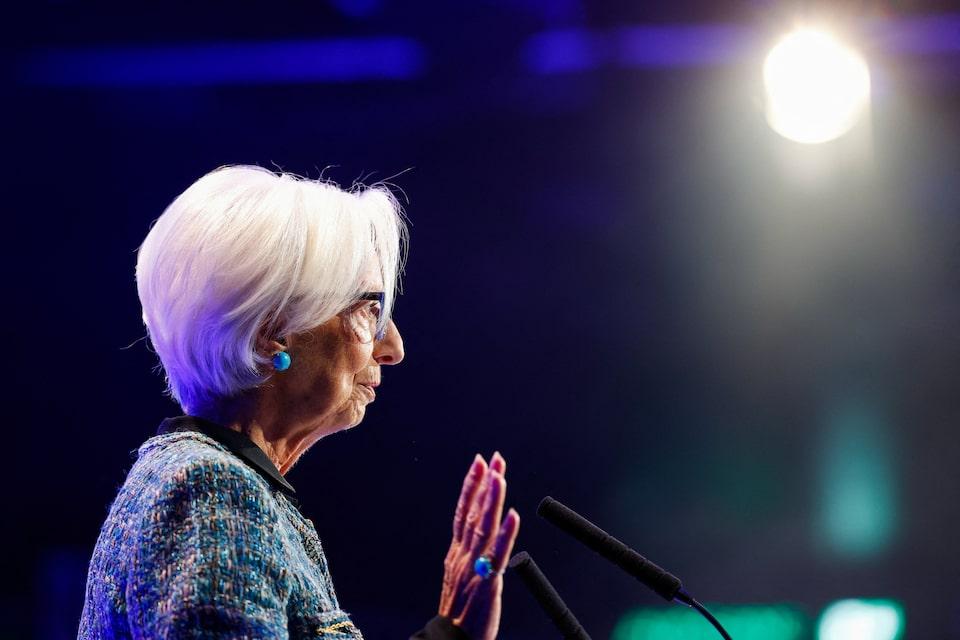
Domestic barriers a bigger drag than tariffs, says Lagarde Bundesbank says more help needed to free up good EU firms Domestic savings need to be mobilised, ECB says FRANKFURT, Nov 21 (Reuters) - The European Union can offset the economic drag from U.S. trade tariffs and deglobalisation by removing internal barriers, top European Central Bank policymakers said on Friday. The EU is quickly falling behind global competitors because of weak competitiveness, structural rigidities and a complex set of rules that often vary greatly across 27 member states. Sign up here. "Our analysis shows that if all EU countries were merely to lower their barriers to the same level as that of the Netherlands, internal barriers could fall by about 8 percentage points for goods and 9 percentage points for services," ECB President Christine Lagarde said. "If we only did a quarter of that, it would be sufficient to boost internal trade enough to fully offset the impact of U.S. tariffs on growth," Lagarde told a conference. The Netherlands is one of the EU's most open economies. Lagarde's suggestions echo calls by Mario Draghi, a former ECB president and former Italian prime minister, who outlined a series of proposals last year designed to make the EU more competitive. They have been largely ignored by policymakers. NEED TO HELP EUROPE'S 'HIDDEN CHAMPIONS' Bundesbank President Joachim Nagel said the EU's internal barriers prevented "hidden champions", or well-established firms with strong domestic reach, from having the sort of global impact that U.S. rivals enjoy. "Many firms are neither small enough to be truly agile and highly innovative, nor large enough to fully benefit from economies of scale," Nagel said at the same event in Frankfurt. To overcome these barriers, Lagarde and Nagel both argued for a so-called '28th regime' - an alternative legal framework that would be uniform across the EU and stand above the 27 member states' own rules, into which firms would be free to opt in. Such an optional regime would ease the need to harmonise rules, a seemingly impossible task, given the complexities. "This would make cross-border operations easier, cut compliance costs even more, and help businesses scale up faster," Nagel said. "In effect, it would remove some of the remaining barriers across our internal market, which encompasses 450 million customers." Such a regime could also mobilise domestic savings, which are leaving the bloc in hopes of better returns. Euro zone households now keep around 6.5 trillion euros in U.S. stocks, about twice the amount they held at the end of 2015. "If we get this right, firms that could grow based on genuinely European regimes would also be best placed to access pan-European financing, helping to channel our vast savings into productive investment," Lagarde added. Lagarde's other suggestions included harmonising value-added taxes and extending qualified majority voting in the EU, so veto powers could be wielded less frequently. Lagarde also praised fiscal spending, especially in Germany, for buffering the economy and said the ECB, which has cut rates sharply in 2024-25, would play its part. "We will continue to adjust our policy as needed to ensure that inflation remains at our target," Lagarde said. https://www.reuters.com/business/finance/eu-can-beat-trumps-tariffs-with-domestic-trade-ecbs-lagarde-says-2025-11-21/