2025-11-20 18:15
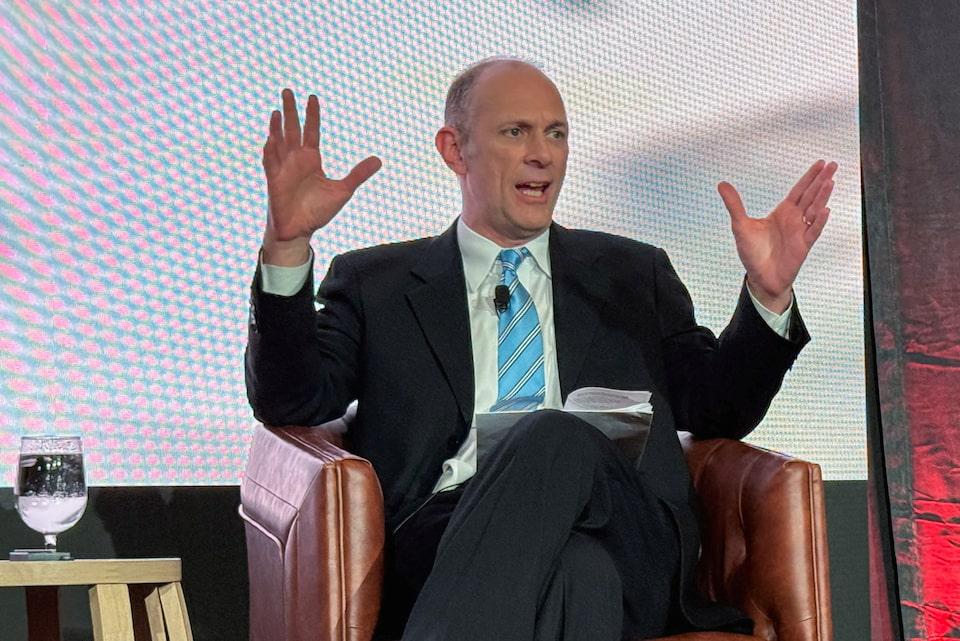
Nov 20 (Reuters) - Chicago Federal Reserve President Austan Goolsbee repeated on Thursday he is "uneasy" about frontloading interest-rate cuts, particularly with progress on inflation towards the Fed's 2% goal looking to have stalled and starting to go the wrong way. "In my view, this underlying the economy is pretty strong and I feel like eventually we are going to be back to, rates can come down a fair amount, but in the near term I'm a little uneasy front loading too many rate cuts, and counting on (that) this will be transitory and inflation will go back down," Goolsbee told the Chartered Financial Analyst Society of Indianapolis. Sign up here. The lack of official data due to the government shutdown, he said, makes him even more uneasy because without it the Fed does not have as much visibility into price pressures as it does on the state of the labor market. https://www.reuters.com/business/feds-goolsbee-repeats-he-is-uneasy-rate-cuts-2025-11-20/
2025-11-20 17:41
Nov 20 (Reuters) - Morgan Stanley on Thursday scrapped its forecast that the U.S. Federal Reserve would cut interest rates by a quarter-point at its December meeting after a firm September jobs report showed signs of a resilient economy. Non-farm payrolls increased by 119,000 jobs after a downwardly revised 4,000 drop in August, the Labor Department's Bureau of Labor Statistics said. Economists polled by Reuters had forecast 50,000 jobs would be added after a previously reported 22,000 gain in August. Sign up here. However, the unemployment rate increased to a four-year high of 4.4% in September. "The sharp and broad rebound in payrolls suggests the summertime slowdown might have been exaggerated," said strategists at Morgan Stanley. The strength in payrolls suggests stabilization, even as the unemployment rate has inched higher, they added. The jobs data was initially due on October 3, but was delayed by the 43-day shutdown of the U.S. government. Morgan Stanley now expects the Federal Reserve to cut rates in January, April and June 2026, bringing the policy rate down to 3% to 3.25%. Traders continued to bet that the Fed will skip an interest rate cut in December, though there was a small pullback in those bets after the release of the jobs data. https://www.reuters.com/business/morgan-stanley-drops-call-december-fed-rate-cut-after-strong-jobs-data-2025-11-20/
2025-11-20 17:11
Nov 20 (Reuters) - Juventus (JUVE.MI) , opens new tab said on Thursday that its board approved a capital increase of up to 37.9 million new ordinary shares, equivalent to roughly 10% of its existing stock, through a sale of shares to institutional investors. The Serie A club said controlling shareholder Exor, holding approximately 65.4% of the club, pledged to fully subscribe to the capital increase. Sign up here. Cryptocurrency group Tether Investments, which holds around 11.5%, said that it would also participate for an amount equal to its stake and may acquire any unallocated shares. The deal is worth up to around 1.5 million euros ($1.7 million) and will allow both shareholders to keep their stakes unchanged after the capital increase. ($1 = 0.8672 euros) https://www.reuters.com/sports/juventus-board-approves-10-capital-increase-via-share-sale-2025-11-20/

2025-11-20 16:22
LONDON, Nov 20 (Reuters) - The S&P 500 index's fall below a closely watched level gave hedge funds that trade stocks on trends the green light to potentially sell almost $40 billion in equities in the coming week, Goldman Sachs (GS.N) , opens new tab said in a note to clients seen by Reuters. The S&P 500 (.SPX) , opens new tab declined in value past a threshold of 6,725 on Wednesday. It closed the day at 6,642. Sign up here. Trend-following hedge funds were watching that threshold as a signal to either sell out of their positions, or to add short bets that stocks would fall further, the note sent to clients late on Wednesday said. After prices fell below that figure, Goldman's calculations suggest that over the next week, $39 billion of global equities might be sold. Should stock prices extend falls, the bank estimates that systematic trend hedge funds could sell as much as around $65 billion. Trend-following hedge funds aim to capitalise on signals on the start of market trends - whether up or down. These signals can be based on the volume of traders in a market, the price or how fast an asset price changes during the trading day. Before stocks began to sell off, these hedge funds were long around $150 billion worth of global equities, the Goldman note said. The last time prices fell through one of these closely watched levels was in October, said Goldman, and prior to that, on April 2 when U.S. President Donald Trump announced a raft of tariff proposals. https://www.reuters.com/business/hedge-flow-goldman-projects-40-billion-stock-selling-scenario-over-next-week-2025-11-20/

2025-11-20 14:27
NEW YORK, Nov 20 (Reuters) - The pace of U.S. job growth accelerated more than expected in September, and the unemployment rate increased, indicating the labor market remained on the sluggish side, while expectations the Federal Reserve was unlikely to cut rates in December remained largely unchanged. Nonfarm payrolls increased by 119,000 jobs in September, after a downwardly revised 4,000 drop in August, the Labor Department data showed on Thursday. Economists polled by Reuters had forecast 50,000 jobs added last month. Sign up here. The unemployment rate rose to 4.4% in September from 4.3% in the previous month. The release of the jobs report had been delayed due to the U.S. government shutdown and the October nonfarm payrolls will instead be combined with November's employment report now due on December 16, the Bureau of Labor Statistics said. MARKET REACTION: STOCKS: S&P E-minis moved higher and were last up 105 points, or 1.58%. BONDS: Treasury yields briefly jumped before reversing course, with the yield on the benchmark U.S. 10-year note down 1 basis point to 4.121% and the two-year note yield off 2.3 basis points to 3.575%. FOREX: The dollar index pared gains after a brief spike and was last up 0.07% to 100.16. COMMENTS: JUAN PEREZ, DIRECTOR OF TRADING, MONEX USA, WASHINGTON “This is a very mixed set of numbers that seems overwhelming in how incomplete a picture it is providing on the labor sector. There is evidence of both insignificant growth as well as revision hinting at very high losses of opportunities for employment. Meanwhile, wages are not increasing much at all while unemployment went up. We get no clarity nor guidance from this, in particular because it encompasses too long a period of time and there has been a variety of reasons behind market, FX or equity movements. This leaves things in the midst of confusion and leaves [Fed] decision-makers with a 50-50 flip of a coin chance of acting to address it. Per the numbers, seems like they may not help lead to a comprehensive analysis that satisfies officials enough to act in consensus. They may rather be cautious and take a breather before meeting again and thinking stimulus 2026.” JAN NEVRUZI, U.S. RATES STRATEGIST, TD SECURITIES, NEW YORK: “Depending on your priors from the Fed, it probably gives both the hawks and the doves something to confirm what they thought. We have a little bit of a stronger number on the headline side, despite the revisions, but the unemployment rate almost rounded up to 4.5%.” “We’re rallying (in Treasuries) because we’re bringing the pricing back closer to a coin flip (for the December Fed meeting).” PETER CARDILLO, CHIEF MARKET ECONOMIST, SPARTAN CAPITAL SECURITIES, NEW YORK: “What we're seeing here is the first glimpse of a jobs report since the government shutdown, and it certainly is not reflecting what may have happened in the month of October and what's presently happening now in November. “There have been a lot of layoffs that are not showing up yet, but I believe that they will show up. The labor market perhaps not as strong as the perception. I don't think it's really going to mean that very much. “I don't think (the Fed) has enough labor data to make a decision. And I think that's why bets on a on a rate reduction have decreased substantially. So I think the Fed is going to have to go on its own guts. And from a contrarian viewpoint, I do believe that they will cut by 25 basis points. And the reason is the economy is not that strong and this labor market is not that strong. Companies are laying off left and right. “The rhetoric that we're hearing from a lot of Fed members is just playing it safe, from Powell down to the hawkish ones. But I think the dovish members are probably going to win, and they are going to be right.” WASIF LATIF, CHIEF INVESTMENT OFFICER, SARMAYA PARTNERS, NEW JERSEY: “It was definitely a stronger number than what was expected. So I think you’re seeing immediate adjustment based on that and between the tug of war of the Fed: would they or wouldn’t they cut. The “they-won’t-cut number” is weighing out. But I don’t think it’s a done deal. There’s more to come between now and the actual Fed announcement day. As the data continues to come out, we might see this tug of war. The September jobs number was also going to be an okay month. It’s October that’s more anticipated because most of the layoff announcements were done in this month. If that month was to be released, it would likely show greater amounts of job weakness than September is showing. And it would clearly tilt the market in favor of cutting. But we don't know that data yet so unfortunately, we have to go by what we have.” ART HOGAN, CHIEF MARKET STRATEGIST, B RILEY WEALTH, NEW YORK: "The problem with all of this is (that) the report is dated, and the next report won't be out until after the Fed meets in December. So that certainly puts them in a conundrum and likely doesn't improve the chance one way or the other that they could see their way clear to cutting rates." "The markets are reacting positively to a couple of very solid earnings reports, both Nvidia and Walmart. So I think the market reaction post the report likely has more to do with earnings than it does to do with economic data." JAKE DOLLARHIDE, CHIEF EXECUTIVE OFFICER, LONGBOW ASSET MANAGEMENT, TULSA, OKLAHOMA: "The jobs report could cause the market to rally. Good news could be good news in this case... and the unemployment rate ticking up still gives the Fed a lot of leeway toward leaning toward lowering rates. Where there's smoke, there's fire. "The data is just now rolling in. A lot of data is going to roll in between now and the December meeting. The gates are wide open on this dam. This river of data is about to come flooding in. We're going to see exactly what we've been missing the last two months." BRIAN JACOBSEN, CHIEF ECONOMIST, ANNEX WEALTH MANAGEMENT, MENOMONEE FALLS, WISCONSIN: "Dated data is better than no data, but it's not all that illuminating about where we are now or where we're headed. It confirms that the trend for the cyclical parts of the economy were struggling while the steady-eddy parts of the economy, like health care, were still doing fine. "Fed officials that claim they don't have the data to make a decision are ignoring the wide array of surveys and private sector data sources that indicate the labor market is softening. Wage growth isn't accelerating. Tariff exemptions for food items will reduce the perceived threat of inflation. The next Fed decision could be to cut, but there could be a record number of dissents." https://www.reuters.com/business/view-job-growth-accelerated-september-unemployment-rate-ticks-up-2025-11-20/

2025-11-20 13:18
PRETORIA, Nov 20 (Reuters) - South Africa's central bank cut its main lending rate by 25 basis points to 6.75% on Thursday at the first meeting since its inflation target was lowered, easing concerns that the new target would prevent it from cutting rates. The decision by members of the bank's Monetary Policy Committee was unanimous. Sign up here. "Members agreed there was scope now to make the policy stance less restrictive, in the context of an improved inflation outlook," Governor Lesetja Kganyago told a news conference. The bank made small downward revisions to its inflation forecasts for 2025 and 2026. Economists polled by Reuters had been divided on what Thursday's policy decision would be. Some thought the committee would take a cautious stance given its new 3% inflation target, while others thought there was room for a rate cut with inflation only slightly above target (ZACPIY=ECI) , opens new tab and within a 1-percentage-point "tolerance band" set by the finance minister. There has been a long list of positive developments since the last monetary policy meeting in September. South Africa was removed from a "grey list" of countries subject to increased monitoring for illicit money flows, its sovereign credit rating was upgraded by S&P Global and its mid-year budget review was well-received by investors. Government borrowing costs have fallen and the rand hit its best level since 2023 against the dollar. "We remain on track to deliver 3% inflation over the medium term," Kganyago said. "The tolerance band ... does not mean we will be indifferent to inflation anywhere between 2% and 4%. We want to be at 3%." The governor, who had for years advocated for a lower inflation target before last week's formal change, added that the central bank only expected to breach the tolerance band when there are severe shocks. Given that monetary policy actions have their main effects after 12 to 24 months, people should expect the central bank to hit its target over that time frame, Kganyago added. https://www.reuters.com/world/africa/south-african-key-rate-lowered-first-decision-under-new-inflation-target-2025-11-20/