2025-11-18 11:42
Glencore sold 9 million shares on November 10 Glencore converts preferred stock to ordinary shares Century's shares up 80% since June LONDON, Nov 18 (Reuters) - Glencore (GLEN.L) , opens new tab has cut its stake in Century Aluminum (CENX.O) , opens new tab by 10% to 33%, raking in millions following a share price rally triggered by U.S. tariffs on aluminium imports and a profit bonanza for local aluminium smelters. U.S. President Donald Trump doubled tariffs on aluminium imports to 50% on June 4 with the aim of incentivising investment in production of the metal in the United States. Sign up here. London-listed Glencore is Century's largest shareholder. It supplies Century with alumina, a feedstock for aluminium, while buying nearly all of its North American aluminium production for U.S. customers. It sold nine million shares of its 40 million holding on November 10 for $272.25 million and converted all of its Series A Convertible Preferred Stock into 4.95 million ordinary shares, according to a regulatory filing in the United States. CONFIDENCE IN CENTURY'S MANAGEMENT Century's stock was trading around $28 on Monday and is up 80% since June due to soaring U.S. aluminium prices as the market priced in the tariff and the incentive needed for producers to keep shipping to the United States. Glencore's transactions leave it holding around 36 million shares, equating to about 33% of Century's equity, down from 43% previously. The commodity trader and miner has had a stake in Century for around 30 years. In another regulatory filing, Glencore said it remained confident in Century's management team and that it had taken "action to monetise" a portion of its investment. Century is the largest primary aluminium producer in the United States where last year it produced 690,000 metric tons of the metal used in the construction as well as power and packaging industries. The United States relies on aluminium imports, which last year amounted to 3.94 million tons, according to information provider Trade Data Monitor. For producers to keep shipping aluminium to the United States, the prices they charge need to cover the tariff. Consumers in the United States buying aluminium on the physical market pay the benchmark price on the London Metal Exchange plus the Midwest premium that covers costs such as freight and taxes. LME aluminium touched $2,920 on November 3, the highest since May, partly due to tight markets while the U.S. premium hit a record 88.21 U.S. cents per pound or $1,944 a ton last week. https://www.reuters.com/business/glencore-cuts-century-aluminum-stake-33-after-tariff-driven-rally-2025-11-18/

2025-11-18 11:41
Could breach EU rules on central bank independence, critics say Italy has world's third largest national bullion reserves Central banks hold gold to hedge against adverse scenarios ROME, Nov 18 (Reuters) - Italian lawmakers have revived attempts to establish that the central bank's $300 billion in gold reserves belong to the state by presenting a proposal to parliament. All five lawmakers who signed the proposal, which was tabled as an amendment to next year's budget, are senators from Prime Minister Giorgia Meloni's Brothers of Italy party. Sign up here. The Bank of Italy sits on the world's third-largest national gold stockpile, behind only the United States and Germany. Its 2,452 metric tons of gold are equivalent to around 13% of national output. Unlike Britain or Spain, Italy has refused to sell off gold during financial downturns, retaining its reserves even through the 2008 debt crisis. Central banks generally accumulate gold to hedge against adverse scenarios and preserve confidence in the financial system. Around 1,100 tons of the Bank of Italy's gold are stored in a vault beneath its headquarters at Palazzo Koch in Rome. A similar portion is held in the United States, while smaller amounts are kept in Britain and Switzerland. Politicians of all parties have called in the past 20 years to clarify ownership of the gold and then sell it to cut Italy's public debt, which totals more than 3 trillion euros ($3.48 trillion) and is predicted by the Italian Treasury to peak at 137.4% of GDP next year. Critics say such initiatives would undermine the central bank's independence established under European Union treaties. "The gold reserves managed and held by the Bank of Italy belong to the state, on behalf of the Italian people," said the proposal presented to parliament. Lucio Malan, one of the sponsor lawmakers, did not reply when asked about the rationale of the initiative. However, amendments to the budget that do not affect tax revenue or spending are usually declared inadmissible under parliamentary rules. The Bank of Italy says on its website that gold could be used as collateral to obtain loans or, as a last resort, sold on the market to buy the national currency to support its value. Gold accounted for nearly 75% of Italy's official reserves at the end of last year, a significantly higher ratio than the 66.5% of the euro zone, World Gold Council data shows. Another amendment to the budget proposes a one-off levy for households to declare gold held off the books, in a move that could potentially yield the state more than 2 billion euros. ($1 = 0.8628 euros) https://www.reuters.com/business/finance/lawmakers-revive-italys-claim-central-banks-300-billion-gold-pile-2025-11-18/
2025-11-18 11:36
Nov 18 - What matters in U.S. and global markets today By Mike Dolan , opens new tab, Editor-At-Large, Finance and Markets Sign up here. Persistent tech sector valuation and leverage jitters, a deepening crypto drawdown and trepidation ahead of Nvidia's quarterly results all stoked the highest volatility in a month on Wall Street. The main U.S. equity indexes swung back and forth intraday on Monday but ended almost 1% in the red, and futures remained lower ahead of Tuesday's bell. The VIX "fear index" of S&P500 implied volatility hit its highest since mid-October at more than 23, and tech-heavy stock markets around the world fell sharply on Tuesday - with 3% losses in Tokyo and Seoul. Wariness of earnings day swings in the world's most valuable stock Nvidia was part of the anxiety, with the $5 trillion market cap chip giant due to report on Wednesday. Its stock fell 2% on Monday, with filings showing tech billionaire Peter Thiel's hedge fund sold its entire stake in Nvidia during the third quarter. But doubts about creeping leverage in the sector amid the AI investment frenzy were also stoked by Amazon's $15 billion debt offering, its first in three years. And that spoke to growing demand to hedge AI-related equity exposure via credit default swaps on some of the leading tech companies in the sector. Private credit nerves were also jangled as alternative asset manager Blue Owl tumbled 3% premarket after it moved to block redemptions from one of its private credit funds ahead of a merger. Blue Owl is involved with Meta in the financing of a huge Louisiana data center. The tech sector jitters are also seeping into crypto markets, with the world's biggest digital token bitcoin extending its recent sharp shakeout on Tuesday. Bitcoin plunged below $90,000 for the first time since April 22, almost 30% below its record peak it hit early last month. Alphabet was one of the few big names to escape Monday's latest downdraft, which included 7-8% stock price hits for Dell and Hewlett Packard, and the Google parent gained 3% on news of a $4 billion Berkshire Hathaway stake in the search giant. But, adding to the wary mood, Alphabet Chief Executive Sundar Pichai told the BBC on Tuesday that no company would be unscathed if the AI boom collapses, acknowledging "elements of irrationality" in the "extraordinary" tech breakthrough. "I think no company is going to be immune, including us." The European Commission, meantime, said it had launched market investigations into cloud computing services by Amazon and Microsoft under the Digital Markets Act, which aims to curb the power of Big Tech and ensure a level playing field for smaller rivals. The other big earnings updates of the week come from the big U.S. retailers, with Home Depot due to report on Tuesday and Walmart later in the week. Macro markets were more subdued on Tuesday, with hopes of another Federal Reserve interest rate cut this year knocked back considerably over the past week by hawkish Fed comments on needing to keep above-target inflation in check. Treasury yields did dial back, however, amid the fresh burst of equity volatility. With a backlog of government economic releases focused on Thursday's September payrolls report, more up-to-date soundings on the economy underlined the more cautious Fed policy stance. The New York Fed's latest business survey showed business conditions well above forecast for November. In today's column, I take a look at the recent wobble in UK gilts amid confusing government budget signals and rumblings of a leadership challenge within the ruling Labour Party. Today's Market Minute Chart of the day Nvidia shares have soared about 1,000% since the launch of ChatGPT in November 2022. This includes a year-to-date gain of more than 40% that made Nvidia the first company to surpass $5 trillion in market value last month. That market heft means the stock's moves can sway equity indexes. Nvidia carries an 8% weight in the S&P 500 and a roughly 10% weight in the widely followed Nasdaq 100. Analysts on average expect the company to post a 53.8% year-over-year rise in third-quarter earnings per share, on revenue of $54.8 billion, according to LSEG. Today's events to watch (all times EDT) * U.S. November NAHB housing sentiment (1000), August factory goods orders (1000), Treasury September TIC data on overseas holdings (1600), Canada October housing starts (0815) * Dallas Federal Reserve President Lorie Logan, Richmond Fed President Thomas Barkin and Fed Board Governor Michael Barr all speak; Bank of England policymaker Swati Dhingra speaks * U.S. corporate earnings: Home Depot, Medtronic * Saudi Crown Prince Mohammed bin Salman meets U.S. President Donald Trump at the White House Want to receive the Morning Bid in your inbox every weekday morning? Sign up for the newsletter here. You can find ROI on the Reuters website , opens new tab, and you can follow us on LinkedIn , opens new tab and X. , opens new tab Opinions expressed are those of the author. They do not reflect the views of Reuters News, which, under the Trust Principles , opens new tab, is committed to integrity, independence, and freedom from bias. https://www.reuters.com/business/finance/global-markets-view-usa-2025-11-18/
2025-11-18 11:27
Nov 18 (Reuters) - Reverse stock splits globally have climbed to a record this year, underscoring the strain on small-cap companies struggling to stay listed even as an AI-fueled rally lifts technology heavyweights to fresh highs. Companies carried out a record 288 reverse splits through the end of October, compared with just 53 traditional splits, according to research firm Wall Street Horizon. Sign up here. Nearly 80% of the companies that executed reverse splits had a market value below $250 million, a Reuters analysis of the data showed. Reverse stock splits consolidate multiple shares into one and are typically used to lift a company’s share price above exchange-listing requirements. They are often viewed as a sign of financial stress, unlike traditional stock splits, which reduce the price per share and tend to draw increased interest from retail investors. The record gap between reverse and traditional splits this year highlights a widening divide in equity markets, with struggling small caps using financial maneuvers to support their share prices while megacaps extend a powerful rally driven by AI and technology spending. "Slower earnings growth and higher funding costs have exacerbated the problems at smaller companies," said Brett Mitstifer, chief investment officer of private banking and wealth management at Flagstar Bank. Small caps represent just 1.2% of total U.S. market capitalization, close to a 100-year low and well below the historical average of 3.6%, according to data from Pzena Investment Management. By contrast, AI-linked and large technology stocks have driven 75% of the S&P 500’s (.SPX) , opens new tab returns between November 2022, when OpenAI launched ChatGPT, and September 2025, J.P. Morgan Asset Management said. Major companies including Netflix (NFLX.O) , opens new tab, ServiceNow (NOW.N) , opens new tab, Apple (AAPL.O) , opens new tab, Amazon.com (AMZN.O) , opens new tab, Nvidia (NVDA.O) , opens new tab and Walmart (WMT.N) , opens new tab have split their shares in recent years as they pushed deeper into the megacap ranks. "There's a lot of competition among asset classes and companies. So stock splits can increase a company's profile and bring it back into the fold," said Christine Short, head of research at Wall Street Horizon. Retail appetite for Big Tech has surged this year. So far in 2025, retail investors have poured 34% more capital into Netflix than in all of 2024, while Alphabet (GOOGL.O) , opens new tab has drawn 19% higher inflows, according to VandaTrack. Meta (META.O) , opens new tab, Tesla (TSLA.O) , opens new tab and Nvidia have also recorded increases of 19%, 13% and 10%, respectively. https://www.reuters.com/business/record-reverse-splits-expose-growing-divide-between-small-caps-megacaps-2025-11-18/
2025-11-18 11:25
KARACHI, Nov 18 (Reuters) - Pakistan approved a new offshore exploration consortium on Tuesday, clearing Turkish Petroleum Overseas Company to take over operatorship of the Eastern Offshore Block-C as part of a push to revive drilling, the adviser to the finance ministry said. Pakistan's Economic Coordination Committee approved Pakistan Petroleum Limited's (PPL.PSX) , opens new tab request to assign part of its interest in the block to TPOC, Mari Energies (MARE.PSX) , opens new tab and state-run Oil & Gas Development Co Ltd (OGDC.PSX) , opens new tab, leaving PPL with a 35% stake. Sign up here. TPOC will hold 25% and will operate the block once a formal agreement is signed. "This will bring valuable international offshore operating experience to Pakistan’s exploration landscape and this transition is expected to enhance technical capabilities, operational efficiency, and overall project delivery," Khurram Schehzad, the adviser to the finance ministry said on X. He said the block contains a drill-ready prospect that the consortium will now pursue, a step he added could attract fresh foreign investment. With the ECC's approval, the consortium is now set to advance preparations for drilling operations, he said. In October, bids were awarded for 23 of 40 offshore blocks offered, covering around 53,500 square kilometres, in Pakistan's first offshore bidding round since 2007. Pakistan's 300,000 square kilometre offshore zone, bordering energy-rich Oman, the United Arab Emirates and Iran, has seen just 18 wells drilled since independence in 1947, too few to fully assess its hydrocarbon potential. https://www.reuters.com/business/energy/pakistan-clears-tpoc-led-consortium-operate-offshore-block-2025-11-18/

2025-11-18 11:24
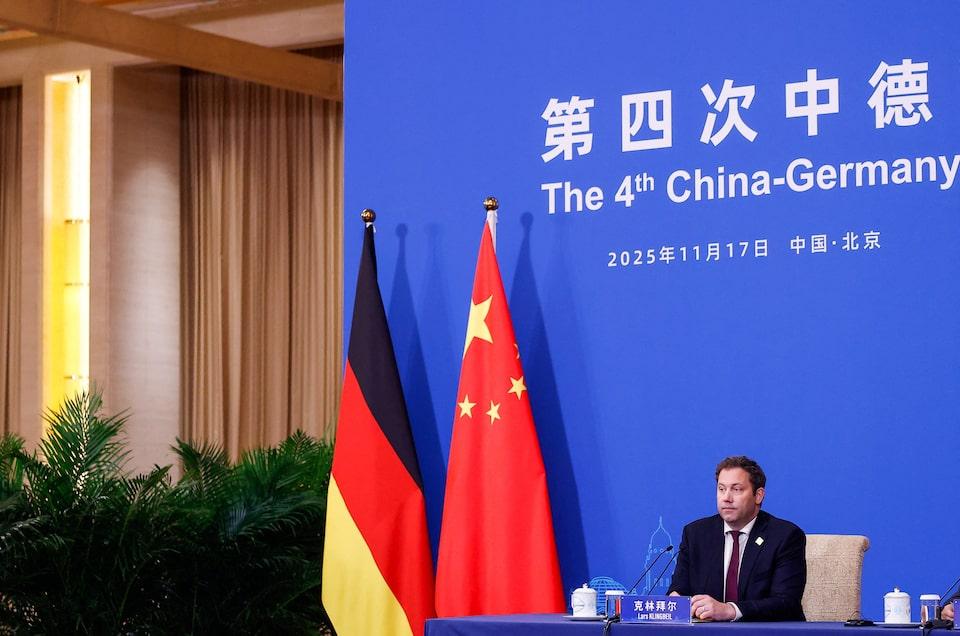
BEIJING, Nov 18 (Reuters) - German Finance Minister Lars Klingbeil discussed overcapacity in China on Tuesday during his visit to Beijing and stressed that the Europen Union would act if a solution was not found. "I made it clear that, if necessary, decisions will be made at the European level to better protect our markets," Klingbeil said. "I’d like to avoid that, but in the end, Europeans — and we Germans — must not be the ones left behind." Sign up here. On his second day in China, Klingbeil discussed overcapacity, German-Chinese cooperation in multilateral organizations and the war in Ukraine at the Party Dialogue in Beijing. Asked about EU divisions on relations with China, Klingbeil said coordination among Europen countries was key, and that he had liaised with his colleagues in the bloc before his trip. "It’s crucial that Europe, where we have a lot of common ground, doesn’t present different voices and positions in China," Klingbeil said. Ties between the two industrial powerhouses have been strained, in particular over Chinese export curbs on chips and rare earths that have caused major disruption for German firms. Germany must diversify its supply chains to avoid disruption in the sourcing of rare earth minerals, he said, although he said the Chinese side gave him clear assurances about reliable access on Monday. "Still, I want to stress: We need to do our homework in Germany," said Klingbeil. https://www.reuters.com/world/china/eu-will-protect-its-market-if-needed-german-finance-minister-says-china-2025-11-18/