2025-11-13 11:58
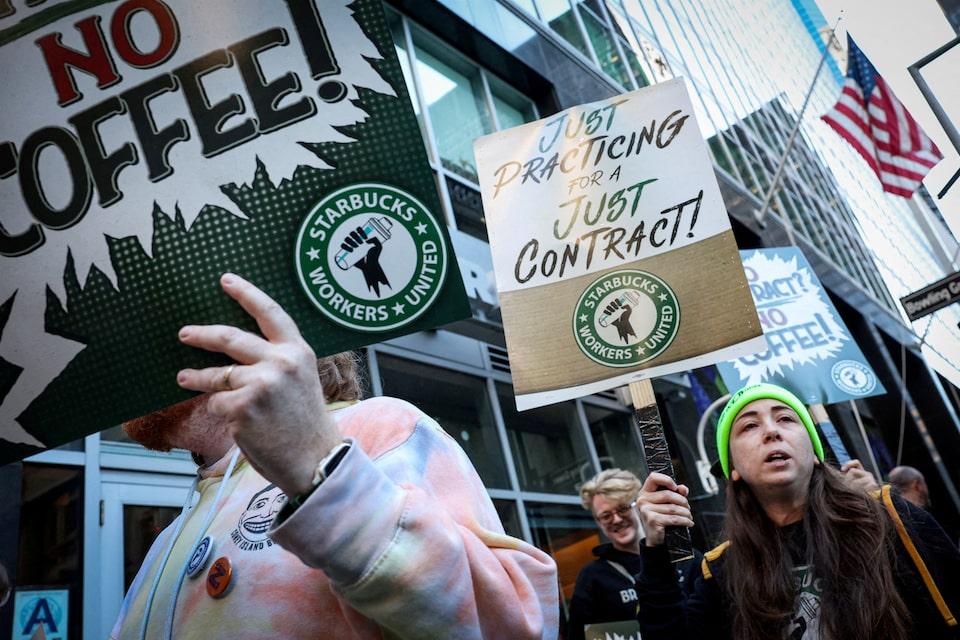
Nov 13 (Reuters) - More than 1,000 Starbucks unionized baristas in over 40 U.S. cities launched an indefinite strike on Thursday, intensifying their push for a collective bargaining agreement over increasing pay and staffing levels at the coffee giant. The walkout will begin with 65 stores, the Starbucks Workers United said, coinciding with the Red Cup Day, a busy sales event that typically drives higher customer visits at more than 17,000 coffeehouses in the U.S. Sign up here. So far, there has been minimal impact with less than 1% of stores seeing any disruption, a Starbucks spokesperson told Reuters. The union, which represents employees at about 550 U.S. stores, plans to rally at 4 p.m. local time in more than a dozen cities and warned the strike could become the largest and longest in the history of Starbucks. Multiple protesting baristas across outlets in Manhattan and Brooklyn told Reuters they wanted their employer to come back to the negotiating table and give them a better schedule and pay among other things. Stores in cities, including Seattle, New York, Philadelphia, Dallas, Austin and Portland, will join the work stoppage, the union, which represents roughly 9,500 workers, or 4% of its cafe workforce according to Starbucks, said, with some locations already shut down for the day. NEGOTIATIONS DRAG ON The strike comes as CEO Brian Niccol shuts hundreds of underperforming stores, including the unionized flagship Seattle location, and focuses on improving service times and in-store experience to revive demand in the U.S. Talks between the union and the company ended in December after stretching for about eight months last year following which the workers went on strike during the key holiday period. Niccol had said in September last year when he took over as CEO that he was committed to dialogue. However, Lynne Fox, the union's international president, said on a call with journalists that things changed once Niccol took office. "A year into Niccol's tenure, negotiations have gone backwards after months of steady progress and good faith negotiations," Fox said. Starbucks declined to comment on Fox's remarks. In April, the union voted to reject a Starbucks proposal that guaranteed annual raises of at least 2%, saying it did not offer changes to economic benefits such as healthcare, or an immediate pay hike. WHAT ARE THE DEMANDS? The union has filed more than 1,000 charges to the National Labor Relations Board for alleged unfair labor practices such as firing unionizing baristas and last week voted to authorize a strike if a contract was not finalized by November 13. "We're striking for a fair union contract, resolution of unfair labor practices and a better future at Starbucks," said Dachi Spoltore, a Starbucks barista from Pittsburgh who joined the strike. Starbucks has said it pays an average wage of $19 an hour and offers employees who work at least 20 hours a week benefits including healthcare, parental leave and tuition for online classes at Arizona State University. The union has said starting wages are $15.25 per hour in about 33 states and the average barista gets less than 20 hours per week. "What we're asking for is pretty simple and basic. We want enough hours to meet the benefits. We want enough staffing in our stores so we're not overworked. And we want to be paid enough to live in this city," said Rey Shao, a Starbucks supervisor at one of its Manhattan coffee shops. INVESTORS KEEP A CLOSE WATCH Both sides have blamed the other for stalling the talks, and say they are ready to return to the bargaining table. Some investors and lawmakers over the past year have urged Starbucks to resume talks with the union and settle on a contract. "As we quickly approach the fourth anniversary of the first stores to unionize in Buffalo, NY, it is remarkable that management has not been able to reach a first contract," said a spokesperson for Trillium Asset Management, a long-term Starbucks shareholder. Starbucks' shares closed down about 1% on Thursday. "In absolute terms, it is a fraction of stores and, therefore, unlike the China stake sale, recent restructuring or remodeling announcements, (the strike) is not directly driving earnings estimates," said Meredith Jensen, analyst at HSBC Securities. "The market is weighing many factors – qualitative and quantitative – on Starbucks turnaround and widespread and highly publicized negative stories factor can't be totally excluded from the company's investment story." PAST PROTESTS This is not the first time that the union is going on a strike on Red Cup Day, when Starbucks hands out reusable red holiday-themed cups to customers for free on coffee purchases. In 2022, workers at about 100 U.S. stores went on a one-day strike on Red Cup Day in protest against firings and store closures that they said were illegal retaliation by Starbucks against them. Workers at hundreds of stores also walked off their jobs on Red Cup Day in 2023, demanding improved staffing and schedules for the promotional event, which they said was one of the "most infamously hard, understaffed days." https://www.reuters.com/legal/litigation/starbucks-union-baristas-walk-out-40-cities-push-contract-talks-2025-11-13/
2025-11-13 11:40
Raises demand growth forecasts for this year and next IEA expects global supply to rise by 3.1 mln bpd in 2025 Implied surplus to reach 4.09 mln bpd in 2026, up by 120,000 bpd from last month LONDON, Nov 13 (Reuters) - The global oil market faces an even bigger surplus next year of as much as 4.09 million barrels per day as OPEC+ producers and rivals lift output and demand growth slows, the International Energy Agency said on Thursday. The outlook from the IEA, which advises industrialised countries, is the latest warning that the oil market is heading for oversupply. A surplus of 4.09 million bpd would be equal to almost 4% of world demand, and is much larger than other analysts' predictions. Sign up here. "Global oil market balances are looking increasingly lopsided, as world oil supply is forging ahead while oil demand growth remains modest by historical standards," the IEA said in its monthly report. OPEC+, or the Organization of the Petroleum Exporting Countries plus Russia and other allies, has been boosting output since April. Other producers, such as the U.S. and Brazil, are also increasing supply, adding to glut fears and weighing on prices. Oil prices edged higher to around $63 a barrel after the IEA report to recoup some of the 2% drop on Wednesday after OPEC shifted its 2026 outlook to a small surplus, having earlier seen a sizeable deficit. IEA LIFTS OUTLOOK FOR SUPPLY Global oil supply will grow by around 3.1 million bpd in 2025, and 2.5 million bpd next year, each up by around 100,000 bpd on the month, the IEA said. Supply is rising faster than demand in the IEA's view even after upward revisions on Thursday. The agency now expects oil demand to rise by 770,000 bpd next year, up 70,000 bpd from last month, citing increased needs in petrochemical plants. The short-term outlook in the IEA's monthly report contrasts with the agency's annual outlook on Wednesday, which sees global oil and gas demand potentially rising until 2050. OPEC sees a surplus of just 20,000 bpd next year according to Reuters calculations based on its own monthly oil market report on Wednesday, although this marks a further retreat from its forecast of a sizeable deficit. RUSSIAN EXPORTS NOT IMPACTED Global oil output was 6.2 million bpd higher in October than at the start of this year, divided evenly between OPEC+ and non-OPEC producers, the IEA said. Top OPEC producer Saudi Arabia contributed 1.5 million bpd of the increase, while Russia added just 120,000 bpd amid sanctions and Ukrainian attacks. Russian oil exports have continued largely unabated despite new U.S. sanctions on Russian firms Rosneft (ROSN.MM) , opens new tab and Lukoil (LKOH.MM) , opens new tab, which still may have the most far-reaching impact yet on global oil markets, the IEA said. The IEA added that new entities have already started handling Russian exports as it adapts to sanctions. In October, companies MorExport, RusExport and NNK, which have only been active since May, lifted around 1 million bpd of Russian crude and fuels, it said. WATERBORNE STOCK LEVELS SURGE The Paris-based IEA also drew attention to a sharp rise in global oil inventories, which rose to their highest since July 2021 in September at just under 8 billion barrels. The increase was driven by a sharp increase in waterborne oil in storage, which rose by 80 million barrels in September. Preliminary October data shows further rises for global stocks, again driven by increasing waterborne barrels, the agency added. https://www.reuters.com/business/energy/iea-sees-global-oil-supply-growth-driving-larger-market-glut-2025-11-13/
2025-11-13 11:37
LONDON, Nov 13 (Reuters) - The pound rose on Thursday, as a deal in Washington to reopen the U.S. government after the longest shutdown on record drew investors to more volatile assets, though gains were tempered by data showing the UK economy barely grew in the third quarter. The British economy grew 0.1% in the third quarter of 2025, the Office for National Statistics said, slowing from growth of 0.3% in the second quarter. Sign up here. The data underlined the backdrop of slow growth against which finance minister Rachel Reeves is preparing her November 26 budget, which is widely expected to contain a raft of tax hikes. The pound was last up 0.2% on the day at $1.3158, having earlier traded at a session low of $1.3102. Traders are attaching a near-80% chance of a December rate cut from the Bank of England, which refrained from cutting rates at its November meeting, given the uncertainty over the outlook for inflation and growth, particularly in the run-up to Reeves' budget. They expect at least two more rate cuts next year, with a decent chance of a third, according to money market derivatives. Adding an extra possible drag on the pound is political turbulence in London, where Prime Minister Keir Starmer faces division within his ruling Labour Party and tumbling poll ratings. "We expect the pound to weaken further if the market moves to price in a higher political risk premium," Lee Hardman, currency strategist at MUFG, said, adding that local elections next May could provide a key test of his leadership. More immediately, markets are looking to Reeves' belt-tightening budget in two weeks. A rise in implied volatility on options expiring in two weeks' time reflected growing trader demand for hedges against large swings in the value of sterling on the day of the budget, with vol rising to 6.83% , from 6.358% a week ago . https://www.reuters.com/world/uk/sterling-edges-up-gains-tempered-by-soft-uk-growth-data-2025-11-13/

2025-11-13 11:36
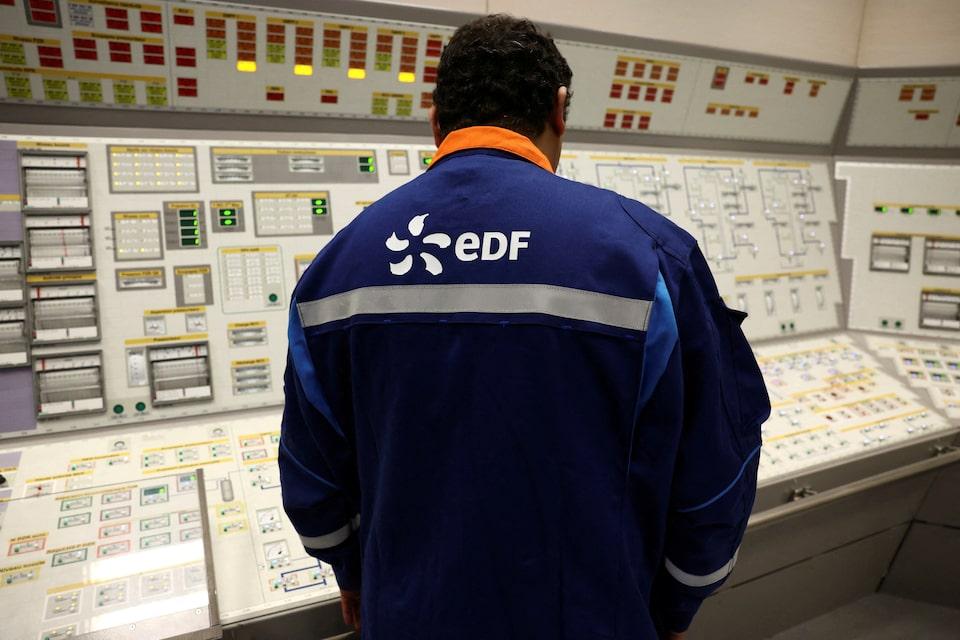
EDF offering 10.6 TWh of long term contracts to utilities, distributors and businesses Contracts will include competitors and businesses outside France Medium term contracts doing well with more customers signed PARIS, Nov 13 (Reuters) - France's EDF said on Thursday it is looking to expand its long-term contracts to include competitors and more power consumers. EDF is looking to lock in an extra 10.6 terawatt-hours (TWh) of long-term power contracts to utilities, power distributors and other large consumers for delivery starting in January 2027, reducing its exposure to volatile energy prices. Sign up here. "The goal is to provide solutions for French industry and for industrial and economic sectors to ensure they are efficient, sustainable, and resilient," said EDF's executive director in charge of clients and services, Marc Benayoun. EDF's call for interest in the contracts, known as nuclear production allocation contracts (CAPN), comes after it struggled to sign long-term deals with industrial users, who are facing weak demand. Market prices for next year are currently much lower than those offered in long-term contracts, making it difficult to sign up customers for longer periods. However, EDF said it has interest in its medium term contracts that go over 4 to 5 years, with more than double the volumes signed up compared to the long-term contracts for a combined 35 to 40 TWh. "Many players, after the experience they had in (during the energy crisis), want to have a contract that offers attractive price levels and whose terms are fixed," Benayoun said. EDF estimates it will produce between 350 and 370 TWh of power from its domestic nuclear reactors in 2026 and 2027, with the CAPN scheme aimed at covering almost 10% of its production. The contracts will eventually be open to all players in Europe, Benayoun told reporters. Former EDF CEO Luc Remont tried to open contracts for delivery to heavy industry outside France at the start of the year, but this angered French industry and contributed to his ouster a few weeks later. https://www.reuters.com/business/energy/frances-edf-offer-long-term-contracts-more-customers-2025-11-13/
2025-11-13 11:20
From Egypt to Kazakhstan buyers express interest in assets Lukoil has until November 21 to complete any transaction US could freeze funds from sales Nov 12 (Reuters) - From Egypt to Kazakhstan, the foreign assets of Russian oil major Lukoil (LKOH.MM) , opens new tab are attracting potential bidders as time runs out to clear deals before U.S. authorities enforce sanctions. The U.S. has hit Lukoil with sanctions as part of its effort to bring the Kremlin to peace talks over Ukraine, and has already blocked Lukoil's attempt to sell foreign assets to trader Gunvor ahead of the November 21 sanctions deadline. Sign up here. The sanctions have also already disrupted Lukoil's operations in Iraq, at pump stations in Finland and a refinery in Bulgaria. As its empire creaks, governments and partners are hoping to snap up its foreign assets on the cheap. Lukoil didn't reply to requests for comment. BIDDERS CIRCLE Kazakhstan's state firm KazMunayGas is studying a bid for Lukoil's assets in the country, said two sources familiar with the matter. Lukoil has a stake in Karachaganak, one of the world's largest gas and condensate fields, with Eni (ENI.MI) , opens new tab, Shell (SHEL.L) , opens new tab, Chevron (CVX.N) , opens new tab and KazMunayGas (KMGZ.KZ) , opens new tab. Any new partnership will be decided by the project's participants, taking into account the sanctions, Kazakhstan's energy ministry said in a statement. Shell is interested in Lukoil's deepwater blocks in Ghana and Nigeria, two other sources said. Shell declined to comment. In Egypt, Lukoil has indicated to the government its possible plans to sell out, a fifth source familiar with the situation said. Lukoil holds three concessions in Egypt. Egypt's petroleum ministry didn't respond to a request for comment. The government of Moldova has started talks to nationalise Lukoil’s infrastructure at Chisinau airport, the airport’s director Serdgiu Spoiala said on Tuesday. Bulgaria is preparing to seize Lukoil’s Burgas refinery. Azerbaijan's state firm Socar and Cengiz Holding of Turkey jointly bid for the refinery before the sanctions. Cengiz aims to proceed with the deal, Turkish media reported this week. Cengiz didn't immediately respond to a request for comment. LUKOIL'S OPTIONS Lukoil faces difficult choices, said Sergey Vakulenko, a senior fellow at the Carnegie Russia Eurasia Center and former head of strategy at Russian oil firm Gazprom Neft. If the company sells its assets, the proceeds could be frozen by the U.S. Treasury, he said. But delaying action would likely mean state takeovers of some assets or their freezing, said Vakulenko, and Igor Yushkov from the Financial University of the Russian government. "There's really no point for Lukoil to rush," said Yushkov. "If some assets are frozen, they're frozen. Just wait until the conflict in Ukraine ends, and then maybe sanctions will be eased. That's the lesser evil, probably." Lukoil may try to emulate the strategy of Russian oil firm Rosneft, which saw Germany put its three refineries under a trusteeship in 2022. The plants are now controlled by Berlin but Rosneft still owns them. "Either you sell it yourself and hope you'll get the proceeds, or you try to retain ownership," Vakulenko said. https://www.reuters.com/business/energy/lukoils-foreign-assets-attract-rush-buyers-2025-11-12/

2025-11-13 11:15
WHAT: USDA to release first US, global crop estimates since September WHEN: Friday, November 14, 12 noon EST (1700 GMT) Lack of USDA data on crop size feeds wide range of analyst estimates Late-season dryness, crop disease likely hurt US production, analysts say Export demand uncertain as China's soybean purchase agreement remains unconfirmed CHICAGO, Nov 13 (Reuters) - A crop data blackout during the longest-ever U.S. government shutdown has led to the widest range of analyst estimates in a decade for corn and soybean yields, as an information vacuum at harvest time and during critical trade negotiations distorted the market for the country's two most valuable crops. The U.S. government reopened on Thursday after the 43-day shutdown. On Friday, the U.S. Department of Agriculture is set to release a hotly anticipated crop report, including the government's first estimates of the two feed crops since mid-September, before the harvest had taken shape. In the absence of last month's world agriculture supply and demand estimates report, traders have relied on disparate bits of data to take positions. Sign up here. Buyers and analysts have examined harvest estimates from private forecasters, media reports about export sales, local cash market prices, and social media posts showing overflowing grain bins in some parts of the country and ample storage space in others. None of this, however, gives as definitive a picture as the USDA report. "It's at harvest, when we are trying to figure out the true size of the crops. It's the worst time to be without that information because it robs the market of essential production data," said Scott Irwin, a University of Illinois agricultural economist. Analysts' highest and lowest corn crop estimates reflect a difference of 389 million bushels of production, more than Michigan's entire crop last year. Their soybean estimates reflect a difference of opinion equal to 184 million bushels, half of Indiana's crop in 2024. The government's crucial export sales data was suspended for weeks, fueling uncertainty about crop demand during the busiest period of the year for shipments, leaving markets reliant on rumors of trade negotiation breakthroughs or the threats of new tariffs. On October 30, Treasury Secretary Scott Bessent said China had agreed to purchase 12 million tons by December. The main U.S. soybean buyer has shunned U.S. supplies during President Donald Trump's trade war. Beijing has not yet confirmed a deal and trade sources told Reuters that China has booked rival South American supplies in recent days with only minimal purchases from the U.S. Markets remain on edge, raising stakes for farmers and traders ahead of Friday's USDA report. Pre-report estimates gathered from analysts and brokers showed exceptionally varied opinions. Estimates for average 2025 U.S. corn yields ranged from 181.7 to 186.0 bushels per acre -- all below USDA's September estimate of 186.7. Estimates for U.S. soybean stocks remaining ahead of the next harvest were between 187 million and 494 million bushels, a spread nearly three times as wide as normal. In September, USDA projected the largest corn and soybean yields on record and the largest harvested area for corn since the Great Depression. But in the absence of updated government data, analyst consensus has been building that the two crops' harvest will come in smaller than projected. Analysts with farm lender CoBank warned of an acute crop storage shortage, but grain piles never materialized in many areas. In October, buyers in some locations began bidding up the cash price for crops, reinforcing ideas that the harvest had fallen short. The USDA's last supply-demand report was released on September 12, as the U.S. corn and soy harvests were just beginning. Both are now nearly complete, according to private analysts regularly polled by Reuters during the shutdown. Aside from anecdotal farmer reports, it was unclear how badly late-season dryness and crop disease impacted national production. The USDA told Reuters that its staff collected crop field samples despite the shutdown. Lance Honig, an official with the USDA's National Agricultural Statistics Service, said the statistical methodology for estimating national yields had not changed and the agency was "collecting the necessary survey and administrative data to support the forecasts." EXPORT UNCERTAINTY The USDA also suspended crop export sales reporting during the shutdown, although it was still gathering the data, according to its shutdown plan. The USDA released data missed in the first week of the shutdown on Thursday and set a schedule for the weekly reports that were suspended in the weeks that followed to be published through the end of the year. The agency is also due to release a compiled a list of large daily sales reported by exporters during the shutdown on Friday. The blackout coincided with trade negotiations with China, which accounts for 50% to 60% of all U.S. soybean exports. The U.S. ships about two-thirds of the oilseed, its most valuable farm export, between October and January. Buyers other than China have booked U.S. soybean shipments during the shutdown. But without weekly government confirmation of sales, estimates of demand have varied significantly. Analysts surveyed by Reuters during the data blackout estimated net soybean sales of between 3 million and 102 million tons over six weeks. Sales as of the end of October may be down 50% from a year ago at the lowest since 2007, or down merely 25% at the lowest since the last U.S.-China trade war in 2019. https://www.reuters.com/world/us/usda-data-blackout-fuels-uncertainty-ahead-upcoming-crop-report-2025-11-13/