2025-11-12 22:57
SAO PAULO, Nov 12 (Reuters) - Brazilian state-run lender Banco do Brasil (BBAS3.SA) , opens new tab on Wednesday lowered its outlook for adjusted net income this year, citing higher funding expenses and rising defaults among local farmers. The bank now expects annual net income of 18 billion t o 21 billion reais ($3.33 billion-$3.89 billion), down from a previous forecast of 21-25 billion reais. Sign up here. Banco do Brasil, long seen as a pillar of farm credit in the country, has been grappling with record default levels in its agribusiness portfolio, which hit results and raised investor concern over its exposure to the sector. In the third quarter, the bank's agribusiness default ratio hit 5.34%, up from 3.49% in the prior three-month period and above its overall 90-day default ratio of 4.93%, which rose 72 basis points sequentially. "Given this scenario, we have acted with transparency and implemented effective measures to address the situation, responding quickly and decisively," the bank said in its earnings report. Banco do Brasil posted an adjusted net profit of 3.79 billion reais ($701.35 million) for the third quarter, down 60.2% from a year earlier but slightly above the 3.71 billion reais expected by analysts polled by LSEG. The lender's return on equity, a gauge of profitability, was down 1,276 basis points year-on-year to 8.4%, but unchanged quarter-over-quarter. In another revision, Banco do Brasil also raised its estimate for cost of credit in 2025 to a range between 59 billion and 62 billion reais, from the 53 billion to 56 billion reais forecast before. ($1 = 5.4039 reais) https://www.reuters.com/business/finance/banco-do-brasil-cuts-2025-net-income-outlook-farmer-defaults-surge-2025-11-12/

2025-11-12 22:48
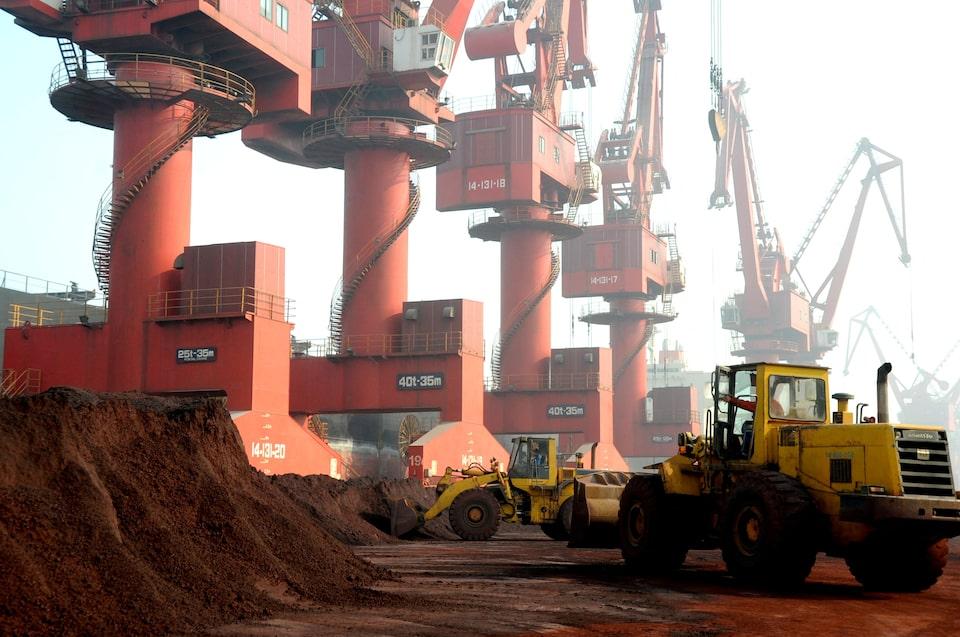
US House committee report accuses China of manipulating mineral prices Report recommends price controls, US minerals stockpile Report says Hong Kong ownership makes LME susceptible to Chinese influence LME says its pricing is based on transparent trading activity Nov 12 (Reuters) - China for decades has sought to manipulate global critical minerals prices, using its control as an economic weapon to expand its manufacturing sector and its geopolitical influence, a U.S. House of Representatives committee said on Wednesday. The allegations, contained in a 50-page report from the bipartisan U.S. House Select Committee on China and reviewed by Reuters, adds to a series of missives from Washington criticizing Beijing's sway in critical minerals markets. Sign up here. President Donald Trump and his predecessor, Joe Biden, have in recent years sought to crimp China's dominance in the critical minerals sector. COMMITTEE RECOMMENDATIONS INCLUDE MINERALS PRICE CONTROLS The committee's legislative report aims to codify presidential orders into law with an array of recommendations including price controls and expanded government oversight of price reporting agencies. The Chinese Embassy in Washington did not immediately reply to a request for comment. China has previously accused the U.S. of distorting and exaggerating Beijing's rare earths export controls and of stirring up panic over the issue. "China has a loaded gun pointed at our economy, and we must act quickly," said Congressman John Moolenaar, a Michigan Republican and chair of the committee. A chemist by training who previously worked at Dow Chemical (DOW.N) , opens new tab, Moolenaar added that Beijing's practices had "caused American job losses, driven American miners out of business, and jeopardized national security." The report, compiled by committee staff, was also endorsed by the ranking Democrat, Congressman Raja Krishnamoorthi of Illinois. It alleges that China's role as the world's largest processor of many critical minerals has made it nearly impossible for the United States and allies to determine the true price of certain metals, including rare earths. The report also suggests that the London Metal Exchange, where many minerals are traded, is susceptible to influence from Beijing, as it is owned by the Hong Kong Exchanges and Clearing (0388.HK) , opens new tab. "The LME advertises itself as showing prices that 'properly reflect global supply and demand.' However, with the (Chinese government) looking over HKEC's shoulder, it is difficult to determine whether the prices it publishes accurately reflect global supply and demand." The LME said it is subject to the laws and regulations of the United Kingdom, where it is based. "All of the LME's key prices are determined on the basis of transparent trading activity from an international participant base," a spokesperson said. REPORT ALLEGES CHINA TARGETS PRICING OF RARE EARTHS The House committee's report, based on published reports and data, also alleges that China has specifically targeted the lithium and rare earths industries, raising and lowering prices to bolster its own economy. "Each time lithium prices rose, the PRC government took action to bring lithium prices back down," the report said. The Trump administration cited issues with pricing in September when it sought an equity stake in Lithium Americas , opens new tab(LAC.TO) , opens new tab. The report offers 13 policy recommendations, some of which Trump has already taken. It also aims to spark broader dialogue about China's presence in the minerals markets rather than seek to address every concern. "One single policy will not completely address the serious challenge the United States faces on critical minerals, so we must simultaneously pursue multiple policy prescriptions," it said. One of those recommendations, the creation of a "critical minerals czar," was instituted by Trump earlier this year. The report also suggests the creation of a U.S. minerals stockpile, which the administration has indicated it is open to. https://www.reuters.com/world/us/us-house-report-accuses-china-minerals-market-interference-2025-11-12/
2025-11-12 22:15
TRIPOLI, Nov 12 (Reuters) - Libya's Zallaf for Oil and Gas Co said on Wednesday it has exported its first oil shipment from the Chadar oil field in the Sirte Basin, southeast of Ajdabiya in eastern Libya. The subsidiary of Libya's National Oil Corporation did not disclose the destination of the shipment of more than 600,000 barrels of high-quality Sidra crude in a statement on its verified Facebook page. Sign up here. At the Chadar field, also known as NC-126, more than five development wells have been completed within the first phase of the project, Zallaf said. Daily production there started in January with more than 7.5 million cubic feet of associated gas and 1,500 barrels of crude. In March 2023, Zallaf signed a contract with U.S.-based Honeywell for engineering work on the planned South Refinery project, likely to cost $500 million to $600 million. The refinery would process about 30,000 barrels per day of crude oil, producing conventional petroleum products. https://www.reuters.com/business/energy/libyas-zallaf-oil-gas-exports-first-shipment-chadar-oil-field-2025-11-12/

2025-11-12 22:12
BELEM, Nov 12 (Reuters) - Global supply chains for lithium could benefit from collaboration among governments but any intervention on prices would need to be handled carefully, Dale Henderson, CEO of Australian lithium miner PLS (PLS.AX) , opens new tab, said on Wednesday on the sidelines of Brazil's COP30 climate summit. China dominates global processing for lithium, an essential component for electric vehicle batteries and renewable energy storage. But weak demand due to slower-than-expected growth of the EV sector has sent prices plunging from their high in 2022. Sign up here. Henderson said the growth of trading mechanisms such as futures markets should eventually help regulate prices for the industry. Australia is the lithium industry's top producer, followed by Chile and China. "To the point about, should there be government intervention for price support, I think that needs to be carefully considered because it could actually support the wrong projects," he said in an interview. He called for governments to boost support for supply chains outside China. "It's about the government-to-government collaboration to support industrial parks and other trade agreements to bring forth and accelerate these new supply chains," he said. PLS, formerly Pilbara Minerals, expects to release exploration studies for its Colina lithium project in Brazil in the second quarter of next year. From there it will make an investment decision, "depending, of course, on where the lithium market is at that time," Henderson said. https://www.reuters.com/business/energy/ceo-australias-pls-says-government-support-could-boost-lithium-supply-chains-2025-11-12/

2025-11-12 22:05
ORLANDO, Florida, Nov 12 (Reuters) - U.S. tech shares stumbled again but the Dow climbed to a new high on Wednesday as investors geared up for an end to the U.S. government shutdown, while oil prices slumped on reports that crude supply will be higher than previously thought. More on that below. In my column today I look at why the end of the U.S. government shutdown won't lift the economic fog for some time. Indeed, some key indicators like the unemployment and CPI inflation rates for October may never be released. Sign up here. If you have more time to read, here are a few articles I recommend to help you make sense of what happened in markets today. Today's Key Market Moves Today's Talking Points * AI bursting with energy The scale of AI investment over the coming years is staggering enough when measured in dollars. It's equally staggering in terms of the power and energy required to run all these data centers. Can the demand be met? If so, what are the inflationary and economic impacts? Take the Stargate project. According to UniCredit, it will target 10 gigawatts of electrical power by 2029, the equivalent of ten medium-sized nuclear power plants. Morgan Stanley estimates total U.S. data center power demand through 2028 at 69 GW, but warns of a potential 44 GW shortfall, barring creative "time to power" solutions. * When QE is not QE It won't be long until the Fed starts buying bonds again to expand its balance sheet, says New York Fed president John Williams. The Fed skeptics and 'doomers' on financial social media say this is proof the Fed will never shake its addiction to quantitative easing, and inflation and dollar debasement are inevitable. Not really. These purchases would be part of a technical effort to ensure bank reserves are "ample", allowing the Fed to keep control over ultra short-term interest rates and money market liquidity. It would probably involve the purchase of T-bills, not long-dated bonds, and would have no implication for monetary policy. * Labour pains Pressure is mounting on UK Prime Minister Keir Starmer, and speculation is rife he may soon face an internal leadership challenge. His poll ratings have sunk since the 2024 election, unemployment is the highest in nearly six years, and later this month he is expected to break a manifesto pledge not to raise income tax. What does this mean for markets? The FTSE 100 is at a record high but sterling is at a two and a half year-low against the euro and teetering on a break below $1.30. The government will be desperate to get the bond market onside, and avoid a return of what TS Lombard economist Dario Perkins termed the "moron risk premium" during former PM Liz Truss's short-lived tenure. End of US government shutdown won't lift economic fog The end of the longest-ever U.S. government shutdown is in sight, which means official economic data will soon be forthcoming. But even if investors and the Federal Reserve are breathing a sigh of relief, the signals they should soon get might not be all that reliable. Some of the delayed figures should begin to trickle out quickly. Economists at Morgan Stanley predict the September nonfarm payrolls report will probably be released a few days after the shutdown ends, as the data has already been collected. It will be much longer before the October report lands, however, but when it does, it could be missing one key element: the unemployment rate. For the first time since 1948, the "household survey," from which the unemployment rate is calculated, was not carried out last month, according to Claudia Sahm, chief economist at New Century Advisors. Unlike the "establishment survey" which determines the monthly change in payroll jobs, subsequent household surveys don't ask about prior months. This data gap could factor into the U.S. central bank's interest rate decision in December, as Fed Chair Jerome Powell has made clear the labor market side of the central bank's dual mandate has weighed more heavily on recent policy decisions than inflation. To be sure, what employment data the Fed does have to go on is not painting a pretty picture. Based on private-sector data and the limited government figures available, economists at Goldman Sachs now reckon nonfarm payrolls declined by 50,000 in October. That would be only the second monthly drop since December 2020, and the biggest decline in more than five years. A report last week from global outplacement firm Challenger, Gray & Christmas showed planned layoffs soared to more than 150,000 in October, the highest reading for that month since 2003. The Fed, however, may put its rate cuts on hold as long as the official employment and other data remain incomplete and potentially unreliable. "What do you do if you're driving in the fog? You slow down," Powell told reporters last month after the end of the Fed's policy meeting. INFLATION DISTORTION The inflation and spending picture should remain hazy as well. Using the 2013 shutdown as a rough guideline, Morgan Stanley's economists believe October inflation and consumer spending data will not be released in time for the Fed's December 9-10 policy meeting, never mind the November figures. UBS economists are even more pessimistic about getting an update on CPI inflation. They say the October report, originally scheduled for Thursday, may not be released at all because the Bureau of Labor Statistics was closed for the full month, so price quotes were not collected. Getting even deeper into the CPI weeds, UBS notes that October data points are used as a base for some price index calculations that affect other months. That means November, December, and even April CPI inflation data could be distorted. Meanwhile, there's a chance that October retail sales data may also not be released before the Fed's next meeting. According to UBS economists, retail sales data are collected by mail, fax, or telephone, and aggregated within six business days of the reference month. Was September's data collected? "We could be without a key statistic for understanding a large chunk of U.S. GDP for some time," they wrote on Friday. Indeed, it's even possible that the unemployment and CPI inflation rates for October are never released, because the data were either partially collected or not collected at all. So while the wave of relief lifting most stock markets this week is understandable, the end of the shutdown should not be confused with a return to economic clarity. What could move markets tomorrow? Want to receive Trading Day in your inbox every weekday morning? Sign up for my newsletter here. Opinions expressed are those of the author. They do not reflect the views of Reuters News, which, under the Trust Principles , opens new tab, is committed to integrity, independence, and freedom from bias. https://www.reuters.com/world/china/global-markets-trading-day-graphic-2025-11-12/

2025-11-12 22:03
WASHINGTON, Nov 12 (Reuters) - President Donald Trump is committed to providing Americans a $2,000 check using money that has come into government coffers from Trump's tariffs, the White House said on Wednesday. White House press secretary Karoline Leavitt told reporters that Trump's staff is exploring how to go about making the plan a reality. Sign up here. https://www.reuters.com/world/us/trump-is-committed-2000-dividend-americans-using-tariff-income-white-house-2025-11-12/