2025-11-11 11:08
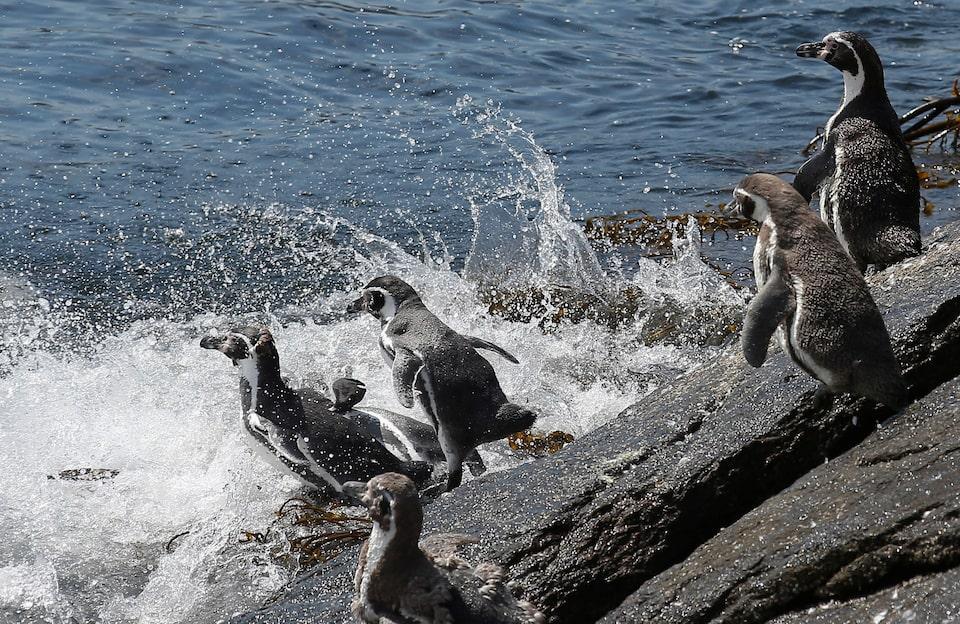
CACHAGUA ISLAND, Nov 11 (Reuters) - Chilean scientists warned of further risks to the world's shrinking population of Humboldt penguins, one of the few species that live on rocky coastlands in more temperate regions, after officials declared the species endangered. Chile's Pacific coast is home to 80% of the world's remaining Humboldt penguins, and scientists at the Universidad de Concepcion estimate that their numbers have dwindled to fewer than 20,000 from around 45,000 in the late 1990s. Sign up here. International organizations consider the species vulnerable and prohibit commercial trade, but late last month Chile's Environment Ministry reclassified the seabird as "endangered." Biologists fear numbers will continue to decline. Competition for food from commercial fishing as well as habitat loss, pollution, bird flu and the worsening impacts of climate change have contributed to declining numbers. "The series of threats facing penguins today has not diminished," Guillermo Cubillos, a marine biologist at Chile's national zoo, told Reuters. "If these threats persist over time, it is very likely this species will go from endangered to critically endangered, and from there it is a very short step to the species disappearing for good." Paulina Arce, a veterinary expert on the Humboldt penguin, said the species is threatened by deaths in fishing nets as well as competition for marine resources, and the classification calls for stricter legislation for sustainable fishing, both on the industrial and small-scale fronts. "The measures that have been implemented so far are not working," she said. "It is useless to reclassify a species if this is not combined with measures to ensure that this species can continue to live and feed in its habitats." Legislation, Arce said, is key so humans can coexist with nature. https://www.reuters.com/sustainability/climate-energy/chiles-endangered-humboldt-penguins-risk-further-decline-scientists-say-2025-11-11/
2025-11-11 11:07
Nov 11 (Reuters) - Sterling snapped a four-day rising streak as data on Tuesday showed British unemployment rose, while annual wage growth slowed slightly, bolstering expectations for a Bank of England interest rate cut next month. Yields on 2-year gilts , more sensitive to expectations for BoE policy rates, dropped 6 bps to 3.74%, within a whisker of their lowest since August 2024. Sign up here. Appetite for risky assets, which usually supports the British currency, was mixed with European shares (.STOXX) , opens new tab rising to a two-week high while U.S. stock futures dropped 0.20% after the S&P 500 jumped 1.5% the day before. Sterling fell 0.33% to $1.3135 , after hitting the day before $1.31914, the highest level since October 29. The U.S. dollar rose against the safe-haven yen and versus the growth-sensitive Australian dollar on Tuesday as investors shifted their focus to data expected once the U.S. government shutdown ends. However, the main focus for sterling traders remained the BoE rate outlook. "Markets still underestimate the depth of the Bank's potential easing cycle," said Modupe Adegbembo, an economist at Jefferies. She mentioned traders pricing 21 bps of BoE rate cuts for December, up from 17 bps before the jobs data, and 65 bps of easing by December 2026 versus 58 bps before. "Given the weakness in the labour market and the additional fiscal tightening likely to be delivered by the Chancellor, we expect the BoE to bring (the) Bank Rate down to around 3% (which now stands at 4%)," she added. BoE policymaker Megan Greene said she was concerned about surveys showing a relatively high level of pay settlements planned for next year. The euro jumped 0.45% to 88.10 pence after a four-day falling streak. It reached 88.30 last week, its highest level since May 2023. While markets anticipate further BoE rate cuts, the euro remains supported by a firmly anchored outlook for European Central Bank policy, with its key rate expected to stay unchanged through 2027. "Weak UK growth fiscal difficulties and the current low popularity ratings of both (finance minister Rachel) Reeves and prime minister (Keir) Starmer also hint at political headwinds ahead,” said Jane Foley, senior forex strategist at Rabobank. She expects the euro to continue edging higher into next year versus the British currency. https://www.reuters.com/business/sterling-snaps-four-day-rising-streak-after-jobs-data-2025-11-11/

2025-11-11 10:26
Nov 11 (Reuters) - CoreWeave's (CRWV.O) , opens new tab shares tumbled 10% on Tuesday after it scaled back its annual revenue forecast due to data center hiccups despite strong demand for its artificial intelligence services. The Nvidia-backed company's margins are pressured by soaring infrastructure expenses, rising AI chip prices and intensifying competition for computing power, weighing on profitability. Sign up here. CoreWeave said it faced delays with a key data center partner, but that the impacted customer had agreed to extend the contract, keeping the deal's total value intact. It did not name the client. The company was set to lose around $5 billion from its market value, if losses hold. At least six brokerages have cut their PT on the stock following the results. "The quarter revealed something that investors have feared for a while - operational risk," analysts at Barclays said. "This is the first time for the young AI infrastructure industry that this has come up and will likely remind investors that these large scale AI data centers are not easy engineering projects." Once a major Ethereum miner, CoreWeave has pivoted to capitalize on the AI boom by leasing Nvidia GPUs and securing deals with tech majors such as Meta (META.O) , opens new tab and ChatGPT-maker OpenAI. The stock, which has climbed about 164% since its March IPO, reported third-quarter revenue of $1.36 billion, topping analysts' average estimate of $1.29 billion, according to data compiled by LSEG. The company's adjusted operating income margin slipped to 16% in the third quarter from 21% a year earlier. "This seems like an incrementally worse setup for the day in the future when demand isn't off the charts," analysts at MoffettNathanson said. https://www.reuters.com/business/nvidia-backed-coreweaves-shares-fall-data-center-delay-hits-annual-revenue-2025-11-11/

2025-11-11 09:34
PARIS, Nov 11 (Reuters) - Crypto tokens linked to mainstream financial assets could create new risks for investors, the global securities regulator IOSCO said in a report on Tuesday, as the finance industry remains split on the merits of "tokenization". Tokenization - the process of creating blockchain-based tokens linked to real-world assets such as stocks or bonds - has seen a revival of interest among crypto enthusiasts this year, with new tokenized products being sold to the public via online brokers. Sign up here. IOSCO, a body whose members are the regulators responsible for almost all of the world's securities markets, said that the majority of the risks around tokenization come under pre-existing frameworks, but that there could be new risks and vulnerabilities stemming from the underlying technology. "Although adoption remains limited, tokenization has the potential to reshape how financial assets are issued, traded, and serviced," said Tuang Lee Lim, chair of IOSCO's board-level fintech taskforce. The different ways tokenized assets are structured could leave investors uncertain about whether they own the underlying asset or just the crypto token, and the third-party token issuer creates counterparty risks, IOSCO added, echoing some of the concerns raised by the European Union's securities regulator in September. "Tokenization could also suffer from potential spill-over effects from increased inter-linkages with the crypto asset markets," IOSCO said. Some mainstream financial institutions, including Nasdaq, are making a push into tokenization, but other Wall Street players have raised concerns. EFFICIENCY GAINS 'UNEVEN' For years, various financial institutions have experimented with issuing blockchain-based versions of assets. Commercial interest in tokenization is rising, but actual adoption is still "limited", IOSCO said. Promoters of tokenized assets say that using blockchain can cut trading costs, speed up settlement, facilitate around-the-clock trading and even attract younger investors. But IOSCO said that "efficiency gains are uneven" as market participants still need to use traditional market infrastructure for the trading processes, rather than replacing it with blockchain. "Issuers do not tend to publicly disclose actual quantifiable efficiency gains, if any," IOSCO said. https://www.reuters.com/sustainability/boards-policy-regulation/global-securities-watchdog-says-tokenization-creates-new-risks-2025-11-11/

2025-11-11 07:58
BEIJING, Nov 11 (Reuters) - China's carbon dioxide emissions were flat year-on-year in the third quarter, extending a now 18-month streak of flat or falling emissions, an analysis for climate publication Carbon Brief found. The trend, which started in March 2024, means CO2 emissions could fall this year in the absence of any year-end spike, showed the analysis by Lauri Myllyvirta of Helsinki-based Centre for Research on Energy and Clean Air. Sign up here. CO2 output rose 0.8% in 2024 after a post-pandemic rebound at the start of the year, a previous Carbon Brief analysis found. The government in September pledged to cap its carbon emissions by 2030 and, by 2035, reduce them by 7% to 10% from that as-yet unknown peak. That commitment was China's first to reduce emissions, though the scale of the cuts fell short of broader expectations. The EU climate commissioner called it "disappointing". The U.S. pullback from international climate agreements under President Donald Trump has created an opening for China to play a greater role in the matter, including at the U.N. COP30 climate summit in Brazil, which began on Monday. Flat emissions in the third quarter of 2025 came as rising chemical sector emissions offset declines or plateaus elsewhere. Transport emissions fell 5% and power-sector emissions were flat in the third quarter, even as electricity demand grew 6.1%, the analysis found. Electricity generation from wind, solar, nuclear and hydropower covered some 90% of that increase in demand. Gas-fired generation also cut into coal's share. But growth in the chemical industry kept overall emissions from falling. Plastic production grew 12% on the year in January-September, driven by surging domestic demand for plastic in food delivery and e-commerce. China has also ramped up domestic production of polyethylene, the most widely used type of plastic, in response to the trade war with the U.S., the analysis said. The government has also encouraged refineries to shift to chemical production to make up for a drop in transport fuel demand amid a widespread shift to electric vehicles. https://www.reuters.com/sustainability/climate-energy/chinas-co2-emissions-havent-risen-18-months-analysis-finds-2025-11-11/
2025-11-11 07:32
Lukoil declares force majeure at Iraqi oilfield amid sanctions U.S. government shutdown resolution boosts demand expectations Saudi Arabia, Iraq, Kuwait to supply more oil to India NEW YORK, Nov 11 (Reuters) - Oil prices gained about $1 on Tuesday on the impact of the latest U.S. sanctions on Russian oil and the optimism over a potential end to the U.S. government shutdown, although oversupply concerns limited gains. Brent crude futures settled $1.10, or 1.72%, higher to $65.16 a barrel. U.S. West Texas Intermediate crude climbed 91 cents, or 1.51%, to settle at $61.04 a barrel. Sign up here. Investors continued to assess the fallout from the U.S. sanctions on Russia, and their impact on both crude oil and refined fuel markets. Russia's Lukoil (LKOH.MM) , opens new tab declared force majeure at an Iraqi oilfield it operates, sources told Reuters on Monday, marking the biggest fallout yet from the sanctions imposed last month. Restricted fuel exports due to the sanctions are propping up oil prices in the face of a crude oil glut, PVM analyst Tamas Varga said. "Fresh U.S. sanctions on major Russian oil producers and exporters are weighing on product exports," Varga said. As a result, heating oil and gasoline are moving in a different direction from crude. Middle Eastern producers Saudi Arabia, Iraq and Kuwait will raise crude oil supplies to India in December as Indian refiners seek alternatives to Russian barrels, sources at four Indian refiners said on Tuesday. The markets also saw support as the longest government shutdown in U.S. history could end this week after the Senate approved a compromise that would restore federal funding. "The optimism around the government reopening is increasing demand expectations," said Phil Flynn, senior analyst for Price Futures Group. The Republican-controlled House of Representatives is due to vote on the deal Wednesday afternoon. However, worries about crude oversupply are curbing price gains. Earlier this month, OPEC+ agreed to increase December output targets by 137,000 barrels per day, but also agreed to a pause in increases in the first quarter of next year. "The oil market is also facing a considerable oversupply in the coming year, which is why prices are likely to remain under pressure. The main cause of the oversupply is the significant expansion of supply by OPEC+," Commerzbank analysts said in a note. OPEC+, which includes the Organization of the Petroleum Exporting Countries and allies such as Russia, has added 2 million bpd of output since April, and a willingness within the group to reverse voluntary production cuts further after the first quarter pause could add an extra 1 million bpd in the coming year, Commerzbank said. https://www.reuters.com/business/energy/oil-retreats-oversupply-worries-2025-11-11/