2025-11-06 23:17
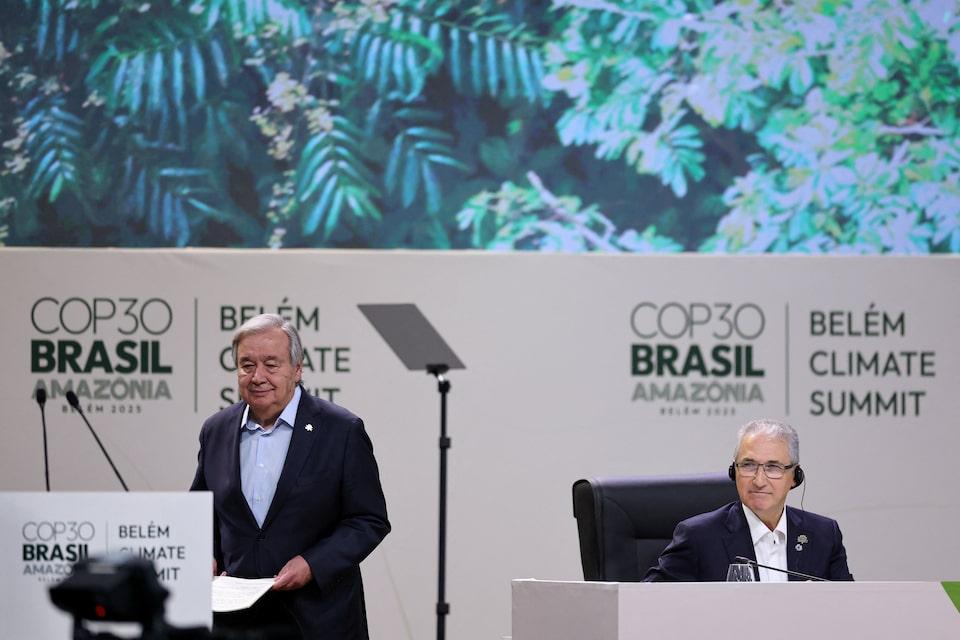
Guterres criticizes corporations for profiting from devastation Leaders take aim at Trump and climate denial Pledges come in for Brazil's forestry fund BELEM, Brazil, Nov 6 (Reuters) - Country leaders at a climate summit in Brazil on Thursday bemoaned the fractured global consensus on climate action, taking swipes at the climate-denying U.S. government while trying to assure the world they were still on mission. U.N. Secretary-General Antonio Guterres tore into nations for their failure to limit warming to 1.5 degrees Celsius, as Brazil hosted world leaders for a summit ahead of the COP30 climate conference in the rainforest city of Belem. Sign up here. "Too many corporations are making record profits from climate devastation, with billions spent on lobbying, deceiving the public and obstructing progress," Guterres said in his speech. "Too many leaders remain captive to these entrenched interests." Countries are spending about $1 trillion each year subsidizing fossil fuels. Leaders have two clear options, Guterres said: "We can choose to lead - or be led to ruin." Missing from the lineup were leaders from four of the world's five most-polluting economies – China, the United States, India and Russia – though the European Commission president and China's vice premier were on site. The U.S. administration opted to send no one to the talks. Instead, top U.S. officials were in Greece alongside fossil fuel giant Exxon Mobil on Thursday as it signed a new deal to explore offshore for natural gas. Colombia's president criticized the absence of U.S. President Donald Trump, whose country is responsible for releasing the most emissions into the atmosphere. "Mr. Trump is against humanity. His absence here demonstrates that," said President Gustavo Petro, who had U.S. sanctions imposed against him last month. A handful of leaders referenced Trump's description of climate change as the world's greatest "con-job". Chilean President Gabriel Boric said bluntly through a translator: "That is a lie." Ireland's prime minister questioned the priorities of those skipping the summit. "At a time when political leadership has never been more vital, there are fewer of us here in Belem, fewer leaders ready to tell it as it is," said Irish Prime Minister Micheal Martin. "Climate change is unarguable. The science is undeniable. Temperatures are rising, and the clock is ticking," he said. "If we are not prepared to tell our citizens the truth about this, we are failing them and this planet in the most profound way." Some said the absence of the United States from COP30 may free countries to discuss action without any one player dominating the outcome. "Without the U.S. present, we can actually see a real multilateral conversation happening," said Pedro Abramovay, vice president of programs at Open Society Foundations and a former justice minister under Brazil's President Luiz Inacio Lula da Silva. 'COALITION OF THE WILLING' The COP30 conference marks three decades since global climate negotiations began. In that time, countries have curbed the projected climb in emissions somewhat, but not enough to prevent what scientists consider extreme global warming in the next few decades. The World Meteorological Organization announced this year would likely be the second- or third-warmest on record, with the temperature average through August being 1.42 C above the preindustrial average, after record heat in 2023 and 2024. Outside of the conference venue - still under construction ahead of next week's summit start - a small group of Indigenous people marched in a circle while singing and urging protection of the world's forests and their people. A flotilla bringing Indigenous leaders and activists down rivers of the Amazon Basin to the conference was delayed and would not arrive until next week. "The world, my friends, has never been changed by spectators and naysayers," Barbados Prime Minister Mia Mottley told the summit. "Do we need everybody acting at the same time? That would be ideal. But if we don't, then we must construct a coalition of the willing and show everyone what they stand to benefit," Mottley said. Contributions began to roll in for Brazil's flagship Tropical Forests Forever Facility, a multilateral fund proposed to support global conservation of endangered forests. Norway said it would contribute about $3 billion, France said it could contribute 500 million euros and others were expected to make pledges in the next few weeks. Brazil's finance minister said the fund was expected to meet an initial $10 billion target earlier than previously thought. Brazil expects these initial funds to bring in private cash that would help the fund meet a $125 billion target in three years. https://www.reuters.com/sustainability/cop/leaders-meet-amazon-summit-amid-worries-over-global-cooperation-cop30-climate-2025-11-06/
2025-11-06 23:09
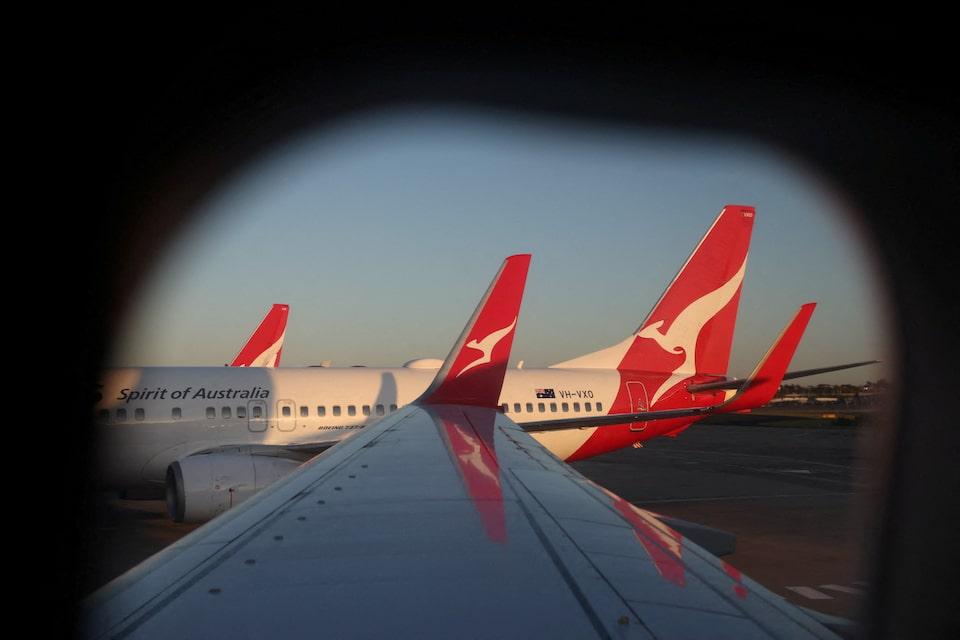
Nov 7 (Reuters) - Australian flag carrier Qantas Airways (QAN.AX) , opens new tab on Friday cut its first‑half domestic unit revenue outlook and nudged up its fuel bill, citing softer non-resources corporate demand at home and elevated refining margins, pressuring its shares. Shares fell as much as 4% by 1142 GMT to a five-month low of A$9.77, underperforming the broader market (.AXJO) , opens new tab, which slipped marginally by 0.1%. Sign up here. Qantas now expects first-half 2026 domestic unit revenue to rise about 3%, coming in at the lower end of its earlier forecast range of 3% to 5%. The country's flag carrier said travel demand from the mining and resources sector remained robust, but broader corporate travel in Australia was recovering at a slower pace than previously expected. "With Jetstar Asia ceased and Japan FX‑related, we estimate investors will largely look through, while the refining-margin fuel increase to us appears better than feared," analysts at Citi noted. Group capacity for the first half of 2026 is now expected to be "slightly lower than previously guided," due to delays in the return to service of its A380 fleet, the company flagged. "We are adjusting domestic capacity in the second half to match the demand profile we are seeing," CEO Vanessa Hudson said in a separate statement. The carrier is monitoring the ongoing U.S. government shutdown, with no material impact seen so far. Fuel costs for the half are now forecast at A$2.62 billion ($1.70 billion), up from a prior outlook of A$2.6 billion, reflecting elevated jet refining margins due to ongoing geopolitical volatility. The revised figure includes around A$25 million in additional non-cash carbon costs tied to higher compliance obligations under the international CORSIA scheme. Qantas has been rebuilding trust after legal setbacks, including an A$120 million package of penalties and customer payments over "ghost flights," and a record A$90 million court fine for illegally outsourcing ground staff - costly chapters that have weighed on sentiment even as profits recovered. The group is also digesting the closure of Singapore‑based Jetstar Asia on July 31, part of a capital recycling push due to rising regional competition and costs. Jetstar Japan and Jetstar's Australia services are unaffected. Earlier, Qantas flagged A380 reactivation delays as a swing factor for near‑term capacity and yield mix. ($1 = 1.5389 Australian dollars) https://www.reuters.com/world/asia-pacific/qantas-flags-softer-1h-domestic-revenue-non-resource-corporate-demand-slows-2025-11-06/
2025-11-06 23:07
Hong Kong, November 7 (Reuters) - The copper-gold ratio recently touched a multi-decade low even as the world economy and stock markets continued to roll along. However, this does not mean the indicator is broken. It is just telling a new narrative about global transition and fragmentation. The commonly cited copper-gold ratio, or price of copper divided by that of gold, based on generic front-end COMEX futures contracts traded in New York, has historically been a go-to indicator of investor sentiment about global economic growth. Sign up here. Copper is the quintessential industrial metal used across a range of industries, including construction, power, telecoms, machinery and appliances. Demand in those sectors tends to track the pace of global GDP growth, so when the world economy booms, demand for copper typically soars. Gold, on the other hand, is the ultimate safe haven. Its price tends to rise during periods of economic and geopolitical stress or when real interest rates are low or negative. Typically, in the past, when the ratio rose, it was an indication of a “risk on” environment. Investment expanded, appetite for safe assets fell, and the cyclical growth outlook improved. And whenever the ratio fell, it signaled the opposite. However, that relationship has started to unravel recently. Global growth has proven more resilient than many expected, especially in the United States where the artificial intelligence boom has underpinned investment and stock markets have repeatedly hit all-time highs, even as the copper-gold ratio has declined sharply. To understand why, one needs to look closely at both the ratio’s numerator and denominator. COPPER’S COMPLEX RIDE The dramatic drop in the copper-gold ratio might suggest that copper demand is severely depressed, but this isn’t the case. While the dominant source of demand for copper over the past two decades – Chinese fixed asset investment – has slowed in recent years, there is now a new secular demand driver, electrification. Electric vehicles, renewables, grid upgrades and broader electrification, including power-hungry data centers are responsible for a rising share of copper use. This has lifted the metal’s long-run demand outlook. Meanwhile, supply has been somewhat fragile. Copper mining projects are notoriously vulnerable to delays, due to a complex combination of operational, environmental and social risks. Outages can quickly tighten the market, as was seen in September at Indonesia’s Grasberg mine, one of the world’s largest copper reserves, which led to a force majeure declaration and cuts to global copper supply growth forecasts. Strong demand and limited supply have pushed copper on the London Metal Exchange to record highs. However, the copper-gold ratio, which is based on U.S. prices, has been distorted by trade policy. Copper flooded into the U.S. ahead of expected tariffs from President Donald Trump’s administration. When a 50% tariff on semi-finished copper finally did take effect in July, raw and refined copper were unexpectedly exempted, shocking investors. New York copper futures plunged nearly 20% before rebounding partially, highlighting how disruptive trade policy can be. Ultimately, what happens with copper prices over the long term will likely reflect the electrification of the world’s two largest economies, the U.S. and China, suggesting that structural growth in copper demand still has significant runway ahead. SAFE HAVEN? That explains what’s happening with the numerator of the copper-gold ratio, but what about the denominator? Gold has been an enduring global store of value for centuries, but it has recently started behaving more like an equity. Gold hit a record high above $4,300 per ounce last month. While prices have since fallen, gold is still up over 100% in the past five years, as of November 5. One statistics currently making the rounds is the fact that gold’s five-year U.S. dollar return tops the S&P 500’s performance over that period. This comparison is getting attention precisely because it goes against intuition. However, if you look more closely, you will see that most of gold’s outperformance occurred in 2025. For most of the prior years, gold largely languished while equities advanced on steady earnings growth. Central bank purchases of gold did pick up after 2022, when Russia’s official foreign exchange reserves were frozen following the outbreak of the Ukraine war. But buying interest from financial investors truly accelerated this year, likely ignited by increased geopolitical risk and currency debasement fears. Gold then picked up significant momentum from retail investors as its price skyrocketed. Momentum can cut both ways, however. In late October, gold experienced its sharpest one-day decline since 2013, a reminder that when a safe-haven becomes the object of speculative flows, its safety starts to come into question. TRANSITION AND FRAGMENTATION What this all ultimately means is that the copper-gold ratio is not “broken” but merely “bent” because the numerator and denominator are responding to different narratives. The copper price reflects transition: massive investment in an AI-powered, electrified, renewables-heavy economy that should require more copper over time. The gold price reflects fragmentation: more siloed geopolitical blocs and a reassessment of unquestioned U.S. dominance across the global financial system. These two narratives are occurring simultaneously, while a third factor – shifts in market behavior, including the rise of retail investment and momentum-based trading – is amplifying market movements. This evolution means the ratio is no longer a clean, high frequency “risk on/risk off” signal. Instead, this metric now tells a more complex story about how capital is being allocated between our economic future and our geopolitical present. (The views expressed here are those of the author. Taosha Wang is a portfolio manager and creator of the “Thematically Thinking” newsletter at Fidelity International.) Enjoying this column? Check out Reuters Open Interest (ROI), , opens new tab your essential new source for global financial commentary. ROI delivers thought-provoking, data-driven analysis of everything from swap rates to soybeans. Markets are moving faster than ever. ROI , opens new tab can help you keep up. Follow ROI on LinkedIn, , opens new tab and X. , opens new tab https://www.reuters.com/markets/commodities/copper-gold-ratio-is-bent-not-broken-2025-11-06/

2025-11-06 21:51
Trump to host talks with five Central Asian leaders US seeks partnerships on critical minerals, energy and trade routes Central Asia remains economically tied to Russia, with China in the wings Nov 6 (Reuters) - U.S. President Donald Trump will host the leaders of five Central Asian nations at the White House on Thursday as the U.S. seeks to gain influence in a region long dominated by Russia and increasingly courted by China. The talks take place amid intensifying competition for Central Asia's vast mineral resources. Western nations are seeking to diversify supply chains away from Moscow and Beijing. Sign up here. In particular, the U.S. is pursuing new partnerships to secure critical minerals, energy, and overland trade routes that circumvent its geopolitical rivals. Launched in 2015, the so-called C5+1 platform brings together the United States and the five Central Asian states — Kazakhstan, Kyrgyzstan, Tajikistan, Turkmenistan, and Uzbekistan — to advance cooperation on economic, energy and security issues. Their leaders will also attend a dinner with Trump at the White House on Thursday. CRITICAL MINERALS MEMORANDUM SIGNED U.S. and Kazakh representatives signed a memorandum of cooperation on critical minerals, according to the news service of the country's President Kassym-Jomart Tokayev. It did not elaborate. The White House had no immediate comment on that report. Among business deals to be announced is an agreement for Boeing (BA.N) , opens new tab to sell up to 37 airplanes to airlines in Kazakhstan, Tajikistan and Uzbekistan combined, according to a government statement. A U.S. company, Cove Capital, will mine tungsten in Kazakhstan with government-backed financing. Kazakhstan was also set to take a symbolic step of joining the Abraham Accords that have normalized relations between Israel and Muslim-majority nations, according to a senior U.S. official. Gracelin Baskaran, a director at the Center for Strategic and International Studies, said the administration will pursue government-to-government engagement but also commercial deals that secure U.S. access to vital minerals. "As China and Russia entrench their control over the region’s mining, processing, and infrastructure systems, Washington is seeking to establish a tangible foothold through targeted strategic projects," Baskaran said. NATIONS ARE RICH IN URANIUM, COPPER, GOLD Rich in minerals and energy, the five nations remain economically tied to Russia, their former Soviet ruler, while neighboring China has expanded its influence through large-scale infrastructure and mining investments. Together, the countries are home to 84 million people and hold vast deposits of uranium, copper, gold, rare earths and other strategic minerals essential to global efforts to transition to greener forms of energy. Kazakhstan, the region’s largest economy, is the world’s leading uranium supplier, producing nearly 40% of global output in 2024, while Uzbekistan ranks among the top five. Together, they account for just over half of the world’s uranium production — a vital resource for U.S. nuclear power, which is a significant source of U.S. electricity. Russia supplies roughly 20% of the U.S.' imported uranium, making diversification increasingly urgent. Under Trump, the U.S. has pursued a multi-pronged strategy to secure critical minerals and reduce reliance on China, which dominates global supply chains for strategic metals including uranium, rare earth elements, copper, and titanium. China, at times, has leveraged its dominance by restricting exports. https://www.reuters.com/world/china/trump-meet-central-asian-presidents-us-seeks-counter-china-russia-influence-2025-11-06/

2025-11-06 21:45
AMSTERDAM, Nov 6 (Reuters) - The Netherlands' economy minister, Vincent Karremans, said on Thursday he trusts computer chips made by Dutch chipmaker Nexperia will reach customers in Europe and the rest of the world in the coming days. A shortage of Nexperia chips following a dispute with China over ownership and control of the company has disrupted auto supply chains, hit production and caused some buyers to furlough staff. The chips are also widely used in industrial, computing, mobile and consumer products. Sign up here. In a statement, Karremans said the Netherlands had been informed by China and the U.S. that the trade deal they struck last week would enable the resumption of supplies from Nexperia's facilities in China. "This is also consistent with information provided to the European Commission by the Chinese Ministry of Commerce," he said. Karremans seized control of Nexperia on September 30, citing fears its operations would be moved to China where its parent, Wingtech, (600745.SS) , opens new tab is based. The Chinese government responded by blocking exports on October 4. This week carmakers and auto parts distributors began to apply to the Chinese Ministry of Commerce for exemptions but it is unclear whether any have received the chips. https://www.reuters.com/world/china/dutch-official-says-he-trusts-nexperia-chips-will-reach-world-coming-days-2025-11-06/
2025-11-06 21:44
Nov 6 (Reuters) - EOG Resources (EOG.N) , opens new tab beat analysts' estimates for third-quarter profit on Thursday, as a rise in output helped the U.S. oil and gas producer offset a drop in crude prices. The company received a production boost from its $5.6 billion deal for Encino Acquisition Partners, which helped expand EOG's presence in the Utica and Marcellus region, one of the most prolific natural gas basins in the world. Sign up here. Meanwhile, oil and gas production in the U.S. rose to record highs in August, data from the Energy Information Administration showed. EOG said it produced 1.3 million barrels of oil equivalent per day, which rose from 1.08 million boepd a year earlier. The Houston-based company posted an adjusted profit of $2.71 per share for the quarter ended September 30, compared with analysts' average estimate of $2.43, according to data compiled by LSEG. https://www.reuters.com/business/energy/us-shale-producer-eog-resources-beats-third-quarter-profit-estimates-2025-11-06/