2025-11-04 23:41
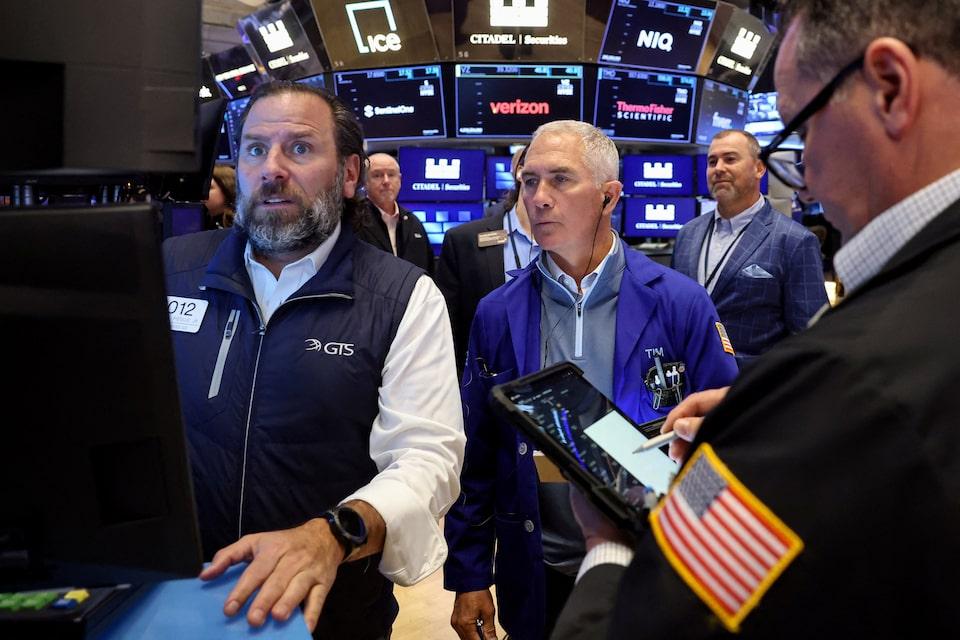
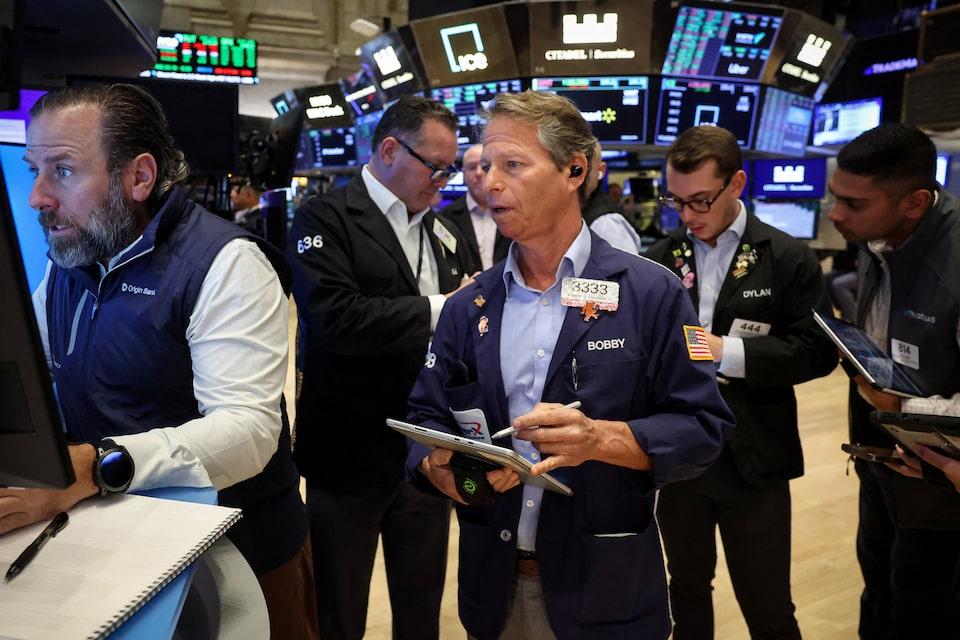
Indexes down: Dow 0.53%, S&P 500 1.17%, Nasdaq 2.04% Palantir slides despite estimate-topping Q4 revenue forecast Uber slides as Q4 adjusted core profit misses estimates NEW YORK, Nov 4 (Reuters) - U.S. stocks closed sharply lower on Tuesday as big banks warned that equity markets could be headed for a drawdown, reflecting mounting concerns over stretched valuations. All three major U.S. stock indexes slid well into negative territory after the CEOs of Morgan Stanley (MS.N) , opens new tab and Goldman Sachs (GS.N) , opens new tab stoked fears of a potential market bubble, with the S&P 500 having climbed to a series of all-time highs, largely powered by the artificial intelligence boom. Sign up here. The S&P 500 and the Nasdaq suffered their biggest one-day percentage drop since October 10. Tech shares (.SPLRCT) , opens new tab weighed particularly heavily on the Nasdaq, with six of the "Magnificent Seven" AI-related momentum stocks losing ground on the day. The Philadelphia SE Semiconductor index (.SOX) , opens new tab dipped 4.0%. JPMorgan Chase (JPM.N) , opens new tab CEO Jamie Dimon warned last month of the heightened risk of a significant stock market correction within the next six months to two years, citing factors including geopolitical tensions. "Investors seem a little more worried about valuation than they have in a while, at least today," said Chuck Carlson, chief executive officer at Horizon Investment Services in Hammond, Indiana. "A lot of these companies' valuations were pretty stretched and their earnings were good, but not great," Carlson added. "And that's a recipe for profit-taking." The U.S. government shutdown, the result of a congressional impasse, is nearing the record for the longest ever. The resulting dearth of official government data has led to increased scrutiny of private sources such as ADP's National Employment Report expected Wednesday. Comments from Federal Reserve officials are being parsed for clues as to how the data-dependent central bank will forge its monetary policy in the absence of crucial economic indicators. Local elections for New York's mayor and governors in New Jersey and Virginia will also be closely tracked. The Dow Jones Industrial Average (.DJI) , opens new tab fell 251.44 points, or 0.53%, to 47,085.24, the S&P 500 (.SPX) , opens new tab lost 80.42 points, or 1.17%, to 6,771.55 and the Nasdaq Composite (.IXIC) , opens new tab lost 486.09 points, or 2.04%, to 23,348.64. Tech was down the most among the 11 major sectors comprising the S&P 500, falling 2.3%. Financials (.SPSY) , opens new tab led the gainers. Palantir Technologies (PLTR.O) , opens new tab slid 8.0% despite the data analytics company's better-than-expected fourth-quarter revenue forecast. The stock has soared over 152% so far this year. Uber (UBER.N) , opens new tab fell 5.1% in the wake of the ride-hailing platform's quarterly profit miss, while Henry Schein (HSIC.O) , opens new tab advanced 10.8% after hiking its annual profit forecast. Spotify (SPOT.N) , opens new tab and U.S.-listed shares of Shopify dipped 2.3% and 6.9%, respectively, after their quarterly results. Declining issues outnumbered advancers by a 2.45-to-1 ratio on the NYSE, where there were 68 new highs and 178 new lows. On the Nasdaq, 1,134 stocks rose and 3,578 fell as declining issues outnumbered advancers by a 3.16-to-1 ratio. The S&P 500 posted 13 new 52-week highs and 19 new lows while the Nasdaq Composite recorded 54 new highs and 260 new lows. Volume on U.S. exchanges was 19.82 billion shares, compared with the 21.04 billion average for the full session over the last 20 trading days. https://www.reuters.com/business/futures-tumble-after-wall-st-banks-warn-market-pullback-palantir-slides-2025-11-04/
2025-11-04 23:06
Crypto exchanges in Japan ramp up offerings as demand surges Japanese investors' digital asset holdings hit record in July Anticipated domestic regulatory changes add to tailwinds Experts warn of risks; investors prefer larger tokens over altcoins TOKYO, Nov 5 (Reuters) - From the launch of new products and services in Japan to facilitating leveraged trading bets, crypto exchanges and some financial firms are rushing to cash in on rising investor enthusiasm for digital assets amid hopes of easing regulations. The recent surge underscores a higher appetite for riskier investments in Japan as inflation outpaces wage growth and overrides a wariness around crypto investments that followed serious security breaches at exchanges in 2014 and 2018. Sign up here. Japanese investors' crypto assets surpassed a record 5 trillion yen ($33.16 billion) at the end of July, jumping 25% from just a month earlier. The price of bitcoin - the dominant holding - rose only 15% in yen terms over the same period. Holdings have since dropped marginally to 4.9 trillion yen as of end-September. Industry players are now positioning for growth to pick up pace. Regulatory changes under discussion could bring in yet more retail investors by potentially cutting tax paid on crypto gains and easing curbs on trading using borrowed money and asset securitisation. 'CONSIDERABLE OPPORTUNITY' "There are around three times as many people with securities accounts as crypto accounts, so there's still a considerable opportunity," said Satoshi Hasuo, representative director and executive officer of exchange Coincheck (CNCK.O) , opens new tab . "Next, we have to think about how we'll win these people over," Hasuo said. CJ Fong, Asia Pacific general manager at crypto market maker GSR, said the firm has also been engaged in more talks this year with Japanese exchanges and financial firms, mainly to provide greater liquidity across a spectrum of digital assets. The burst of activity shows how Japan is re-establishing itself as a major crypto market as industry players capitalise on the boost the industry has had globally under U.S. President Donald Trump. "The Trump administration has spurred the Japanese government and regulators into adopting a friendlier approach to crypto, so Japan doesn't fall behind," said Noriyuki Hirosue, CEO of exchange Bitbank. According to a report by crypto data platform Chainalysis, Japan ranked 19th out of the top 20 nations in crypto adoption globally this year. NEW PRODUCTS AND ENTRANTS Established exchanges are developing products and services in anticipation of regulatory changes that would tax digital-asset gains like those of securities and allow crypto investment through products such as ETFs and tax-free investment vehicles. The Japan Financial Services Agency is refining rule changes, which will then be debated by parliament and, if passed, would come into effect in 2026 or 2027. A similar overhaul of tax rules around foreign exchange trading in 2012 triggered a boom that saw trading volumes swell about tenfold in the space of 10 years, Bitbank's Hirosue said. "I think this could hugely expand the market," he added. In August, Coincheck announced a partnership with the crypto assets arm of online marketplace Mercari (4385.T) , opens new tab to offer a wider range of assets to Mercari's more casual customer base. Mercari introduced simple crypto trading functions to its marketplace buyers and sellers in March 2023 and grew to 3.4 million crypto accounts by July 2025, making up over a quarter of Japan's total of 13.2 million accounts. Its rapid growth has helped introduce crypto trading to a much larger audience, industry players say. SBI VC Trade is considering "enhancing leveraged trading services" on the prospect of leverage trading ratios being relaxed from the current two times to about 5-10 times, representative director and president Tomohiko Kondo said. The firm, the crypto trading arm of conglomerate SBI Holdings (8473.T) , opens new tab, also plans to offer lending services in USDC stablecoin and is exploring the launch of crypto ETF products, Kondo said. Japan's financial regulator is considering allowing members of banking groups to launch cryptocurrency trading services, in a move to expand market access and foster competition, the Nikkei reported in October. CHASING THE HIGHS The crypto trading boom in Japan comes as retail investors seek higher returns and diversify away from low-yielding assets like government bonds and bank loans. "Over 90% of my assets are in cryptocurrency. A diversified portfolio is only worthwhile when you have a big sum of money already," said Umi Soyama, a 27-year-old worker at a Tokyo-based advertising agency and a crypto investor for around two years. "I want to take on risk now and then. If I build up enough assets I'll diversify into stocks, bonds and gold," Soyama said. Other investors have responded to Trump's crypto boosterism. In the month he was elected, SBI VC Trade said it saw account openings grow five times more than usual. However, crypto assets' wild volatility poses risks to new investors. "It can go up, go down. People have to understand this kind of movement and if they are to invest it's an alternative investment, not the main play," said Motonobu Matsuo, senior managing director of the Japan Securities Dealers Association. And with asset prices near all-time highs, some investors are now looking to reduce their holdings. Kou Okamoto, CFO at a Tokyo-based financial firm, has invested a small proportion of his assets in crypto since 2019. He now primarily owns bitcoin but is considering reducing his exposure to "altcoins" - those other than bitcoin. "You can't make 100 or 200 times returns on other types of investments and easing regulations would make crypto more attractive, but altcoins are like gambling with slightly better odds than horse racing," Okamoto said. "I'm considering moving those into more medium-risk, medium-return investments," he said. ($1 = 150.7800 yen) https://www.reuters.com/business/finance/japans-crypto-players-jostle-market-share-regulatory-easing-hopes-2025-11-04/
2025-11-04 22:43
Nov 4 (Reuters) - Canada's integrated oil and gas firm Suncor Energy (SU.TO) , opens new tab beat third-quarter profit estimates on Tuesday, as higher production and strong refining margins helped offset lower prices. Demand and margins for refiners are recovering after last year's slump, when profits eased from post-pandemic highs and supply disruptions from Russia's invasion of Ukraine. Sign up here. The company's refining and marketing segment reported operating adjusted earnings of C$894 million ($637.48 million), up about 85% from a year earlier. Its refined product sales were up 5.6% to its record high of 646,800 barrels per day from a year earlier, while refinery utilization was at 106%, compared with 105% last year. The company also benefited from higher upstream production, which was at 870,000 bpd in the quarter, up 5% from a year earlier. Canadian oil producers are gaining from the expanded Trans Mountain pipeline, which opens access to global markets and lessens their dependence on the U.S. pipeline system. The production helped offset lower oil prices, which were down about 14% to $69.10 per barrel, after OPEC+ accelerated output hikes and raised concerns about oversupply. The company also raised its current-year production forecast by about 3%, its refinery throughput by about 7% and its refined product sales by about 8%, at the mid-point. The company reported an adjusted profit of C$1.48 per share for the quarter ended September 30, compared with the analysts' average estimate of C$1.08 per share, according to data compiled by LSEG. ($1 = 1.4024 Canadian dollars) https://www.reuters.com/business/energy/suncor-energy-beats-third-quarter-profit-estimates-2025-11-04/
2025-11-04 22:20
Nov 4 (Reuters) - Mediterranean restaurant chain Cava Group (CAVA.N) , opens new tab on Tuesday cut its annual same-store sales growth forecast for the second time this year, signaling sluggish spending on dining out by budget-conscious customers. Shares of the company were down 4% after the bell. Sign up here. The company expects full-year same-restaurant sales to rise between 3% and 4%, down from its prior forecast of 4% to 6%. Fast-casual brands such as Chipotle Mexican Grill (CMG.N) , opens new tab and Cava have warned of margin pressures and slowing demand while fast-food chains such as Burger King and Domino's Pizza have gained from their focus on value-menu items. Customers aged 25 to 35 are also under strain and pulling back on spending amid rising unemployment, resumed student loan payments and higher rents, Cava CFO Tricia Tolivar told Reuters, echoing comments by Chipotle executives last week. Cava's quarterly restaurant-level profit margin fell to 24.6% from 25.6% a year earlier, partly hurt by higher food, beverage, and packaging expenses linked to tariffs. The company also lowered its annual restaurant-level profit margin forecast to 24.4%–24.8% from 24.8%–25.2%. "In the current quarter, there's about a 20-basis-point impact related to tariffs, largely for our imported beef that we've served to our guests every day," Tolivar said. Revenue for the third quarter was $289.8 million, missing estimates of $292.59 million, according to data compiled by LSEG. Cava posted quarterly earnings of 12 cents per share for the period ended October 5, compared with analysts' estimates of 13 cents. https://www.reuters.com/business/restaurant-chain-cava-cuts-sales-forecast-again-younger-diners-pull-back-2025-11-04/
2025-11-04 22:07
ORLANDO, Florida, Nov 4 (Reuters) - Wall Street succumbed to a tech-led selloff on Tuesday, slammed by warnings of a market pullback from top U.S. bank CEOs and a steep slide in AI darling Palantir, while the dollar continued its climb and Treasuries drew some safe-haven demand. In my column today, I look at deepening splits at the Fed, and how the polarization of opinions on where rates should go poses a major test of consensus-builder and Fed Chair Jerome Powell's leadership and skills of persuasion. Sign up here. If you have more time to read, here are a few articles I recommend to help you make sense of what happened in markets today. Today's Key Market Moves Today's Talking Points * U.S. government shutdown matches record The government shutdown entered its 35th day on Tuesday, matching a record set during President Trump's first term for the longest in history. Food assistance for the poor has now been halted, federal workers across the spectrum are going unpaid, and airspace in certain parts of the country may soon be shut down. At the macro level, the CBO estimates an eight-week shutdown will reduce Q4 annualized real GDP growth by 2 percentage points, although much of that will be recovered. Meanwhile, the Fed is flying blind owing to the economic data drought. You can see why investors might want to take some chips off the table. * Wall Street and a democratic socialist mayor? New York City chooses its next mayor, most likely Zohran Mamdani, a 34-year-old Muslim democratic socialist who has pledged to hike taxes on people making over $1 million a year and raise corporation tax. According to the Empire Center think tank, Mamdani's income tax hike will affect about 1% of filers, and the corporate tax hike would affect about 1,000 of the city's 250,000 businesses. Wall Street heavyweights Bill Ackman and Dan Loeb have warned that Mamdani will be a disaster for New York. Others have warned the rich will leave the city and take their money with them. Online prediction platform Polymarket puts the probability of a Mamdani win at 95%. * British budget blues Tax rises in Britain are coming. In a speech on Tuesday ahead of the annual budget later this month, Chancellor Rachel Reeves warned of the "hard choices" she faces to protect public services, avoid austerity, and bring down the national debt. One of Labour's main election pledges last year was not to raise any of the major taxes, so Reeves is in a difficult spot. Investors aren't particularly impressed, and sterling slumped - growth might suffer and the BoE may be forced to offset tighter fiscal policy with looser monetary policy. Fed divisions threaten Powell's era of consensus Disagreement and dissent among the Federal Reserve's 19-strong monetary policymaking committee are deepening as the fog of economic uncertainty thickens, putting Chair Jerome Powell's consensus-building skills to the ultimate test. The Fed's decision last week to cut interest rates was unexceptional, but the meeting was historic. The 10-2 vote to cut rates by a quarter of a percentage point was only the third time since 1990 that voting Fed members dissented in favor of both tighter and looser monetary policy. Trump-appointed governor Stephen Miran voted to cut by 50 basis points, while Kansas City Fed President Jeffrey Schmid voted for no change. These fissures were underscored by Powell in his post-meeting press conference. He told reporters that officials hold "strongly differing views about how to proceed," meaning easing in December is not the "foregone conclusion" markets had been pricing in. Indeed, December's decision may boil down to a coin-flip between another 25-basis-point rate cut or no change. This all comes at a challenging moment. Not only are investors navigating an economic data drought caused by the U.S. government shutdown – set to become the longest on record – but the indicators that are available show both a weakening labor market and sticky inflation. Meanwhile, the Fed is being heavily politicized, with the Trump administration attacking the central bank's independence as it also prepares to nominate Powell's successor next year. It's a perfect storm that markets don't need, especially ones priced for perfection. HAWKS VS DOVES There is always going to be a wide range of views on a 19-member committee, with 12 voting members at any one time, including a mix of Fed governors and presidents of the 11 regional Fed banks. Broadly speaking, the current division between the "doves" and the "hawks" appears loosely to have governors on one side and regional bank presidents on the other. Both sides contain centrists, but the governors are leaning in favor of easier policy, with the regional Fed presidents more apt to be cautious about further rate cuts. Since the Fed's meeting last Wednesday, concerns about cutting rates have been voiced by Dallas Fed President Lorie Logan, Kansas City Fed President Jeffrey Schmid, Cleveland Fed President Beth Hammack and Chicago Fed President Austan Goolsbee. Meanwhile, Governors Miran, Christopher Waller, and Michelle Bowman have publicly supported the decision to cut last week and backed further easing. Waller and Bowman are on Treasury Secretary Scott Bessent's short list to replace Powell, whose term as Chair ends in May. 'ROWDY AND DISORDERLY' Powell's leadership and ability to pull together a consensus in this climate will be severely tested, as recent policy meetings attest. Governors Waller and Bowman dissented in favor of a rate cut in July, and then there was the historic two-way dissent last month. It's true that non-voting regional Fed presidents are flexing their muscles, but it remains to be seen how effective that will ultimately be. As Tim Duy, chief U.S. economist at SGH Macro Advisors, points out, "the power flows from the Board". "It's more difficult for Powell to create a consensus in this space," Duy says, adding that Powell has done a "great job" in doing just that over the years of his chairmanship. If this policy polarization intensifies, many investors operating today will be in unfamiliar territory, having grown accustomed to well-telegraphed, consensus-driven Fed policy. James Egelhof, chief U.S. economist at BNP Paribas, argues that the "very high level of consensus" investors are used to might prove "elusive" in the months ahead. Egelhof still expects the Fed to deliver further rate cuts, including in December, but he also thinks we could see a "rowdy and disorderly" process leading to a "bumpier and more unpredictable" path than investors typically face. "Polarization leads to uncertainty," he says. Of course, greater policy uncertainty tends to fuel market volatility and increased risk aversion, which, in theory, should be reflected in rising risk premiums or widening spreads. That hasn't happened yet. But if the emerging splits on the FOMC continue to widen, we could see just that. Don't say you weren't warned. What could move markets tomorrow? Want to receive Trading Day in your inbox every weekday morning? Sign up for my newsletter here. Opinions expressed are those of the author. They do not reflect the views of Reuters News, which, under the Trust Principles , opens new tab, is committed to integrity, independence, and freedom from bias. https://www.reuters.com/world/china/global-markets-trading-day-graphic-2025-11-04/
2025-11-04 21:59
LOS ANGELES, Nov 4 (Reuters) - U.S. ocean shipping company Matson (MATX.N) , opens new tab has paid $6.4 million in port fees to China since they were implemented on October 14, CEO Matt Cox said on Tuesday. President Donald Trump and President Xi Jinping last week agreed to put those tit-for-tat levies on pause for 12 months, starting on November 10. Media outlets in China had reported that Hawaii-based Matson, one of a handful of global shipping firms with U.S.-built and -flagged vessels, was the first to pay the fees in China. Sign up here. Matson expects the U.S. Trade Representative and the China Ministry of Transport to publish specific instructions, including any refund programs, regarding port entry fees shortly, Cox said on the company's quarterly earnings call. Early this year, the Trump administration announced plans to levy fees on China-linked ships to loosen the country's grip on the global maritime industry and bolster U.S. shipbuilding - a move vessel operators warned would disrupt trade flows and ultimately drive up costs for consumers. China retaliated with fees on ships with links to the United States, and started charging them on October 14 - the same day U.S. fees went into effect. "This is a welcome development," Cox said of the deal struck between the leaders of the world's largest economies, which also trimmed U.S. tariffs on Chinese goods and put China's rare earth export curbs on hold. If the levies had not been put on hold, Matson could have paid $80 million annually in port fees in both 2026 and 2027, Cox said. China's state-owned COSCO (600428.SS) , opens new tab container shipping line was most exposed to U.S. port fees, which analysts said could cost the firm $1.5 billion annually. https://www.reuters.com/world/asia-pacific/matson-has-paid-64-million-port-fees-china-since-levies-started-october-2025-11-04/




