2026-02-04 07:15
SINGAPORE, Feb 4 (Reuters) - Malaysia's MISC Berhad (MISC.KL) , opens new tab and its Japanese partner have secured a 10-year time charter with Norway's Northern Lights joint venture for a new liquefied carbon dioxide carrier, the Malaysian shipper said on Wednesday. The 12,000-cubic-metre carrier, which will be owned jointly by MISC and Japanese shipper Kawasaki Kisen (K-Line) (9107.T) , opens new tab, is expected to feature dual-fuel liquefied natural gas propulsion, allowing the carrier to run on both LNG and conventional marine diesel, MISC said in a statement. Sign up here. It will transport liquefied carbon dioxide from industrial capture sites to permanent offshore storage in Norway, it added. A second time-charter party for a second new-build liquefied CO2 carrier is expected to be awarded in April, MISC said. The new carriers are expected to be delivered between the second half of 2028 and first half of 2029. The Northern Lights carbon capture and storage (CCS) project is a joint-venture between Equinor (EQNR.OL) , opens new tab, TotalEnergies (TTEF.PA) , opens new tab and Shell (SHEL.L) , opens new tab aimed at commercialising CCS as a way to reduce CO2 emissions, especially for sectors that rely on fossil fuel input and are hard to decarbonise. The project's first phase started operations in August last year. https://www.reuters.com/sustainability/climate-energy/misc-supply-liquefied-carbon-dioxide-carrier-northern-lights-ccs-project-2026-02-04/

2026-02-04 07:05
Reuters Open Interest (ROI) is your essential source for global financial commentary. CAPE TOWN, Feb 4 (Reuters) - The headline news that global coal demand reached a record high in 2025 masks some important underlying shifts in how the fuel is being produced, traded and used. The trend of coal production, shipping and demand shifting toward Asia has been in place for decades, but 2025 saw a shift insofar as less coal was shipped around the region even as more of the fuel associated with climate change was consumed. Sign up here. A total of 1.09 billion metric tons of all grades of coal was imported from the seaborne market in Asia in 2025, down 4.4% from the record 1.14 billion the prior year, according to data compiled by commodity analysts Kpler. The most important type of coal consumed in Asia is thermal, which is used mainly to generate power but also to produce products such as cement and bricks. Asia's seaborne imports of thermal coal dropped to 860.5 million tons last year, down 4.6% from the all-time high of 902.2 million, according to Kpler data. The question for the market is whether the decline in 2025 is the start of a structural trend to a weaker seaborne market for thermal coal, or if it is merely a blip and coal will remain competitive given its cost advantage over alternatives such as liquefied natural gas. The answer depends on what happens in the world's two largest coal producers, importers and consumers, namely China and India. There are two important trends at work in those giant energy markets, and they are likely to shape seaborne coal markets in coming years. OUTPUT GAINS The first is that both China and India are producing more domestic coal. China's output reached a record 4.83 billion tons in 2025, up 1.2% from 2024, according to official data. At the same time China's mostly coal-based thermal power generation fell in 2025, the first drop in 10 years, as rapid growth in renewable generation was enough to meet record overall power usage. Thermal electricity, generated mostly by coal-fired capacity with a small amount from natural gas, fell 1% in 2025 to 6.29 trillion kilowatt-hours (kWh), according to the National Bureau of Statistics. India shows a similar pattern to China, with rising coal production coupled with slightly lower coal-fired power generation as renewables such as hydropower and solar grab a larger share. Final figures are not yet available, but India's 2025 domestic output of all coal is likely to be around 1.1 billion tons, up from 1.09 billion the prior year. However, India's coal-fired power generation dropped 3% in 2025 from the prior year, according to data from Carbon Brief. The combination of higher domestic coal output and stagnant to lower coal-fired generation is one that leads to lower demand for imports. Given both Beijing and New Delhi favour policies boosting domestic coal output and a rising share of renewables, the outlook for the seaborne thermal coal market is gloomy. However, both countries are still likely to import significant quantities of thermal coal, mainly for structural reasons. For China, it's easier to import coal from top exporters Indonesia and Australia to meet the demand from southern coastal utilities than it is to ship or rail it from northern production centres. Imported coal also can be blended with lower-quality domestic grades in order to meet environmental standards. India also has coastal power plants that depend on imported fuel, but it also has demand from non-power coal users, who tend to be the last priority for supply from state-controlled mining giant Coal India. China's thermal coal imports dropped 11.2% in 2025 to 302.2 million tons, the first annual decline since 2022, according to Kpler. India's thermal coal arrivals dipped 2.7% to 157.3 million tons in 2025, the second straight annual decline. China and India together imported 43.4 million tons less thermal coal in 2025 compared to 2024. That's a relatively modest volume loss, and if a similar drop occurs in 2026 it won't be too much concern for exporters, especially if Indonesia does implement plans to restrict coal output. Enjoying this column? Check out Reuters Open Interest (ROI), your essential new source for global financial commentary. ROI delivers thought-provoking, data-driven analysis of everything from swap rates to soybeans. Markets are moving faster than ever. ROI can help you keep up. Follow ROI on LinkedIn , opens new tab and X , opens new tab. The views expressed here are those of the author, a columnist for Reuters. https://www.reuters.com/markets/commodities/peak-coal-may-be-elusive-peak-seaborne-coal-is-here-2026-02-04/
2026-02-04 06:59
NEW DELHI, Feb 4 (Reuters) - India's priority is to ensure energy security for its citizens, trade minister Piyush Goyal said on Wednesday, two days after New Delhi and Washington announced they had agreed to a trade deal. Sign up here. https://www.reuters.com/business/energy/indias-priority-is-ensure-energy-security-its-people-says-trade-minister-2026-02-04/

2026-02-04 06:49
MUMBAI, Feb 4 (Reuters) - Bank of America expects the Indian rupee to strengthen further by the end of March, after a trade agreement with the U.S. led to its sharpest gain in over seven years on Tuesday, the bank's top treasury official in India told Reuters. "We are expecting the rupee to strengthen to around 88.60-89.00 against the U.S. dollar, 2% below the bank's previous forecast for the pair," said Vikas Jain, head of India fixed income, currencies and commodities trading at the bank in an interview on Tuesday. Sign up here. The foreign lender had earlier forecast the currency at 90.50-91.00 levels. U.S. President Donald Trump announced late on Monday that tariffs on Indian goods would be cut to 18% from 50%. The rupee surged 1.4% on Tuesday from near record lows to 90.2650, the biggest single day gain since December 2018. On Wednesday, the rupee was trading at 90.46. Uncertainty over the trade deal had been a key drag on the Indian currency, which weakened by 2% in January and hit a record low of 91.9875, as foreign investors sold a net amount of around $4 billion in the stock markets. "Rupee was under pressure due to the outflows which we saw for the last month, and I think that should stop," Jain said. Exporters could also start to increase their hedging ratios, which may further support the local currency, he said. The sharp fall in the rupee, and expectations that it would weaken further, had prompted exporters to reduce their hedging activity and hold dollars overseas for longer, traders said. Jain does not expect India's central bank to aggressively accumulate foreign exchange reserves by buying dollars if foreign inflows return. According to latest data, the Reserve Bank of India sold nearly $30 billion in the September-November period. Still, the country's foreign exchange reserves hit a record high of $709 billion for the week ended January 23, lifted by a sharp rally in gold prices and the impact of multiple FX swaps. "I do not think RBI will be buying aggressively at the current level. If the rupee stays around this level, the RBI might roll over their forward book and not intervene heavily," Jain added. https://www.reuters.com/world/india/pix-bofa-lifts-nearterm-rupee-forecast-by-2-886089-after-us-trade-deal-2026-02-04/

2026-02-04 06:05
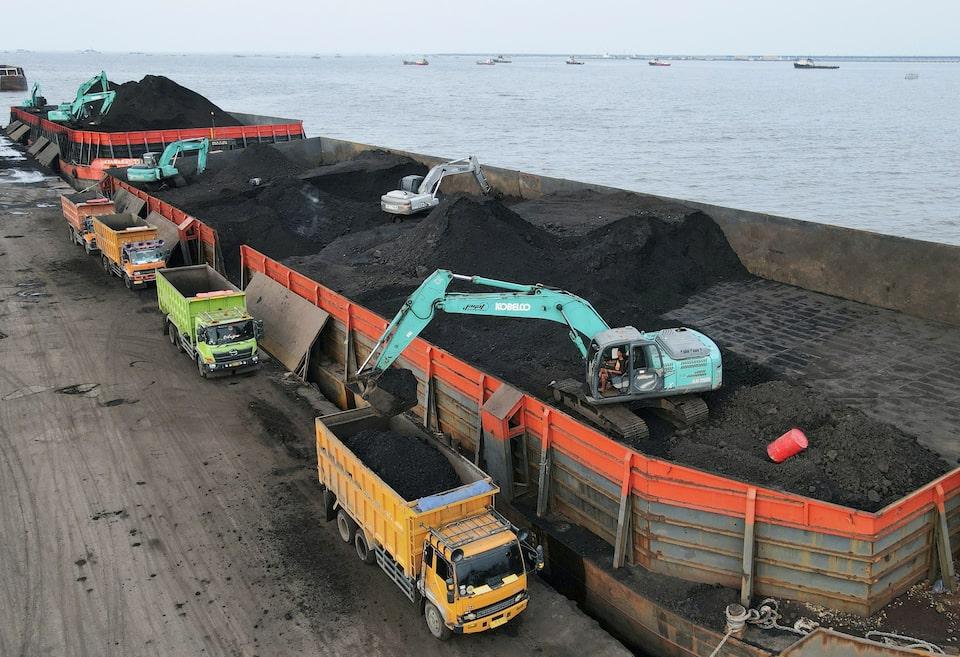
LITTLETON, Colorado, Feb 4 (Reuters) - Utilities across Asia are scrambling to plug a potential shortfall in critical coal supplies after miners in the top global coal producer Indonesia halted spot coal exports in protest over government proposals to limit output. An Indonesian coal mining official said that exports tied to long-term contracts would be maintained, but that spot shipments would be "limited until a final decision is made on the government quotas." The official also warned that even some term contracts are at risk as miners face unforeseen circumstances. Sign up here. Indonesia supplied half of all global thermal coal exports in 2025, and is by far the top coal supplier to many of the world's largest coal importers including China, India, Vietnam and the Philippines. However, an extended stretch of weak global prices has spurred Indonesia's government to propose production cuts and quotas in a bid to drive up export prices and tax revenues. Indonesian mining firms have also threatened layoffs and mine closures as a result of any forced output cuts, which has put the government under pressure to forge a compromise before mining activity and export flows grind to a halt. The authorities have proved willing to play hardball with the mining sector before, and briefly suspended coal exports in 2022 due to a shortage of coal supplies at local power plants. That suspension triggered a steep climb in global coal prices at the time, and benchmark futures on Asian seaborne thermal coal have already climbed 9% to their highest in over a year on the back of the latest intervention. Further price gains in global coal markets are likely as key importers react to the threat of a steep fall in supplies from Indonesia and attempt to secure replacement volumes from other exporters and trading houses. WIDE SPAN Sixteen different nations imported 1 million metric tons or more of Indonesian thermal coal in 2025, data from commodities intelligence firm Kpler shows. That span of countries ranged from nearby Brunei to China, and includes most of the world's top coal consumers. However, some countries are more reliant on Indonesian supplies than others, as key countries including China and India depend mainly on domestic mines for most of their coal needs. That said, several Southeast Asia and South Asia economies are almost entirely dependent on imports for their total coal supplies, and run power systems that use coal as their primary source of electricity. Further, any sustained fall in Indonesian volumes on global coal markets will have far-reaching impacts, as Asian utilities are already under pressure to meet the peak in regional heating demand and depend on coal for over half of electricity output. IN A PINCH The Philippines, Bangladesh, Vietnam and Malaysia stand out as the countries that may be most sensitive to the Indonesia coal disruption. The most import-dependent buyer of Indonesian coal in 2025 was the Philippines, which secured 98% of its total coal imports from Indonesia, according to Kpler data. Further, coal is by far the top source of electricity in the Philippines, and accounted for around 57% of utility electricity output last year, data from energy think tank Ember shows. Bangladesh also secured more than 90% of its coal imports from Indonesia last year, and last year lifted coal's share of its electricity supply mix to record highs. Malaysia and Vietnam secured more than half of their annual coal imports from Indonesia in 2025, and also rely on coal for 40% or more of their utility electricity supplies. FARTHER AFIELD The impact from any lengthy stoppage in Indonesian spot coal exports will be felt even in less import-reliant markets such as China and India, due to the configuration of coastal power plants. Several major coal-fired power plants in China and India are located close to major bulk commodity import ports, and so source most of their coal from international suppliers rather than from the domestic market. In the event of a sustained rally in international coal markets, those power plants can source more coal from the domestic market but will incur higher transit costs as trucks and rail systems replace bulk vessel deliveries. That means that even though utilities in the Philippines and Bangladesh may be the first to respond to Indonesia's export halt, all coal plants in Asia will likely be impacted as markets price in volume cuts from the world's top supplier. The opinions expressed here are those of the author, a columnist for Reuters. Enjoying this column? Check out Reuters Open Interest (ROI), your essential new source for global financial commentary. Follow ROI on LinkedIn , opens new tab and X , opens new tab. And listen to the Morning Bid daily podcast on Apple , opens new tab, Spotify , opens new tab, or the Reuters app , opens new tab. Subscribe to hear Reuters journalists discuss the biggest news in markets and finance 7 days a week. https://www.reuters.com/markets/commodities/asias-power-mix-be-shaken-up-by-indonesias-coal-export-stoppage-2026-02-04/
2026-02-04 05:54
Uniper's Poppinga trusts US LNG system over political concerns Uniper emphasizes need for diversification in LNG sourcing US LNG accounts for 96% of Germany's LNG imports DOHA, Feb 4 - A top executive at German utility Uniper has played down European concerns over increasing dependence on liquefied natural gas (LNG) from the United States, saying companies sign contracts with firms rather than governments, while stressing the need for diversification. U.S. President Donald Trump's transactional diplomacy and his pursuit of "energy dominance" has sharpened European concerns about their heavy reliance on U.S. LNG, which replaced most of the volumes previously supplied by Russia. Sign up here. The European Union's LNG imports from the U.S. stood at almost 60 million tons in 2025, nearly four times higher than its 2021 levels, according to Kpler data. "We are not dealing with an administration, we are dealing with companies operating in a certain system and I trust that system," Carsten Poppinga, Uniper's chief commercial officer, told Reuters in an interview on the sidelines of the LNG2026 conference in Doha, Qatar. "That there will be a dominance of U.S. LNG, I think that's understandable and right, because it's the most economical solution." Nevertheless, companies need to manage portfolio risks by means of diversification, he added. Germany imported 1.031 terawatt hours (TWh) of pipeline gas and LNG in 2025, up more than 16% year-on-year, with Norway (44%), the Netherlands (24%) and Belgium (21%) being the top suppliers, according to figures from the country's energy regulator. Around 10% of all imports occurred via the country's LNG terminals, most of which were hastily built during Europe's energy crisis, with the United States accounting for 96% of those. In April 2025, Uniper signed an LNG deal with Woodside Energy (WDS.AX) , opens new tab, with supply coming from the Australian firm's global portfolio as well as its Louisiana project in the U.S. Poppinga added that the company would seek to diversify its supply sources to include the Middle East and Argentina. "We will have a large share of U.S. LNG in the portfolio in Europe, there's no way around it. The only thing I'm saying is that you need this diversification. How much percentage that is, any company needs to decide for itself, but you need to have partners from different regions in the world." His comments were echoed by Egbert Laege, chief executive of German energy firm SEFE, who said Europe must not repeat past mistakes by becoming overly dependent on a single supplier or region. "In 2022, there was a big temptation just to travel a couple of miles further out on the Gulf Coast to get another supplier in the portfolio. But if there is one lesson that we can learn from a European side... diversification, that's the best risk management tool," Laege said at the conference during a panel session. "Of course, in the aftermath of 2022, the first reaction of Europe was to look to the U.S., because there were many projects on the verge of being licensed, but I think it would be a very big mistake to just lean on one region... Europe should not repeat to depend too much on one region." Asked about concerns of an LNG supply glut as new projects, mainly from the United States and Qatar come online later this year through 2029, Poppinga said the market would ultimately "rebalance" and Asia's rising demand should absorb additional volumes, expecting longer-term European gas prices to settle around €20–25/MWh. "It might take some time (to rebalance), but I don't believe in a structural, long lasting oversupply," he said. https://www.reuters.com/business/energy/germanys-uniper-downplays-increasing-reliance-us-lng-stresses-diversification-2026-02-04/