2025-10-29 12:35
Oct 29 (Reuters) - 21Shares on Wednesday filed for regulatory approval to launch a passive exchange-traded fund that would track the price of Hype token, a week after the company agreed to be acquired by digital assets trading firm FalconX. The U.S. Securities and Exchange Commission has been flooded with filings for ETFs tied to cryptocurrencies, as money managers and institutions seek exposure to the rapidly growing asset class via conventional platforms. Sign up here. In September, the regulator removed the last remaining hurdle to dozens of new spot ETFs tied to cryptocurrencies ranging from solana to dogecoin. However, SEC's approval for the dozens of crypto ETF filings is still pending as the agency continues to function with skeletal staffing amid a U.S. government shutdown. Hype, the native digital asset of the Hyperliquid network, is the eleventh largest cryptocurrency by market value, according to CoinMarketCap. The token's price has multiplied more than 15 times over the past 12 months. Passive ETFs track a chosen index or asset's price by holding it in unchanged proportions, while active ETFs actively pick and choose investments to generate a predetermined return. 21Shares has chosen Coinbase (COIN.O) , opens new tab and BitGo as the custodians for its holdings, it said in the filing. Founded in 2018, 21shares now manages over $11 billion in assets across dozens of products. FalconX plans to leverage 21shares' expertise in crypto ETFs and its brokerage platform to advance the adoption of digital asset investment products. https://www.reuters.com/sustainability/boards-policy-regulation/21shares-files-hype-etf-amid-robust-crypto-allure-2025-10-29/
2025-10-29 12:28
Oct 29 (Reuters) - Adidas (ADSGn.DE) , opens new tab expects U.S. import tariffs to have a direct impact of 120 million euros ($140 million) on its operating profit in 2025, with the largest hit coming in the fourth quarter, its CEO said on Wednesday. "The indirect impact of the tariffs, we don't know. We do not know how the consumer will react in the U.S. when these higher prices come to effect," CEO Bjorn Gulden said during a media call. Sign up here. Adidas has increased prices in the United States to offset the impact of tariffs. ($1 = 0.8575 euros) https://www.reuters.com/business/retail-consumer/adidas-sees-140-million-hit-operating-profit-us-tariffs-2025-10-29/
2025-10-29 12:25
Oct 29 (Reuters) - China's Sinopec (600028.SS) , opens new tab reported on Wednesday a 32% year-on-year decline in net income for the first three quarters due to lower oil prices and weaker fuel sales. The world's largest refiner by capacity, Sinopec's third-quarter net profit was 8.5 billion yuan ($1.19 billion), largely flat from a year earlier, based on Chinese accounting standards. Net income for the first nine months was 29.98 billion yuan ($4.21 billion), Sinopec said in a stock filing. Sign up here. Between January and September, Sinopec processed 186.4 million metric tons of crude oil, or about 4.98 million barrels per day (bpd), down 2.2% from a year earlier. Sales of refined fuels fell 5.7% year-on-year during the period to 171.4 million tons. Of that, domestic sales made up 133.1 million tons, down 3.6%. As oil prices weakened along with fuel sales, "the company optimized plant utilization and maximized output of the profitable products," Sinopec said. As a result, its refining department raked in 7 billion yuan profit before tax and interests for the 9-month period. Sinopec produced 211.2 million barrels of crude oil during the first three quarters, down 0.1% on the year, while natural gas output rose 4.9% to 1,099.3 billion cubic feet. Capital expenditure for the first nine months reached 71.6 billion yuan, versus 86.35 billion a year earlier, with nearly 60% of the spending on exploration and development projects such as Jiyang shale oil in east China and Tahe oilfield in the northwest. The chemicals segment reported a 8.2 billion yuan loss before tax and interests during the nine-month period, despite a robust 15.4% growth in ethylene output, owing to "continued new capacity release" and "persistently thin margins." Sinopec's Hong Kong-listed shares have dropped 5.2% year-to-date, underperforming the Hang Seng index (.HSI) , opens new tab which has risen 31.3% during the period. (metric ton = 7.3 barrels for crude oil conversion) ($1 = 7.1230 Chinese yuan renminbi) https://www.reuters.com/sustainability/climate-energy/sinopecs-jan-sept-profit-down-third-lower-oil-weaker-fuel-sales-2025-10-29/
2025-10-29 12:24
FTSE 100 up 0.8%, FTSE 250 up 0.2% Glencore gains on strong copper output Next shines after fourth outlook upgrade GSK gains as cancer, HIV drug sales lift 2025 outlook Oct 29 (Reuters) - London stocks gained on Wednesday, with the blue-chip FTSE 100 advancing to a record high for a second consecutive session, on the back of strong forecasts from drugmaker GSK and retailer Next. The FTSE 100 (.FTSE) , opens new tab was up 0.8% to 9,779.32 points, as of 1205 GMT, also helped by a weaker pound that enhances the revenue for internationally-focused companies. The domestically-focused FTSE 250 (.FTMC) , opens new tab edged up 0.2%. Sign up here. Healthcare stocks (.FTUB2010) , opens new tab gained 2% and gave the biggest boost to the FTSE 100. GSK (.GSK.L) , opens new tab gained 3.3% after raising its 2025 sales and earnings forecasts on strong sales of its speciality HIV and cancer medicines. Next's (NXT.L) , opens new tab shares surged 7.5% to a record high after raising its full-year profit guidance for the fourth time in eight months. The broader retail sector (.FTNMX404010) , opens new tab surged 3%. "Next is benefitting from a virtuous circle in its international business – strong sales are enabling more spending on digital marketing which in turn drives higher profitable sales, enabling a higher digital marketing budget, pushing sales further ahead," said Steve Clayton, head of equity funds at Hargreaves Lansdown. The focus will now shift to the U.S. Federal Reserve's monetary policy meeting. Traders are expecting a 25-basis-point interest rate cut and will parse comments from Chair Jerome Powell for guidance on future policy path. Among other stocks, Glencore (GLEN.L) , opens new tab gained 6.2% after the miner's third-quarter production report showed copper output surged 36% quarter-on-quarter. Gold miner Fresnillo (FRES.L) , opens new tab advanced 6.5%, as brokerage Peel Hunt raised its target price to 1,954 pence from 1,493 pence. Precious metal miners (.FTNMX551030) , opens new tab rose 4.5% and led sectoral gains, tracking a bounce in gold prices. GOL Meanwhile, Bank of England data showed lenders approved more mortgages in September than in any month so far in 2025, which could help counter recent signs of wariness in the housing market ahead of Finance Minister Rachel Reeves' budget next month. https://www.reuters.com/world/uk/ftse-100-hits-record-high-strong-forecasts-gsk-next-2025-10-29/
2025-10-29 12:15
BEIJING, Oct 29 (Reuters) - Shares in China's solar companies jumped on Wednesday after an industry executive told state media that leading firms were forming an association, raising expectations that the industry would move forward with a plan to pare back overcapacity. "Seventeen companies have basically already signed. We are building an association," the chairman of polysilicon producer GCL Technology Holdings (3800.HK) , opens new tab, Zhu Gongshan, told CCTV on Tuesday night. "We are making an effort to complete it this year." Sign up here. Some market participants interpreted the comments as related to a proposal introduced by GCL in July that would see China's largest producers of polysilicon, a building block for solar cells, create a fund to acquire and shut down a portion of the sector's bloated capacity. GCL said at the time that the acquisition fund would launch in the third quarter. Polysilicon producer Tongwei (600438.SS) , opens new tab closed up 10% on Wednesday and top solar equipment manufacturers Trina Solar (688599.SS) , opens new tab and Longi Green Energy (601012.SS) , opens new tab rose 11% and 10%, respectively. The Hong Kong exchange, where GCL is listed, was closed on Wednesday for a public holiday. The CCTV segment detailed the central government's repeated calls since July to address overcapacity and unsustainable competition in the solar sector, and reported that the industry is scaling back production. CCTV found that at Longi's Xian operations, nine of 15 production lines were closed for upgrades. And an employee at a Jiangsu polysilicon factory told CCTV the company was adhering to production limits set by the industry association. But global solar demand is also falling, Zhu said. It is expected to reach 480 gigawatts (GW) next year, down from 520 to 540 GW this year, he said, calling the drop a "new inflection point" for an industry that has seen demand grow for years. https://www.reuters.com/sustainability/climate-energy/china-solar-shares-jump-after-state-media-report-overcapacity-2025-10-29/
2025-10-29 12:04
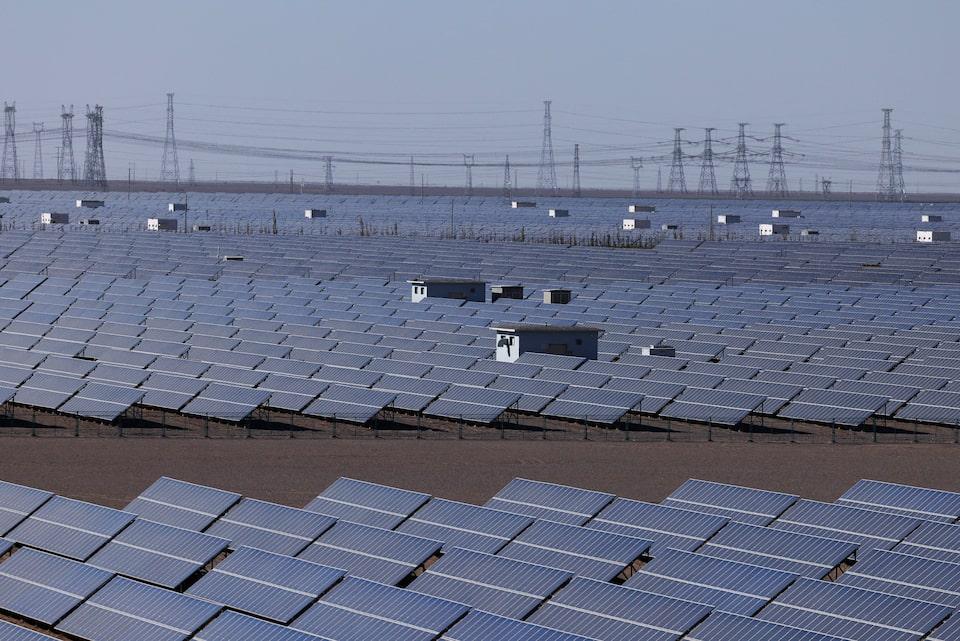
Solar cheaper than gas and coal, Tenaga CEO says 2030 power sector gas use to rise over 40% to 1,000 MMSCFD Local gas-based power 29% cheaper than LNG-fired power SINGAPORE, Oct 29 (Reuters) - Malaysia will focus on a mix of solar and gas-fired power generation as it shifts away from coal, the chief executive of state utility Tenaga Nasional (TNB) (TENA.KL) , opens new tab said on Wednesday, adding that the renewable source would help keep costs down. The Southeast Asian nation of over 35 million people has been cranking up its coal-fired power fleet to keep electricity costs low, but plans to boost the use of natural gas and solar - the former being more flexible but the latter cheaper. Sign up here. "The cost-per-unit for solar is actually much cheaper than gas and coal. The best position is that we have a good mix so that the affordability will be addressed," TNB CEO Megat Jalaluddin told Reuters in an interview. MALAYSIA MAY NEED LNG IMPORTS IN FUTURE Malaysia is expected to add 6-8 gigawatts of gas-fired capacity and more than double its renewable capacity of 9 GW as it looks to cut dependence on coal from 2029. Coal currently accounts for 43% of Malaysia's annual power output, while gas makes up about 37% and solar over 2%, data from energy think-tank Ember shows. The country is the fifth-largest exporter of liquefied natural gas, but has said it could start importing the superchilled fuel this decade, amid rising power demand from data centres. Jalaluddin said he expected gas consumption by the power sector to rise to around 1,000 million standard cubic feet per day (MMSCFD) by 2030 from around 700 MMSCFD currently, forcing utilities to switch to pricier LNG imports to address incremental demand. Malaysia currently depends almost entirely on its relatively cheap local natural gas supply for power generation, and per-unit costs of LNG-fired power are about 29% more expensive than local gas-based electricity, he said. Separately, Malaysia is pushing data centre developers to invest outside the southern Johor state - home to two-thirds of its 4,000 megawatt data centre capacity, and new data centres with over 500 MW capacity are coming online in central Pahang state and Melaka next year, Jalaluddin said. "As owner and operator of the grid, we would like to see infrastructure built in a balanced manner throughout the country," he said. https://www.reuters.com/sustainability/climate-energy/malaysia-bets-mix-solar-gas-it-shifts-away-coal-2025-10-29/