2024-05-08 06:32
Siemens Gamesa CEO Eickholt to step down by end-July To resume 4.X sales in Europe by end-September Now expects 2024 sales to grow by 10-12% Q2 profit before special items up more than fourfold Shares +6.6% pre-market FRANKFURT/DUESSELDORF, May 8 (Reuters) - Siemens Energy will replace the boss of its troubled wind turbine division after little more than two years in the job, the company said on Wednesday, also flagging job and capacity cuts as it tightens its grip on the loss-making business. The company, a former Siemens (SIEGn.DE) New Tab, opens new tab division that supplies equipment to the power industry, also raised its outlook for 2024, primarily on the back of its power grid business, causing its shares to rise 6.6% in pre-market trade. The group, in presentation slides alongside second-quarter results, said that sales of its 4.X onshore turbine, one of the platforms plagued by quality issues and responsible for a group-wide crisis, would resume in Europe by the end of September. It made no mention on when sales of the 5.X model, the other affected platform, would restart. Jochen Eickholt, who took over as Siemens Gamesa CEO in March 2022, will step down at the end of July and be replaced by Siemens Energy board member Vinod Philip, the company said, adding it was time for a generational change at the struggling business that has been loss-making for years. Eickholt, a Siemens veteran, led the wind turbine maker through its most turbulent time since it was created in 2017, including last year's product quality crisis, which prompted Siemens Energy to seek billions of euros in state-backed guarantees. "It is only fair to emphasise that the causes of the quality problems did not fall under his tenure as CEO," said Siemens Energy CEO Christian Bruch. Going forward, Siemens Gamesa's onshore business will be focused on two main markets, Europe and the United States, the group said, fleshing out a more streamlined approach that was first flagged late last year. Thanks to strong demand for power grid equipment, Siemens Energy raised its outlook for sales, operating profit and free cash flow, now expecting revenues to grow by 10%-12% in 2024. Second-quarter profit before special items rose more than fourfold to 170 million euros ($183 million) in the second quarter. "Very strong reporting. Visibility to us seemed rather low so this is a positive surprise," a local trader said. ($1 = 0.9308 euros) Sign up here. https://www.reuters.com/business/energy/siemens-energy-raises-outlook-flags-ceo-change-troubled-wind-unit-2024-05-08/

2024-05-08 06:15
MATHURA, India, May 8 (Reuters) - Indian Prime Minister Narendra Modi has drawn up new targets to boost farmer incomes as he seeks to secure his legacy of reforming the world's largest democracy and tries to assuage a key voting bloc disillusioned by his government's past failures. Modi, who is eyeing a rare third term in ongoing elections, wants to lift rural per-capita income by 50% by 2030, according to documents reviewed by Reuters. He plans to raise incomes in the hinterland by increasing corporate investments in agriculture to 25% of the overall investment in the sector from 15% now and increase non-farm jobs through strengthening small scale industries, the documents prepared by Modi's administration show. Modi's focus on reforming the agricultural sector and improving the rural standard of living is crucial to sustain India's fastest growing tag without increasing inequality between urban and rural Indians that has worsened during his term. "While agriculture occupies a shrinking share of India’s GDP, it still accounts for more than 40% of the labour force," Milan Vaishnav, an expert on South Asian politics and economy at the Carnegie Endowment for International Peace think-tank. "I think Modi’s economic legacy will hinge, at least in part, on what happens to this large share of rural dwellers." But having failed to double farmer incomes by 2022 as promised in 2016 during his first tenure, the new targets are less ambitious and are likely to face scepticism in many parts of the rural community. Modi’s last big reform push was met with violent protests by farmers that forced him to repeal three farm laws in 2021 aimed at increasing corporate participation and deregulating the sector that accounts for about 20% of the economy. Modi has set out a broad plan for the country of 1.4 billion to become a developed nation by 2047 when it will mark 100 years of freedom from British rule, and transformation of the farm sector is key to that objective. By then, Modi wants corporate investments in agriculture to jump to more than 40% by 2047 which will aid mechanized farming, help develop more warehouses, cold storage facilities and food processing units. FAILED PROMISES The new targets, however, are seen by many farmers spoken to by Reuters in Uttar Pradesh, Maharashtra and Odisha as tough to achieve. "Forget about doubling our incomes, they are in decline," 32-year old Sanjay Kumar said while sitting besides his wheat at an auction market in the ancient city of Mathura in the northern state of Uttar Pradesh. "Input costs for farming have increased, but the rise in prices for our crops are not commensurate. How will incomes rise?" Rural wages have indeed stagnated during Modi's rule. Real rural wages growth was around 1% in 2023 after contracting nearly 3% in the previous two years, according to credit rating agency ICRA, while salary growth in urban areas was about 10%. "Modi ji is always talking a big game, making all these promises and painting these grand pictures for us," said Kishore Patil, a cotton farmer in the western state of Maharashtra, using a term of respect for the leader. "But when it comes down to it, he never follows through." Opinion polls had predicted Modi's Bharatiya Janata Party (BJP) and its allies could win up to three-fourths of parliament's 543 seats at stake, but lacklustre voter turnout is creating doubts about the outcome. There are no term limits for the prime minister but this could be Modi's final tenure in office if he sticks to an unwritten party rule that calls for leaders to quit public office after the age of 75. Modi turns 74 in September. Emails seeking comments from the prime minister's office, and the ministries of finance, agriculture, information and broadcasting and were not answered. CORPORATE FEARS Farmers are also sceptical about plans to increase corporate participation in the sector. "With a system with companies around, we are fearful that if anything goes wrong, we will lose control of our land and our crops," said Arun Kumar, a wheat farmer in Mathura. The government "should explain things to us properly so that we are aware of the pros and cons of higher corporate investments," Kumar added. The documents did not show if the government had plans to bring back the farm laws to increase corporate investment in the sector. "Farm laws are neither necessary nor sufficient to solve the agricultural problem," said Rathin Roy, an economist and former adviser to Modi. Raising corporate investments will not automatically turn the sector profitable, and as an initial step the government should get "hard commercial information" on agriculture, reduce its price interventions and avoid sudden policy changes, Roy said. As incomes fell, farmers hit the streets again earlier this year seeking legal guarantees for government minimum support prices (MSP) for all their crops. During Modi's 10 year rule, MSP for rice and wheat rose 67% and 63%, respectively, versus 138% and 122% over the previous decade, government data showed. What's more, Modi banned exports of wheat, rice and onions when prices rose to contain domestic inflation, which hurt farmer incomes. Last week, India lifted its ban on onion exports ahead of voting in key onion-growing areas. "Whenever there is a chance to get a good rate, Modi ji comes in and stops exports. So is this the government doing good work?", said farmer Meera Singh, 38. "Not one thing they have got right." The opposition Congress party has also made promises to better farmer incomes in their manifesto for the ongoing elections. Congress has said it will add legal guarantees to the MSP, waive farmer loans and dole out annual cash handouts of 100,000 rupees to unemployed youth and poor women. Modi's manifesto includes plans to raise MSP for crops and strengthen infrastructure to attract investments and create jobs. "I do not doubt their intentions but it has to be implemented in the ground," said Dilleswar Pradhan, a paddy farmer in Odisha. ($1 = 83.3200 Indian rupees) Sign up here. https://www.reuters.com/world/india/indias-modi-chasing-reform-legacy-shifts-income-goals-struggling-farmers-2024-05-08/

2024-05-08 06:05
LONDON, May 8 (Reuters) - If worries about sterling were a factor preventing the Bank of England cutting interest rates too far ahead of the U.S. Federal Reserve, then Japan's dollar-selling intervention may, weirdly, help keep its options open. Britain's central bank announces its latest policy decision on Thursday. While its unlikely to change UK base rates this week, there's speculation about whether it may guide markets towards a cut as soon as next month - just two weeks after a widely flagged move from the European Central Bank on June 6. More dovish recent noises from senior BoE figures, not least Deputy Governor Dave Ramsden, suggest some rhetorical movement in the Bank's Threadneedle Street home - even as Fed hawks hang tough on a 'higher-for-longer' tack across the Atlantic. As it stands, money markets see a 90% chance of an ECB move next month, but less than a 50% chance of a June BoE cut - with a quarter-point reduction for the latter not fully priced until its Aug. 1 meeting. With a first Fed easing now not fully discounted in the futures market until November, that middle ground may seem comfortable for UK policymakers. However, BoE hesitation in joining the ECB may stem in part from a reluctance to undermine the pound against a resurgent U.S. dollar - as that in turn may just aggravate dollar-priced import costs in energy, commodity and other goods and cut across the UK disinflation process. But if the dollar has come off the boil more generally, there could well be bolder view in London. To that effect, Japanese government intervention over the past week to sell dollars and put a floor under its plunging yen might finally turn down the heat on the greenback - just as the Fed cools simmering speculation of another hike there. Morgan Stanley strategists point out that when Japan last intervened to sell the U.S. currency in late 2022, the dollar's broader DXY (.DXY) New Tab, opens new tab index - which is almost 60% weighted against the euro but up to 14% and 12% respectively against the yen and sterling too - recoiled 10% over the following three months. While they're quick to point out that wasn't all down to Japan selling, the snowballing was aided back then by a resumption of U.S. disinflation and a China rebound - not an unlikely combination this time around either, even if less forceful. With the dollar on a tighter leash at least, BoE willingness to signal some more independence from the standing Fed policy timeline may increase. And reckoning the door may well open up this week for a June BoE rate cut, the Morgan Stanley team said its estimate of a 4.5% "sensitivity" of the sterling/dollar exchange rate to every 100 basis point fall in two-year U.S.-UK yield gaps would make that tolerable. "While unhelpful for the near-term inflation dynamic, this is not a dramatic depreciation," it wrote, adding it's enough to allow the BoE to deviate somewhat from the Fed. 'ALTERED GUIDANCE' Deutsche Bank strategist Shreyas Gopal and UK economist Sanjay Raja riffed off a similar theme and said "divergence between the BoE and Fed is coming closer into view now." The Deutsche pair said the environment of low currency market volatility (.DBCVIX) New Tab, opens new tab more generally has reduced the sensitivity of sterling to a diverging rate path. It sees an even smaller 3.5% fall in the pound on a 100 basis point drop in the two-year U.S.-UK rate gap versus what would have been an equivalent 8% hit to the pound in the decade before COVID-19. And that sort of contained currency hit would only see a modest 6 basis point increase in UK inflation over the following year, they said. Barclays too thinks the BoE will hold the line this week - but "with altered guidance to pave the way to a June cut." Further encouraging the BoE to lean to June will be the way in which the euro took only a glancing blow over the past couple of months as ECB officials insisted a cut next month is in store. And so while Japanese intervention may be the furthest thing from BoE policymakers' thinking on Thursday, Tokyo's timely shot across the dollar's bow may indirectly encourage them that the pound can hold up comfortably in the crossfire. The opinions expressed here are those of the author, a columnist for Reuters. Sign up here. https://www.reuters.com/markets/currencies/japans-helping-hand-with-boe-june-rate-cut-window-mike-dolan-2024-05-08/
2024-05-08 06:05
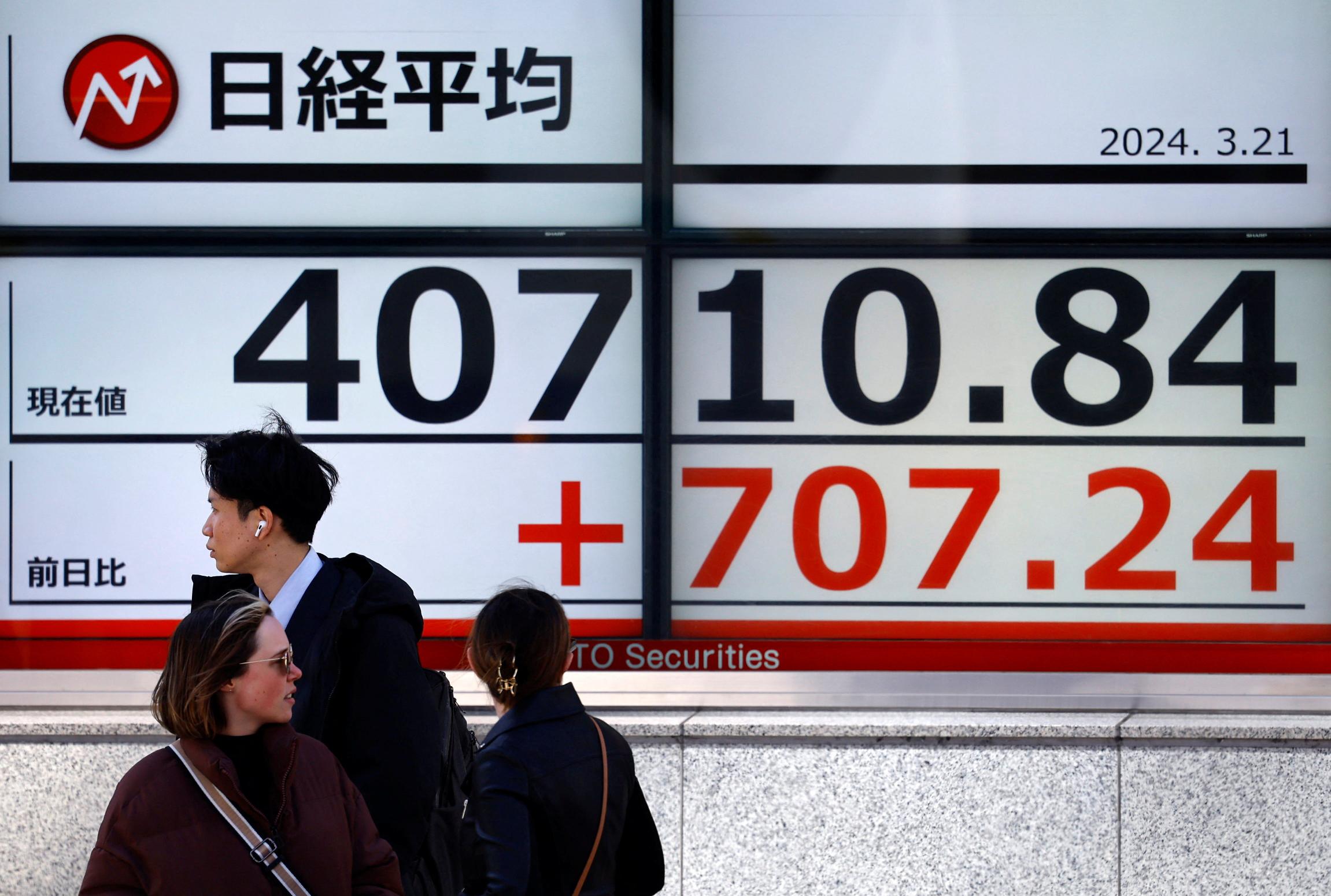
Fed still is focus as market pauses ahead of CPI data European stocks hit record high, Wall Street ends mixed Dollar gains on U.S. exceptionalism trade Oil edges up after U.S. stockpiles fell last week NEW YORK/LONDON, May 8 (Reuters) - Global equity markets mostly faltered on Wednesday as investors await fresh inflation data to better assess the likelihood of Federal Reserve interest rate cuts, while the dollar edged higher on expectations of U.S. economic out-performance. European stocks rose to a record high, boosted by company earnings, but stocks on Wall Street slid as a downbeat forecast from Uber (UBER.N) New Tab, opens new tab knocked its shares down 5.7% and made the ride-hailing firm one of the biggest decliners on the S&P 500. The yen weakened for a third day and kept investors wary of intervention from Japanese authorities, while crude oil edged up from near two-month lows. In Europe, the Swedish crown was under pressure after the central bank cut rates as expected and said two more cuts were likely this year if inflation remained mild. The big concern among traders and investors is whether inflation is on course to reach the U.S. central bank's 2% target and when Fed Chair Jerome Powell might cut rates. Fed Boston President Susan Collins said the U.S. economy needs to cool off as an avenue toward getting inflation back to the central bank's 2% target. "The market is still very much waiting for the CPI report next Wednesday. We're basically stuck in a bit of a range here until we get data," said Gennadiy Goldberg, head of U.S. rates strategy at TD Securities in New York. "Investors are still very cautious at this point. They don't want to over extrapolate from one data point or a couple of developments," he said. MSCI's gauge of stocks across the globe (.MIWD00000PUS) New Tab, opens new tab fell 0.18%, while Europe's pan-regional STOXX 600 index (.STOXX) New Tab, opens new tab rose 0.34% to a record close. On Wall Street, the Dow Jones Industrial Average (.DJI) New Tab, opens new tab rose 0.44%, the S&P 500 (.SPX) New Tab, opens new tab closed unchanged and the Nasdaq Composite (.IXIC) New Tab, opens new tab slid 0.18%. Global stocks fell sharply in April as strong U.S. economic data caused investors to rein in their bets on rate cuts from the Fed and, by extension, other major central banks this year. Stocks, however, have rallied in May, partly encouraged by last week's nonfarm payrolls, which showed a cooling in the hot U.S. labor market but remained stronger than pre-pandemic data. "Investors continue to underestimate or miscalculate interest rate cuts," said Michael Arone, chief investment strategist at the U.S. SPDR business at State Street Global Advisors in Boston. However, if the economy expands with inflation anchored and the labor market reasonably strong, "that makes for a pretty good backdrop for stocks," he said. "So unless some of those ingredients change, the markets will continue to do OK." In currency markets, the yen dropped 0.61% to 155.64 per dollar even after Bank of Japan governor Kazuo Ueda said the central bank may take monetary policy action if currency falls affect prices significantly. Japan has intervened to boost the currency from its lowest level in 34 years in recent days, according to traders and analysts, keeping the market alert for further swings. The dollar index , which tracks the currency against six peers, rose 0.13% to 105.55 and was less than 1% below a 5-1/2 month high touched in April. The euro was down 0.09% at $1.0742. U.S. Treasury yields have fallen in recent days as traders have moved to price back in two rate cuts from the Fed this year, having seen one as most likely in the middle of April. The 10-year yield, which moves inversely to its price, rose 3.7 basis points to 4.498%. Oil prices edged higher after U.S. oil storage data showed a draw in crude stockpiles as refiners ramped up output ahead of the summer driving season. U.S. crude rose 61 cents to settle at $78.99 a barrel and Brent settled up 42 cents at $83.58 per barrel. Gold steadied as while investors awaited data for clues on potential Fed rate cuts, though a slight uptick in the dollar limited any upside. U.S. gold futures for June delivery settled 0.1% lower at $2,322.30 per ounce. Bitcoin fell 1.31% to $62,142.09. Sign up here. https://www.reuters.com/markets/global-markets-wrapup-1-2024-05-08/
2024-05-08 06:02
LITTLETON, Colorado, May 8 (Reuters) - China's hydro dams generated their lowest share of total electricity output in at least eight years during the first quarter of 2024, but look primed for a rebound following heavy rains across key parts of the south and southwest. Hydro power accounted for just 9% of China's total electricity output during the first quarter of 2024, down from a 5-year average of 11% during that period, data from think tank Ember shows. In absolute terms, total hydro generation during the first quarter was 212 terawatt hours (TWh), which was up 2% from the same period in 2023 but well below potential capacity following a lengthy drought since mid-2022. Below-par output from hydro dams, which provide China's electricity generators with a key source of dispatchable clean power, has meant power firms have had to boost coal-fired generation to record highs this year to balance system needs. However, heavy rains during April and early May look set to sharply boost hydro dam generation heading into the summer, when China normally receives its peak rainfall during the East Asia monsoon season. In June of 2022, the last summer that China's hydro output matched average levels, hydro dams accounted for over 20% of total national electricity generation, and so provided a key source of clean power just as China's total electricity demand needs hit their peak due to higher air conditioner demand. In 2024, if precipitation keeps climbing back towards average levels, hydro dams could potentially match that share of national electricity output, which may help power firms cut back on coal-fired output and limit associated emissions. DROUGHT-BUSTING RAINS? Southwest China is the main region for hydro generation, with the provinces of Sichuan and Yunnan alone accounting for 48% of total hydroelectric generation in 2020, according to National Bureau of Statistics data. Since mid-2022, the region has been hit by sustained drought, with some areas reporting 50% or less of normal annual rainfall levels. Some of those same areas have been hit by very heavy rains in recent weeks, however, which may reverse the regional hydro output underperformance. "Southern parts of China are expected to see more rainfall than usual this month," China's National Climate Center reported in early May. "Precipitation in many areas in this part of China will be 20 percent to 50 percent higher than for the same period in average years, and this may lead to more floods in these areas," it added, noting national precipitation in April was 51.8% higher than the overall average. In Sichuan province, accumulated rains from April 1 to May 4 totalled 92.4 millimetres, compared to a long-term average of 57.6 millimetres over the same period, according to LSEG. Forecasts for Sichuan through May 16 call for roughly twice the normal amount of rain, LSEG data shows, so the soggy conditions look set to persist. HYDRO REACTION Not all the recent rains will yield more hydro dam output, as much of the precipitation flooded fields, towns and cities that were miles away from the main hydro dam systems. However, due to China's extensive sewage and drainage channels, large volumes of the recent rains will have been steered into regional river and reservoir networks, from where they will flow though electricity-generating dam systems. Data for April hydro generation is not yet available, but is likely to be sharply above the 71.77 TWh generated in March, according to Ember. The April generation average from 2018 through 2022 was 79.8 TWh, but output could surpass in 2024 thanks to newly added capacity brought online in 2023 and so far in 2024. New installations include the one of the world's highest elevation hydro dams, the Maerdang station in northwest Qinghai province, which commenced operations last month and when fully operational could provide about 15 TWh of electricity annually, according to operator China Energy Investment Co Ltd. Combined with higher output from the south/southwest dam network, the Maerdang and other power stations have the potential to reverse the recent declining trend in national hydro output, and help boost total clean power production. Sign up here. https://www.reuters.com/business/energy/chinas-hydro-output-primed-boost-after-heavy-rains-maguire-2024-05-08/
2024-05-08 05:42
MUMBAI, May 8 (Reuters) - The Indian rupee was under pressure on Wednesday on portfolio outflows and dollar payments by oil companies, but remained largely supported near an important level. The rupee was at 83.50 to the U.S. dollar at 10:54 a.m. IST, barely changed from the previous session. "It's just that we have non-stop bids (on USD/INR). Oil companies are buyers and have seen foreign banks too, likely related to portfolio outflows and fixing," a trader at a large public sector bank said. "That we are not moving higher (on USD/INR) is just a function that the market believes the RBI is there." Several traders reckoned that it was likely the Reserve Bank of India was selling dollars to keep the rupee from sliding below the all-time low of 83.5750. "However, it's difficult to be sure. The way I see it is that at open, they make it known that they will be there and then the market does the work for them," a senior trader at a private sector bank said. The rupee has been in a less-than-two-paisa range so far on Wednesday, with the realised volatility for the last 10 days at just an annualised 1% level. Other Asian currencies were mostly weaker and the dollar index inched up to 105.56. The dollar has managed to reclaim its upward momentum following its slide on the less-hawkish-than-expected Federal Reserve and weak U.S. payrolls. U.S. interest rate outlook remains a key point for the dollar. Federal Reserve Bank Minneapolis President Neel Kashkari said on Tuesday that while he has pencilled in two rate cuts for this year, it's possible that the Fed only cuts once, or opts for no rate cuts this year. Sign up here. https://www.reuters.com/markets/currencies/oil-companies-portfolio-outflows-keep-rupee-under-pressure-2024-05-08/