
2024-05-02 05:49
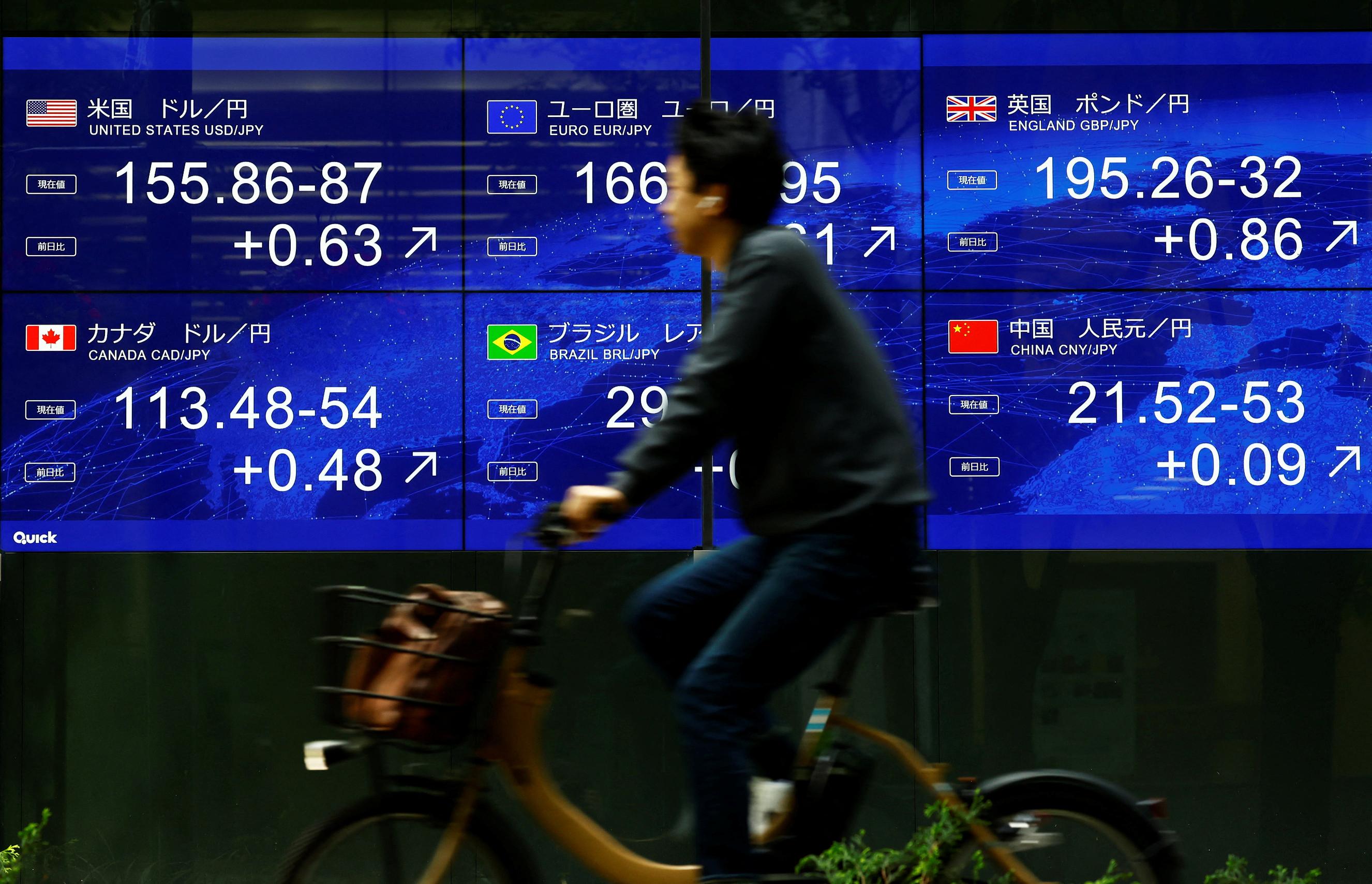
NEW YORK, May 2 (Reuters) - The yen gained on Thursday, following a sudden rally late on Wednesday that traders and analysts attributed to intervention by Japanese authorities, while the dollar was broadly lower before key jobs data on Friday. The sharp move in the yen on Wednesday came in a quiet period for markets after Wall Street had closed, and hours after the U.S. Federal Reserve had wrapped up its policy meeting. Fed Chair Jerome Powell confirmed the central bank's expectation to cut rates, but acknowledged such a move would come later than expected due to stubbornly high inflation. The dollar eased, however, due to the Fed not adopting a more hawkish tone that included the potential for further rate hikes. The timing of the intervention was "pragmatic," as “volumes were light, liquidity was thin, and it’s easier to make an impact at that time,” said Brad Bechtel, global head of FX at Jefferies in New York. The dollar was last down 0.9% at 153.09 yen. . Japan's vice finance minister for international affairs, Masato Kanda, who oversees currency policy at the Ministry of Finance, told Reuters he had no comment on whether Japan had intervened in the market. Wednesday's volatility came after a similar move on Monday, which was also during a time of light trading. “Clearly they want to make as much as an impact and do it as efficiently as possible,” said Bechtel. The Bank of Japan's official data indicated Japan may have spent 3.66 trillion yen ($23.59 billion) on Wednesday and 5.5 trillion yen ($35.06 billion) supporting the currency on Monday to pull it back from new 34-year lows. While the supposed interventions may buy Japan some time, the trend is likely to remain negative for the Japanese currency until the U.S. economy slows and as long as the Bank of Japan disappoints traders on how far it is willing to raise rates. The dollar remains up more than 10% against the yen this year, as traders push back expectations on the timing of a first Fed rate cut, while the BOJ has signaled it will go slow with further policy tightening after raising rates in March for the first time since 2007. The next major U.S. economic focus that could drive further moves in dollar/yen will be Friday’s jobs report for April, which is expected to show that employers added 243,000 jobs during the month. (USNFAR=ECI) New Tab, opens new tab "A lot hinges on tomorrow’s jobs report," said Marc Chandler, chief market strategist at Bannockburn Global Forex in New York. A weaker number would give Japanese authorities relief, and likely pull Treasury yields and the dollar lower. A strong report, however, could send yields and the greenback higher and increase the risk of further interventions. If 10-year Treasury yields approach the 5% region, "I’d say the dollar/yen is going to come under more pressure," said Chandler. "It’s all about what happens with U.S. rates - we’re sort of the big moving piece." Benchmark 10-year Treasury yields were last at 4.57%. Data on Thursday showed that the number of Americans filing new claims for unemployment benefits held steady at a low level last week. The dollar index fell 0.38% to 105.31, while the euro gained 0.17% to $1.0728. The dollar weakened 0.59% to 0.91 Swiss francs after Swiss annual inflation in April accelerated faster than expected. In cryptocurrencies, bitcoin gained 3.56% to $59,319. Sign up here. https://www.reuters.com/markets/currencies/yen-gives-up-ground-vs-dollar-following-surge-suspected-intervention-2024-05-02/
2024-05-02 05:37
TOKYO, May 2 (Reuters) - Japanese trading house Sumitomo Corp (8053.T) New Tab, opens new tab reported net profit for the fiscal year ended in March fell 31.7% from a year earlier to 386.4 billion yen ($2.5 billion), missing estimates. A LSEG poll of analysts had forecast Sumitomo's net profit for the fiscal year at 504.9 billion yen. Sumitomo said its net profit for the year ending in March 2025 is forecast at 530 billion yen. ($1 = 155.8700 yen) Sign up here. https://www.reuters.com/markets/asia/japans-sumitomo-corp-net-profit-down-32-misses-estimates-2024-05-02/

2024-05-02 05:18
JAKARTA, May 2 (Reuters) - Indonesia's annual inflation rate cooled slightly in April as pressure from some food prices eased as the harvest season began, the country's statistics bureau said on Thursday, staying within the central bank's 1.5% to 3.5% target range. The Consumer Price Index rose 3.00% on a yearly basis in April, compared with the 3.06% forecast by economists polled by Reuters and March's 3.05%. The annual core inflation rate, which strips out volatile food prices and prices controlled by the government, accelerated slightly to 1.82% in April, from 1.77% in March. Volatile food inflation was recorded at 9.63% last month, down from 10.33% the previous month, with rice stocks improving at the start of harvest season. The bureau said prices of rice, chillies and eggs declined on a monthly basis. Inflation in Southeast Asia's largest economy has been within Bank Indonesia's (BI) target range since mid-2023, but the central bank last week raised its policy rates to support the rupiah currency amid global uncertainty about the timing of any U.S. monetary easing and wars in Ukraine and the Gaza Strip. The rupiah , which has fallen to four-year lows against the dollar on the risk-off sentiment in markets, strengthened slightly after the data was released. The currency has been trading around 16,200 per dollar since the middle of April. Myrdal Gunarto, an economist with Maybank Indonesia, said price pressures should continue to gradually decrease, as household spending in Indonesia typically peaks during Eid al-Fitr, which fell in April this year. However, he also noted risks of imported inflation from the rupiah's depreciation and a potential rise in oil prices due to tensions in the Middle East. "BI is more concerned with the rupiah, as we can see from its latest policy statement," Myrdal said, adding the central bank's room to ease monetary policy would likely depend on when the Federal Reserve starts cutting U.S. rates. Sign up here. https://www.reuters.com/markets/asia/indonesias-inflation-rate-eases-slightly-april-2024-05-02/

2024-05-02 04:59
HONG KONG, May 2 (Reuters) - The Hong Kong Monetary Authority (HKMA) kept its base rate charged through the overnight discount window unchanged at 5.75% on Thursday, tracking a decision by the U.S. Federal Reserve to keep rates steady. The U.S. Federal Reserve held interest rates steady on Wednesday and signalled it was still leaning towards eventual reductions in borrowing costs, but flagged recent disappointing inflation readings that could delay the rate cuts. "The high interest rate environment may last for some time," HKMA said New Tab, opens new tab in a statement, adding the Fed has not yet gained enough confidence about the U.S. inflation trajectory to start cutting interest rates. Hong Kong's financial and monetary markets continue to operate in a smooth and orderly manner, the Hong Kong dollar exchange rate remains stable while Hong Kong dollar interbank rates might remain high for some time, HKMA said. Hong Kong's monetary policy moves in lock-step with the United States as the city's currency is pegged to the dollar in a tight range of 7.75-7.85 per dollar. HSBC Holdings said it kept its best lending rate in Hong Kong unchanged at 5.875%. Sign up here. https://www.reuters.com/markets/asia/hong-kong-central-bank-keeps-key-rate-unchanged-tracks-fed-move-2024-05-02/

2024-05-02 04:35
TOKYO, May 2 (Reuters) - The weaker yen risks hurting the Japanese economy by boosting energy prices and accelerating inflation, Mitsubishi's (8058.T) New Tab, opens new tab CEO said on Thursday, and may raise obstacles to investments abroad that are essential for business growth. The yen has slid to 34-year lows this year as the Bank of Japan keeps interest rates low, causing investors to buy higher-yielding currencies. For Japanese consumers, the weaker currency makes typically dollar-priced commodities more expensive. "The current depreciation of the yen will actually lead to soaring prices for Japan's resources and energy, and lead to inflation," Mitsubishi CEO Katsuya Nakanishi said at a briefing after the company released its annual results. "The yen represents national power, so the depreciation of the yen also means that national power is weakening." Mitsubishi shares closed down 2.5% after the group reported an 18.4% drop in net profit for the year ended March to 964 billion yen ($6.2 billion), below a forecast of 979 billion yen from a LSEG poll of analysts. That was due in part to lower metallurgical coal prices, it said. The company expects net profit for the year to March 2025 to be 950 billion yen, and plans to boost its dividend payout to 100 yen per share from 70 yen a year previously. Nakanishi said that while the weaker yen boosts the value of Mitsubishi's profits in yen terms as about 70% of its revenues originate from overseas, it could be negative for mergers and acquisitions abroad, making it cautious about future investments. Masumi Kakinoki, the CEO of Mitsubishi's smaller rival Marubeni (8002.T) New Tab, opens new tab, which also presented results on Thursday, said too that excessive depreciation and wild swings in the yen were unwelcome. "We feel investment targets have become more expensive when converted to yen," Kakinoki said. The group does yet see much of a problem yet as its revenues are also increasing, he added, "but the time to sound the alarm seems to be approaching". For trading houses, foreign business is a key area for growth. Mitsubishi is looking to invest in liquefied natural gas (LNG), new fuels such as green hydrogen, and mineral resources key for the energy transition, including copper, to propel future growth, Nakanishi said. It is meanwhile taking measures to stabilise output of metallurgical coal in Australia, one of its key profit drivers, he added. Mitsubishi forecasts an average yen rate for the current fiscal year at 143 per U.S. dollar, up from 144.59 last year and against Thursday's rate of 155.4 per dollar. For Mitsubishi, a 1 yen depreciation boosts its profit by 5 billion yen. Its peer Mitsui (8031.T) New Tab, opens new tab, which assumes the yen at 145 per dollar, forecasts this change at 3.4 billion yen. ($1 = 154.9400 yen) Sign up here. https://www.reuters.com/markets/asia/japans-mitsubishi-full-year-profit-down-18-misses-estimates-2024-05-02/
2024-05-02 04:32
A look at the day ahead in European and global markets from Tom Westbrook Sudden yen rallies and a 5.5 trillion yen ripple in Japan's money markets seem to put us in the midst of another round of intervention. The latest yen surge came in the thin morning of the Asia day, an hour after daybreak in Wellington. Like Monday, it occurred during low-liquidity trading. Only this time, it did not follow any wild drop in the yen and came instead as markets drifted in the wake of Federal Reserve chair Jerome Powell's post-meeting news conference. The Fed held rates and Powell noted that fighting inflation was taking longer than expected. Then he framed the outlook as a decision between cutting or holding, a relief for markets nervous about the risk of another rate hike and a slight negative for the dollar. Enter Japan, or so traders suspected, as the dollar suddenly tanked from 157.5 yen to 153. Assuming it was the work of Japanese authorities, the tactic is an evolution - riding dollar weakness for effect and not just correcting sudden falls in the yen. But the worrying part for them is how quickly and strongly the bid for dollars returned. By mid-morning in Tokyo, the dollar/yen was back to 156, suggesting that some speculators - rather than being rinsed out - are simply taking the opportunity to reload bets against the yen at more favourable prices. Markets are pricing only one Fed cut this year and less than 20 basis points of tightening in Japan. That doesn't add up to much when the short-term rates differential is more than 500 basis points. Outside of currencies, Apple (AAPL.O) New Tab, opens new tab results headline U.S. earnings releases. Hugo Boss (BOSSn.DE) New Tab, opens new tab, Novo Nordisk (NOVOb.CO) New Tab, opens new tab, and Shell (SHEL.L) New Tab, opens new tab report in London and Europe. Final manufacturing PMIs will roll out in Europe and there is second-tier data in the U.S., including initial jobless claims and durable goods orders. Chinese markets are closed for a holiday. Bank of Japan minutes showed members agreeing that markets ought to be setting benchmark yields in the government bond market. Qualcomm (QCOM.O) New Tab, opens new tab shares rose 4% after hours as the chipmaker's results showed better-than-expected profits and strong China sales. Standard Chartered beat estimates with a 5.5% rise in first-quarter pretax profit. Key developments that could influence markets on Thursday: Economics: Euro zone final manufacturing PMIs Earnings: ArcelorMittal, Hugo Boss, ING, Novo Nordisk, Universal Music, Apple. Sign up here. https://www.reuters.com/markets/europe/global-markets-view-europe-2024-05-02/


