2024-04-29 12:24
LONDON, April 29 (Reuters) - Japan's yen saw a sudden jump on Monday, suggesting the country's authorities may have finally followed through on the FX market intervention warnings they have be making for months. Monday's moves follow a near-11% drop in the yen's value against the dollar this year and a 35% slump over the last three decades that has pushed it to a 34-year low. Here are five charts to show what has been happening. 1/INTERVENTION EFFORTS Monday's suspected intervention came after the yen dived past 160 to the dollar , well below where most FX traders had thought it would get to before the Bank of Japan reacted. The last time authorities intervened was in September and October of 2022. They were estimated to have spent as much as 9.2 trillion yen ($60.78 billion) defending the currency at that time. The other big effort came during the Asian financial crisis in 1998, when the yen lost almost 25% in just 14 months and reached nearly 148 per dollar in August that year. The United States joined in with the intervention push and the yen rallied over 35% in the following four months. There has been intervention in the opposite direction too. In March 2011, Group of Seven (G7) nations jointly stepped in to stem yen strength when the currency spiked to a record high in the aftermath of a major earthquake that also crippled the large Fukushima nuclear plant. 2/TOKYO DRIFT This isn't a sudden thing. The yen has been universally weak over the last four years. Not only is it down 31% against the greenback over this period, it is down 29% against China's currency , 29.5% against the euro and nearly 36% against the safe-haven Swiss franc . 3/STOCK UP The weak yen has been no bad thing for Japan's stock market (.N225) New Tab, opens new tab which is filled with companies that sell their products around the world. The weak yen keeps them competitive and has helped lift the market over 162% over the last decade, which is not far off the 174% rise the U.S. S&P 500 (.SPX) New Tab, opens new tab has seen over the same timeframe. 4/YIELD VS YEN One of the main drivers of the yen's weakness is that Japanese interest rates are far lower than elsewhere in the world. Benchmark 10-year U.S. government bonds, for example, currently yield 3.7 percentage points more than Japan's. This differential means it is not appealing for big international investors like pension funds to buy those Japanese government bonds, or JGBs as they are known, which it turn caps the demand for the yen. Japan's government debt-to-GDP ratio is also among the highest in the world, having more than trebled to close to 260% from 85% back in 1994. 5/WHERE WE ARE AT The yen's drop since the start of January is its third worst start to a year in the last three decades and the fifth time in the last six years that it has been down at this stage of the year. Sign up here. https://www.reuters.com/markets/currencies/five-charts-japanese-yens-decades-long-drop-2024-04-29/
2024-04-29 11:55
NEW DELHI, April 29 (Reuters) - India's Chennai Petroleum Corp Ltd (CHPC.NS) New Tab, opens new tab will build a 180,000 barrels per day (bpd) refinery at Nagapattinam in Southern Tamil Nadu State by the end of 2027, two years later than initially planned, its head of finance Rohit Kumar Agrawala said on Monday. India, the world's third biggest oil consumer and producer, is expanding its refining capacity as it is expected to be the largest driver of global oil demand growth between 2023 and 2030, according to the International Energy Agency. Chennai Petroleum initially planned to complete the refinery by the end of 2025. The company recently changed the capital structure of the joint venture building the project, with its parent company Indian Oil Corp (IOC.NS) New Tab, opens new tab controlling a 75% stake and Chennai Petroleum the remainder. The joint venture is awaiting approval from the government on the new equity structure, Agrawala said, adding that 36 months would be needed from then to complete construction of the plant and three months for commissioning. He said the project cost had also been revised to about 364 billion rupees ($4.36 billion), with about 66% of that to be met through debt. In a recent stock exchange filing, Chennai Petroleum had pegged the previous cost at about 294 billion rupees. Chennai Petroleum also operates the 210,000 bpd Manali refinery at Chennai in southern Tamil Nadu state. Agrawala said his company planned to shut some units at the Manali refinery for a month-long maintenance in July-August. ($1 = 83.4422 Indian rupees) Sign up here. https://www.reuters.com/world/india/indias-chennai-petroleum-sees-two-year-delay-building-new-180000-bpd-refinery-2024-04-29/

2024-04-29 11:44
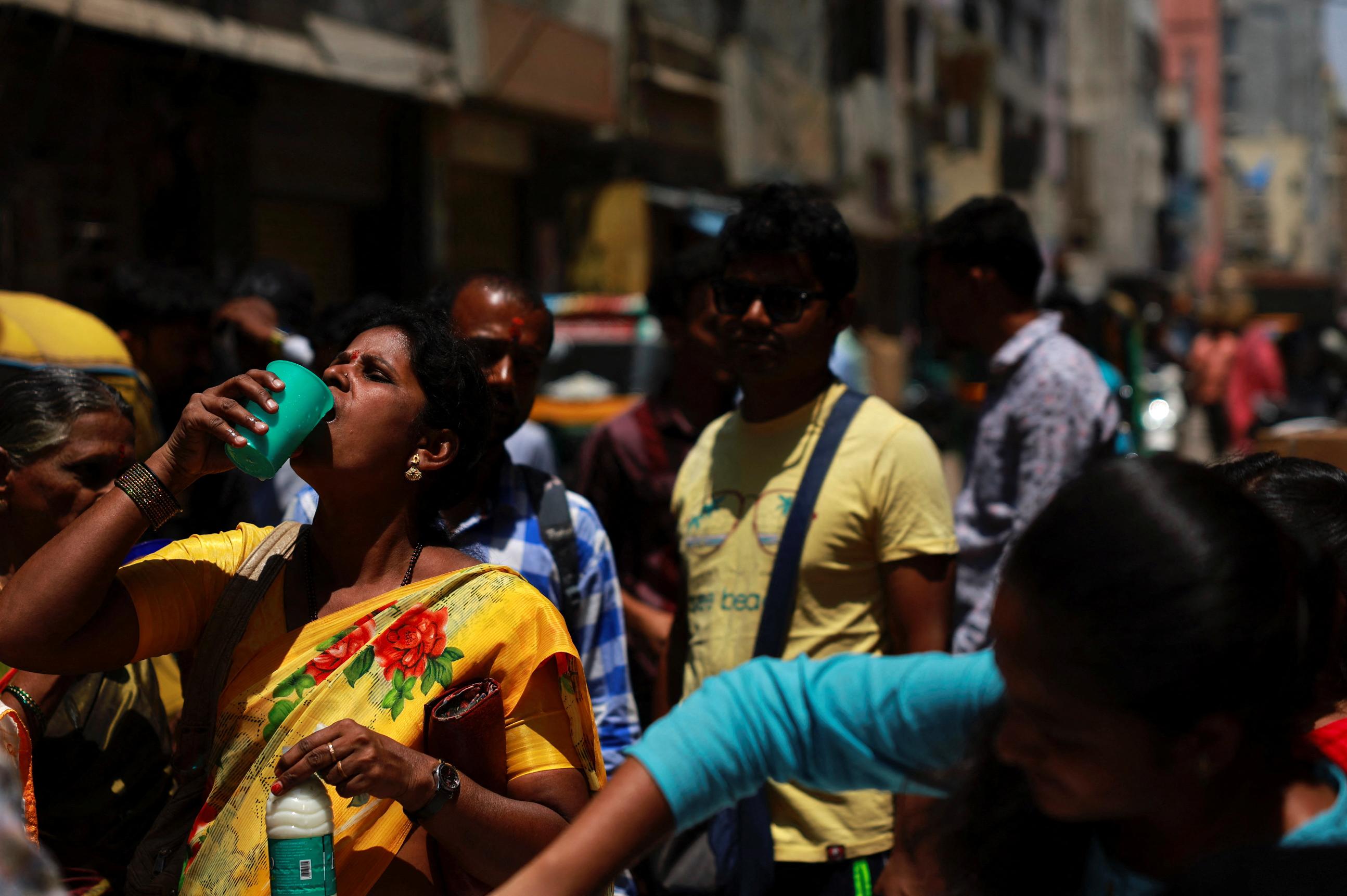
THIRUVANANTHAPURAM, India, April 29 (Reuters) - At least two people have died in India's southern state of Kerala of suspected heat stroke, media reported on Monday, as the country battles a sweltering summer that has seen temperatures soar to record levels. A 90-year-old woman and a 53-year-old man died in Kerala on Sunday, The Hindu newspaper reported, as temperatures soared to 41.9 degrees Celsius (107°Fahrenheit), nearly 5.5 degrees Celsius above normal. "We are yet to confirm whether these deaths were due to heat waves. The medical process for examining the deaths is on," state disaster management official Shekhar Kuriakose said. Scientists have said climate change is contributing to more frequent, severe, and longer heatwaves during summer months. Temperatures across Kerala were expected to be higher than normal, causing authorities to issue warnings asking people to take precautions against the heat. India's weather department has predicted more heat-wave days than normal between April and June this year. In the eastern state of Odisha, where temperatures touched 44.9 degrees Celsius (113°F) on Sunday, the highest recorded in April, at least two people have died this summer of sun stroke, said Odisha’s public health director Dr Niranjan Mishra. In neighbouring Bangladesh, authorities re-opened schools on Sunday despite a heatwave sweeping the region, but have encouraged citizens to stay indoors during the day. But for those who work outdoors, like rickshaw driver Mohammed Shameem, there is not much respite. "It is too hard to work under the sun during a brutal heatwave. There are not many people who are coming out which means getting passengers is tough. But we have no option but to come out and work," Shameem said. Sign up here. https://www.reuters.com/world/india/two-people-die-southern-india-heatwave-scorches-region-2024-04-29/
2024-04-29 11:42
April 29 (Reuters) - Hershey (HSY.N) New Tab, opens new tab and Mondelez International (MDLZ.O) New Tab, opens new tab investors will be eager to see how the chocolate makers plan to tackle the recent surge in cocoa and sugar prices when they report first quarter results this week. These companies have already been grappling with heightened costs in the past few quarters, which they have in part passed on to consumers by raising prices. A recent surge in cocoa prices amid a shrinkage in supplies due to droughts and inconsistent rainfalls as well as crop disease in the world's top cocoa producing regions could spell more trouble for them. In addition, sugar prices have also spiked in recent months. "A lot of investors are waiting to learn about how the consumer is reacting to the current price of chocolate in the market and how that influences the companies' decisions to take more pricing in the future," said Sean King, an analyst at Columbia Threadneedle Investments, which holds shares of both Hershey and Mondelez. THE CONTEXT Cocoa prices - which have nearly tripled in value this year - currently form about 20% and 10% of Hershey and Mondelez's cost-of-goods-sold (COGS), respectively, according to Jefferies. "Typically, these companies incur higher cocoa costs first and then they go to their retail customers and try to increase prices," said CFRA Research's Arun Sundaram, adding there could potentially be stronger pricing in the second half. The possibility of more price hikes comes when demand has already started to falter and companies try to make up for the fall by raising prices. Data from market research firm Circana showed unit sales for chocolate in the U.S. dropped 1.8% in 13 weeks ending March 24, while prices climbed 6.3%. "The big question would be whether price-related growth is enough to offset volume declines that we're likely going to see this year," Sundaram noted. THE FUNDAMENTALS ** Mondelez, which reports results on April 30, is expected to report a slight drop in profit for the first time in 14 quarters to 89 cents ** Its quarterly sales are expected to be flat ** Mondelez's organic volume growth was at 1.3 percentage points (pp) in 2023, while prices rose 13.4 pp. ** Hershey, which reports results on May 3, will see profit drop for the first time in 25 quarters to $2.76 ** Quarterly revenue is expected to increase to about 4.2%. ** Hershey's organic volume dropped 1.3% in 2023, while prices climbed 8.3% WALL STREET SENTIMENT ** Mondelez shares are down 4.3% in the last one year, while Hershey has fallen nearly 32% ** 26 analysts rate Mondelez "buy" on average, with a median price target of $82 - LSEG ** 24 analysts rate Hershey "hold" on average, with a median price target of $208 Sign up here. https://www.reuters.com/business/retail-consumer/soaring-cocoa-prices-put-spotlight-hershey-mondelez-earnings-2024-04-29/

2024-04-29 11:37
Inflation rebound looms in central Europe Price risks from services, fuel and weaker currencies Central European FX squeezed by broad dollar gains Investors scale back rate easing bets for end-2024 BUDAPEST/PRAGUE, April 29 (Reuters) - With steep falls in inflation over and the timing of the first Federal Reserve rate cut pushed back by strong U.S. data, a period of carefree rate easing appears to be over for central Europe's rate-setters now facing a growing list of concerns. A collapse in price growth from last year's double-digit rates in Poland, the Czech Republic and Hungary allowed central banks to reduce borrowing costs sharply, helping their economies back to growth from recession or stagflation. March headline inflation sank to 2% in Poland and the Czech Republic and 3.6% in Hungary, which experienced the worst inflationary surge in the European Union with levels exceeding 25% in the first quarter of last year. But economists believe the current lows are unsustainable and project a rebound in price growth to around 5% by the end of 2024 in both Poland and Hungary, as helpful base effects fade and the Polish government unwinds cost-of-living subsidies. Amid risks from higher fuel prices, weaker exchange rates, persistently strong services inflation and the prospect of the region's economic recovery gaining traction, central bankers have grown cautious about cutting rates further. "The situation has changed," economists at Allianz said. "As markets have dialled back their expectations for cuts in advanced economies, they have also done the same for emerging markets." An analysis of changes in market pricing based on JP Morgan figures shows investors have priced out about 100 basis points of rate cuts in the Czech Republic and Poland by December compared with end-2024 levels expected in early January. The shift is the largest in Hungary, with investors slashing the scope of expected easing by nearly 200 bps. Late-April market pricing showed just 35 bps of cuts in Poland's main rate by the end of 2024, less than a third of what was priced in at the start of the year. VULNERABLE CURRENCIES While 2024 inflation is seen hovering around 2% in the Czech Republic, by far the lowest in central Europe, some rate-setters there too have expressed concerns over real wage growth and currency weakness as the economy begins to show signs of life. The region's currencies, like other emerging market assets, were hammered by data showing the strength of the U.S. economy, which boosted the dollar and pushed back investor bets on the timing of the first Federal Reserve rate cut to September - or later. The Czech crown and the Hungarian forint are both in the red for 2024, due in part to their narrowing rate differential, with the ripple effects of the dollar's rally knocking even Poland's zloty off the four-year-highs it scaled early this month. "CZK and PLN are among the most vulnerable emerging market currencies to persisting inflation, U.S. economic outperformance, and higher repricing of the Fed funds rate path," strategists at Societe Generale said, citing the currencies' strong ties with the euro. Last week Czech National Bank Governor Ales Michl said even if the bank cuts rates on Thursday, with analysts projecting another 50 bps reduction, the CNB would take a "very cautious" approach to rate easing beyond that point. "The more cautious approach of monetary institutions to rate cuts in view of possible reflation is evident on both sides of the Atlantic," ING economists said. "After all, the European Central Bank is watching the Federal Reserve, and the CNB is watching the ECB." Hungary's central bank has also flagged a cautious approach to further easing, with Deputy Governor Barnabas Virag all but ruling out rate cuts in the second half after the bank lowered its base rate by just 50 bps last week, the smallest step in an easing cycle launched last May. Another 50-bps Czech rate cut in June, which economists think is on the cards, would take the Czech rate within a whisker of the European Central Bank's main rate by June, when the ECB is widely expected to start cutting rates. How fast the ECB cuts rates after that is less certain, with markets having scaled back bets on euro zone rate cuts in the second half of the year. "While we continue to expect the (Czech) policy rate to reach 3.50% by the end of the year, we see risks to our call as being skewed to the upside," Morgan Stanley economist Georgi Deyanov said, citing currency weakness and possible shifts in ECB rate expectations as factors in coming months. Sign up here. https://www.reuters.com/markets/europe/central-europes-rate-setters-have-pause-thought-2024-04-29/
2024-04-29 11:34
LONDON, April 29 (Reuters) - The pound reached its highest in around two weeks against the dollar and the euro at the start of a week packed with market-moving events, and fell more than 1% against the yen, as traders said Japanese authorities intervened to support their currency. The pound was last at 195 yen, down 1.22% on the day after briefly nudging above 200 yen in early Asia trade, its highest since 2008. The volatility in the pound versus the yen was all about the yen side of the pair, as traders said Japanese authorities bought the yen, which is at its weakest against the dollar since 1990, as its weakening trend accelerated sharply in the last two sessions. Versus the dollar, the pound was up 0.27% at $1.25275, its highest since April 12, a small recovery from five-month lows in mid April, when investors' expectations the Bank of England would cut interest rates earlier than the Federal Reserve caused them to sell the pound. Markets expect the Bank of England to start cutting rates in August, while the Fed is expected to wait until later in the year, causing the gap between U.S. and British government bond yields to widen. Economic data since then however has helped the pound - and the euro - perform better than the gap between U.S. and European and British rates would indicate, MUFG analysts said in a note. "Cable (the pound versus the dollar) was trading closer to the 1.2000-level when yield spreads were last at current levels just over a year ago," they wrote. "The negative impact from the energy price shock in the region continues to fade, and we saw more convincing evidence over the past week that economic growth is beginning to pick up." Euro-zone and UK services PMI surveys last week both climbed to their highest levels in almost a year, possibly indicating that the period of economic stagnation is ending. The pound was also slightly firmer on the euro at 85.52 pence to the common currency, sterling's strongest since April 17. Sign up here. https://www.reuters.com/markets/currencies/sterling-two-week-high-dollar-falls-12-yen-2024-04-29/