2024-04-26 07:02
Shares up 9% In talks on further 30% stake Deal expected to close this year Clause enables both parties to step back from deal FRANKFURT/BERLIN/PRAGUE, April 26 (Reuters) - Thyssenkrupp will sell a 20% stake in its steel business to the energy holding controlled by Czech billionaire Daniel Kretinsky, a major breakthrough for the German conglomerate after years of unsuccessful attempts to divest the unit. For Thyssenkrupp (TKAG.DE) New Tab, opens new tab the deal marks what it hopes will result in a balance sheet separation from a cyclical and struggling business it has been trying to sell, spin off or merge. With a history of supplying steel for factories and railways stretching back more than 200 years, Thyssenkrupp Steel Europe is Germany's largest steelmaker and tied to the country's rise as an industrial powerhouse. However, cheaper Asian competitors, high power prices and a cooling global economy have put pressure on the business, leading to operating losses in four of the past five years. The parties are in talks for Kretinsky to buy a further 30% stake, aiming for a 50-50 joint venture in the future, Thyssenkrupp said on Friday, sending its shares up 9% by 1305 GMT. Thyssenkrupp is currently hammering out a business plan for the division, which is struggling with 3 billion euros ($3.2 billion) worth of pension funds, including investment plans and ensuring a solid capital base, CEO Miguel Lopez told reporters. The deal is centred around the idea that steel production will require cheap and green electricity going forward, areas where Kretinsky's holding EPCG can deliver with its 22 gigawatts (GW) of installed capacity across Europe. EPCG, which made core profit of 7.3 billion euros last year, has been shutting its coal-fired plants and investing heavily in hydrogen-ready new gas-fired plants, with 2.4 GW currently under construction at three sites in Italy and Britain. Its EPETr unit will hold most of the remaining coal assets, which are to be phased out as part of a 10 billion euro renewables investment push. LABOUR CONFLICT No deal value was disclosed, but brokerage Baader said that, unless more writedowns were announced for the unit, Thyssenkrupp could receive 350-400 million euros for the stake. "This strategic partnership is an historic and significant step toward ensuring a resilient and climate friendly steel production," Lopez said, adding it contributed to securing the future of Germany's steel sector. Lopez said the steel unit's book value was 3.6-3.7 billion euros and there was no need for writedowns currently. Both parties have the right to step back from the deal, he added. Kretinsky, who has been on a European buying spree, called the transaction an important contribution to steel decarbonisation, adding that "the entire European steel sector will undergo a similar transformation to the energy sector". The news comes as Thyssenkrupp is revamping the steel unit, which employs about 27,000 people, to climate-neutral production by 2045, with the help of multi-billion government subsidies. The German industrial conglomerate recently announced it will cut jobs and reduce capacity at its main Duisburg site, which was a sticking point in talks with Kretinsky and has sparked criticism from the German government. The Alfried Krupp von Bohlen and Halbach Foundation, Thyssenkrupp's biggest shareholder with a stake of roughly 21%, welcomed the deal. Powerful labour representatives, who said they were informed just a few hours before the official announcement, were less enthusiastic. "We now need a viable concept for the future for the further reorganisation towards green steel - and finally a return to respectfulness for the labour side," said Juergen Kerner, board member at the IG Metall union and deputy chairman of Thyssenkrupp's supervisory board. "Otherwise, conflict is inevitable." ($1 = 0.9318 euros) Sign up here. https://www.reuters.com/markets/deals/thyssenkrupp-enters-strategic-partnership-with-kretinskys-epcg-2024-04-26/
2024-04-26 06:16
KYIV, April 26 (Reuters) - A Ukrainian court ordered Agriculture Minister Mykola Solsky to be taken into custody on Friday to face allegations of his alleged involvement in an illegal acquisition of state-owned land worth about $7 million. Solsky denies the allegations, which relate to events in 2017-2021, before he started as agriculture minister in March 2022. The judge set bail at 75.7 million hryvnias ($1.9 million). Solsky tendered his resignation on Thursday but technically remains in his post until parliament considers his request. He is the first known minister under President Volodymyr Zelenskiy to be named a suspect in a corruption case. The judge said that Solsky would remain in custody until June 24. Prosecutors told a court hearing on Thursday that the allegations against him were punishable by up to 12 years in jail. Solsky was unavailable for immediate comment. Solsky, 44, has been at the centre of Ukraine's effort to keep its grain industry going as Russia's full-scale invasion has blocked Black Sea export routes, strewn fields with landmines, and seen farmland occupied. The National Anti-Corruption Bureau has said the allegations relate to a scheme to acquire state-owned land worth 291 million hryvnia ($7.35 million) and trying to obtain land worth 190 million hryvnia. Under the alleged scheme, the land was illegally taken from two state firms and transferred to war veterans on the condition they lease it to some private firms, prosecutors said. Solsky and his lawyer told the hearing on Thursday that he did not benefit from any such scheme. Kyiv has applied to join the European Union, and Ukraine's agriculture minister will be heavily involved in negotiations to integrate the country's giant grain industry into the 27-member bloc. A major Ukrainian farm union declined to comment on the Solsky custody ruling when reached by Reuters. Zelenskiy has tried to project a zero-tolerance line on corruption and last year replaced his defence minister after graft allegations pertaining to the defence ministry. Sign up here. https://www.reuters.com/world/europe/ukraine-court-orders-agriculture-minister-be-taken-into-custody-2024-04-26/

2024-04-26 06:02
LONDON, April 26 (Reuters) - The slightly alarming sight of a French leader calling on the European Central Bank to nuance its focus on inflation may be less dramatic than it first seems - but it speaks loudly to market zeitgeist and increasingly anxious bond investors. In a keynote speech on the European Union at the Sorbonne University in Paris on Thursday, French President Emmanuel Macron said the ECB should no longer focus solely on keeping inflation under control and urged an expanded economic remit for the central bank - even suggesting a de-carbonization target. "We can no longer have a monetary policy whose sole objective is inflation," Macron said, in comments harking back to the ECB's strategic review in 2021 and intense Franco-German rows over both the ECB's mandate and euro budget pact prior to the euro launch 25 years ago. They may well get short shrift again in Germany and other like-minded euro states - and within related parts of the ECB. But with ECB policymakers set to discuss green monetary policy and another upcoming strategy review at a retreat in Ireland next month, it certainly sets a tone. Most obviously, the words may feed a brewing assumption in world markets that policymakers will be too distracted by concerns about growth, geopolitical rivalry, mounting public debts and even climate change to squeeze inflation sustainably back to 2% targets over the years ahead. As U.S growth stays firm and inflation sticky through early 2024, the Fed is already hesitating in lowering interest rates this year. But the ECB looks determined to start cutting in June - interpreting far more sluggish euro zone growth as sufficient to zap the vestiges of above-target inflation there. The broader economic context around just inflation is already well acknowledged by both major institutions. But partly because of that, long-term market inflation expectations , have not yet returned to 2% despite frequent protests by both central banks that they're bound to get them there and will deliver. JPMorgan research head Joyce Chang and her team said one of their top 10 takeaways from meetings held around last week's International Monetary Fund gathering in Washington was that "global core inflation should settle closer to 3% than 2%." Although risk premiums in long-term bond markets remain relatively subdued, the growing conundrum for bond investors is how to price either that higher inflation plateau over time - and hence lower real returns - or the possibility of even more determined central banks keeping policy rates higher for longer. The upshot is that nominal U.S. Treasury and European sovereign bond yields are returning to what were considered a danger zone for world markets last autumn - and threatening a scary Halloween re-dux. In that context, Macron headlines on broadening the ECB remit are unlikely to soothe any nerves - not least in a year where many investors also fret about potential threats to Federal Reserve independence after November's U.S. election. Although just one of 20 leaders in the multi-national euro zone, Macron may have some support in countries struggling close to recession over the past nine months and facing rising interest costs on bloated public debt piles. In fact, Bank of France Governor Francois Villeroy de Galhau underlined the point on Monday and said the upcoming period of ECB rate cuts "creates favourable conditions for budget consolidation." While the Fed has an explicit dual mandate of maximum employment and price stability, it's long been presumed the ECB's founding charter kept it solely focused on inflation - though less rigidly than some think, as Macron and others seem to insist. As often in European politics, this issue one has been around the houses in different forms before. Macron's take re-opens a long-standing debate on what the ECB's founding fathers set in stone about its future role - one much discussed as the central bank set about its last strategic review New Tab, opens new tab three years ago. Specifics of that 2021 rethink included a shift to a "symmetric" 2% inflation target from a prior formulation of "close to or below" and climate change was also added as a formal consideration in formulating long-term policy. But the whole process shone a light into what ECB watchers call the central bank's "secondary mandate" - as enshrined in Article 127 New Tab, opens new tab of the Treaty on the Functioning of the European Union. Article 127 makes clear the ECB's "primary objective" is price stability, although it leaves defining that up to the ECB itself. But it adds that: "Without prejudice to the objective of price stability, the (ECB) shall support the general economic policies in the Union with a view to contributing to the achievement of the objectives of the Union." As euro debt crisis rescues over the past 15 years and strategic policy changes attest, this leaves considerable wiggle room both for ECB policymakers themselves and their political masters in changing priorities, targets and leanings ahead. While these may never be used to undermine the primary objective, it's not hard to see why bond markets are not entirely convinced the latter is in stone and Macron's statement just underlines that. The opinions expressed here are those of the author, a columnist for Reuters Sign up here. https://www.reuters.com/markets/europe/macron-dig-ecb-remit-may-jar-bond-investor-nerves-mike-dolan-2024-04-26/
2024-04-26 05:43
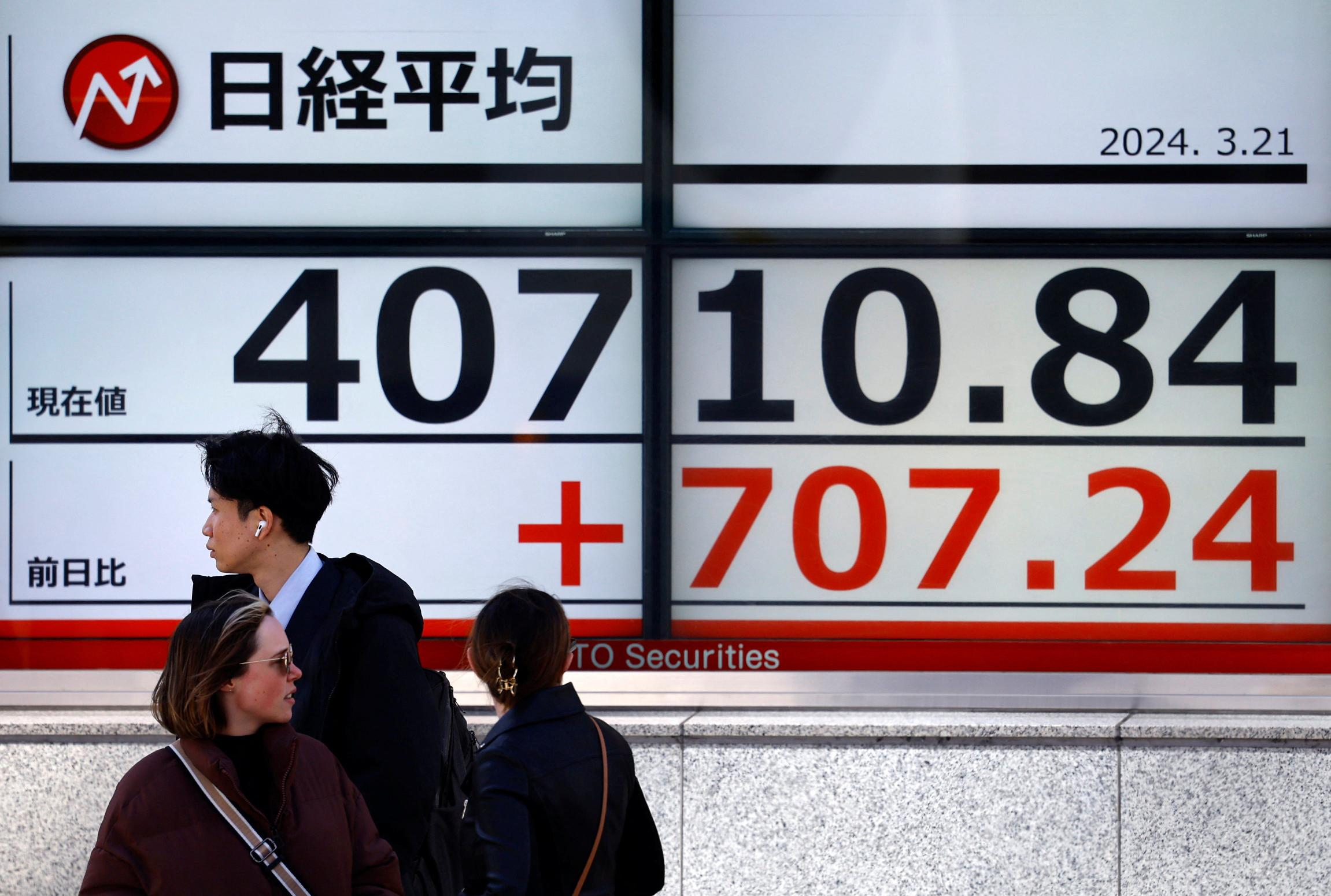
Google, Microsoft earnings signal Wall Street relief rally US consumption data also aids sentiment Japan's yen sinks to another 34-year low NEW YORK/LONDON, April 26 (Reuters) - Global stocks were higher on Friday as Big Tech gains lifted Wall Street shares, while Japan's yen sank to a 34-year low after the Bank of Japan (BOJ) kept monetary policy loose. MSCI's gauge of stocks across the globe (.MIWD00000PUS) New Tab, opens new tab rose 6.80 points, or 0.90%, to 762.39 on tech sector optimism following robust results from Alphabet and Microsoft. U.S. data also boosted sentiment, with the consumption expenditures (PCE) price index up 0.3% in March, in line with estimates by economists polled by Reuters. In the 12 months through March, PCE inflation advanced 2.7% against expectations of 2.6%. The S&P 500 and the Nasdaq registered their biggest weekly percentage gains since early November 2023. The Dow Jones Industrial Average (.DJI) New Tab, opens new tab rose 153.86 points, or 0.40%, to 38,239.66, the S&P 500 (.SPX) New Tab, opens new tab gained 51.54 points, or 1.02%, to 5,099.96 and the Nasdaq Composite (.IXIC) New Tab, opens new tab gained 316.14 points, or 2.03%, to 15,927.90. Europe's benchmark stock index had its biggest daily gain in more than three months, closing up 1.2%, on gains in banking and industrial stocks. The technology sector got a boost from upbeat results from U.S. megacaps. The dollar hit 158.275 yen , the highest since June 1990. World equities were poised to finish the month lower, as hopes of rapid Fed rate cuts receded following a series of U.S. inflation readings. The Bank of Japan kept interest rates around zero at its policy meeting, despite forecasting inflation of around 2% for three years. Markets are braced for Tokyo authorities to prop up the currency, in what would be an unconventional and politically tough decision. BOJ Governor Kazuo Ueda said on Friday that exchange-rate volatility could significantly impact the economy. U.S. Treasury Secretary Janet Yellen told Reuters on Thursday that currency intervention was acceptable only in "rare" circumstances and that market forces should determine exchange rates. Yellen also said U.S. economic growth was likely stronger than suggested by weaker-than-expected data on first-quarter output. "The stall-out of inflation's return to 2% in the first quarter is still a disappointment," Bill Adams, Chief Economist for Comerica Bank in Dallas, said in a market note. "When the Fed meets next week, they are almost certain to say that the first quarter’s economic data don't hit their high bar to begin cutting interest rates." The yen was trading about 40% below its fair value, Pictet Asset Management chief strategist Luca Paolini said. "We underestimate the potential for something to go very wrong when you have a currency that is totally misaligned with (economic) fundamentals," he said. "The sooner they hike rates, the better." YIELDS FALL Longer-dated U.S. Treasury yields fell after data showed inflation gains in March in line with economists’ expectations. The yield on benchmark U.S. 10-year notes fell 4.3 basis points to 4.663%, from 4.706% late on Thursday. Bond yields rise as prices fall. The 2-year note yield, which typically moves in step with interest rate expectations, fell 0.5 basis points to 4.9934%, from 4.998%. Traders now expect the Fed to lower its main funds rate, currently at a 23-year high of 5.25% to 5.5%, by just 36 basis points this year, with some fearing a further hike. Euro zone government bond yields fell as market expectations for cumulative European Central Bank rate cuts this year dropped way below 75 basis points on the back of strong U.S. economic data. MSCI's broadest index of Asia-Pacific shares outside Japan (.MIAPJ0000PUS) New Tab, opens new tab closed 0.75% higher at 535.58, while Japan's Nikkei (.N225) New Tab, opens new tab rose 306.28 points, or 0.81%, to 37,934.76. Spot gold added 0.21% to $2,336.79 an ounce. U.S. gold futures settled 0.2% higher at $2,347.20. Brent crude futures settled up 49 cents, or 0.55%, to $89.50 a barrel. U.S. West Texas Intermediate crude futures settled up 28 cents, or 0.34%, to $83.85 a barrel. Sign up here. https://www.reuters.com/markets/global-markets-wrapup-1-2024-04-26/
2024-04-26 05:29
MUMBAI, April 26 (Reuters) - The Indian rupee was largely flat on Friday, tracking rangebound Asian peers with traders expecting the local unit to stick to its prevailing range ahead of closely watched U.S. inflation data. The rupee was at 83.33 against the U.S. dollar as of 10:00 a.m. IST, barely changed from its close at 83.3150 in the previous session. The currency hovered in a tight band between 83.3075 and 83.34 in early trading. Asian currencies were mostly rangebound despite a surge in US bond yields but the Japanese yen dropped to its lowest in 34 years after the Bank of Japan kept policy rates unchanged. The rupee is likely to trade "sideways as market might want to wait for PCE inflation data to give direction to the dollar," a foreign exchange salesperson at a private bank said. The dollar index was steady at 105.7 even as the 10-year Treasury yield rose above 4.70% for the first since November after a US inflation reading cemented bets that the Federal Reserve will not rush to cut interest rates. Meanwhile, U.S. GDP data for the January-March quarter showed that the U.S. economy grew at an annualized rate of 1.6% last quarter, below the 2.4% gain expected by economists. Odds of a Fed rate cut in July have dropped to about 33%, down from slightly above 40% a week earlier, according to CME's FedWatch tool. During the day's session, the rupee could "rise to 83.25 ... where importers are expected to buy dollars", limiting the rupee's gains, Anil Bhansali, head of treasury at Finrex Treasury Advisors said. Investors now await US personal consumption expenditure data due later on Friday with economists polled by Reuters expecting the data to show that core PCE prices rose 0.3% month-on-month in March. Sign up here. https://www.reuters.com/markets/currencies/rupee-lingers-narrow-band-tracking-mostly-subdued-asian-peers-2024-04-26/
2024-04-26 04:58
YOKOHAMA, Japan, April 25 (Reuters) - On a recent Saturday, some 100 volunteers gathered on a popular beach in the Japanese port city of Yokohama, wading in the shallows to plant strands of light-green eelgrass on the seabed. What began as a project to restore the natural ecosystem along the coast of the city just south of Tokyo has taken on national importance: helping fight climate change as Japan aims to achieve carbon neutrality by 2050. Japan, the world's fifth-largest emitter of greenhouse gases, covers a surface area smaller than California but has some of the longest coastlines in the world. That makes marine vegetation a viable method of capturing at least a fraction of the carbon dioxide it produces, scientists say. "Over the course of this work, we've come to understand that it can absorb and store the carbon that causes climate change," said Keita Furukawa, marine scientist at the Association for Shore Environment Creation. In a world first, Japan's most recent annual Greenhouse Gas Inventory, provided to the United Nations Framework Convention on Climate Change (UNFCCC) this month, factored the carbon absorbed by seagrass and seaweed beds into its calculations. The Ministry of the Environment estimates that in fiscal year 2022, that amount of blue carbon – carbon that is naturally stored by marine and coastal ecosystems – was roughly 350,000 tons. While that is just 0.03% of the 1.135 billion tons of CO2 equivalent greenhouse gases Japan emitted that year, blue carbon has taken on more importance as the country's forests age, absorbing less carbon dioxide than younger trees. The amount of greenhouse gases absorbed by forests fell 17% over the five-year period to 2022, government data shows, and Japan has said it would make efforts on both land and in the sea to capture more carbon. "If eelgrass were to grow in every shallow area of the sea it's possible for it to grow, I think it could absorb perhaps 10 or 20% of human emissions," Furukawa said. Sign up here. https://www.reuters.com/sustainability/battling-climate-change-japan-looks-seagrass-carbon-capture-2024-04-25/