2024-04-25 02:23
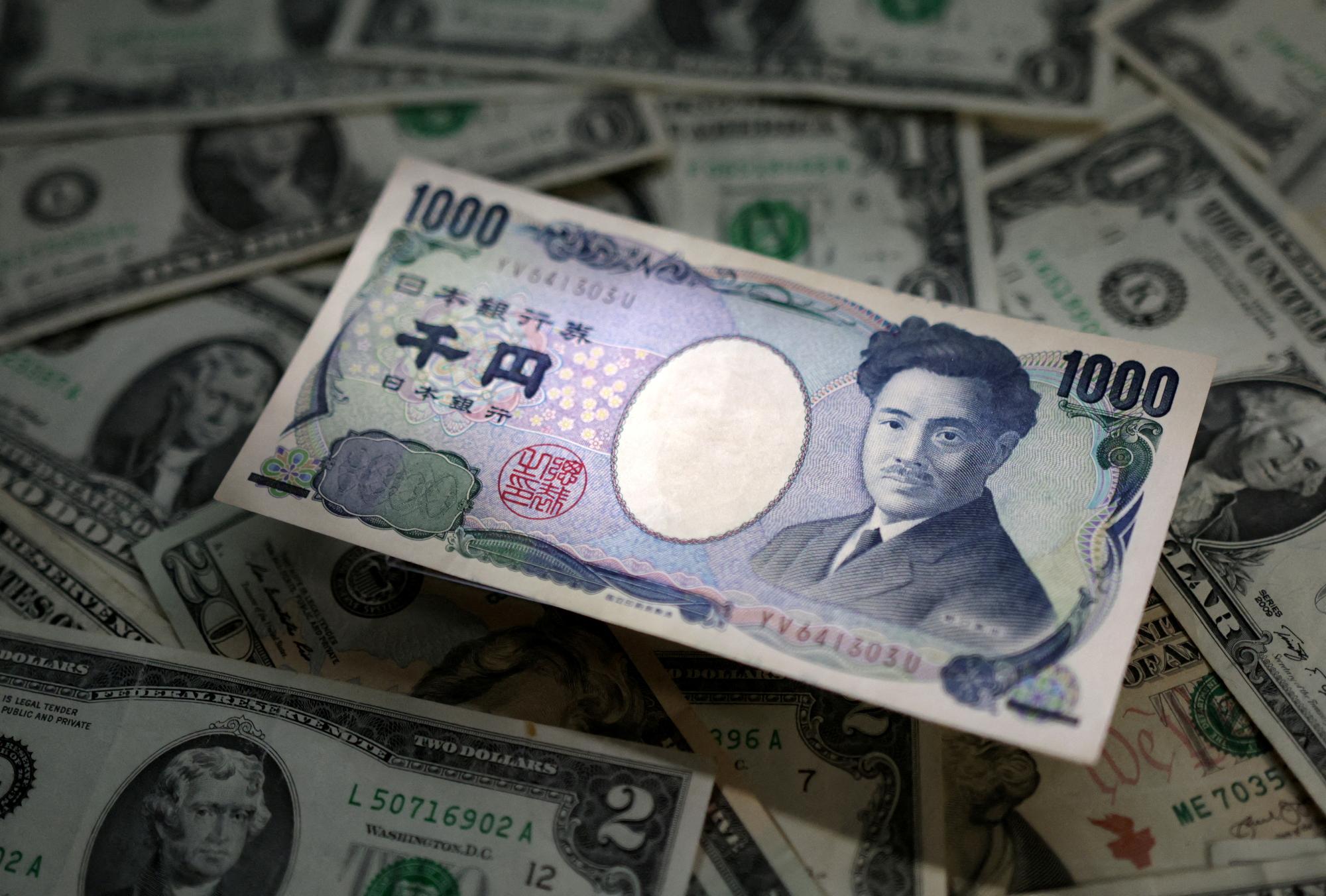
Yen's fresh fall below 155 vs dollar keeps BOJ under pressure Markets wary of 2022 repeat when dovish BOJ led to intervention BOJ to keep rates steady, may reduce bond-buying plan for May Finance minister says will respond appropriately to yen moves TOKYO, April 25 (Reuters) - The yen's slide to fresh 34-year lows is likely to force Bank of Japan Governor Kazuo Ueda to walk a delicate line in guiding monetary policy this week as he tries to maintain a calibrated path to exiting ultra-easy rates without upending the currency. The BOJ chief will be mindful of avoiding the episode of 2022, when his predecessor's dovish remarks triggered a yen plunge that forced Tokyo to intervene to prop up the currency. Ueda has ruled out the chance of aggressive rate hikes due to Japan's fragile economy, which has in part fed expectations of low-for-longer rates and emboldened yen bears. In recent comments, however, Ueda has dropped hints the BOJ could raise borrowing costs again later this year, although that has hardly done anything to reverse the yen's inexorable slide over the past few months. The BOJ is expected to keep interest rates steady at a two-day meeting ending on Friday, and project inflation to stay near its 2% target in coming years on prospects of steady wage gains. The prospect of Japanese rates staying low for an extended period and expectations for a delayed start to U.S. rate cuts have continued to push down the yen despite aggressive jawboning by Japanese authorities. The yen fell below 155 to the dollar on Thursday, a level seen as authorities' line in the sand that heightens the chance of currency intervention. The dollar rose as high as 155.37 yen on Wednesday, its strongest since mid-1990, before falling back in choppy trading. It was last at 155.29 in Asia on Thursday. "There is no change to our stance. We'll watch market moves carefully and respond appropriately," Finance Minister Shunichi Suzuki told parliament on Thursday, when urged by an opposition lawmaker to intervene in the currency market. Chief Cabinet Secretary Yoshimasa Hayashi also said Japanese authorities were ready to take action as needed. "It's important for currency rates to move stably reflecting fundamentals. Excessive volatility is undesirable," Hayashi told a press conference. He declined to comment on recent yen moves, or on the possibility of currency intervention. Markets are focusing on whether BOJ's Ueda will offer a more hawkish tone on prospects of a near-term interest rate hike. "The BOJ won't hike rates just for the sake of preventing yen declines," said former BOJ official Nobuyasu Atago. "But he may repeat his recent commentary that the BOJ would respond if yen moves have a big impact on the economy and prices. If that keeps markets guessing the timing of a rate hike could be pushed forward, it would be effective jawboning." Ueda will hold a press conference after the two-day meeting concludes on Friday. REPEAT OF 2022? Some analysts point to the risk of a repeat of September 2022, when Japan intervened to prop up the yen after it plunged on former BOJ Governor Haruhiko Kuroda's post-meeting remarks stressing the bank's resolve to maintain ultra-loose policy. In Japan, the Ministry of Finance, not the BOJ, is in charge of deciding when to intervene in the currency market. The decision is highly political and typically reflects the administration's views on whether yen moves warrant action. There seems to be no consensus within the ruling Liberal Democratic Party (LDP), however, on whether the time is rife for currency intervention. Japan's ruling party is not yet in active discussion on what yen levels would be deemed worth intervening in the market, though the currency's slide towards 160 to the dollar could prod policymakers to act, party executive, Takao Ochi, told Reuters. Markets are also focusing on whether the BOJ will leave unchanged guidance it offered in March to keep buying government bonds around the current pace of 6 trillion yen per month. A removal or tweak of the guidance could be interpreted by markets as suggesting that the BOJ will soon taper its bond buying to allow bond yields to rise more, analysts say. Alternately, the BOJ may announce a modest decline in its bond buying plans for May, which will be released after the policy meeting, some analysts say. Speaking at a seminar in Washington, Ueda last week has said the BOJ will eventually start to shrink its balance sheet and roll out the process irrespective of the state of the economy. But Ueda has stressed that the BOJ won't dramatically change the pace of bond buying for the time being and won't use the size of its asset purchases as a monetary policy tool. Sign up here. https://www.reuters.com/markets/asia/fragile-yen-could-make-bojs-ueda-tilt-more-towards-hawkish-stance-2024-04-25/
2024-04-25 00:47
U.S. economic growth slowed in first quarter U.S. gasoline stockpiles fall less than expected Israel intensifies airstrikes on Gaza's Rafah HOUSTON, April 25 (Reuters) - Oil prices settled higher on Thursday on worries of supply disruptions in Middle East supply as Israel stepped up airstrikes on Gaza's Rafah and on the U.S. Treasury secretary's comments that the economy was performing well. Brent crude futures settled 99 cents, or 1.1%, higher at $89.01 a barrel. U.S. West Texas Intermediate crude futures was up 76 cents, or 09%, at $83.57. Treasury Secretary Janet Yellen told Reuters U.S. economic growth was likely stronger than suggested by weaker-than-expected quarterly data. Before Yellen's comments, oil prices had been pressured by data showing economic growth slowed more than expected in the first quarter. An acceleration in inflation suggested the Federal Reserve would not cut interest rates before September. Yellen said U.S. GDP growth for the first quarter could be revised higher after more data is in hand and inflation will ease to more normal levels after a clutch of "peculiar" factors held the economy to its weakest showing in nearly two years. "The U.S. economy continues to perform very, very well," Yellen said in the interview. Feeding worries about fuel demand, U.S. gasoline stockpiles fell by less than forecast and distillate stockpiles rose against expectations of a decline in the week to April 19, according to Energy Information Administration (EIA) data on Wednesday. U.S. crude inventories unexpectedly fell sharply last week, the EIA report also showed, as exports jumped. The concern about U.S. fuel demand arises amid signs of cooling U.S. business activity in April and as stronger-than-expected inflation and employment data means the Fed is seen as more likely to delay expected interest rate cuts. "The market started to realize that if you put the whole report into perspective, the slowing growth numbers were probably overstated," said Phil Flynn analyst at Price Futures Group. "I think then the market has also started to focus on the tight supply situation and the geopolitical risk factors," Flynn added. Israel stepped up airstrikes on Rafah overnight after saying it would evacuate civilians from the southern Gazan city and launch an all-out assault despite allies' warnings this could cause mass casualties. Still, oil supply has not been affected as yet. "Traders continue to waver on how much geopolitical risk to price in after Israel and Iran backed away from further direct confrontation last week, said Tim Evans, an independent energy analyst, cautioning that some residual risk remains as Israel ramps up operations against Hezbollah in southern Lebanon and Hamas in Gaza. Sign up here. https://www.reuters.com/markets/commodities/oil-eases-us-demand-concerns-outweigh-fears-over-middle-east-conflicts-2024-04-25/

2024-04-25 00:43
NEW YORK, April 25 (Reuters) - The U.S. dollar fell on Thursday, except against the yen, vacillating after data showed unexpected slowing in economic growth and an unwelcome inflation acceleration, potentially tying the Federal Reserve's hands on a pivot to easier interest rates. While the dollar was hardly shaken against the beleaguered yen, it otherwise only popped briefly after the Commerce Department reported that U.S. gross domestic product grew at a 1.6% annualized rate in the January-March period, slower than the 2.4% rate expected by economists polled by Reuters. The report also showed that underlying inflation as measured by the core personal consumption expenditures (PCE) price index rose 3.7% in the first quarter, eclipsing forecasts for a 3.4% rise. The inflation surprise puts an even greater-than-usual focus on the release on Friday of PCE price index data for March. The PCE index, and core PCE index factoring out food and energy prices are among the Fed's most important gauges of price behavior. Inflation remains stubbornly above the U.S. central bank's 2% inflation target. "The market reaction to the (GDP) data tells all you need to know about what investors are focused on and it's mostly inflation and not growth," said Boris Kovacevic, global market strategist at Convera in Vienna, Austria. "The print on the 3.7% PCE does suggest that tomorrow's PCE number will be higher." The yen, meanwhile, hit a fresh 34-year low versus the dollar and a 16-year low against the euro on Thursday as investors expect a Bank of Japan (BOJ) policy meeting that ends on Friday to not be hawkish enough to support the Japanese currency. The dollar index , a measure of the U.S. currency's value against six rivals, reversed a small overnight loss after the data caused benchmark Treasury yields to rise, topping at 106.00. It was last at 105.60, off 0.21%. Conversely, the greenback fell as low as 155.31 yen after the GDP data, but quickly reversed to stand 0.19% higher at 155.63. It peaked at a 34-year high of 155.75 yen, while the euro/yen pairing surged to 167.025, a 16-year peak. Investors guessed the dollar/yen 155 level would be a line in the sand for Japanese authorities, above which the BOJ could intervene to shore up the currency. But it's a moving target and the market has been on high alert for such central bank action since the yen fell below 152 per dollar about two weeks ago. "I think that Japanese officials have been very clear that they are not really looking at a particular level," said Marc Chandler chief market strategist, at Bannockburn Global Forex in New York. "We should expect a hawkish hold from the BOJ where they hold policy and they talk about how the weakness of the yen could contribute to inflation and which they'd respond to." The euro went up 0.26% to $1.0725. Sterling strengthened 0.35% to $1.2504. Following the GDP data, the U.S. rate futures market was pricing in a 58% chance of a Fed rate cut in September, down from 70% late on Wednesday, according to CME Group's FedWatch tool. Rate futures traders on Thursday were factoring in a 68% chance that the Fed's first rate cut since 2020 could happen at its meeting in November. "The inflation figures ... potentially even point to the need for a further tightening," said Stuart Cole, chief macro economist, at Equiti Capital in London. "We know that returning CPI (consumer price index) to target is the Fed's main objective and therefore, on balance, today's figure probably pushes an interest rate cut further down the road." In cryptocurrencies, bitcoin gained 0.80% at $64,492.00. Ethereum rose 0.94% at $3158.95. Sign up here. https://www.reuters.com/markets/currencies/markets-wary-intervention-yen-struggles-155-level-2024-04-25/
2024-04-24 23:06
April 25 (Reuters) - Britain's car production fell 27.1% year-on-year in March as manufacturers wound down existing models and more plants transitioned to electric vehicle production, data from the Society of Motor Manufacturers and Traders (SMMT) showed on Thursday. SMMT said the latest production outlook report by AutoAnalysis expects UK car and light van production to tumble 6.2% to about 940,000 units this year, primarily due to the model changeovers. WHY IT'S IMPORTANT This is the first time car output has dropped in six months and comes at a time when electric vehicle production has successively grown as giants like Nissan (4021.T) New Tab, opens new tab and Tata (TAMO.NS) New Tab, opens new tab pour in billions in the country to ramp up EV plans in a bid to become net zero. CONTEXT SMMT has previously said manufacturers are offering "generous incentives" in a push to switch to zero-emission vehicles and called for further incentives from the government for private retail buyers. The industry body also citied fewer trading days in March due to Easter for the fall in production. BY THE NUMBERS Around 59,467 cars rolled out of factory lines in March, compared with 81,605 units in the same month last year. EV volumes made up more than a third of all production but dwindled around 30% year-on-year, mainly due to model changeovers, it said. The production of battery-electric (BEV), plug-in hybrid (PHEV), and hybrid (HEV) vehicles in the UK surged 48% in 2023. KEY QUOTES "This fall is not unexpected given the wholesale changes taking place within UK car factories as existing models are run out and more plants transition to electric vehicle production," said SMMT Chief Executive Mike Hawes. "We can expect further volatility throughout 2024 as manufacturers lay the foundations for a successful zero-emission future," Hawes added. Sign up here. https://www.reuters.com/business/autos-transportation/uk-car-output-falls-march-ev-transition-gears-up-says-industry-body-2024-04-24/

2024-04-24 22:44
Meta shares sink after Q1 results Boeing's Q1 revenue falls Tesla shares jump on promise of new models NEW YORK, April 24 (Reuters) - Benchmark S&P 500 closed higher in choppy trading on Wednesday, as investors weighed an uptick in Treasury yields amid positive corporate results particularly from technology giants. An auction of a record $70 billion worth of five-year U.S. Treasury notes on Wednesday helped to push bond yields higher and had weighed on equities. The benchmark 10-year Treasury note rose five basis points to 4.6459%. The Dow finished lower while the Nasdaq ended higher. Seven out of 11 S&P 500 sectors made gains led by stocks in consumer staples, utilities, consumer discretionary and real estate. Investors were also focused on quarterly earnings from companies, especially from megacap growth stocks. Shares of Meta Platforms (META.O) New Tab, opens new tab fell 11% in extended hours trading after the tech giant reported that its capital expenditure could reach up to $40 billion in 2024, even as its first quarter revenue beat estimates. Microsoft (MSFT.O) New Tab, opens new tab and Alphabet (GOOGL.O) New Tab, opens new tab are scheduled to report their results later this week. Tesla (TSLA.O) New Tab, opens new tab jumped 12% after the electric vehicle maker's plans to boost production and roll out more affordable models overshadowed its weak quarterly results. "My biggest concern is the bond market, particularly the long end of the U.S. yield curve," said Bill Strazzullo, chief market strategist at Bell Curve Trading in Boston. The S&P 500 (.SPX) New Tab, opens new tab gained 1.08 points, or 0.02%, to 5,071.63 and the Nasdaq Composite (.IXIC) New Tab, opens new tab gained 16.11 points, or 0.10%, to 15,712.75. The Dow Jones Industrial Average (.DJI) New Tab, opens new tab fell 42.77 points, or 0.11%, to 38,460.92. Markets are eyeing first quarter gross domestic product data on Thursday and personal consumption expenditures (PCE) for March on Friday. Hotter-than-expected consumer price inflation report for March had pushed back expectations of when the Fed will begin cutting interest rates. Shares of Boeing (BA.N) New Tab, opens new tab fell 2.8% after the planemaker reported its first quarterly revenue drop in seven quarters, even though the result beat analyst expectations. Solar inverter maker Enphase Energy (ENPH.O) New Tab, opens new tab dropped 5.5% after projecting second-quarter revenue below analysts' estimates. Texas Instruments (TXN.O) New Tab, opens new tab climbed 5.6% after the chipmaker forecast second-quarter revenue above analysts' estimates. The Philadelphia Semiconductor Index (.SOX) New Tab, opens new tab closed higher as most chip stocks rallied. Drugmaker Biogen (BIIB.O) New Tab, opens new tab gained 4.5% after it beat first-quarter profit expectations, while Boston Scientific (BSX.N) New Tab, opens new tab rose 5.7% after the medical device maker raised its annual profit forecast. Hasbro (HAS.O) New Tab, opens new tab climbed nearly 12% after the toymaker reported a smaller-than-expected drop in first-quarter sales and handily beat profit estimates. Declining issues outnumbered advancers by a 1.33-to-1 ratio on the NYSE. There were 80 new highs and 50 new lows on the NYSE. On the Nasdaq, 1,903 stocks rose and 2,316 fell as declining issues outnumbered advancers by a 1.22-to-1 ratio. The S&P 500 posted 11 new 52-week highs and four new lows, while the Nasdaq recorded 55 new highs and 120 new lows. Volume on U.S. exchanges was 10.2 billion shares, compared with the 11.07 billion average for the last 20 days. Sign up here. https://www.reuters.com/markets/us/sp-nasdaq-futures-advance-tech-boost-earnings-cheer-2024-04-24/
2024-04-24 22:28
BRASILIA, April 24 (Reuters) - Brazil's government submitted proposed rules to Congress on Wednesday to carry out a historic tax overhaul approved last year, a key element of President Luiz Inacio Lula da Silva's strategy to foster growth in Latin America's largest economy. The Finance Ministry said in a statement the bill contains most of the regulations needed to implement the constitutional amendment approved last year, and that a second proposal will be sent to lawmakers in the coming days specifically addressing management and oversight of the new taxes. The reform's goal is to enhance productivity by streamlining Brazil's complex tax framework, known for burdening businesses with significant compliance costs. The reform consolidates five existing levies into a value-added tax (VAT) with separate federal and regional rates, to be determined through the complementary bills. Full implementation of the new taxes is expected only in 2033. It also introduces a selective tax targeting products considered harmful to the environment and health. Speaking to reporters, Finance Minister Fernando Haddad said that the consumption tax rate is currently around 34%. With the reform and its regulation, the expectation is that the system will become digital and curb evasion and fraud, which could pave the way for this rate to be reduced even with the foreseen exceptions for some sectors, he said. Bernardo Appy, the ministry's tax reform secretary, said that the expected average rate with the reform would be 26.5%. Haddad, who went to Congress to deliver the text, also said the tax reform should drive down prices of popular consumer products as they will no longer be subject to multiple layers of taxes. The government will disclose more details of the bill in a press conference on Thursday morning, he said. Sign up here. https://www.reuters.com/world/americas/brazils-government-submits-rules-streamline-consumption-taxes-2024-04-24/