2024-04-24 06:06
SEOUL, April 24 (Reuters) - South Korea is considering easing real-time reporting requirements for investors in the nation's $1.8 trillion bond market as it seeks inclusion into FTSE Russell’s global bond index, three people familiar with the matter said. The finance ministry and the Financial Supervisory Service (FSS) are in talks to change a requirement for banks to report any bond trading in the over-the-counter market to authorities within 15 minutes of each transaction. That rule has been a major pain point in the government's efforts to court global investors into the Korean bond market. It would also need to be addressed as Korean bonds move to the Euroclear settlement platform from July this year. No decisions have yet been made on the specific changes to the rules but could include reducing reporting requirements to once or twice a day, said the sources, which included a finance ministry official who declined to be named. A current 7pm local deadline for reporting would also need to be addressed. "Many foreign institutions have pointed out that the requirement to report transactions manually every 15 minutes is a restriction in carrying out transactions efficiently, and we're working to improve that," a source directly involved in the government discussion said, who declined to be named due to sensitivity of the issue. "We're communicating with relevant authorities to ease them," he said. The FSS, South Korea's market regulator, declined to comment. The changes would follow recent reforms Asia's fourth-largest economy has introduced as it looks to shake off its classification as an emerging market and gain acceptance to major global market benchmarks. Inclusion in FTSE Russell's World Government Bond Index (WGBI), for example, could attract tens of billions of dollars in inflows, analysts say. Authorities are now looking to ease a series of rules for banks and brokerages created after financial crises of past decades and designed to monitor major capital flight risks. South Korean government bonds have been on FTSE Russell's watchlist for WGBI inclusion since September 2022 and easing the 15-minute reporting requirement could improve the prospects of index admission, the sources say. FTSE Russell is due to release an update on its WGBI constituents in September. South Korea needs to improve in areas such as "sound regulatory environment" and "investment restrictions" to meet the minimum standards for WGBI inclusion, a FTSE Russell report said in a 2022 report. FTSE Russell determines WGBI inclusion based on an investor survey on market accessibility. Foreign investors make up about 10% of the country's bond market. Currently details of all over-the-counter transactions including price, quantity, time and parties involved need to be reported in real-time to the Korea Financial Investment Association, an industry body. Global banks say the real-time reporting obligations currently create significant barriers for foreign investors wanting to buy large volumes of Korean bonds. Among the regulatory reforms South Korea adopted recently to boost foreign access to its financial markets was the scrapping of a 30-year-old rule that foreigners must register with authorities in order to trade listed stocks. The won's onshore market trading hours will also be extended. In 2022, the government scrapped taxes on foreigners' income from investments in treasury bonds and monetary stabilisation bonds. Sign up here. https://www.reuters.com/markets/asia/south-korea-considers-easing-bond-market-reporting-rules-sources-say-2024-04-24/

2024-04-24 05:59
COLOMBO, April 24 (Reuters) - Iran's President Ebrahim Raisi arrived in Sri Lanka on Wednesday for a brief state visit aimed at strengthening ties, during which he will also open a $514-million hydropower project. The first visit by an Iranian president to Sri Lanka since an April 2008 trip by its then president, Mahmoud Ahmadinejad will see the two countries sign five pacts, or Memorandums of Understanding (MoUs). Iran agreed to build the hydro power project in 2010 but funds dried up after the release of $50 million, as U.S. sanctions imposed later that year on the Middle East nation made it hard to transfer money, forcing Sri Lanka to fund the rest. It was also hit by delays because of the COVID-19 pandemic, environmental concerns and protests from villagers. The project will add 290 GWh to the national grid, while supplying water to 6,000 hectares (15,000 acres) of farmland and drinking water to thousands of families in three districts, the office of Sri Lanka's president said in a statement. "The ceremony, chaired by the presidents of Iran and Sri Lanka, will symbolise the co-operation between the two nations in this significant infrastructure endeavour," the statement said. Sign up here. https://www.reuters.com/world/asia-pacific/irans-raisi-arrives-sri-lanka-foster-ties-open-hydropower-project-2024-04-24/

2024-04-24 05:55
NEW YORK, April 24 (Reuters) - U.S. prosecutors want Changpeng Zhao, the founder and former chief executive of Binance, the world's largest cryptocurrency exchange, to serve three years in prison after he pleaded guilty to violating laws against money laundering. Prosecutors made the request in a Tuesday night filing in Seattle federal court. They said sentencing Zhao to twice the maximum 18 months recommended under federal guidelines would reflect the magnitude of his willful violations, and send a message that "the right choice, every time, is to comply with the law." Lawyers for Zhao requested probation. U.S. District Judge Richard Jones is expected to sentence Zhao on April 30. Once the most powerful figure in the crypto industry, Zhao, 47, stepped down as Binance's chief last November, when he and the exchange admitted to evading anti-money laundering requirements under the Bank Secrecy Act. Binance agreed to a $4.32 billion criminal penalty. Prosecutors said Binance, employing a "Wild West" model that welcomed criminals, did not report more than 100,000 suspicious transactions with designated terrorist groups including Hamas, al Qaeda and the Islamic State of Iraq and Syria, or ISIS. They also said Zhao's platform also supported the sale of child sexual abuse materials and was a recipient of a large portion of ransomware proceeds. "He made a business decision that violating U.S. law was the best way to attract users, build his company, and line his pockets," prosecutors said. In seeking leniency, Zhao's lawyers cited the first-time offender's "unflinching" acceptance of responsibility, his $50 million criminal fine, and that no defendant in a remotely similar case has been imprisoned. They also said Zhao made Binance an industry leader on compliance, "despite the initial failures that led to this prosecution." Zhao founded Binance in 2017. He has been free on a $175 million bond, and agreed not to appeal any sentence within federal guidelines. Binance's penalty included a $1.81 billion criminal fine and $2.51 billion of restitution. Zhao also paid $50 million to the U.S. Commodity Futures Trading Commission, his lawyers said. The case is U.S. v. Zhao, U.S. District Court, Western District of Washington, No. 23-cr-00179. Sign up here. https://www.reuters.com/legal/us-seeks-36-months-jail-binance-founder-zhao-2024-04-24/

2024-04-24 05:28
NEW YORK/LONDON, April 24 (Reuters) - U.S. and European shares finished mixed on Wednesday ahead of more corporate earnings this week, and the yen was mired near 34-year lows, keeping traders wary of intervention from Japan. An auction of a record $70 billion worth of five-year U.S. Treasury notes on Wednesday helped to push bond yields higher, pressuring equities. MSCI's gauge of stocks across the globe (.MIWD00000PUS) New Tab, opens new tab rose 1.31 points, or 0.17%, to 759.46. On Wall Street, the S&P 500 closed slightly higher after choppy trading. Europe's broad STOXX 600 index (.STOXX) New Tab, opens new tab closed down 0.5% as financial stocks dragged the index off a more than one-week peak. The S&P 500 (.SPX) New Tab, opens new tab gained 1.08 points, or 0.02%, to 5,071.63 and the Nasdaq Composite (.IXIC) New Tab, opens new tab gained 16.11 points, or 0.10%, to 15,712.75. The Dow Jones Industrial Average (.DJI) New Tab, opens new tab fell 42.77 points, or 0.11%, to 38,460.92. "This week is getting back to market fundamentals and earnings. At least temporarily, we are sidestepping geopolitics which have been impacting markets in the last two weeks," said Samy Chaar, chief economist at Lombard Odier. Spot gold continued its slide, trading down 0.26% to $2,315.82 an ounce. U.S. gold futures settled 0.2% lower at $2,338.4. DATA DIVERGENCE Purchasing Managers Index surveys on Tuesday showed overall business activity in the euro zone and in Britain expanded at their fastest pace in nearly a year, while business activity cooled in the U.S. That divergence helped the euro nudge above $1.07 in Asia trade, its highest in more than a week. "For once, US-eurozone divergence in data has come to the benefit of euro/dollar," said Francesco Pesole, currency strategist at ING, in a note. "(Though) hard data - inflation and employment above all - has been the real drag on the pair so far, so caution is warranted when it comes to rallies prompted by activity surveys like PMIs." U.S. gross domestic product and March personal consumption expenditure data due later this week will be crucial for the dollar and for investors' attempts to gauge the path of U.S. rates. Traders expect the Federal Reserve to start easing rates in September and ending the year with 42 basis points of cuts, down from previous bets for 150 bps. "One thing is fore sure: the Fed is not raising rates. I believe they want to tighten financial conditions by communicating a further distance is required for cuts, but they can do those cuts at whatever speed is necessary," said Jamie Cox, managing partner for Harris Financial Group in Richmond, Virginia. INTERVENTION ZONE The drastic shift in rate expectations has elevated Treasury yields and lifted the dollar in the past few weeks, with pressure felt particularly in Asia. In the latest illustration, Indonesia's central bank delivered a surprise rate hike on Wednesday, stepping up efforts to support the rupiah currency. The Japanese yen weakened 0.09% against the greenback at 154.95 per dollar and touched its lowest since 1990 ahead of the Bank of Japan's two-day policy meeting that concludes on Friday. A senior official of Japan's ruling party told Reuters they were not yet in active discussion on what yen levels would be deemed worthy of market intervention. The benchmark 10-year Treasury note rose five basis points to 4.6459%. In commodities, Brent crude futures fell 40 cents, or 0.45%, to settle at $88.02 a barrel, while U.S. West Texas Intermediate crude futures slipped 55 cents, or 0.66%, to $82.81. Sign up here. https://www.reuters.com/markets/global-markets-wrapup-1-2024-04-24/
2024-04-24 05:19
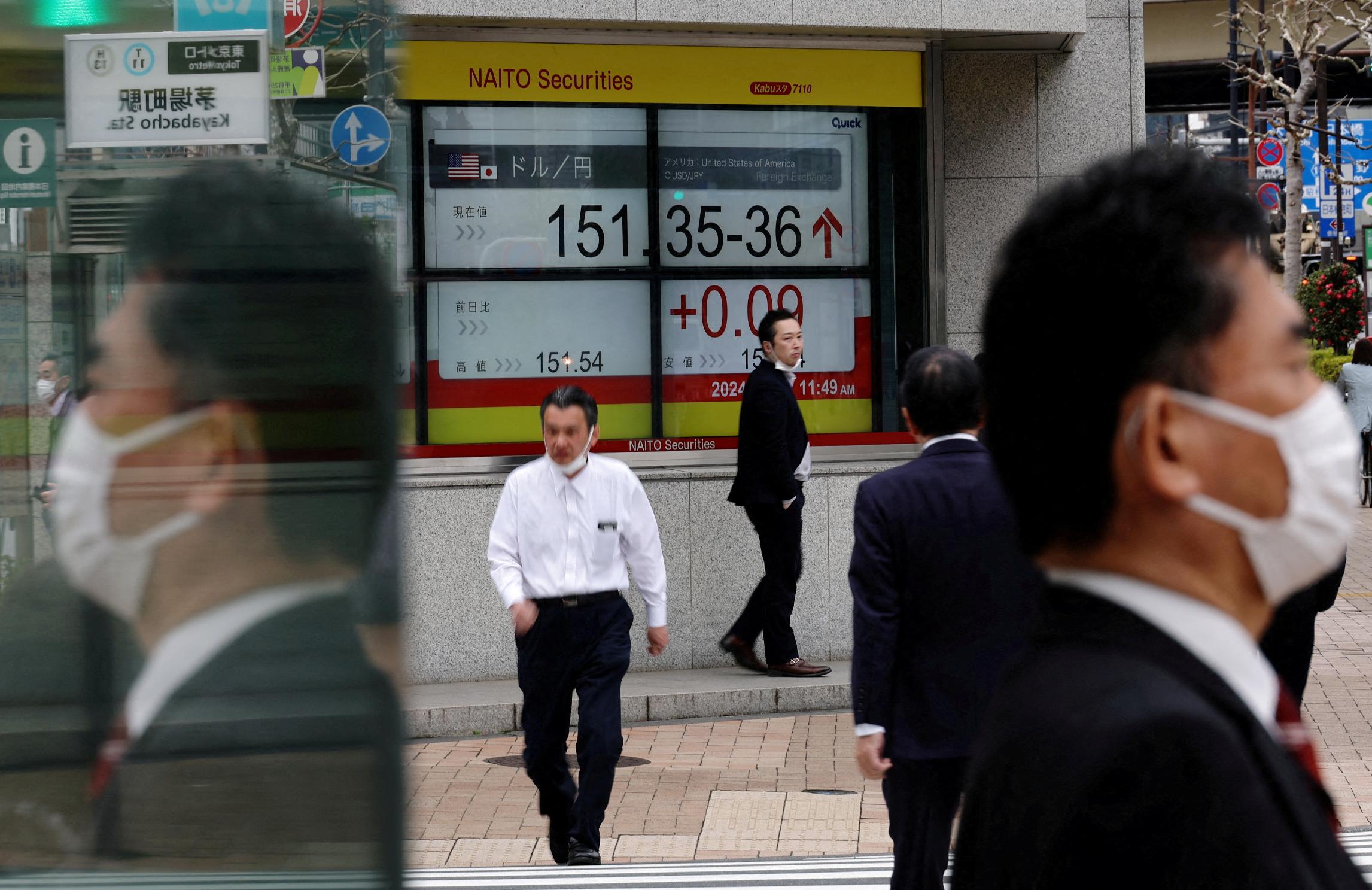
Japan's Ochi says yen slide to 160 could trigger action BOJ widely seen keeping policy unchanged on Friday U.S. durable goods orders rise modestly in March Focus on Friday's U.S. inflation data NEW YORK, April 24 (Reuters) - The yen dropped against the U.S. dollar on Wednesday to its weakest since mid-1990 above the key 155 area, with markets alert to any signs of intervention from Japanese authorities to prop up their currency. As the yen slid, the greenback edged higher, recovering against most currencies from falls caused by Tuesday's data showing U.S. business activity slowed this month. The dollar rose as high as 155.37 yen, its strongest since mid-1990, before falling back in choppy trading, which is a sign of market nervousness around the 155 level. It was last at 155.26, up roughly 0.3% . The yen's weakness against the dollar has ignited the market's anxiety surrounding currency intervention. Japanese Finance Minister Shunichi Suzuki and other policymakers have said they are watching currency moves closely and will respond as needed. Senior ruling party official Takao Ochi told Reuters that a decline in the currency towards 160 could trigger intervention. Ochi said if the yen slides further toward 160 or 170 to the dollar, "that may be deemed excessive and could prompt policymakers to consider some action." Market participants, however, have taken Japanese comments on the yen with a grain of salt. "The move in dollar/yen has been in line with what's happening with the broad dollar re-assessment," said Jayati Bharadwaj, global FX strategist, at TD Securities in New York. "It's not being driven by BOJ (Bank of Japan) speculation, which it was at one point last year, but a broad dollar move backed by fundamentals." She added that if the BOJ were to intervene on behalf of the Ministry of Finance, it's not going to target a "round number." "I don't think there's specific number that the BOJ is keeping in mind. It would have to be the magnitude of the move," she added. The BOJ is set to start its two-day policy meeting on Thursday and is widely expected to leave policy settings and bond purchase amounts unchanged, having raised interest rates for the first time since 2007 just last month. BOJ Governor Kazuo Ueda has said the central bank may raise interest rates again if the yen's decline significantly pushes up inflation. The fall in the yen comes after a string of strong U.S. inflation data pushed the dollar to five-month highs and reinforced expectations that the Federal Reserve is unlikely to be in a rush to cut interest rates this year. The dollar index , which measures the currency's value against six major peers led by the euro, was last up 0.2% at 105.84. Earlier, the index hit 105.59, a roughly two-week low, after Tuesday's surprisingly robust European activity data and cooling U.S. business growth. The greenback pared gains on Wednesday after data showed new orders for key U.S.-manufactured capital goods increased moderately in March and data for the prior month was revised lower. The report suggested that business spending on equipment likely remained weak in the first quarter. The euro was little changed at $1.0697, following Tuesday's rally following data showing business activity in the euro zone expanded at its fastest pace in nearly a year. Sterling , meanwhile, was up 0.1% at $1.2460, continuing gains from Tuesday on data showing British businesses recorded their fastest growth in activity in nearly a year. The pound was also boosted by comments on Tuesday from Bank of England chief economist Huw Pill who said interest rate cuts remained some way off. Friday sees the release of the Fed's favored inflation measure, the personal consumption expenditures (PCE) price index. Markets currently price in a 70% chance of a first U.S. rate cut by September, according to the CME's FedWatch tool. In other currencies, the Australian dollar rose 0.1% to US$0.6497, after hitting as high as US$0.6530 for the first time since April 12, as it rallied on the back of hotter-than-expected consumer price data. That led markets to abandon hopes for any rate cuts from the Reserve Bank of Australia in the near term. Sign up here. https://www.reuters.com/markets/currencies/dollar-shaky-after-euro-rebound-yen-mired-34-year-low-2024-04-24/
2024-04-24 05:04
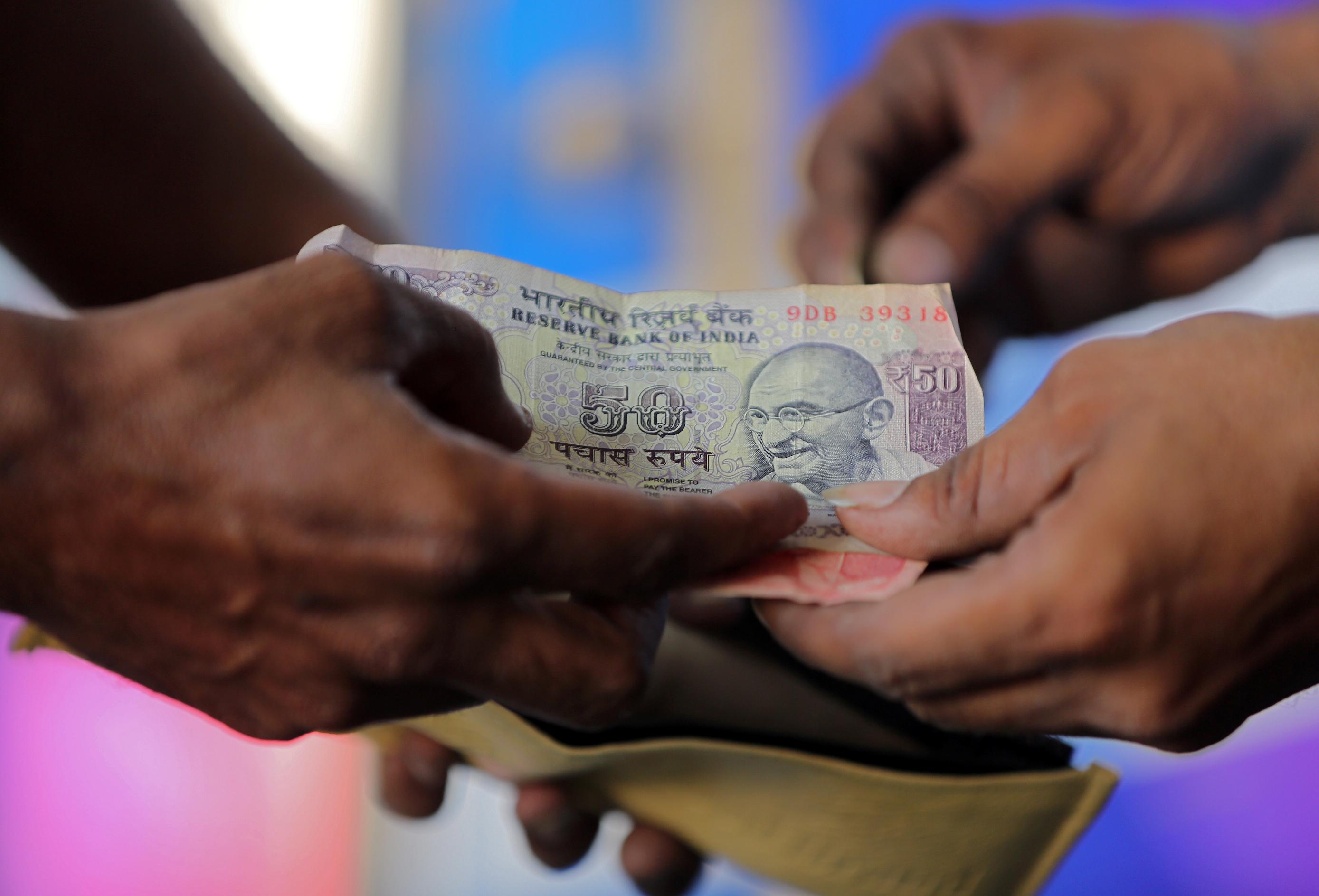
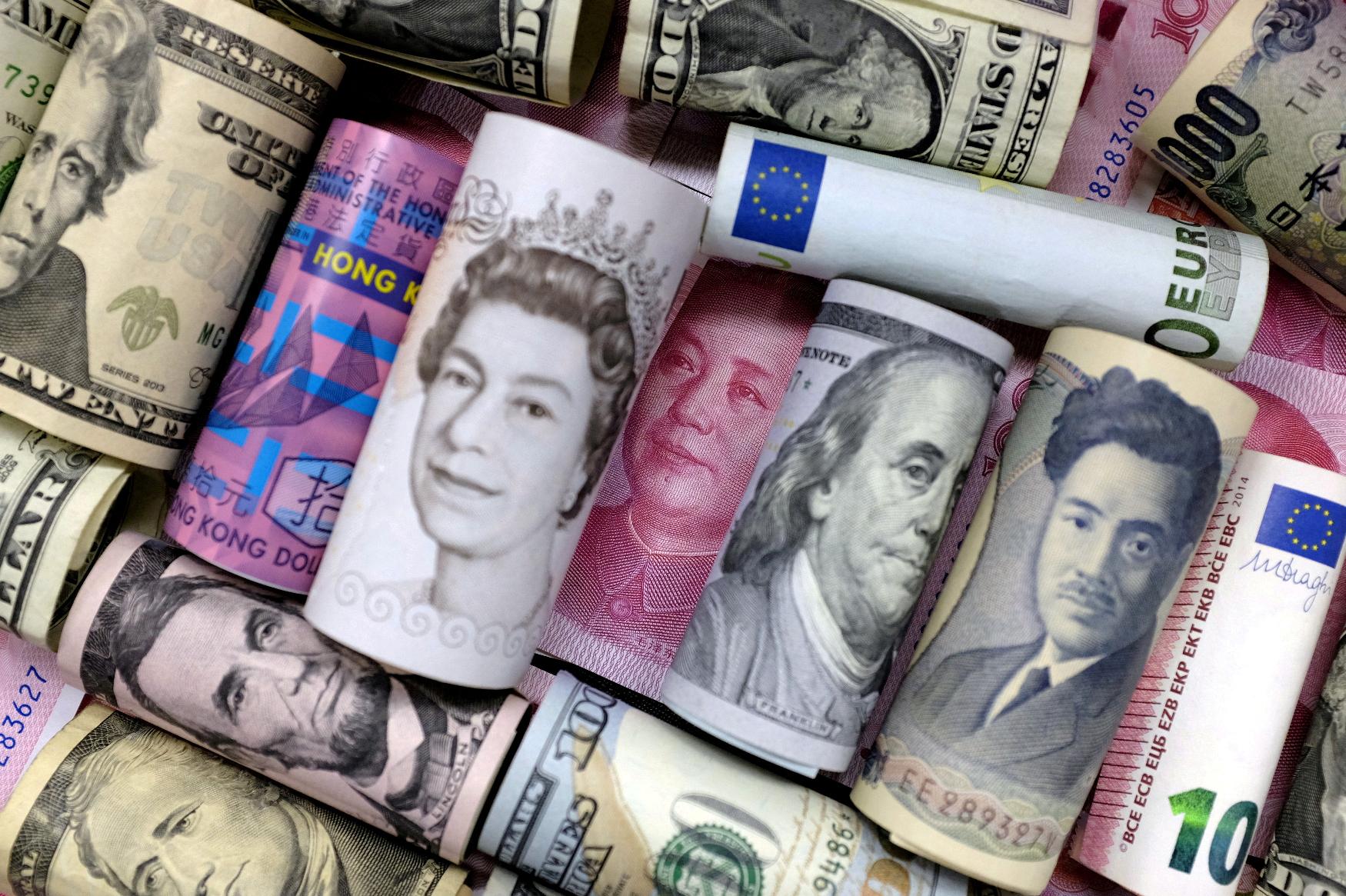
MUMBAI, April 24 (Reuters) - The Indian rupee gained on Wednesday, aided by a recovery in risk appetite that helped lift Asian currencies, while dollar-rupee forward premiums also ticked higher. The rupee was at 83.27 against the U.S. dollar as of 10:15 a.m. IST, its strongest level since April 10 and higher than its close of 83.3425 in the previous session. The dollar index declined on Tuesday and was last quoted at 105.6, while the Korean won and Indonesian rupiah rose by 0.4% each to lead the gains among the rupee's Asian peers. U.S. PMI data on Tuesday showed that business activity cooled to a four-month low in April due to weaker demand, which pulled the dollar down by nearly 0.4%. The rupee is likely to head higher after risk assets saw a smart recovery in the past two days and is expected to hover in a range of 83.20 to 83.50 in the near term, said Dilip Parmar, a foreign exchange research analyst at HDFC Securities. Meanwhile, dollar-rupee forward premiums ticked higher, with the 1-year implied yield up 2 basis points at 1.68%. "Weak data from the U.S. typically spurs some paying interest but broadly, far forwards continue to be a receive on upticks," a foreign exchange trader at a state-run bank said. Investors now await the release of U.S. GDP data on Thursday and personal consumption expenditure (PCE) inflation data on Friday for cues on the potential timeline of rate cuts by the U.S. Federal Reserve. U.S. GDP growth is expected to have slowed to 2.4% in the January-March quarter, from 3.4% in the previous quarter, while core PCE inflation likely held steady at 0.3% month-on-month in March, according to Reuters' polls. Sign up here. https://www.reuters.com/markets/currencies/rupee-rises-two-week-high-improved-risk-appetite-forward-premiums-tick-up-2024-04-24/