2024-04-18 00:59
Prices fall for fourth straight session, down 4% on week OPEC spare capacity could offset Iran sanctions, analyst says EIA: U.S. crude inventories up 2.7 million barrels LONDON, April 18 (Reuters) - Oil prices fell to a three-week low on Thursday, extending losses on hopes of easing tensions in the key producing region of the Middle East, while investors turned their focus to a bleaker demand picture. Brent futures were down 60 cents, or 0.7%, at $86.69 a barrel, while U.S. crude futures traded 53 cents lower, or 0.6%, at $82.16 a barrel at 1135 GMT. Both were down for a fourth straight session. Prices were down more than $1 at their intra-day low and have slumped around 4% so far this week. Investors are unwinding the geopolitical risk premium in oil prices on the perception that any Israeli retaliation to Iran's attack on April 13 will be moderated by international pressure. Any new Western sanctions against Iran could be offset by greater output from other oil-producing nations, and their impact could be limited without Chinese cooperation, said Ole Hvalbye, commodities analyst at SEB Research. Iran is the third-largest producer in the Organization of the Petroleum Exporting Countries, according to Reuters data, and an easing of its conflict with Israel would reduce the potential for supply disruptions. "However, the current reassuring production cushion makes increasing thirst for the black stuff very much quenchable," said PVM analyst Tamas Varga said. Analysts at JP Morgan highlighted in a note late on Tuesday that worldwide oil consumption so far in April has been 200,000 barrels per day (bpd) below its forecast, averaging 101 million bpd. Surging U.S. crude inventories also kept a lid on prices. Oil inventories rose by 2.7 million barrels to 460 million barrels in the week ending April 12, the Energy Information Administration said, nearly double analysts' expectations in a Reuters poll for a 1.4 million-barrel build. Stockpiles built up as refinery utilization declined at a time when processing typically rises ahead of summer driving demand in the U.S. Oil prices fell 3% on Wednesday despite Venezuela losing a key U.S. license that allowed it to export oil to markets around the world. The Reuters Power Up newsletter provides everything you need to know about the global energy industry. Sign up here. https://www.reuters.com/business/energy/oil-inches-up-after-us-reimposes-venezuela-oil-sanctions-2024-04-18/
2024-04-17 23:34
April 18 (Reuters) - Australian oil and gas producer Santos (STO.AX) New Tab, opens new tab said on Thursday its first-quarter revenue fell about 14%, hurt by lower production across its product portfolio and a decline in volumes in recent months. Severe weather events and planned maintenance activities hurt production, while sales revenue was hit primarily due to lower liquefied natural gas and ethane volumes, partly offset by higher realised prices. The company produced 21.8 million barrels of oil equivalent (mmboe) in the quarter ended March 31, 2024, compared with 22.2 mmboe a year earlier. Sales volume stood at 23.2 mmboe, versus 23.8 mmboe in the prior corresponding period. Average realised price for its liquefied natural gas product was $12.68 per million British thermal units (mmBtu), down from last year's $14.46 per mmBtu. The country's No. 2 independent gas producer said its sales revenue was $1.40 billion for the three-month period, down from $1.63 billion a year ago New Tab, opens new tab. According to Citi, the Visible Alpha consensus estimate was $1.37 billion. The Reuters Power Up newsletter provides everything you need to know about the global energy industry. Sign up here. https://www.reuters.com/business/energy/australias-santos-first-quarter-revenue-falls-14-2024-04-17/
2024-04-17 23:06
April 17 (Reuters) - Cleveland Federal Reserve Bank President Loretta Mester said on Wednesday she expects price pressures to ease further this year, allowing the Fed to reduce borrowing costs, but only when it is "pretty confident" inflation is heading sustainably to its 2% goal. "At some point, as we get more confidence, we will start to normalize policy back to a less restrictive stance, but we don't have to do that in a hurry," Mester said. Inflation so far this year has run higher than expected, she said, with the personal consumption expenditures price index running at 2.5%, and core PCE - which the Fed uses to gauge where inflation is heading - at near 3% over the last six months on an annualized basis. "Sometimes things don't cooperate; we just have to sort of be watchful here, and wait until the economy shows itself about where we are," she said. And with the labor market strong - unemployment was 3.8% in March - and U.S. economic growth solid, the Fed has time to wait for more information before making any move, she said. Mester's comments mark a retreat from her expectation just two weeks ago that the Fed will likely begin cutting the policy rate from its current 5.25%-5% range "later this year." Other Fed officials have made similar rhetorical pivots away from guidance on the timing of rate cuts, with Fed Chair Jerome Powell on Tuesday signaling rates may stay higher for longer. Financial markets have gotten the message. Traders of futures contracts tied to the Fed's policy rate are now pricing a first rate cut in September, with only about a 50-50 chance of one more quarter-point cut before the end of this year. Just a few weeks ago, three rate cuts was the dominant expectation, both in markets and among both Fed policymakers and outside analysts. Mester has a vote on U.S. monetary policy this year until the Fed's mid-June meeting, after which she will leave her post under the central bank's mandatory retirement rules. A successor has not been named. Get a look at the day ahead in U.S. and global markets with the Morning Bid U.S. newsletter. Sign up here. https://www.reuters.com/markets/us/fed-cut-us-rates-at-some-point-no-hurry-mester-says-2024-04-17/

2024-04-17 23:01
LONDON, April 17 (Reuters) - The commodities super cycle is back with a vengeance if copper's performance since the start of the month is anything to go by. London Metal Exchange (LME) three-month copper touched $9,640.50 per metric ton on Monday, its highest trade since June 2022. The Friday announcement of new U.S. and UK sanctions on Russian metal may have played a role but if so it was only a bit part. Copper is on Wednesday trading just shy of that peak at $9,560. Copper below $9,500 per ton is now cheap, according to analysts at Citi, who have raised their forecasts to an average $10,000 in the fourth quarter of this year and $12,000 in 2026. Many other analysts are doing likewise. Reasons to be bullish include supply constraints, a turn in the old manufacturing cycle and an acceleration in copper-intensive energy transition sectors. The promise of a further demand booster from artificial intelligence in the form of bigger data centres is the latest strand in copper's bull narrative. The only skeptics are physical copper users, who are not seeing any tangible signs of that promised boom in their current order books. But does it matter? Forward-looking funds not immediate fundamentals are why the price is on a roll right now. FUNDS BUY IN Investment funds have lifted their bets on higher prices to record levels in the London market. Long positions reached 84,117 contracts, equivalent to over two million tons, at the end of last week. That's the highest level since the LME started publishing its Commitments of Traders report at the start of 2018 and far exceeds the previous peak of 67,583 seen in August last year. The bulls are also out in force on the CME copper contract, lifting long positions to 119,649 contracts in the week to April 9, a level last seen in January 2018. Shorts haven't yet capitulated on either exchange, meaning the net long exposure hasn't surpassed the February 2021 peaks. How long that remains the case will depend on whether copper can maintain its upward momentum. This new enthusiasm for copper seems to be part of a broader investor rotation into commodities, with gold flying and the rest of the industrial metals now up on the start of the year after a weak first quarter. Fund managers are evidently looking beyond the immediate headwinds of high interest rates and stuttering manufacturing activity to a boom time of synchronised old-economy and new-economy growth. Until a few weeks ago the super-bulls were lurking in the options market, buying call options with strikes all the way up to $20,000 per ton. They are now swarming into the futures market with a resultant jump in trading activity. Average daily volumes on the CME contract were up 18% year-on-year in March, those on the LME by 21%. CME open interest has mushroomed from 192,235 contracts at the start of March to a current 299,513. FUTURE PERFECT Copper's short-term optics remain at best lukewarm. The European manufacturing sector is still in the recessionary doldrums, contracting for the 21st month in March, while U.S. and Chinese factory sectors are showing only the first signs of expansion. The Yangshan premium, a closely-watched indicator of China's import appetite, has slumped from over $100 per ton in December to $24, according to local data provider Shanghai Metal Market. The seasonal build in Shanghai Futures Exchange stocks this year has been the strongest since 2020. Headline stocks on the London market look low but a yawning contango across the front part of the curve suggests there is no immediate constraint on availability. But as Citi points out, "investor conviction in the future emergence of physical shortages is enough alone to send prices soaring." "The actual realisation of demand strength, physical shortages, and or inventory drawdowns" has not been necessary to get the copper rally going, it said in an April 8 research note. It is copper's future promise rather than its mundane present that is motivating investment managers to place their bets. It is sheer market momentum that is drawing ever more speculative money into the market, adding more fuel to the fiery rally. SUPER RALLY The impact of fund flows on the current price dynamics may be a harbinger of things to come. Citi contends copper is now entering its second mega bull rally of the century after that of the 2010s, when China's industrialisation and urbanisation drained stocks and sent the price soaring above the $10,000 level for the first time ever. Copper's exposure to energy-transition sectors such as electric vehicles, solar power and smart grids is well known but has been over-shadowed by weakness in more traditional end-use sectors such as property and white goods over the last year or so. A recovery in the old industrial cycle promises a period of sustained demand growth that risks outpacing supply, exhausting inventories and sending the price to new record highs. Funds will play an important part in that process in a way they didn't during the early-century boom. Investment activity in the base metals sector was muted back then and most investors joined the bull party of the 2010s just as last orders were being called. This time they're leading from the front and likely to become ever more influential a price driver as copper's bull narrative unfolds. The opinions expressed here are those of the author, a columnist for Reuters. Get a look at the day ahead in U.S. and global markets with the Morning Bid U.S. newsletter. Sign up here. https://www.reuters.com/markets/commodities/funds-buy-back-into-coppers-super-cycle-credentials-andy-home-2024-04-17/

2024-04-17 22:57
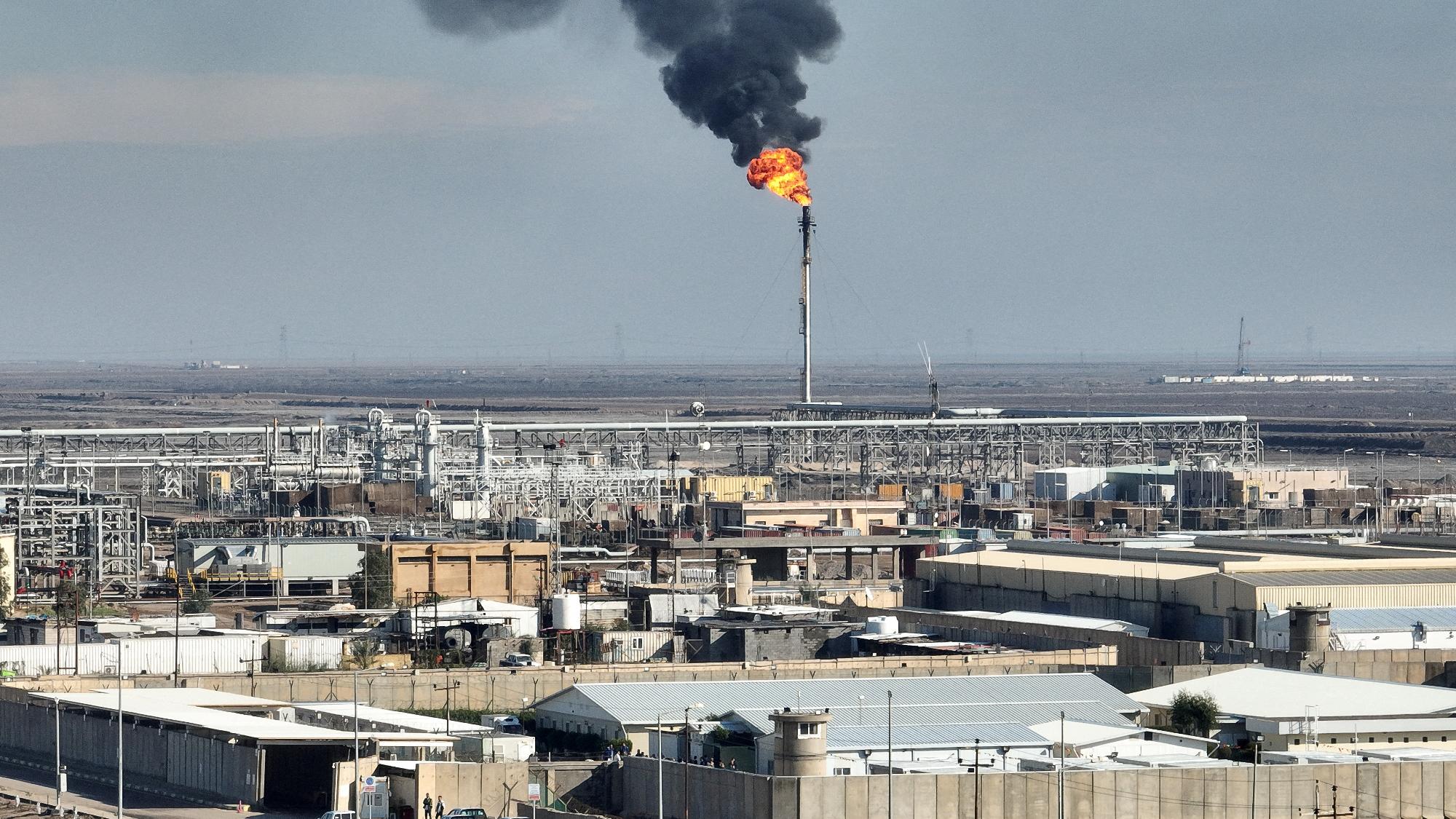
WASHINGTON, April 17 (Reuters) - Iraqi and U.S. companies signed a series of agreements on Wednesday to capture natural gas traditionally flared from Iraq's oilfields and use it to produce domestic power while reducing dependence on neighboring Iran for energy. Boosting the energy independence of Iraq, one of the world's top oil and gas producers, and reducing reliance on Iran is a top U.S. foreign policy goal. But Iraq's oil and gas fields have suffered years of under investment and since 2018, Washington has had to issue Iran sanctions waivers to Iraq that allow it to buy power imported from the Islamic republic. The agreements, signed in Washington in the presence of Iraqi Prime Minister Mohammed Shia al-Sudani and U.S. officials, are meant to spur investment in processing 300 million standard cubic feet per day of natural gas at the Bin Umar oilfield. Halfaya Gas Company, an affiliate of Iraq's RAS Group, signed an agreement with Iraq's South Gas Company to invest in processing the gas. U.S. companies signing memorandums of understanding with Iraqi entities on the projects included KBR (KBR.N) New Tab, opens new tab, Baker Hughes (BKR.O) New Tab, opens new tab, and GE (GE.N) New Tab, opens new tab. The companies did not disclose projected monetary value of the agreements. Collecting and burning the gas to generate power can help fight climate change as simply flaring it wastes the fuel while doing nothing to reduce demand for additional gas supply from Iran. The agreements also call for 400 kilometers (250 miles) of pipelines to transport the gas, a marine export terminal, a gas processing plant and other facilities. Iraq has the potential to "harness immense natural gas resources, invest in new energy infrastructure and renewables, and achieve energy self-sufficiency by 2030" said a statement jointly issued by the U.S. and Iraq during a visit to Washington by Sudani this week. Geoffrey Pyatt, assistant secretary for energy resources at the U.S. State Department said the projects would be developed over the next couple of years. "Because they have under-invested over many years in their oil and gas sector, they have tremendous potential to do much more today," Pyatt told Reuters. The Reuters Power Up newsletter provides everything you need to know about the global energy industry. Sign up here. https://www.reuters.com/business/energy/iraqi-us-companies-sign-agreements-capture-burn-gas-power-2024-04-17/
2024-04-17 22:39
NEW YORK, April 17 (Reuters) - Foreign holdings of U.S. Treasuries surged to a record in February, its fifth straight monthly rise, Treasury Department data released on Wednesday showed. Holdings totaled $7.965 trillion, up from a revised $7.945 trillion in January. Treasuries owned by foreigners rose 8.7% from a year earlier. Holdings of Treasuries grew the most in Belgium, by $27 billion, to hit $320 billion. Japan, the largest non-U.S. holder of Treasuries, increased its U.S. government debt to $1.167 trillion, the largest since August 2022 when the country's holdings were at $1.196 trillion. Investors have been alert to the threat of Japanese intervention in the currency market to boost the yen, which plunged to a 34-year low of 154.79 per dollar on Tuesday. The Bank of Japan intervened three times in 2022, selling the dollar to buy yen, first in September and again in October as the yen slid toward a 32-year low of 152 to the dollar. In September and October 2022, Japan's Treasury holdings declined $131.6 billion from $1.196 trillion in August. China's pile of Treasuries also fell in February to $775 billion, data showed. The monthly decline of $22.7 billion was the second biggest among the 20 major countries on the Treasury's list. Holdings of Treasuries by China, the world's second largest economy, have been declining, reaching $763.5 billion in February, the lowest since March 2009. Britain listed its Treasury holdings at $700.8 billion, up about $9 billion from January. The benchmark 10-year Treasury yield started February at 3.863% and ended the month at 4.252%, up nearly 39 basis points. Yields rose as a slew of solid economic data was released that month, reflecting expectations that the Federal Reserve will delay cutting interest rates. Major U.S. asset classes had inflows during the month, the data showed. On a transaction basis, U.S. Treasuries posted inflows of $88.8 billion, up from $46.3 billion in January. Foreign buying of U.S. corporates and agencies persisted in February, with inflows of $52.7 billion and $3.7 billion, respectively. U.S. equities showed a minor inflow of $400 million, compared with outflows of $15.4 billion in January. Overall, net foreign acquisitions of long- and short-term securities, as well as banking flows, showed a net inflow of $51.6 billion in February, up from outflows of $30.8 billion the previous month, Treasury data showed. Get a look at the day ahead in U.S. and global markets with the Morning Bid U.S. newsletter. Sign up here. https://www.reuters.com/markets/us/foreign-holdings-us-treasuries-hit-record-high-japan-holdings-rise-data-shows-2024-04-17/