
2024-04-12 06:34
Regulations, public support greater in Europe Europe ESG fund flows stay strong vs U.S. flows Climate coalitions dominated by European firms April 12 (Reuters) - Steady investor demand in Europe for environmental and socially responsible investments and wide-ranging regulation are helping Europe's finance industry withstand political pressures that have pushed some U.S. peers to backtrack on their green agendas. In the United States, conservative politicians have been successful in tamping down environmental, social and corporate governance (ESG) product marketing, in diluting regulations that promote ESG disclosures, and in discouraging financial firms from co-ordinating on curbing greenhouse gas emissions. But Europe has so far largely resisted the anti-ESG tide, due to greater political and consumer support for greener products and a swathe of regulations that underpin the operations of the finance industry and companies in the real economy. Some politicians have been active in Europe to soften environmental rules and legislation, highlighting the costs to consumers of going green. This has led to the watering down of some new regulations promoting ESG in Europe. But fund flow data shows that Europe overall remains an ESG stalwart. European investors have seven times as much capital in sustainable fund assets than U.S. investors, following five consecutive quarters of U.S. outflows, based on Morningstar data. "We've seen faster regulations lead to faster conformity, which has shielded European financial institutions from ESG headwinds," said Nathan Abela, head of research at sustainability data tracker ESG Book. Across Europe's financial services sector there are 20 rules and 25 voluntary guidelines pertaining to ESG, compared to just two rules and five voluntary guidelines in the United States, according to ESG Book. There is also more investor demand for ESG in Europe, driven by public pension funds. Some 73% of European pension schemes said climate change was an investment priority in 2023, compared with 53% of U.S. schemes, based on a 2023 LSEG survey New Tab, opens new tab. European financial firms' commitment to ESG could prove crucial to the survival of international climate alliances. Initiatives such as Glasgow Financial Alliance for Net Zero (GFANZ) and Climate Action 100+ have seen defections by U.S. firms, but their European membership has largely remained intact. This is important because most of their members are European. One of the GFANZ coalitions for example, the Net-Zero Banking Alliance, has 71 European members but only nine from the U.S. The Net-Zero Insurance Alliance, has eight European firms as members but none from the United States. REGULATORY SUPPORT ESG has a solid framework of regulation in Europe, including the European Union's Taxonomy, which defines climate-friendly investments. Other key EU rules are the Sustainable Finance Disclosure Regulation, which forces financial groups to disclose their sustainable investments, and the Corporate Sustainability Reporting Directive (CSRD), which applies to companies in the real economy. Also, people in Europe tend to be more united in their support for climate action. A 2022 study from the non-profit Pew Research Center, showed Europeans of whatever political leaning were more likely to consider climate change a "major threat". In the U.S., the study found a big divide on climate views between people on the right and left of the political spectrum. "In the EU or in Europe, there is disagreement about the importance of this (ESG) but the disagreements are not as wide as that in the U.S.," said Kamiar Mohaddes, associate professor of economics and policy at the Cambridge Judge Business School. But Europe has not been immune to attacks on ESG regulations. CSRD and a separate law aimed at ensuring that corporate supply chains are environmentally friendly and protect human rights changed over the past year to cover fewer companies and provide more time to comply. There has been a dent in European investor demand for ESG but it has been small. New ESG fund launches fell 10% in Europe in 2023, but the slide in the United States was even more pronounced, down 75%, according to Morningstar. U.S. outflows from sustainable investment funds in the fourth quarter hit $5.1 billion versus $3.3 billion of inflows in Europe, making Europe's assets under management seven times as great as that seen in the United States. "What we're seeing in Europe is everyone continues to be quite focused on ESG and how it is implemented," said David Zahn, head of sustainable fixed income at asset manager Franklin Templeton (BEN.N) New Tab, opens new tab. Zahn said, however, that ESG is not investors' only concern. "It's not just ESG that they care about. They want to see portfolios that take into account ESG, that maybe have some constraints, but they also want performance." The Reuters Daily Briefing newsletter provides all the news you need to start your day. Sign up here. https://www.reuters.com/sustainability/sustainable-finance-reporting/europe-stands-firm-against-us-driven-esg-backlash-2024-04-12/

2024-04-12 06:32
NEW YORK/LONDON, April 12 (Reuters) - U.S. stocks sold off sharply on Friday while the dollar jumped as investors grappled with rising geopolitical tensions and persistent inflation that could lead to diverging monetary policy between the U.S. and Europe. MSCI's gauge of stocks across the globe (.MIWD00000PUS) New Tab, opens new tab was last down 1.2%, its biggest one-day drop in about six months, dragged down by U.S. performance. Wall Street's main indexes all slumped well over 1% with the S&P 500 (.SPX) New Tab, opens new tab posting its biggest one-day drop since Jan. 31, as first-quarter earnings season kicked off on a dour note with reports from major banks. "We have a mix of elevated geopolitical risk, inflation worries and mild (earnings) disappointments," said Angelo Kourkafas, senior investment strategist at Edward Jones. Worries that Iran might retaliate for an airstrike on its embassy in Damascus that it blamed on Israel have hovered over markets, propping up oil and prompting moves into gold and other safe-haven assets. Israel did not claim responsibility for the airstrike on April 1. U.S. President Joe Biden said on Friday he expected Iran to attack Israel "sooner, rather than later" and warned Tehran not to proceed. There are "concerns that there may be an attack on Israel by Iran," said Kristina Hooper, chief global market strategist at Invesco. "Geopolitical risk has been driving a lot of the moves." Central bank outlooks were also in focus. The European Central Bank signaled on Thursday it could start cutting rates, while a hotter-than-expected inflation reading on Wednesday pushed back bets for the Federal Reserve's first cut until later in the year. The dollar index gained 0.69% and hit its highest level in over five months. The euro was down 0.76%. "We've got a dollar, U.S. interest rate strength play, that's what's going on here," said Joseph Trevisani, senior analyst at FX Street in New York. The Japanese yen bucked the trend, firming 0.02% against the dollar in a rebound after hitting a 34-year low during the day as investors watched for signs of intervention from Tokyo officials. On Wall Street, the Dow Jones Industrial Average (.DJI) New Tab, opens new tab fell 475.84 points, or 1.24%, to 37,983.24, the S&P 500 (.SPX) New Tab, opens new tab lost 75.65 points, or 1.46%, to 5,123.41 and the Nasdaq Composite (.IXIC) New Tab, opens new tab lost 267.10 points, or 1.62%, to 16,175.09. Investors were digesting results from JP Morgan (JPM.N) New Tab, opens new tab, Citigroup (C.N) New Tab, opens new tab and Wells Fargo (WFC.N) New Tab, opens new tab, with the S&P 500 Banks index (.SPXBK) New Tab, opens new tab dropping 3.3%. Europe's STOXX 600 (.STOXX) New Tab, opens new tab index rose 0.14%. The yield on benchmark U.S. 10-year notes fell 5.9 basis points to 4.518% from 4.576% late on Thursday. Federal Reserve Bank of Boston President Susan Collins is eyeing a couple of interest rate cuts this year amid expectations it could still take some time to get inflation back to targeted levels. Market pricing implied investors expect the Fed to reduce its main funds rate by about 48 basis points this year after traders started 2024 betting on about 150 bps of cuts. Oil prices rose on Middle East tensions. U.S. crude settled up 0.75% at $85.66 a barrel and Brent settled at $90.45 per barrel, up 0.79% on the day. Spot gold lost 1.24% at $2,343.76 an ounce, taking a breather after rising above $2,400 per ounce to an all-time high. Get a look at the day ahead in U.S. and global markets with the Morning Bid U.S. newsletter. Sign up here. https://www.reuters.com/markets/global-markets-wrapup-1-2024-04-12/

2024-04-12 06:17
LONDON, April 12 (Reuters) - The idea that the Federal Reserve's steep interest rate rises actually made U.S. inflation stickier has more merit than it first sounds - not least among U.S. central bank researchers themselves. The oft-lampooned notion that interest rate rises actually spur inflation usually receives short shrift - and stems mostly from times when mortgage interest payments were directly included in catch-all household inflation baskets. As the suggestion floated again this week - with JPMorgan Asset Management strategist Jack Manley telling Bloomberg that Fed rate hikes were partly responsible for elevated inflation - social media wags were quick to compare it to the discredited theories of Turkish leader Tayyip Erdogan. But with U.S. markets running scared of yet another hot consumer price inflation report for March, and with rents and shelter costs key aggravators of that miss once again, elements of the counter-intuitive rates-and-inflation idea may deserve some scrutiny - and calm investors down a bit too. What's more, differences between how inflation benchmarks account for housing and shelter in the U.S. and Europe may also go some way to explaining why markets feel the European Central Bank can go ahead and cut rates this June even if they think the Fed may now hesitate. As pointed out by Eurizon SLJ's Stephen Jen and Joana Freire this week, the link is rooted in two papers from Fed researchers in recent years. The first was a discussion paper by economists Daniel Dias and Joao Duarte New Tab, opens new tab that was published by the Fed's Board of Governors in 2019, less than a year before the onset of the COVID-19 pandemic. The study concluded that "housing rents increase in response to contractionary monetary policy shocks" and that "after a contractionary monetary policy shock, rental vacancies and the homeownership rate decline." Put another way, the research showed that rental costs tend to surge as rising mortgage costs force those put off from buying houses to rent instead - while also reducing the number of potential homes to rent. And reinforcing the peculiarity of the response of rent, the paper showed all other main components of the consumer price index (CPI) either decline in response to tighter monetary policy or are not responsive. GIMME SHELTER A second paper last year by San Francisco Fed researchers Zheng Liu and Mollie Pepper New Tab, opens new tab pointed out that housing expenditures represent about 15% of the personal consumption expenditures (PCE) price index, a quarter of the services component of PCE and about 40% of "core" consumer expenditures that exclude food and energy. The PCE is the U.S. central bank's favored inflation measure. As rent and housing-related costs account for some 34% of the CPI index, the "hot" March reading was down largely to another 0.4% monthly rise in "owners' equivalent rent" - an imputed measure of the amount homeowners would pay to rent or would earn from renting their property. The San Francisco Fed paper noted the continued surge in rental prices even following the steep rate hikes in 2022 and 2023, but it said there was evidence that tighter monetary policy tamped down rent prices eventually - with the stickiness due in part to long-term rental contracts. It argued that a one-percentage-point increase in the Fed's policy rate would reduce rental inflation by 3.2 points - and headline PCE rates by half a percentage point. But only after two and half years. So don't hold your breath. That would suggest the full effects on rent from the Fed's initial rate rises in 2022 won't be felt until the end of this year - even though presumably it kicks in sharply from there given that the Fed's policy rate is now 5.25 percentage points higher than it was in March of 2022. SHELTER FROM THE STORM "Rents and rental inflation should eventually fall, as high interest rates crimp households' purchasing power," Eurizon SLJ's Jen and Freire wrote. "Rather perversely, early Fed rate cuts could run the process in reverse and help depress rent and, in turn, inflation," they added. "The general trend in U.S. inflation is definitely down - and in our view all non-shelter components of inflation are either falling fast or are already outright negative." Supermarket food prices were unchanged last month and vehicle prices fell, for example. And even though he said a Fed rate cut was not imminent, New York Fed President John Williams on Thursday stressed core services inflation excluding housing was falling faster than expected. He also batted away suggestions this month from colleagues, such as Fed Governor Michelle Bowman, that the central bank's policy rate may even need to go higher still. And on the basis of the slightly perverse link between rates and rent inflation, another hike at this stage sounds very unwise. After this week's CPI scare chased borrowing rates higher across the maturity spectrum - and pushed traders to take all but one quarter-percentage-point cut off the table - perhaps the biggest market risk from here is the Fed is actually more relaxed than many fear. The opinions expressed here are those of the author, a columnist for Reuters The Reuters Daily Briefing newsletter provides all the news you need to start your day. Sign up here. https://www.reuters.com/markets/rates-bonds/if-fed-hikes-spurred-rent-inflation-markets-should-relax-mike-dolan-2024-04-12/

2024-04-12 06:14
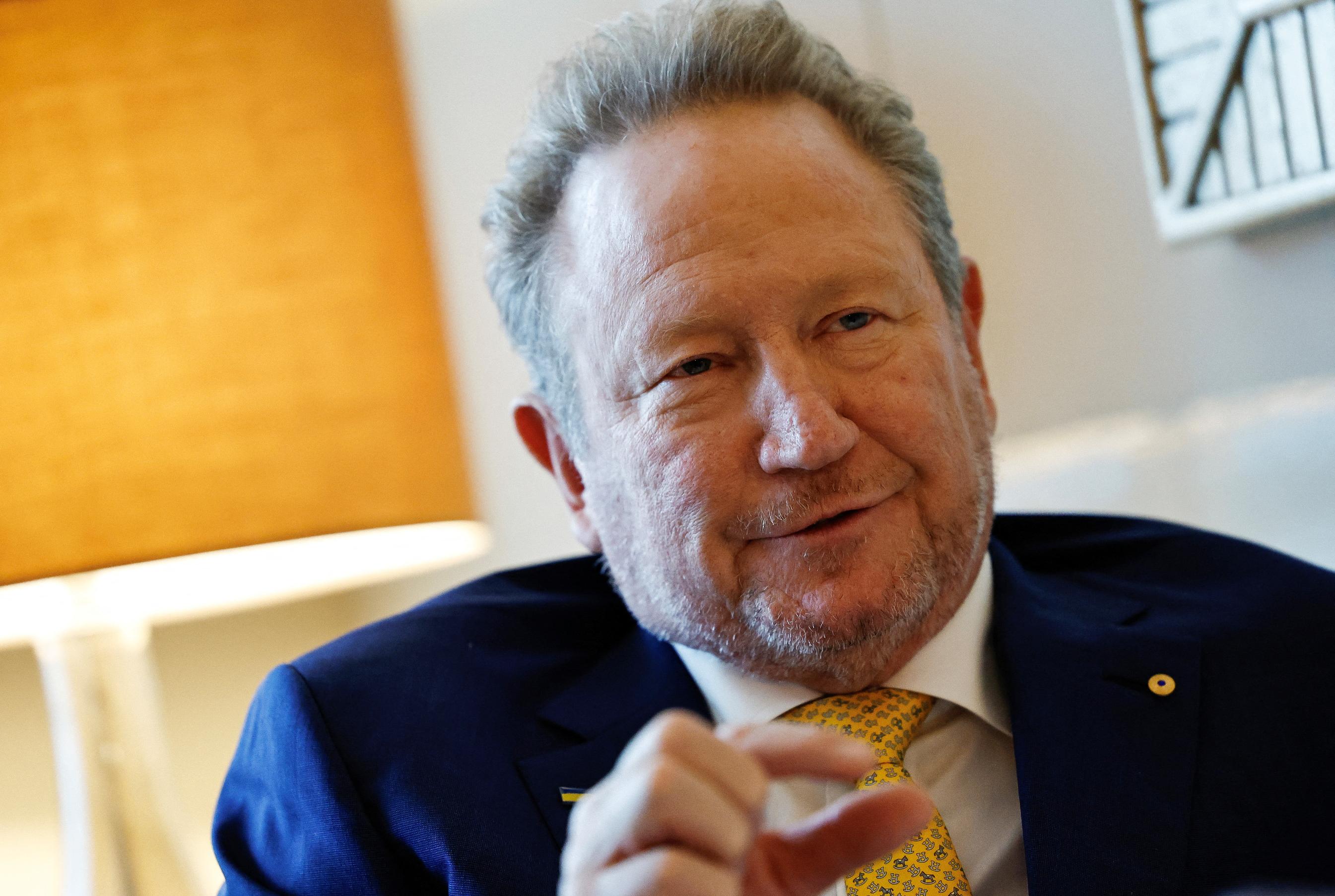
SYDNEY, April 12 (Reuters) - Australian prosecutors have discontinued mining magnate Andrew Forrest's criminal prosecution of Meta (META.O) New Tab, opens new tab over what he said were thousands of scam cryptocurrency advertisements on Facebook that feature his face. The decision is a setback for Forrest, the 37% owner of iron ore producer Fortescue Metals Group (FMG.AX) New Tab, opens new tab and Australia's second-richest person, in his quest to hold the internet giant accountable for the ads. A separate civil lawsuit he has filed against Meta over the ads in California is ongoing. A spokesperson for the Commonwealth Director of Public Prosecutions said on Friday that the department had found there was insufficient evidence to continue the prosecution, but did not elaborate. Forrest has accused Meta of breaking Australia's anti-money laundering laws by allowing third-party scammers to use its software and platform to advertise fake cryptocurrency schemes that feature photos of his face, leading people to believe he had endorsed them. He had pursued the lawsuit under Australian laws that allow an individual to criminally prosecute a foreign corporation with the consent of the attorney general. Forrest said in a statement that the decision to dismiss the case was "a tragedy for innocent parents and grandparents who have lost their life savings." A Meta spokesperson said scams were a complex threat, perpetrators use every available platform and "our sympathy goes out to people who have been impacted". "Meta doesn't want scams on its platforms and we will continue to work tirelessly to prevent them and protect our users," the spokesperson said. Forrest added that he would continue to pursue the California case, in which he accuses the U.S. firm of taking insufficient steps to prevent the advertisements. In a filing for that case, Forrest said Meta promised him in 2019 that it would help remove the scam advertisements featuring his face, but that the ads kept appearing for Australian Facebook users, resulting in hefty losses for people who were duped. The social media giant has argued that a U.S. law exempts internet platforms from responsibility for content posted by third parties and has sought to have Forrest's lawsuit dismissed. Forrest contends that Meta's argument is invalid, arguing that the U.S. law only applies domestically. From April 2023 to November 2023, more than 1,000 such advertisements appeared on Facebook, Forrest's filing said. The Technology Roundup newsletter brings the latest news and trends straight to your inbox. Sign up here. https://www.reuters.com/technology/australian-prosecutors-drop-billionaire-forrests-case-against-meta-2024-04-12/
2024-04-12 06:00
LONDON, April 11 (Reuters) - Portfolio investors have amassed one of the largest bullish positions in U.S. gasoline futures and options since before the coronavirus pandemic, anticipating that prices will continue climbing over the next few months. U.S. gasoline has emerged as the most attractive part of the petroleum complex for investors betting prices will rise further this year in the run up to U.S. presidential and congressional elections in November. Relatively low inventories, employment gains, strong household income growth and the prospect of an active hurricane season are expected to keep gasoline consumption high and inventories under pressure. Ukraine’s drone attacks on refineries in Russia threaten to tighten the international supply situation even further and have prompted the Biden administration to warn Ukraine’s government to change its targeting. BUOYANT CONSUMPTION U.S. gasoline consumption is correlated with employment and household incomes so the current rise in nonfarm jobs and wage rates are likely to underpin strong use in 2024. Domestic consumption has been trending structurally lower since 2007 as a result of improvements in fuel economy, ethanol blending and more recently the deployment of electric and hybrid vehicles. But lower domestic use has been more than offset by strong growth in exports, mostly to Mexico and other countries in Latin America, which has kept overall refinery production trending higher. Strong domestic consumption during the peak summer driving season is likely to cause inventories to tighten cyclically and exert upward pressure on prices in 2024. ACTIVE HURRICANE SEASON Nearly half of the total refinery capacity in the U.S. is located along the Gulf of Mexico on the coasts of Texas and Louisiana. Every year there is a small but non-zero chance refinery processing will be disrupted by a direct hit from a major hurricane. The North Atlantic hurricane season lasts from June through November with activity peaking in August and September (“Tropical cyclone climatology New Tab, opens new tab”, U.S. National Oceanic and Atmospheric Administration, 2024). The precise number of storms, their intensity and the location of landfalls is highly variable and notoriously difficult to predict months in advance. But the expected shift from El Nino to La Nina conditions underway in the central and eastern Pacific is often associated with an increased number and intensity of hurricanes in the Atlantic (“Impacts of El Nino and La Nina on the hurricane season New Tab, opens new tab,” NOAA, 2014). Chartbook: U.S. gasoline inventories and prices New Tab, opens new tab At the same time, Atlantic storm creation and intensity is strongly correlated with sea surface temperatures in the Caribbean and the tropical North Atlantic. Tropical storm formation requires sea surface temperatures of at least 26°C, among a number of other conditions (“Cyclogenesis New Tab, opens new tab”, Australian Bureau of Meteorology, 2017). Sea surface temperatures in the tropical North Atlantic were at a record seasonal high in March 2024, according to data from the U.S. Climate Prediction Centre. Sea surface temperatures surged higher around the world, including a very strong warm El Nino phenomenon in the Pacific, but the exceptional warming was most pronounced in the Atlantic. Surface temperatures in the Atlantic from 5° to 20° North and from 30° to 60° West averaged almost 27.1°C in March, which was more than 1.5°C above the long-term seasonal average. If the surface warmth persists into the second and third quarters it is likely to result in an above average number of tropical storms and more major hurricanes in 2024 and an elevated threat to the Gulf Coast refineries. Colorado State University researchers have predicted an “extremely active” hurricane season in 2024 (“Forecast for 2024 hurricane activity New Tab, opens new tab,” CSU, April 4, 2024). The number of named tropical storms and hurricanes is expected to be more than 50% higher than the long-term average. BULLISH POSITION Hedge funds and other money managers owned bullish long positions equivalent to 99 million barrels on April 2, the highest number for more than four years. After adjusting for a minority of bearish short positions, the net position was 84 million barrels, which was in the 88th percentile for all weeks since 2013. Fund managers were more bullish on gasoline than on crude (56th percentile) or middle distillates such as diesel and gas oil (53rd percentile). Bullish long positions in gasoline outnumbered bearish short ones by a ratio of more than 6.4:1 (68th percentile) on April 2. The long-short ratio suggests positioning is less stretched than the absolute number of long positions, but there is still downside risk to prices when long positions are unwound. LOW INVENTORIES On April 5, U.S. gasoline inventories were 5 million barrels (-2% or -0.42 standard deviations) below the prior ten-year seasonal average. Stocks had been as much as 7 million barrels (+3% or +0.75 standard deviations) above seasonal average in late January. But a site-wide power failure stopped BP’s massive refinery at Whiting, Indiana, lasting for more than a month from the start of February and resulted in a sharp depletion of stocks. Since the refinery restarted in March, the deficit has narrowed slightly, but inventories remain below normal for the time of year, putting upward pressure on prices. EVEN HIGHER PRICES? U.S. retail gasoline prices (including taxes) averaged $3.54 per gallon in March 2024, almost exactly in line with the average since the start of the century once inflation is taken into account. Inflation-adjusted prices have risen from a recent low of $3.22 in January 2024 but are still well below the recent high of $5.42 in June 2022 after Russia’s invasion of Ukraine. Fund managers are betting heavily that gasoline prices will rise further over the remainder of the year. From a purely positioning perspective, the large number of bullish long positions that must eventually be liquidated has itself created downside risk to prices. From a fundamental perspective, however, low inventories, strong consumption, threat to Russia’s refineries, and elevated hurricane risk to U.S. refineries are all sources of upside potential. John Kemp is a Reuters market analyst. The views expressed are his own. Follow his commentary on X New Tab, opens new tab Get a look at the day ahead in U.S. and global markets with the Morning Bid U.S. newsletter. Sign up here. https://www.reuters.com/markets/commodities/investors-bet-further-rise-us-gasoline-prices-kemp-2024-04-11/
2024-04-12 05:27
Israel on alert for Iran attack US dollar index poised for largest weekly gain since Sept. 2022 Euro set for biggest weekly fall in about 1-1/2 years U.S. rate futures pricing in 1st rate cut in September NEW YORK, April 12 (Reuters) - The U.S. dollar rose to its highest since November on Friday, boosted by safe-haven demand amid geopolitical tension in the Middle East as well as increasing divergence in monetary policy between the Federal Reserve and other major central banks. The dollar index was on track to post its largest weekly percentage gain since September 2022. It was last up 0.7% at 106.02 . Israel on Friday awaited an attack by Iran or its proxies, as warnings grew of retaliation for the killing last week of a senior officer in Iran's embassy in Damascus. Iran's supreme leader, Ayatollah Ali Khamenei, accused Israel of the killing and said it "must be punished and shall be" for an operation he said was equivalent to an attack on Iranian soil. "We have a confluence of things happening that are boosting the dollar: geopolitical risk increasing, hawkish data out of the U.S. in terms of inflation and last week's strong employment report," said Brad Bechtel, global head of FX at Jefferies in New York. "Geopolitical risk, in particular, is increasing volatility in the marketplace," he added. The euro, meanwhile, tumbled to a five-month low against the dollar, after the European Central Bank indicated it could soon cut interest rates. The expectation for the Fed, on the other hand, is that it will keep rates higher until later in the year. Europe's single currency last traded at $1.0637, down 0.9%, after hitting $1.0622, its weakest since Nov. 3 and was on pace for its biggest weekly percentage drop since late September 2022. The broad strength in the dollar also sent the yen to a fresh 34-year low as investors remained on the lookout for signs of potential action from Japanese monetary authorities to prop up the currency. Recent U.S. economic data on the labor market and inflation have caused market expectations for a rate cut from the Fed to be dialed back yet again. Expectations for a cut of at least 25 basis points in June have shrunk to 26%, down from 50.8%% a week ago, according to CME's FedWatch Tool New Tab, opens new tab. U.S. rate futures have now priced in a 77% chance of the first rate cut taking place in September. Fed fund futures have also pared back the number of rate cuts of 25-bps cuts this year to fewer than two, or roughly 46 bps, from about three or four a few weeks ago. That puts the Fed in contrast to the European Central Bank, which on Thursday signaled it could begin cutting rates as soon as June. The difference in interest rate expectations has widened the gap between U.S. bond and German euro zone yields, hitting its highest since 2019. That has made U.S. bonds more attractive and boosted the dollar. Economic data on Friday showed U.S. import prices increased for a third straight month in March amid rises in the costs of energy products and food, but underlying imported inflation pressures were tame. A separate survey from the University of Michigan showed its preliminary reading of U.S. consumer sentiment softened in April while inflation expectations for the next 12 months and beyond increased. Sterling also weakened against the dollar and was last down 0.9% at $1.2445 after falling to $1.2426, its lowest since Nov. 17. The pound was set for its largest weekly percentage drop since mid-July. The yen rebounded after the dollar strengthened against the Japanese currency. The dollar rose to its highest since mid-1990 at 153.39 yen and it last changed hands at 153.19 yen, down 0.1%. The threat of currency intervention by Japanese officials appeared to have dampened the moves in the yen, after Finance Minister Shunichi Suzuki said: "If there are excessive moves, we will respond appropriately without ruling out any options." The Japanese currency was on track for a weekly fall of about 0.8% , its second straight week of declines against the dollar. Keep up with the latest medical breakthroughs and healthcare trends with the Reuters Health Rounds newsletter. Sign up here. https://www.reuters.com/markets/currencies/yen-crumbles-under-towering-dollar-us-treasury-yields-2024-04-12/


