2024-04-11 06:40
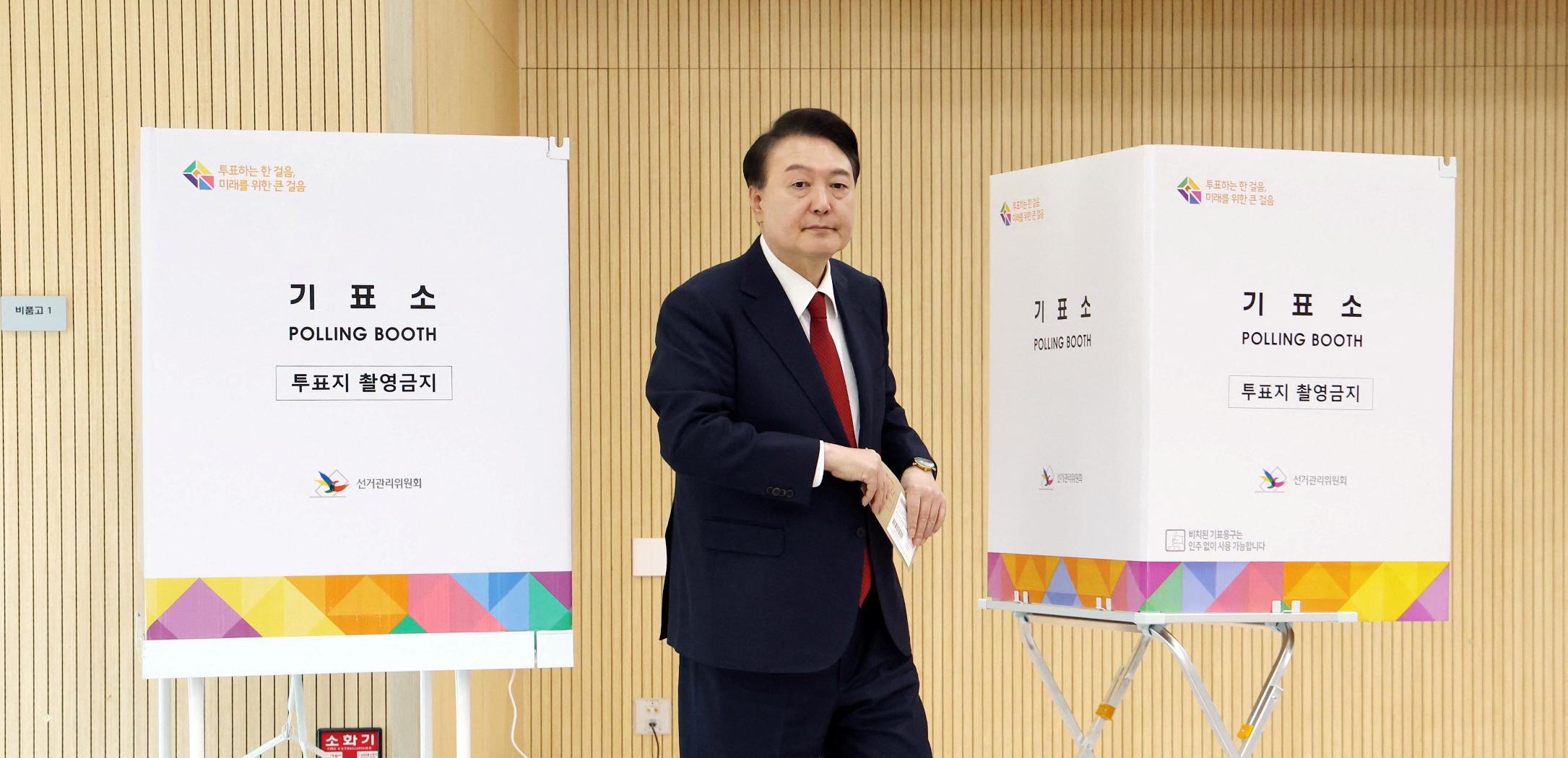
SEOUL, April 11 (Reuters) - South Korean President Yoon Suk Yeol pledged to renew his administration after his party suffered a big defeat in legislative elections, with the result increasing the risk that more of his policy priorities might be blown off course. Yoon, who took office in May 2022, was not up for election this time but his ability to pass legislation is likely to be further inhibited after the opposition led by the Democratic Party increased its majority after a poor showing by Yoon's conservative People Power Party. Here are some policy areas that may be impacted: TAX ON INVESTMENTS Yoon's pledge to scrap planned capital gains tax on income from financial investments will probably flop, analyst say, as it will be difficult to persuade parliament to amend the bill. The tax, aimed at boosting investor sentiment and stock values, is designed to levy at least 20% if annual capital gains from stock investments exceed 50 million won ($36,700). Those making more than 2.5 million won in other financial assets are also subject to the tax. It was due to be introduced in 2025, but the government in January said it should be abolished as the levy would seriously hurt the appetite among local investors for local stocks. VALUE-UP PROGRAMME Momentum for Yoon's campaign to boost the stock market, dubbed the Corporate Value-Up Programme, will weaken, analysts say. The plan, announced in February, seeks to correct a tendency for listed South Korean companies to have lower valuations than global peers due to factors such as low dividend payouts and poor corporate governance. Finance Minister Choi Sang-mok recently said the government plans to reduce corporate taxes on a portion of increased shareholder returns, but the proposal could face opposition in parliament if it is deemed to benefiting cash-wealthy conglomerates, analysts said. RENEWABLE VS NUCLEAR ENERGY The election result may provide a boost to some industries, including sectors such as renewable energy, electric vehicles and batteries, analysts said. The Democratic Party wants to increase the portion of renewable energy in South Korea's energy mix to 40% by 2035 from less than 10% now, create a belt of wind and solar power farms, and consider a law similar to the U.S. Inflation Reduction Act (IRA) which aims to boost investment to tackle climate threats. The party also pledged to provide "half-price" electric vehicles by promising subsidies linked to marriage and childbirth. But the Yoon government's plans for South Korea to become the "strongest in nuclear power" may be disrupted by resistance from the opposition. Shares in nuclear power plant parts maker Doosan Enerbility and plant engineering firm KEPCO Engineering & Construction (052690.KS) New Tab, opens new tab fell 6.9% and 9.2% respectively in afternoon trade, versus a 0.2% rise in the wider market (.KS11) New Tab, opens new tab. DEFENCE SALES, CHIPS NOT LIKELY TO BE AFFECTED Analysts said the election was unlikely to change South Korea's ambitious plans to boost defence exports. Although the Democratic Party did not include the defence industry in its campaign pledge book, it did mention the need to expand trade finance which has been an obstacle to overseas defence orders, NH Investment & Securities said in a note. As for the semiconductor industry, which accounts for nearly a fifth of South Korea's exports, both the opposition and ruling parties appear agreed on the need for continued support. South Korea's existing tax breaks for investment in semiconductor facilities will end this year. While the Democratic Party may stonewall the government's push to ease taxes in some fields, many of its members are likely to back extended tax breaks for chip investments, analysts said. MEDICAL REFORM PLANS Yoon has taken a hardline against doctors who oppose a major healthcare reform plan, the centrepiece of which is to increase the number of new medical students by 2,000 a year to make up what the government says is a severe shortage of physicians. The plan, which also includes incentives for doctors to practice in areas other than Seoul, the capital, has broad public support but there has been increased public concern over the long standoff between the government and doctors. The walkout by trainee doctors since Feb. 20 did not play significantly during the campaign and it was unlikely for Yoon to agree to a compromise and change course, given the public support for the initiative itself, analysts said. FOREIGN POLICY Taking a tougher line on North Korea, Yoon has made it a top priority to strengthen security alliances with the United States and Japan. Foreign policy did not play a significant role on the campaign trail and some analysts said Yoon might even focus more on his overseas agenda now, though those plans could also be at risk if the opposition seeks to cut budgets with its majority. ($1 = 1,363.5300 won) The Reuters Daily Briefing newsletter provides all the news you need to start your day. Sign up here. https://www.reuters.com/world/asia-pacific/how-south-korea-election-may-reshape-yoons-policy-agenda-2024-04-11/
2024-04-11 06:34
April 11 (Reuters) - Oil prices settled lower on Thursday as sticky inflation dampened hopes for near-term U.S. interest rate cuts, but worries that Iran might attack Israeli interests kept crude near six-month highs. Brent crude futures settled down 74 cents, or 0.8%, to $89.74 a barrel while U.S. West Texas Intermediate crude futures settled down $1.19, or 1.4%, to $85.02. It will be difficult to maintain Brent above $90 a barrel in the second half of the year without actual supply disruption associated with geopolitical events, said global energy strategist Vikas Dwivedi of Macquarie. "As a result, we expect oil to turn bearish as the year progresses due to non-OPEC supply growth, a material amount of OPEC+ spare capacity re-entering the market, and the potential that continuing inflation softens demand." Minutes from the U.S. Federal Reserve showed officials worried that progress on inflation might have stalled and a longer period of tight monetary policy would be needed. Investors who had expected a rate cut in June now see September as a likelier timing, following a third straight consumer inflation reading that exceeded forecasts. In Europe, central bank officials kept borrowing costs at a record high as expected, but signalled the ECB may soon cut rates. Slower rate cuts could crimp oil demand, yet OPEC stuck to its forecast for relatively strong global demand growth in 2024. The International Energy Agency will announce its expectations in its monthly report on Friday. Oil prices were also pressured by a power outage on Wednesday that shut multiple fuel-producing units at Motiva Enterprise's massive 626,600 barrel per day Port Arthur, Texas facility. Motiva began restarting the gasoline-producing fluidic catalytic cracker (FCC) on Thursday morning, said people familiar with plant operations. Meanwhile, traders worried that Iran might retaliate for a suspected Israeli air strike on its embassy in Syria on April 1. U.S. Secretary of State Antony Blinken has vowed that the U.S. will stand with Israel against any threats by Iran. This week, Israel and Hamas began a fresh round of negotiations in their more than six-month-old Gaza war but those talks have yielded no agreement. Get a look at the day ahead in U.S. and global markets with the Morning Bid U.S. newsletter. Sign up here. https://www.reuters.com/markets/commodities/oil-consolidates-gains-amid-concerns-worsening-middle-east-crisis-2024-04-11/

2024-04-11 06:10
Rise in U.S. producer prices slower than expected U.S. jobless claims rise less than expected U.S. rate futures price in first rate cut in September Fed's Williams says rate cut not imminent Fed's Barkin says not yet where Fed wants to be on inflation NEW YORK, April 11 (Reuters) - The dollar rose moderately on Thursday in choppy trading, as weaker-than-expected March U.S. producer prices did not relieve concerns about persistent inflation which has reinforced the belief that the Federal Reserve will delay cutting interest rates this year. Fed officials who spoke on Thursday also repeated the need for a patient approach in easing monetary policy, boosting the dollar. Thursday's data showed the producer price index (PPI) rose 0.2% month-on-month in March, compared with an 0.3% increase expected by economists polled by Reuters. On a year-on-year basis, it rose 2.1%, versus an estimated 2.2% gain. The U.S. currency fell after the PPI news but has rebounded. A separate report showed 211,000 U.S. initial jobless claims for the week ended April 6, compared with a forecast for 215,000, reflecting persistent labor market tightness. The dollar barely responded as investors focused on inflation. The PPI report followed a stronger-than-expected consumer prices index (CPI) released on Wednesday. The U.S. CPI rose 0.4% on a monthly basis in March, compared with expectations for a 0.3% increase. "The CPI has done enough damage to the outlook for an earlier rate cut," said Thierry Albert Wizman, global FX and rates strategist, at Macquarie in New York. "We may have to live with that in order to get three more months of low inflation and that means a cut is delayed." In afternoon trading, the greenback was flat against the yen at 153.23 yen , after sliding below 153 yen after the PPI data. Earlier in the session, the dollar hit a fresh 34-year high of 153.32 yen. The yen's slide against the dollar has reignited intervention fears, as Japanese officials reiterated they would not rule out any steps to deal with excessive swings. Japan intervened in the currency market three times in 2022 as the yen slid toward a 32-year low of 152 to the dollar. The dollar index, a measure of the greenback's value against six major currencies, was up 0.1% at 105.26 <=USD>. Against the Swiss franc, the dollar slid 0.3% to 0.9098 francs . Following the PPI data, the U.S. rate futures market has priced in a roughly 69% chance of a Fed rate cut in September, the CME's FedWatch tool showed. This timeline emerged after Wednesday's hotter-than-expected consumer price index last month. For weeks, rate futures had factored in a June rate cut. Fed fund futures have also pared back the number of rate cuts of 25 basis points (bps) this year to fewer than two, or roughly 42 bps, from about three or four a few weeks ago. "Market-implied rate expectations haven't budged materially from yesterday's levels and extraordinarily wide rate differentials are keeping the U.S. dollar elevated," said ," said Karl Schamotta, chief market strategist at Corpay in Toronto. In other currencies, the euro was last down 0.1% at $1.07026 . Earlier, it fell to a two-month low of $1.0699 after the European Central Bank held interest rates at a record high of 4% as expected, but sent a signal it was preparing for a cut. In the United States, the Fed signaled on Thursday a rate cut is not imminent. New York Fed President John Williams said while the U.S. central bank has made considerable progress in lowering inflation, it does not yet need to move to an easier monetary policy setting given volatile movements in inflation. "There's no clear need to adjust monetary policy in the very near term," given where the economy now stands, Williams said. Richmond Fed President Thomas Barkin, a voter this year on the Fed's policy-setting committee, echoed the same sentiment. He said the latest numbers did not increase his confidence that price pressures were easing on a broader basis throughout the economy. Keep up with the latest medical breakthroughs and healthcare trends with the Reuters Health Rounds newsletter. Sign up here. https://www.reuters.com/markets/currencies/dollar-firms-yen-skids-fed-cut-wagers-crumble-2024-04-11/
2024-04-11 06:03
NEW YORK April 11 (Reuters) - A global equities index rose slightly on Thursday after falling earlier in the day while Treasury yields rose as investors looked to the latest inflation data for clues on the potential for Federal Reserve interest rate cuts. A day after March's hot Consumer Price Index (CPI) reading sent equity investors to the exits, Thursday's data showed U.S. producer prices rose more slowly than expected last month with a cost of services increase blunted by falling goods prices. The producer price index (PPI) for final demand rose 0.2% versus economist expectations for 0.3% and a February increase of 0.6%. But New York's Fed President John Williams said on Thursday that while the central bank has made considerable progress with inflation, it does not yet appear to need rate cuts. Richmond Fed President Thomas Barkin said the Fed is not yet where it wants to be to have confidence price pressure will keep easing. "(Thursday) morning's PPI report came in softer than expected, lessening the blow of the disappointing CPI report (on Wednesday), which obviously shows that progress on disinflation is stalling," said Emily Roland, co-chief investment strategist at John Hancock Investment. But while the Fed will have two more months of data to look at before it makes a rate decision in June, Roland said "markets are getting the memo that the Fed is likely not going to be able to cut anytime soon" and that "it's tough to see the case to cut rates." On Thursday, traders were betting on a roughly 76% chance that the Fed will keep rates unchanged in June, versus 83.5% on Wednesday and an almost 51% chance they will stay the same in July compared with 57.6% on Wednesday, according to CME Group's FedWatch tool New Tab, opens new tab. On Wall Street the Dow Jones Industrial Average (.DJI) New Tab, opens new tab fell 2.43 points, or 0.01%, to 38,459.08, the S&P 500 (.SPX) New Tab, opens new tab gained 38.42 points, or 0.74%, to 5,199.06 and the Nasdaq Composite (.IXIC) New Tab, opens new tab gained 271.84 points, or 1.68%, to 16,442.20. MSCI's gauge of stocks across the globe (.MIWD00000PUS) New Tab, opens new tab rose 2.10 points, or 0.27%, to 774.88 after falling earlier by 0.46%. Europe's STOXX 600 (.STOXX) New Tab, opens new tab index closed down 0.4% earlier. Yields on U.S. Treasuries pushed higher with two-year yields breaching 5% for the first time since November before edging down, as investors worried over rebounding inflation after Wednesday's data despite the softer-than-expected producer prices. The yield on benchmark U.S. 10-year notes rose 2.2 basis points to 4.582%, from 4.56% late on Wednesday while the 30-year bond yield rose 3.8 basis points to 4.6723% from 4.634%. The 2-year note yield, which typically moves in step with interest rate expectations, fell 1.7 basis points to 4.9524% after earlier hitting 5.012% as investors continued to digest the data from Wednesday. "Typically when you get a big shock like that markets take about three days to normalize. Day two, we're still squaring some positions, some late tap-on-the-shoulder sellers are out there," said Guy LeBas, chief fixed income strategist at Janney Montgomery Scott. In currencies, trading was choppy with the dollar last up slightly as weaker-than-expected March U.S. producer prices did not relieve concerns about persistent inflation which has fueled fears that the Fed will take its time cutting rates this year. The dollar index gained 0.07% at 105.27, with the euro down 0.16% at $1.0725. Against the Japanese yen , the dollar strengthened 0.05% at 153.25. The yen's recent slide against the dollar re-ignited intervention fears, as Japanese officials reiterated they would not rule out any steps to deal with excessive swings. Oil prices settled lower as sticky inflation dampened hopes for near-term U.S. interest rate cuts, but worries that Iran might attack Israeli interests kept crude near six-month highs. U.S. crude settled down 1.38% at $85.02 a barrel and Brent ended at $89.74 per barrel, down 0.82% on the day. Gold prices firmed after the inflation data while persistent geopolitical concerns added to the metal's shine. Spot gold added 1.84% to $2,375.67 an ounce. U.S. gold futures gained 1.86% to $2,372.90 an ounce. Get a look at the day ahead in U.S. and global markets with the Morning Bid U.S. newsletter. Sign up here. https://www.reuters.com/markets/global-markets-wrapup-1-2024-04-11/
2024-04-11 05:46
KYIV, April 19 (Reuters) - Ukraine will receive 560 million euros for energy and transport infrastructure from the European Investment Bank, Ukrainian Prime Minister Denys Shmyhal said on Friday. In addition to infrastructure development, the funds will go towards rebuilding residential buildings and other economic projects that Shmyhal said would bring Ukraine closer to the European Union. Coming soon: Get the latest news and expert analysis about the state of the global economy with Reuters Econ World. Sign up here. https://www.reuters.com/world/europe/ukrainian-military-denies-russian-forces-have-reached-suburbs-chasiv-yar-2024-04-05/

2024-04-11 04:31
A look at the day ahead in European and global markets from Tom Westbrook After a 0.1% surprise on U.S. inflation sent yields and the dollar back to pre-Christmas highs, even greater focus falls on the European Central Bank's perceived willingness to cut rates. Markets expect no changes at the ECB's policy meeting today, though it could signal that a rate cut is coming as soon as June. Unlike in the U.S., data showed euro zone inflation unexpectedly fell in March. The currency bloc is in its sixth straight quarter of economic stagnation and the labour market is starting to soften. However, with markets not fully pricing the Fed to cut now until November, flagging a move in June would put European policymakers in the unfamiliar position of being ahead of the Fed. Prior to the U.S. inflation data, speculation that this might be uncomfortable, and that the ECB meeting presents hawkish risks, had supported the euro and, at $1.0745 in Asia on Thursday it has stayed above chart resistance at $1.0724. The dollar's big move higher has also turned the blowtorch back on the yen and the yuan. The yen has weakened past the 152-per-dollar level that traders had been so keenly watching for intervention, hitting a 34-year low. Japan's finance minister and top currency diplomat both said all options were on the table. Neither, however, said whether the move was "excessive". The yen rose slightly on crosses and to 152.82 per dollar . China's central bank pushed back against yuan weakness by fixing its trading band more or less steady, in spite of the overnight jump in the dollar - opening up the biggest gap between the fix and market expectations since at least 2018. Fitch cut its outlook on China's sovereign credit rating to negative on Wednesday and Beijing and Washington are at loggerheads over the effects of China's perceived excess manufacturing capacity. China's consumer inflation cooled more than expected in March and producer price deflation persisted. Elsewhere, Lufthansa suspended flights to Tehran with the Middle East on alert for possible Iranian retaliation over a suspected Israeli air strike on Iran's embassy in Syria. Brent crude futures are up 3.7% in April so far, along with other commodity prices, adding to inflationary pressures. U.S. President Joe Biden and Japanese Prime Minister Fumio Kishida unveiled plans for military cooperation and projects ranging from missiles to moon landings, strengthening their alliance with an eye on countering China and Russia. Key developments that could influence markets on Thursday: ECB policy decision U.S. PPI Get a look at the day ahead in European and global markets with the Morning Bid Europe newsletter. Sign up here. https://www.reuters.com/markets/europe/global-markets-view-europe-2024-04-11/