2024-04-10 07:18
WARSAW, April 10 (Reuters) - Polish government is abandoning plans to separate coal-fired power plants into a special company and is considering merging them with mines, said Industry Minister Marzena Czarnecka in a interview published on Wednesday in Rzeczpospolita daily. The previous government's plan assumed the creation of one large state-owned company NABE, that would pool the assets of power plants generating energy from coal. However, according to the Minister of Industry, this is not a good idea. "The problem of coal assets would not be solved, but only transferred to the state treasury, i.e. onto the shoulders of taxpayers. The NABE project will not be implemented," she said in an interview. Czarnecka said that linking coal-fired power plants with mines is being considered instead and the ministry will talk to banks to develop an optimal and acceptable model for them, so that they can finance the green transformation of energy groups. "However, I am convinced that there is no other way than to assign a given power plant to a given mine. Otherwise, this process will not take place," she said. "In July, we should present a plan to 'assign' specific mines to specific power plants. In September, we will present legal solutions on how to implement this idea. We would like to complete this process of arrangements this year." The Reuters Power Up newsletter provides everything you need to know about the global energy industry. Sign up here. https://www.reuters.com/business/energy/polish-government-drops-coal-merger-idea-considering-mines-tie-ups-instead-2024-04-10/

2024-04-10 07:04
H1 sales volumes up 0.7%, keeps FY guidance for flat volumes Shares jump as much as 10% H1 EBIT 178 mln Swiss francs vs forecast 266 mln April 10 (Reuters) - Chocolate maker Barry Callebaut (BARN.S) New Tab, opens new tab reported a small rise in first-half sales volumes on Wednesday, easing fears that a sharp rise in cocoa prices and other inflationary pressures might hit demand and sending its shares as much as 10% higher. The 0.7% increase in volumes in the six months to Feb. 29 was broadly in line with the Swiss company's guidance for flat full-year volumes, a target it reiterated. Shares in the company, which supplies chocolate for Unilever's (ULVR.L) New Tab, opens new tab Magnum ice creams and Nestle's (NESN.S) New Tab, opens new tab KitKat bars, were up 8% at 1035 GMT, on track for their best day in eight years. Vontobel analyst Jean-Philippe Bertschy said the volume figure was reassuring given the spike in raw material prices. Cocoa prices have more than tripled over the last year as disease and adverse weather in Ghana and neighbouring Ivory Coast, the world's top two producers, have hit production. CEO Peter Feld said Barry Callebaut was well covered with cocoa beans thanks to its competitive edge in sourcing. "What goes up fast comes down fast at one point in time," he added on a conference call, referring to cocoa prices. In an emailed comment to Reuters, a spokesperson said the company expected high prices to lead farmers to invest more, "which should in turn boost supply". Finance chief Peter Vanneste said he saw a consistent positive trend in demand for cocoa, although "especially steep price increases can have an impact on short-term demand". The Zurich-based company also reported lower-than-expected half-year operating profit, hit by one-off expenses caused by its transformation plan, which aims to cut costs and speed up getting products to market, among other things. Earnings before interest and tax fell 40% in local currencies to 178 million Swiss francs ($197 million), missing analysts' forecast of 266 million francs, according to a company-provided consensus. ($1 = 0.9036 Swiss francs) The Reuters Daily Briefing newsletter provides all the news you need to start your day. Sign up here. https://www.reuters.com/business/retail-consumer/barry-callebaut-operating-profit-falls-due-transformation-plan-2024-04-10/

2024-04-10 07:01
LONDON, April 10 (Reuters) - A June jamboree in central banking is being scratched from diaries as markets now suspect the Federal Reserve will drag its heels on a first interest rate cut by then and leave the European Central Bank to go solo. And persistent stability in the transatlantic exchange rate despite that shift in policy thinking may well give the ECB heart to push ahead regardless - with euro/dollar still stuck bang in the middle of an 18-month-long eight cent range. One of the most remarkable aspects of the global rates market during the first quarter was lock-step pricing on both the timing and extent of Fed and ECB credit easing this year despite vastly different underlying economic conditions. While impressive disinflation over the past year in both the United States and euro zone has given both central banks an amber light to start rolling back the highest borrowing costs in over two decades, near recession in the euro zone contrasts with still-brisk U.S. expansion and a super-tight jobs market there. A combination of another booming U.S payroll gain last month and stubborn new year inflation readings has seen many Fed officials dampen market hopes for a cut as soon as June - with some even suggesting any rate cuts this year may soon be off the agenda without more significant inflation improvement. Wednesday's consumer price update may bolster that view. But as the ECB meets this Thursday, all the stars are still aligning for it to signal easing by midyear - with core inflation continuing to ebb there last month and a dour bank lending readout for the first quarter showing tight credit conditions biting hard. "We will know a little more in April, but we will know a lot more in June," ECB boss Christine Lagarde said after the last meeting just over a month ago. 'PLAUSIBILITY RANGE' AXA Group Chief Economist Gilles Moec reckons staggered rate moves are now a distinct possibility and the relatively nonchalant euro may be the key to encouraging that. "That the ECB cuts before the Fed is absolutely within our 'plausibility range'," he wrote. "The euro exchange rate has barely softened despite a reversal in market expectations on policy rate differentials (and) this should embolden the ECB to take the right decisions for the euro area irrespective of what the Fed ultimately does." Moec argues that the only channel by which Fed hesitation would have a bearing on the ECB going solo in June is via the exchange rate - where a dollar surge might see renewed pressure on dollar-priced imports and commodity prices for the bloc. The fact that the euro/dollar rate barely budged over the past month puts that to one side. At the start of this month, futures markets had fully priced in a quarter point rate cut by the Fed in June, but that's now been cut to just a 50-50 chance since. The ECB remains fully priced for a June move. Chris Williamson at S&P Global Market Intelligence reckons talk of an earlier ECB move is justified by underlying momentum in both euro zone consumer price trends and price readings from regional purchasing managers surveys. "The CPI and PMI data ... hint at the ECB being the first to see inflation hitting - and remaining below - target, with the U.S. lagging behind in the inflation battle." SHUFFLING THE DECK To be fair, juggling the dates of a first move may seem slightly academic. After all, even if money market traders have got cold feet about June, they still see a full quarter point easing by the end of July. But it's shifts in the extent of the easing cycle ahead that are perhaps more significant. Only 63 basis points of Fed cuts are now penciled in for the remainder of this year but 85bps of ECB cuts are still nailed on. Push it out further and the Fed's so-called 'terminal rate' captured by money market futures has crept back up close to 4.0% for early 2027 - almost a full percentage point higher than it was at the start of the year and implying the entire easing cycle may be just 150bps in total. The equivalent ECB reading has 175bps already priced by the end of next year. Further out still and the outperforming euro zone government bond market has seen the five-year Transatlantic yield gap widen by more than a quarter point since the beginning of last month to give the U.S. a nominal yield premium of more than 200bps for the first time this year. In fact, that five-year yield premium has now more than doubled in just 12 months and euro/dollar is exactly where it was on April 10, 2023. A green light for the ECB? The opinions expressed here are those of the author, a columnist for Reuters. Get a look at the day ahead in U.S. and global markets with the Morning Bid U.S. newsletter. Sign up here. https://www.reuters.com/markets/transatlantic-rate-rift-opening-up-midyear-mike-dolan-2024-04-10/
2024-04-10 06:29
NEW YORK/LONDON, April 10 (Reuters) - Treasury yields surged while equity indexes sank on Wednesday after data showed U.S. consumer prices rose more than expected in March, diminishing hopes for how much and how soon the Federal Reserve can cut interest rates. In currencies, the dollar index rose across the board after the data while the greenback hit its highest level against Japan's yen since 1990, as traders watched to see if Japanese authorities would intervene to prop up the yen. With rising costs for gasoline and shelter, the U.S. consumer price index rose 0.4% last month, in line with February, the Labor Department's Bureau of Labor Statistics (BLS) said. This put the year-on-year increase at 3.5%. Economists polled by Reuters had estimated a gain of 0.3% on the month and 3.4% year-on-year. After the report traders pulled back on rate cut bets now reflecting a roughly 17% chance the Federal Reserve will cut rates in June, down from a roughly 62% chance a week ago. They also pushed bets for a July cut closer to 41% from around 76% last week according to CME Group's FedWatch tool. "We're in this volatile sticky point right now where the Fed hasn't been able to say 'we've won.' They're going to want to see more data points to give them confidence they'll achieve their 2% inflation goal," said Michael Hans, chief investment officer at Citizens Private Wealth. "Today does not do that. It continues to reinforce that a patient approach is still prudent," he said. "The market is reacting because there were much higher expectations coming into this data that there would be a cut in June or July." On Wall Street the Dow Jones Industrial Average (.DJI) New Tab, opens new tab fell 422.16 points, or 1.09%, to 38,461.51. The S&P 500 (.SPX) New Tab, opens new tab dropped 49.27 points, or 0.95%, to 5,160.64 and the Nasdaq Composite (.IXIC) New Tab, opens new tab lost 136.28 points, or 0.84%, to close at 16,170.36. MSCI's gauge of stocks across the globe (.MIWD00000PUS) New Tab, opens new tab fell 6.91 points, or 0.89%, to 772.32. Earlier Europe's STOXX 600 (.STOXX) New Tab, opens new tab index closed up 0.15%. The European Central Bank meets on Thursday and is not expected to change its rate, though it had earlier been indicating that a June rate cut was likely. YEN WEAKENS In Treasuries, the benchmark 10-year yield US10YT=RR rose over 10 basis points to its highest since mid-November after the inflation report. The yield on benchmark U.S. 10-year notes rose 18 basis points to 4.546%, from 4.366% late on Tuesday while the 30-year bond yield rose 12.8 basis points to 4.6273% from 4.499% late on Tuesday. The 2-year note yield, which typically moves in step with interest rate expectations, rose 22.2 basis points to 4.9688%, after hitting its highest level since mid-November. In currencies, the dollar index gained 1.04% at 105.17, with the euro down 1.04% at $1.0742. Against the Japanese yen , the dollar strengthened 0.77% at 152.94. Oil prices rallied after three sons of a Hamas leader were killed in an Israeli airstrike in the Gaza Strip, fuelling worries that ceasefire talks could stall. Another concern is that continued conflict could drag in countries, particularly Hamas-backer Iran, the third-largest producer in the Organization of the Petroleum Exporting Countries (OPEC). U.S. crude settled up 1.15%, or 98 cents at $86.21 a barrel and Brent ended at $90.48 per barrel, up 1.19%, or $1.06 on the day. Gold prices slipped from record-high levels as the U.S. dollar as Treasury yields firmed after the inflation print. Spot gold lost 0.91% to $2,331.12 an ounce. U.S. gold futures fell 0.58% to $2,329.90 an ounce. (This story has been refiled to remove extra words in quotes and speaker attribution in paragraphs 5 and 6) Get a look at the day ahead in U.S. and global markets with the Morning Bid U.S. newsletter. Sign up here. https://www.reuters.com/markets/global-markets-wrapup-1-2024-04-10/

2024-04-10 06:13
ZURICH, April 10 (Reuters) - Influential newspapers in Switzerland on Wednesday criticised a climate change ruling against the Swiss government by Europe's top human rights court, saying it risked undermining democracy and the political clout of environmental groups. Tuesday's ruling by the European Court of Human Rights in favour of over 2,000 Swiss women who said Switzerland had not done enough to combat climate change is expected to embolden more people to bring climate cases against governments. As environmental groups celebrated the ruling by the Strasbourg court, newspaper editorials said the decision would fan fears that the judiciary was getting involved in politics. "Absurd verdict against Switzerland: Strasbourg pursues climate policy from the judges bench," the center-right Neue Zuercher Zeitung (NZZ) newspaper wrote. Describing the ruling as "activist jurisprudence" that could pave the way for "all kinds of claims", the paper said the elderly plaintiffs were ultimately pawns of environmental lobbies that used the court to circumvent democratic debate. Switzerland, where referendums regularly test the limits of national policymaking, has committed to cutting greenhouse gas emissions by 50% by 2030, from 1990 levels. The government had proposed New Tab, opens new tab stronger measures to deliver the goal, but voters rebuffed them in a 2021 referendum. Under the headline "We don't want climate justice", national daily Blick called the court's ruling "questionable" and warned it was likely to deepen divisions over climate policy. "And in European politics, it should be noted, this plays into the hands of those who smell foreign judges everywhere," the paper wrote. The center-left daily Tages-Anzeiger meanwhile said in an editorial that while the court had highlighted the limitations of Switzerland's climate agenda, democracy would come under pressure if courts began to shape policy. Making reference to the 2021 referendum, the paper said the ruling risked confirming widely held views that the court was meddling with national decision-making. That in turn could come back to haunt environmentalists at the ballot box when disgruntled voters vent their frustration "against the Green parties who now want to use the verdict for their political agenda," the paper wrote. The Reuters Daily Briefing newsletter provides all the news you need to start your day. Sign up here. https://www.reuters.com/sustainability/swiss-press-say-absurd-european-climate-ruling-could-harm-democracy-2024-04-10/

2024-04-10 05:28
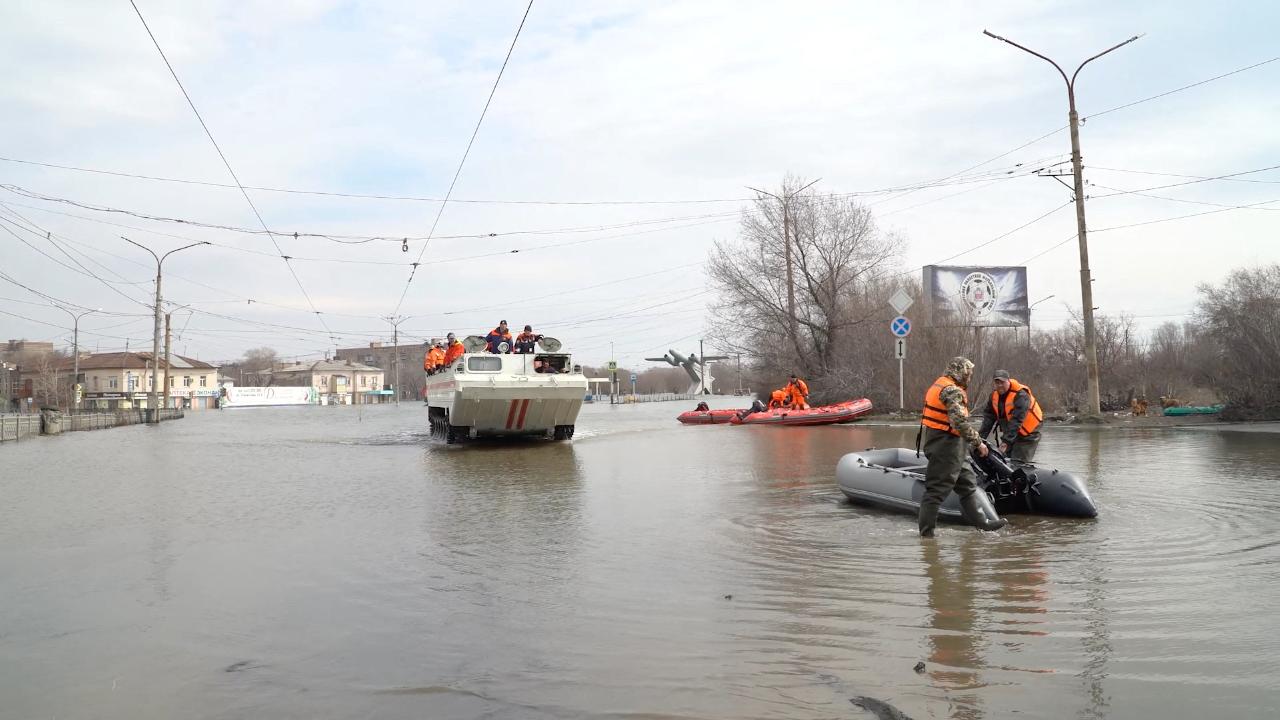
Over 97,000 evacuated in Kazakhstan More than 12,000 evacuated in Russia Water levels rise in Urals city of Orenburg Flooding in Urals, Siberia, Volga and Kazakhstan Pope Francis sends sympathies to victims of floods ORENBURG, Russia, April 10 (Reuters) - Floods engulfed cities and towns across Russia and Kazakhstan on Wednesday after Europe's third-longest river burst its banks, forcing about 110,000 people to evacuate and swamping parts of the Russian city of Orenburg. The deluge of melt water overwhelmed scores of settlements in Russia's Ural Mountains, Siberia, Volga and areas of Kazakhstan after major rivers such as the Ural, which flows into the Caspian, rose more 70 cm (2 foot 3 inches) beyond its bursting point to over 10 metres. In Orenburg, a city with a population of 550,000 about 1,200 km (750 miles) east of Moscow, hundreds of homes were flooded and at least 7,700 people were evacuated as the Ural river rose swiftly beyond critical levels. Whole areas of the city were under water. Residents in Orenburg paddled along roads that now resembled rivers and waters lapped at the windows of traditional wooden houses. In Kurgan, a region which straddles the Tobol river, 4,500 people were evacuated and fears grew that thousands - or even tens of thousands - more would need to evacuated. "The forecast is unfavourable," Kremlin spokesman Dmitry Peskov told reporters. "The water level continues to rise in flood zones, large amounts of water are coming to new regions." The flood situation was acute in parts of Western Siberia, the largest hydrocarbon basin in the world, where the peak is expected in three to five days, and some areas around the Volga, Europe's largest river, the emergencies ministry said. Residents in Orenburg said it was the worst flooding in living memory while Russian officials said it was the worst flooding in the area since records began. Kazakhstan said more than 97,000 people had been evacuated. Russia said 10,500 houses were flooded across 37 regions, most in the Orenburg region. Upstream on the Ural, which flows into Kazakhstan, floodwaters burst through an embankment dam in the city of Orsk on Friday. In Kazakhstan, people worked through the night to build up dykes and strengthen embankments. A state of emergency remained in effect in eight of the country's 17 provinces, down from 10 at the end of last week. Unverified footage from the Aktobe region of northern Kazakhstan, through which the Ilek, a tributary of the Ural, flows, showed dead cattle, settlements covered in silt, with scores of mud-brick houses and embankments collapsed. Pope Francis expressed his sympathy for the victims. "I also want to convey to the people of Kazakhstan my spiritual closeness at this time, when a massive flood has affected many regions of the country and caused the evacuation of thousands of people from their homes," he said during his Wednesday weekly audience in St Peter's Square. "I invite everyone to pray for all those who are suffering the effects of this natural disaster." RECORD FLOODING Spring flooding is a usual part of life across Russia as the harsh winter snows melt, swelling some of mighty rivers of Russia and Central Asia. This year, though, a combination of factors triggered unusually severe flooding. Russian emergency officials said the soil was waterlogged before winter and then was frozen under very high snow falls which then melted very fast in swiftly rising spring temperatures and heavy rains. One Russian official, the Presidential Plenipotentiary in the Urals Region, Vladimir Yakushev, was quoted by Russian media as suggesting that Kazakhstan was to blame for not coordinating the discharge of water more effectively. Kazakh officials have said much of the water was coming from Russia; there are rivers flowing in both directions between the two countries which share the world's longest land border. President Vladimir Putin spoke to President Kassym-Jomart Tokayev of Kazakhstan about the floods on Tuesday. The Kremlin said the worst was still to come for the Siberian region of Tyumen and the Urals region of Kurgan. The Kremlin said Putin was getting updated on the situation but had no immediate plans to visit the flood zone. Sirens in Kurgan, a city on the Tobol river, a tributary of the Irtysh, warned people to evacuate immediately. Kurgan Governor Vadim Shumkov said that if the Tobol rose in the city to 9 metres, then 17,800 people would have to be evacuated but that if it rose to 14 metres then the figure would rise to 280,000 people. The river is currently at about 9.5 metres in Zverinogolovkoye, which is about 100 km away, the local administration said. The Reuters Daily Briefing newsletter provides all the news you need to start your day. Sign up here. https://www.reuters.com/world/europe/homes-flooded-after-ural-river-rises-quickly-russias-orenburg-2024-04-10/