2024-04-03 07:54
Lunate buys 40% stake in ADNOC Oil Pipelines Purchased from Blackstone, KKR for undisclosed sum DUBAI, April 3 (Reuters) - Abu Dhabi investor Lunate said on Wednesday it had bought a 40% stake from private equity firms BlackRock (BLK.N) , opens new tab and KKR (KKR.N) , opens new tab in the entity that leases Abu Dhabi National Oil Company's (ADNOC) oil pipelines. The terms of the deal were not disclosed. The transaction returns the stake to local hands after the two U.S funds bought it for $4 billion in 2019, becoming the first foreign investors to acquire infrastructure assets of a Gulf national oil company. It highlights how Abu Dhabi, home to three wealth funds that collectively manage about $1.4 trillion of assets and positions itself as the "Capital of Capital", is creating a new national champion in the alternative investments sector with Lunate. Alternative investments are in areas such as private equity and infrastructure, rather than traditional financial instruments such as equities and bonds. ADNOC Oil Pipelines, which has a 23-year lease on ADNOC's ownership interests in 22 pipelines, was formed as part of a broader strategy by ADNOC to raise billions of dollars through sales of stakes in energy assets and attract foreign investors. Lunate's investment "aligns with our long-term capital strategy to identify and invest in premium infrastructure assets," managing partner Murtaza Hussain said in a statement. "It also presents an opportunity to invest in a core Abu Dhabi asset and demonstrates our confidence in the UAE economy." Lunate manages $105 billion of assets and is in part backed by sovereign wealth fund ADQ. It is part of the business empire steered by Sheikh Tahnoun bin Zayed Al Nahyan, the United Arab Emirates' (UAE) national security adviser and brother of UAE President Sheikh Mohammed bin Zayed Al Nahyan. Sheikh Tahnoun also chairs the Abu Dhabi Investment Authority, estimated by wealth fund tracker Global SWF to manage $968 billion in assets, and ADQ, the emirate's third largest wealth fund. Lunate invests across private markets including buyouts, growth equity, early and late-stage venture capital, private credit, real assets, and public equities and public credit, according to its website. It launched a $30 billion climate fund dubbed ALTÉRRA at the COP28 U.N. climate summit, in collaboration with global asset managers BlackRock, Brookfield, and TPG, in December. Lunate falls under a newly formed holding company called 2PointZero, whose portfolio includes assets across industries from asset management to mining, and which is owned by IHC, Abu Dhabi’s largest listed company. IHC is planning to list 2PointZero next year, Bloomberg reported last month. Get U.S. personal finance tips and insight straight to your inbox with the Reuters On the Money newsletter. Sign up here. https://www.reuters.com/markets/deals/abu-dhabis-lunate-acquires-40-stake-adnocs-pipeline-assets-2024-04-03/

2024-04-03 07:39
BEIJING, April 3 (Reuters) - Rare storms with typhoon-like winds have killed at least seven people in China's southern Jiangxi province since the weekend, three of them blown out of their high-rise apartments in their sleep. The extreme weather, which began on March 31, has engulfed nine cities including Nanchang and Jiujiang with 93,000 people in 54 counties affected, said the Jiangxi provincial emergency flood control headquarters. On Sunday, freak storms led to gusts that ripped door-size windows off frames in two apartments in a high-rise building in Nanchang, the provincial capital. Three people were pulled from their beds through the holes, plunging to their deaths, according to local media reports. Officials on Wednesday said seven people so far have died across the province and 552 had to be emergency evacuated. They also said 2,751 houses were damaged. Accompanied by dramatic sheet lightning, pounding rain and hailstones the size of golf balls, the powerful storms - the most severe in more than a decade - also caused 150 million yuan ($21 million) in economic losses, local officials said. China's weather bureau had issued warnings of violent winds with speeds of up to level 12 on local wind scales, equal to a Category I hurricane. Winds of such intensity are common when typhoons, as hurricanes are called in China and elsewhere in East Asia, make landfall but are rarely found inland such as landlocked Jiangxi. China's national weather forecaster kept its highest severe convective weather warning advisory - orange - in several areas of southeastern China as strong winds, hail and thunderstorms continue through Wednesday. The forecaster on Tuesday issued the first orange alert for severe convective weather since 2013, state media reported. China has a three-tier, color-coded weather warning system for severe convective weather, with orange representing the most severe warning, followed by yellow and blue. ($1 = 7.2348 Chinese yuan renminbi) The Reuters Daily Briefing newsletter provides all the news you need to start your day. Sign up here. https://www.reuters.com/world/china/storms-with-typhoon-like-winds-ravage-south-china-killing-7-2024-04-03/

2024-04-03 07:31
NEW DELHI, April 3 (Reuters) - Rising crude oil prices are a cause for concern for the world's third-largest importer of the commodity, India's oil secretary Pankaj Jain said on Wednesday. As a consuming nation any increase in prices will cause concern and anxiety, Jain said at an industry event, referring to the "geopolitical premium" in crude prices. If oil prices continue to stay higher for a month longer, oil marketing companies will take an appropriate decision, the secretary said, when asked if there is a case for increasing retail fuel prices. Get a look at the day ahead in U.S. and global markets with the Morning Bid U.S. newsletter. Sign up here. https://www.reuters.com/markets/commodities/high-crude-oil-prices-cause-concern-indias-oil-secretary-says-2024-04-03/
2024-04-03 06:42
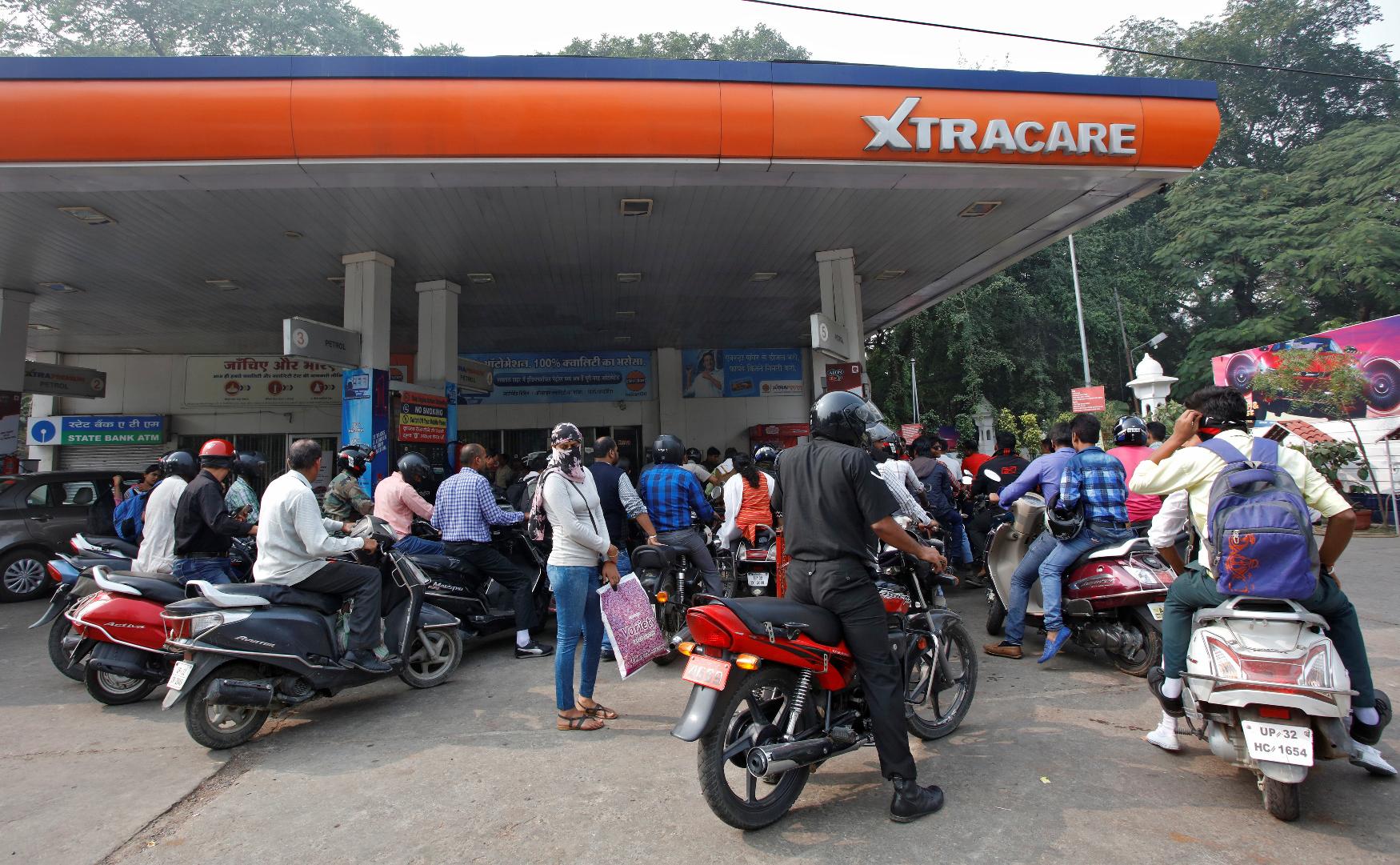
MUMBAI, April 3 (Reuters) - The Reserve Bank of India (RBI) has not materially changed its stance on exchange-traded rupee derivatives and neither has it asked brokerages for proof of their clients' underlying forex exposure, two sources aware of the central bank's thinking said. The RBI had said in January that from April, exchanges may offer forex derivative contracts involving the rupee to users "for the purpose of hedging contracted exposure." "The underlying exposure requirement was always there. There has been no change in that," the first source aware of the central bank's thinking said. However, the RBI's circular from three months back had led brokers to believe that they will need to ensure proof of underlying exposure before allowing clients to make such trades. The rule, which comes into effect on April 5, was reiterated by exchanges on Monday, following concerns raised by brokers about its impact on volumes. A day later, some brokers asked their clients to submit such proof of underlying exposure if they wanted to hold their existing positions beyond April 4. These brokerages are doing so of their own volition and have not been instructed to do so by the central bank, the second source aware of the central bank's thinking said. The sources declined to be named as they are not authorised to speak to the media. The RBI did not immediately respond to a request for comment. The need to prove underlying exposure, brokers had feared, would effectively shut out most market participants from trading in the segment. Proprietary traders and individual investors, who will most likely be unable to furnish proof of underlying forex exposure, were responsible for 80% of the turnover in rupee derivatives in the month of February, according to a recent publication by NSE. Keep up with the latest medical breakthroughs and healthcare trends with the Reuters Health Rounds newsletter. Sign up here. https://www.reuters.com/markets/currencies/india-cenbanks-stance-underlying-exposure-fx-derivatives-unchanged-sources-say-2024-04-03/

2024-04-03 06:13
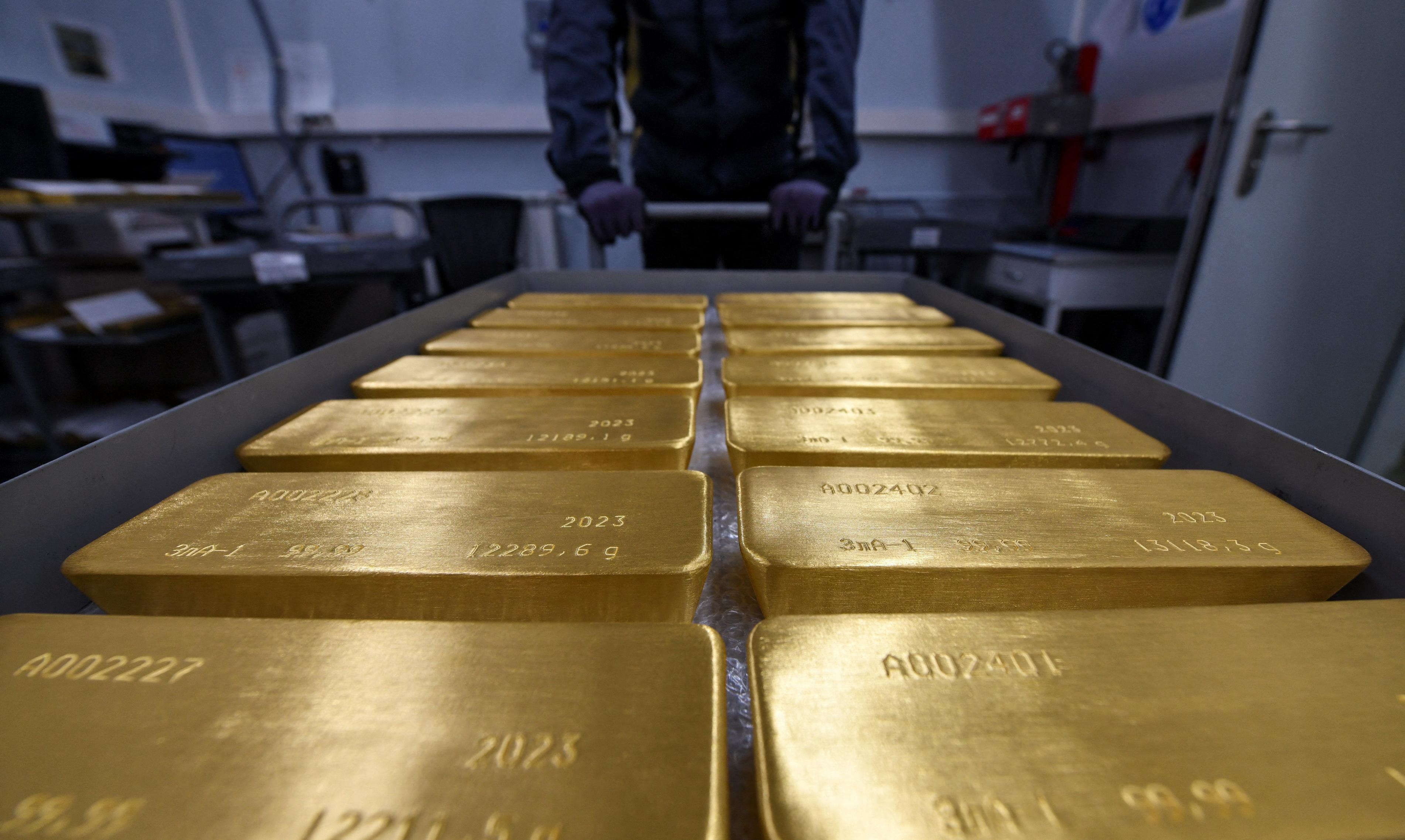
Gold hits an all-time high at $2,288.09/ounce Fed Chair Jerome Powell to speak later in the day U.S. 10-year bond yields hover near four-month peak April 3 (Reuters) - Gold took a breather after notching another record high on Wednesday as growing tensions in the Middle East and U.S. interest rate cut hopes continued to push investors to the safe-haven asset. Spot gold was down 0.3% at $2,272.79 per ounce, as of 1211 GMT after hitting a record high of $2,288.09 earlier in the session. Analysts attributed the slight pullback to an uptick in U.S. yields . U.S. gold futures gained 0.5% to $2,293.20. "The most important factor pushing gold prices higher is the bullish market mood... the narrative seems to centre very strongly around central bank buying," said Julius Baer analyst Carsten Menke. "We remain rather cautious on gold and believe there is more downside than upside to prices from current levels. That said, we also acknowledge that near-term price risks are skewed to the upside, considering the bullish market mood." Strong central bank buying and safe-haven inflows amid escalating geopolitical risks have fuelled the 10% gain in bullion so far this year. "It seems as if gold turns every market development into a price increase," said Alexander Zumpfe, a precious metals trader at Heraeus. Federal Reserve policymakers on Tuesday said they think it would be "reasonable" to cut U.S. rates three times this year, even as stronger economic data recently has sown doubts about that outcome. "The U.S. economy is surprising with its strong performance, which would make a first interest rate cut in June less likely and thus weigh on the gold price - but the precious metal is holding its value," Zumpfe said. Investors now await remarks from Fed Chair Jerome Powell later in the day for clues on when the central bank will deliver its first rate cut. Gold tends to gain when interest rates are low, which reduces the opportunity cost of holding the non-yielding bullion. Elsewhere, silver rose 0.8% to $26.33 per ounce, platinum was up 0.8% at $925.95 and palladium was steady at $1,003.50. Get a look at the day ahead in U.S. and global markets with the Morning Bid U.S. newsletter. Sign up here. https://www.reuters.com/markets/commodities/gold-smashes-record-again-us-inflation-worries-loom-2024-04-03/
2024-04-03 06:08
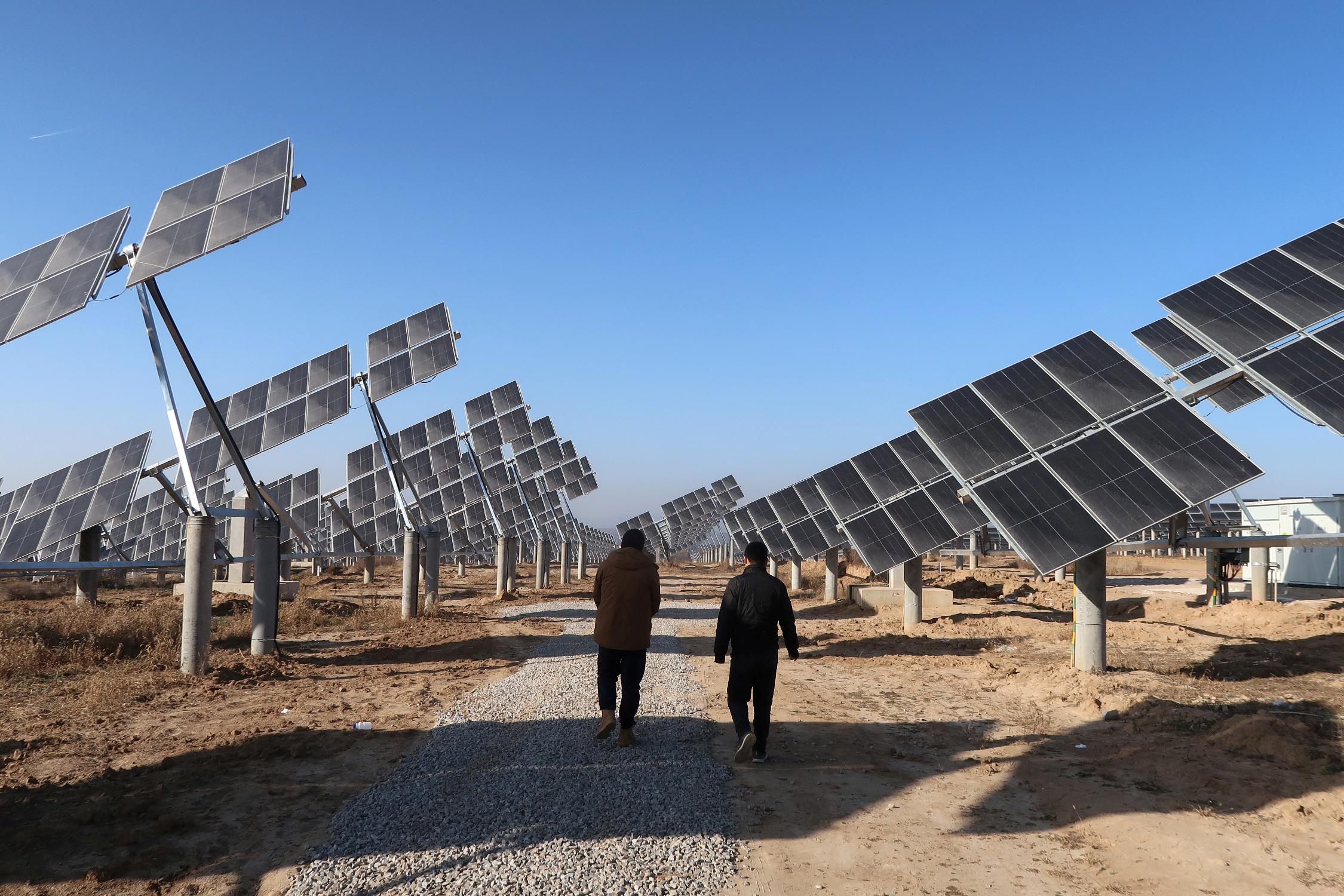
China has driven global oversupply of solar production capacity Prices of Chinese solar panels fell 42% in 2023 -Wood Mackenzie China's 2023 production capacity was double global installations BEIJING, April 3 (Reuters) - Consolidation in China's crowded solar power sector is pushing smaller players out of the market, but excess production capacity - with more on the way - threatens to keep global prices low for years. China accounts for 80% of solar module production capacity after years of subsidies, driving oversupply that has triggered a collapse in global prices and provoked import duties from trading partners to stave off being swamped by low-cost equipment. U.S. Treasury Secretary Janet Yellen, set to visit China this week, plans to warn Beijing of the harm done by subsidies for clean energy products including solar panels that she says are flooding global markets and pose a threat to U.S. firms, workers and the global economy. Overcapacity in China's solar industry is emblematic of the challenges facing the world's second-biggest economy. High levels of state-guided industrial investment and low levels of household consumption mean many sectors produce more than the domestic market can absorb. Oversupply pushed prices of finished solar panels in China down 42% in 2023, making Chinese panels more than 60% cheaper than U.S.-made equipment, with some module-only manufacturers taking orders at negative margins to preserve market share, said Wood Mackenzie analyst Huaiyan Sun. At the end of 2023, China's annual production capacity for finished solar modules was 861 gigawatts (GW) equivalent according to China Photovoltaic Industry Association data, more than double global module installations of 390 GW. Production capacity is expected to increase by a further 500 or 600 GW this year, according to forecasts by Wood Mackenzie and Rystad Energy, as Chinese heavyweights including Longi (601012.SS) , opens new tab, Jinko Solar (688223.SS) , opens new tab and JA Solar (002459.SZ) , opens new tab continue to build new plants. Sector expansion has been driven by local government policy support and comes after years of breakneck demand growth. "China's estimated wafer, cell and module capacity that will come online in 2024 is sufficient to meet annual global demand now through to 2032," said Xuyang Dong, China energy policy analyst at Climate Energy Finance in Sydney. Nearly half of China's solar panel exports in 2023 were to Europe, data compiled by energy think tank Ember showed, where multiple factories have announced plans to close due to the flood of imports. Chinese solar panels have been subject to U.S. tariffs for more than a decade, with further duties recently imposed on several Chinese solar panel makers who finished their panels in Southeast Asia. 'SURVIVAL OF THE FITTEST' China's solar industry generated 2.5 trillion yuan ($346 billion) in investment, goods and services last year, according to a study by think tank Carbon Brief, making it the top contributor to the country's economic growth as investment poured in. "Many non-solar companies in China have been enticed by massive sustained market growth opportunities in solar and favourable policy support," said Dong of Climate Energy Finance, who expects most plans by such players not to materialise. Between June 2023 and February 2024, at least eight companies cancelled or suspended more than 59 GW of new production capacity, equivalent to 6.9% of China's total finished panel production capacity in 2023, according to the China Photovoltaic Industry Association. Utilisation rates for finished solar panel production capacity tumbled to 23% in February 2024, down from more than 60% a year earlier, according to data from consultancy PV Infolink. Marius Mordal Bakke, a solar supply chain analyst at Rystad, said the largest vertically integrated players will grow market share as smaller players are squeezed out. The top four module manufacturers, Jinko Solar, Trina Solar (688599.SS) , opens new tab, Longi and JA Solar, all have integrated cell and wafer supply chains. Transition to more efficient N-type modules gives an advantage to higher tech manufacturers. N-type modules often incorporate additional chemical elements to silicon such as gallium to achieve better performance under high-temperature or low-light conditions. Against this backdrop, consolidation is "good for the leading players, and also good for customers," said Dennis She, vice president of Longi, which recently said it will lay off about 5% of employees in April. Analysts cautioned consolidation was unlikely to significantly support prices in the short term, meaning the dumping concerns being raised by Yellen this week are likely to persist. "As supply is still set to outpace demand in 2024 a sustained increase in component prices is unlikely to happen unless supported by policy changes", such as reforms to bidding for solar components that keep sales prices above input costs, said Rystad's Bakke. China has yet to announce plans for any such changes. Overcapacity means that buyers still hold bargaining power, making it difficult for individual manufacturers to raise prices, said Wood Mackenzie's Sun. "The overcapacity issue will not be easily solved in the short term as more capacity continues to come online," Sun said, describing the industry as facing "survival of the fittest". ($1 = 7.1817 Chinese yuan renminbi) The Reuters Power Up newsletter provides everything you need to know about the global energy industry. Sign up here. https://www.reuters.com/business/energy/china-solar-industry-faces-shakeout-rock-bottom-prices-persist-2024-04-03/