2024-04-01 10:02
A look at the day ahead in U.S. and global markets by Amanda Cooper. Today marks the start of a new week, a new month, a new quarter and a new set of data to get investors going. Friday's personal consumption expenditures price (PCE) index landed when most markets were closed, making this the first real chance to digest the numbers. The PCE index rose at an annual rate of 2.5% in February, up from 2.4% the month before. The number excluding volatile food and energy prices - the Federal Reserve's preferred measure - rose 0.3% on a month-to-month basis, slightly faster than Chair Jerome Powell had anticipated when he said last week that core inflation would be "well below" 0.3% in February. However, after the numbers on Friday, Powell said the latest data was "along the lines of what we would like to see." The first week of the month is always packed with key jobs data, culminating in Friday's non-farm payrolls report. After a blockbuster Q1 for markets, a "three-rate-cut soft landing" appears to be as good as baked into the cake as far as equity investors are concerned. Inflation is behaving, U.S. growth is powering ahead and it would appear a given that the economy is generating jobs quickly enough to support consumer spending. The focus, then, on this week's array of jobs market data will likely fall on any indicators of wage pressure - something over which the Federal Reserve has little, to no, influence. Today's survey of March factory activity from the Institute for Supply Management is expected to show manufacturing contracted for a 17th straight month - the longest stretch since August 2000, after the dot com bubble burst and pushed the economy into recession. That said, the index is expected to have risen to 48.4, from February's 47.8, its highest since December 2022, according to a Reuters poll of economists. The prices paid component is expected to have risen to 52.6, from 52.5 the previous month, reflecting the pick up in the cost of things like gasoline and food that pushed the broader producer price index up by more than expected in March. Of more interest could be the employment sub-index, which last month came in at 45.9. Manufacturing only makes up a tiny portion of job growth - less than 10% of all employees on non-farm payrolls work in the factory sector, compared with over a quarter 50 years ago. But the survey might offer a flavour of the overall trend in the jobs market. Tuesday's Job Openings and Labor Turnover Survey (JOLTS), which lays out hirings and firings, is likely to give a better sense of how tight the employment market is and what investors might expect to see in terms of average wage growth in Friday's NFPs. Key developments that should provide more direction to U.S. markets later on Monday: * March ISM manufacturing survey * Three- and six-month Treasury bill auctions Get a look at the day ahead in U.S. and global markets with the Morning Bid U.S. newsletter. Sign up here. https://www.reuters.com/markets/us/global-markets-view-usa-pix-2024-04-01/

2024-04-01 07:12
SINGAPORE, April 1 (Reuters) - India's hydroelectricity output fell at the steepest pace in at least 38 years during the year ended March 31, a Reuters analysis of government data showed, as erratic rainfall forced further dependence on coal-fired power amid higher demand. The 16.3% drop in generation from the country's biggest clean energy source coincided with the share of renewables in power generation sliding for the first time since Prime Minister Narendra Modi made commitments to boost solar and wind capacity at the United Nations climate talks at Paris in 2015. Renewables accounted for 11.7% of India's power output in the year that ended in March, down from 11.8% a year earlier, a Reuters analysis of daily load despatch data from the federal grid regulator Grid-India showed. India is the world's third-largest greenhouse gas emitter, and the government often points to lower per-capita emissions compared to developed nations to defend rising coal use. A five-year low in reservoir levels means hydro output will likely remain low during the hottest months of April-June, experts say, potentially boosting dependence on coal during a period of high demand before the monsoon starts in June. K. J. Ramesh, former chief of the Indian Meteorological Department, said there is increased chance of high rainfall during the annual monsoon this year, but any impact on hydropower output would not be visible before July. "When hydro increases due to good rainfall, it should be used to reduce dependence on thermal," he said, adding that erratic rainfall means India should not count on hydro as a reliable power source in the future. DECLINING SHARE Hydro's share in India's total power output fell to a record low of 8.3% during the fiscal year ended March 31, Grid-India data showed, compared with an average of 12.3% in the 10 years through 2020. The share of hydropower has steadily declined in recent years amid a slowdown in addition of new capacity, with other sources including coal, solar and wind gaining share. The lightest rainfall since 2018 meant reduced water levels in reservoirs, pushing annual hydro generation to a five-year low of 146 billion kilowatt-hours (kWh). Meanwhile, power generation from coal and lignite in 2023/24 rose 13.9%, outpacing the 9.7% increase in renewable sources' output, data from the grid regulator showed. Total power generation rose 10.3% in 2023/24, Grid-India data showed. India missed a 2022 target to install 175 gigawatts (GW) of renewable energy, and remains 38.4 GW short of that goal, with Grid-India data showing India's dependence on fossil fuel for power hit a five-year high of 77.2% in 2023/24. India's addition of renewables slowed to a five-year low in 2023. Globally, hydropower output fell for only the fourth time since 2000 due to lower rainfall and warmer temperature brought about by the El Nino weather pattern, according to energy think tank Ember. Hydro output in India, the sixth-biggest hydropower producer, fell nearly seven times faster than the global average, Ember data showed. The Reuters Power Up newsletter provides everything you need to know about the global energy industry. Sign up here. https://www.reuters.com/business/energy/india-hydropower-output-records-steepest-fall-nearly-four-decades-2024-04-01/

2024-04-01 06:39
NEW YORK/TOKYO, April 1 (Reuters) - Gold prices hit fresh all-time peaks on Monday with stocks on Wall Street closing mixed as optimism that the Federal Reserve was near to cutting interest rates faded due to a strong U.S. economy that rebuts the need for cuts anytime soon. Chinese shares led a rally around most of Asia overnight amid a broadly optimistic global economic backdrop, while the dollar rose after data showed the U.S. manufacturing sector grew in March for the first time since September 2022. What had been an optimistic reading of key U.S. inflation last week soon darkened as the market weighed the strength of the U.S. economy versus the need for immediate rate cuts. The three government measures of U.S. inflation – CPI, PPI and PCE – show improvement has leveled off, leading to questions about when and by how much the Fed cuts, said Kevin Flanagan, head of fixed income strategy at WisdomTree in New York. "The markets are reassessing what they thought was going to be a very aggressive rate-cut episode," Flanagan said. "Whether they go in June or July, whatever, what is it going to look like? Right now, the data would be showing you that it's not going to be uniform." Oil prices stayed near five-month highs as markets expect tighter supply due to OPEC+ cuts and after attacks on Russian refineries, with Chinese manufacturing data supporting a stronger demand outlook. The dollar index , a measure of the U.S. currency against six major peers, rose 0.47%. MSCI's gauge of stocks across the globe (.MIWD00000PUS) , opens new tab fell 0.36%. On Wall Street, the Dow Jones Industrial Average (.DJI) , opens new tab fell 0.6% and the S&P 500 (.SPX) , opens new tab lost 0.20%, but the Nasdaq Composite (.IXIC) , opens new tab added 0.11%. European markets were closed on Monday and most markets across the globe were closed on Friday. Fed Chair Jerome Powell said on Friday that inflation data released that day "is what we were expecting" and that "you won't see us over-reacting," suggesting the U.S. central bank is content to remain in wait-and-see mode. Tim Ghriskey, senior portfolio strategist at Ingalls & Snyder in New York, said the Fed does not want to relive the 1970s when it cut too soon and inflation reignited. "The potential for a cut keeps getting pushed off because Powell says almost with a giddy tone that this is a great environment. Interest rates are above average, not wildly above, but above average. "It's better to keep those cuts in your pocket." Friday's report on personal consumption expenditures (PCE) price index data earlier drove expectations for easier U.S. monetary policy, lifting gold to a fresh record high. Gold pared gains as the dollar and bond yields rose. Gold prices tend to move inversely with interest rates because as rates rise, gold becomes relatively less attractive. Spot gold hit an all-time high of $2,265.49 an ounce earlier in the session. U.S. gold futures settled 0.9% higher at $2,236.50 an ounce. U.S. Treasury yields rose as the stronger-than-expected manufacturing data raised doubts on whether the Fed can deliver on the three interest rate cuts outlined in its forecast at its last policy meeting. The yield on two-year Treasury notes, which reflects interest rate expectations, rose 9.2 basis points to 4.712%. The 10-year's yield rose 12.3 basis points to 4.317%, after earlier touching a two-week high of 4.337%. Japanese shares earlier tumbled with the yen pinned near levels that kept traders on guard for a currency intervention. The yen loitered below 152 per dollar. Japan's Nikkei (.N225) , opens new tab fell 1.4% as of the close, weighed down by worries about yen-buying intervention that would hurt exporter profit outlooks and returns for foreign investors. Brent rose 42 cents to settle at $87.42 a barrel, while U.S. crude settled up 54 cents to $83.71 a barrel. Get a look at the day ahead in U.S. and global markets with the Morning Bid U.S. newsletter. Sign up here. https://www.reuters.com/markets/global-markets-wrapup-1-2024-04-01/

2024-04-01 05:47
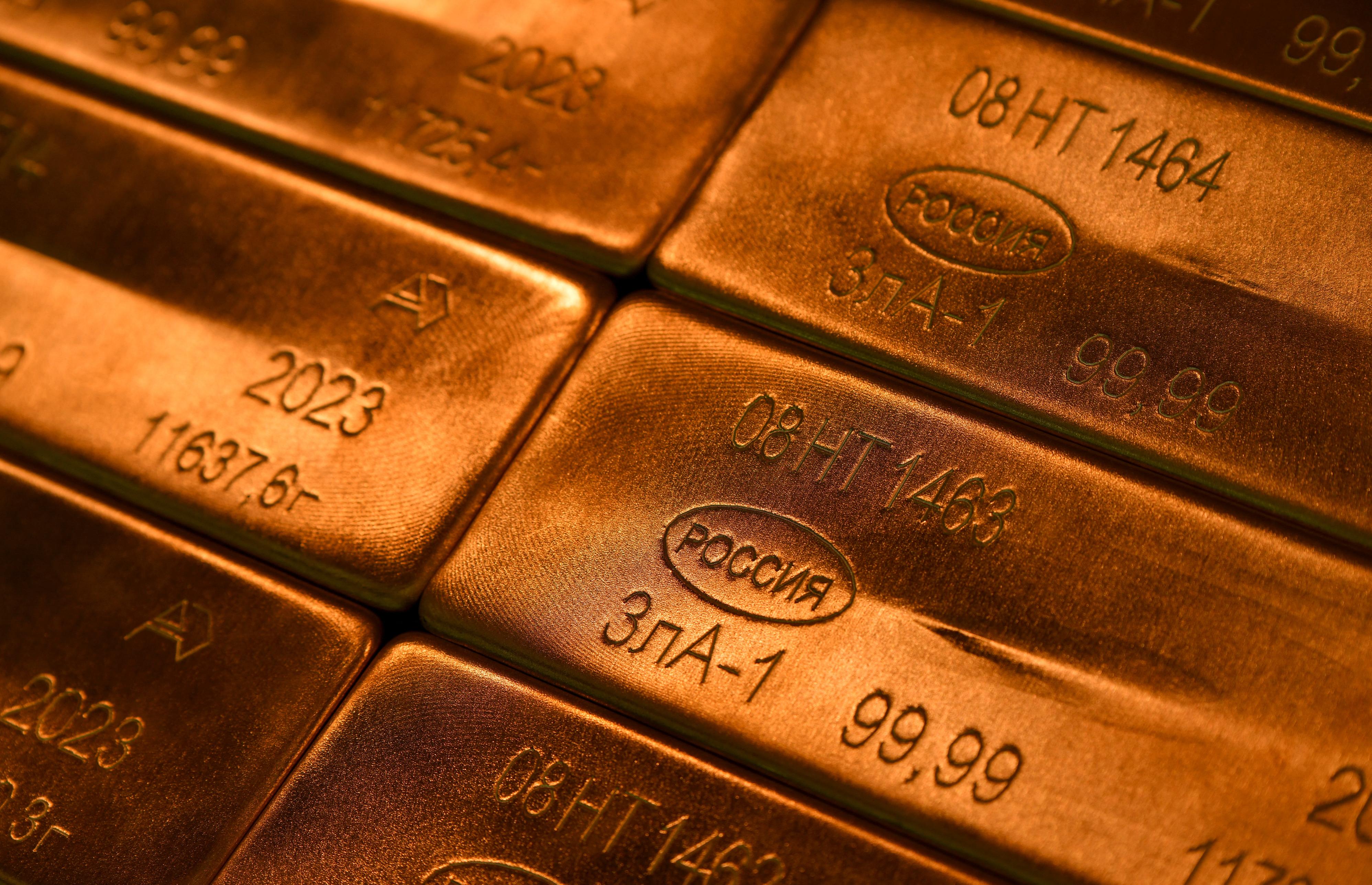
Gold hits all-time high at $2,262.19/ounce US inflation 'along lines of what we would like to see' - Powell India gold prices hit record high, dampening demand April 1 (Reuters) - Gold prices extended their record run on Monday as the latest data showing a slowing U.S. inflation trend boosted expectations that the Federal Reserve could deliver its first interest rate cut in June. Lower interest rates reduce the opportunity cost of holding bullion. Spot gold was up 0.6% at $2,244.89 per ounce as of 1224 GMT after hitting an all-time high of $2,262.19 earlier in the session. U.S. gold futures climbed 1.2% to $2,265.60. "The slightly lower than expected U.S. inflation figure last Friday is supporting the outlook of a mid-year rate cut by the Fed," said UBS analyst Giovanni Staunovo. Data on Friday showed U.S. prices moderated in February, keeping a June interest rate cut from the Fed on the table. Fed Chair Jerome Powell said February's inflation data was "more along the lines of what we want to see." Growing rate cut expectations, safe-haven demand and central bank purchases amid geopolitical tensions have boosted gold by more than 8% this year. "Markets will now want to see if the payroll data will confirm a soft landing from the job market in the U.S. Ongoing solid demand is helping the yellow metal as well, although higher prices may weigh on jewellery demand," Staunovo said. Bullion prices have also hit record highs in other currencies, including euros, the yuan, Japanese Yen, Indian rupee and the British pound sterling. Indian gold futures hit an all-time high on Monday, tracking gains in overseas markets, and squeezing demand in the world's second-biggest consumer of the precious metal, dealers said. "Today's price action is happening in a very low liquidity environment – most European and many APAC markets are still closed for Easter Monday. So, it would not be surprising to see these moves reverse when participation rebuilds later in the week," said Ilya Spivak, head of global macro at Tastylive. Spot silver eased 0.4% to $25.06 per ounce, platinum fell 0.8% to $900.74 and palladium slipped 1% to $1,004.69. Get a look at the day ahead in U.S. and global markets with the Morning Bid U.S. newsletter. Sign up here. https://www.reuters.com/markets/commodities/gold-hits-record-high-soft-us-data-cements-june-rate-cut-bets-2024-04-01/
2024-04-01 05:44
NEW YORK, April 1 (Reuters) - The dollar rose on Monday on news that the U.S. manufacturing sector grew in March for the first time since September 2022, while the yen lingered below 152 per dollar over the threat of intervention by the Bank of Japan. The Institute for Supply Management (ISM) said U.S. manufacturing production rebounded and new orders increased, although factory employment remained subdued and prices for inputs rose. The rebound ended 16 straight months of contraction in manufacturing, which accounts for 10.4% of the economy. That was the longest period of shrinking since August 2000 to January 2002. The dollar index , which measures the U.S. currency against six rivals, was 0.507% higher at 105.01. "The ISM information is really leading the way and it's just showing that ... inflation is not always falling down, and I think the market's reacting quite a bit to that," said Eugene Epstein, head of structuring for North America at Moneycorp. Markets on Monday lowered their bets on the Federal Reserve cutting rates in June, after boosting the odds on Friday's news of easing U.S. prices, the CME FedWatch tool showed. The personal consumption expenditures (PCE) price index rose 0.3% in February, the Commerce Department's Bureau of Economic Analysis said on Friday, compared with the estimated 0.4% rise by economists in a Reuters survey. "In conjunction with Friday's PCE data, I don't think this is still going to materially actually change the calculation for the Federal Reserve, but markets are starting to once again move a little bit more in line with the Fed's own expectations as to how often and when they're going to cut this year," said Helen Given, FX trader at Monex USA. Fed Chair Jerome Powell said on Friday the latest U.S. inflation data was "along the lines of what we would like to see," affirming his remarks after the Fed's policy meeting last month. The currency market's spotlight has been on the yen as its move toward 1990 levels revives the risk Japanese authorities will intervene. The yen touched a 34-year low against the dollar of 151.975 on Wednesday and was last at 151.635 per dollar on Monday. The BOJ intervened in September and October of 2022 as the yen slid toward a 32-year low of 152 to the dollar. Japan's plans for the yen remain difficult to predict. Since the fiscal year has ended, the BOJ need not worry about sudden yen movement affecting balance sheets. But news of last week's emergency meeting of Japan's three monetary authorities - the Ministry of Finance (MOF), BOJ and Financial Services Agency - and comments from officials have so far kept the yen above 34-year lows. Finance Minister Shunichi Suzuki said on Monday he would not rule out options against excessive currency movement and would respond appropriately, reiterating his warning on rapid yen moves. China's yuan weakened on Monday, pressured by the dollar, even as the latest Chinese data implied the economy's recovery has gained traction and the central bank's sustained efforts have stabilised the currency. The offshore yuan last traded at 7.2604 per dollar. In other currencies, the euro was 0.48% lower at $1.0738, while sterling was last at $1.25440, down 0.63% on the day. In cryptocurrencies, bitcoin last fell 1.07% to $68,906. Ether was 1.61% lower at $3,441.90. Keep up with the latest medical breakthroughs and healthcare trends with the Reuters Health Rounds newsletter. Sign up here. https://www.reuters.com/markets/currencies/dollar-steady-pce-data-sets-up-june-rate-cut-bets-yen-focus-2024-04-01/
2024-04-01 05:26
SINGAPORE/DUBAI, April 1 (Reuters) - Exports of Upper Zakum crude from the United Arab Emirates fell sharply in March after ADNOC diverted more supply to its own refinery and boosted shipments of its lighter Murban oil, according to traders, analysts and shipping data. The swap in oil grades at Abu Dhabi National Oil Company's (ADNOC's) Ruwais refinery has tightened medium-sour crude supply in Asia, limiting the number of Upper Zakum cargoes that can be delivered during S&P Global's price assessment process for Middle East crude Dubai and supporting the benchmark. "They invested a lot of money over at least 3-4 years upgrading Ruwais to run heavier grades so it makes a lot of sense to run Upper Zakum and sell Murban," said Adi Imsirovic, director of Surrey Clean Energy. "Barrel-for-barrel, Murban brings more revenue for equal compliance," he added, referring to production quotas that the United Arab Emirates has agreed to as a member the Organization of the Petroleum Exporting Countries (OPEC). ADNOC declined to comment. In 2018, ADNOC invested $3.5 billion to upgrade its 837,000-barrel-per-day (bpd) refinery to process up to 420,000 bpd of heavier and more sour crude including Upper Zakum, according to the company's website. ADNOC started shipping Upper Zakum crude to its refinery in September, with volumes reaching 200,000 to 300,000 bpd in February and March, according to traders. Kpler data showed the share of Upper Zakum crude to Ruwais hit 366,000 bpd in March, or 40% of overall shipments, up from 152,000 bpd in February. Rystad forecasts Upper Zakum exports at about 650,000 bpd in March, down from a monthly average of 940,000 bpd in 2023. Middle East medium-sour crude exports have fallen as new refineries in Kuwait, Oman, the UAE and Saudi Arabia demand local crudes, said Janiv Shah, Rystad's vice president of oil markets. "The largest importer of Upper Zakum and Middle Eastern medium sour barrels is China, who must pivot to importing similar grades as Chinese country level refinery runs increase through 2024 on demand increases, yield shifts and new refinery capacity," he added. Exports of Upper Zakum to China, India, South Korea, Thailand and Singapore fell about 50% or more in March from a year earlier, Kpler data showed, while supply to Japan slipped 13%. ADNOC notified term customers late last year that their Upper Zakum supply for 2024 will be reduced and offered to replace it with Murban, its flagship grade. With less Upper Zakum supply and more Murban in the market, the medium-sour Dubai benchmark has tightened while Murban futures, the light-sour price marker, has weakened, Imsirovic said. Asian refiners have turned to similar quality oil from Qatar and Saudi Arabia to replace Upper Zakum, traders said, as Murban is of a lighter quality. Last week, ADNOC increased Murban export forecasts from June to October to between 1.631 million bpd and 1.658 million bpd. Kpler data showed exports averaged at 1.1 million bpd in 2023. The jump in Murban supply has weighed on prices, narrowing its gap with Upper Zakum to about 10 cents a barrel, versus the typical 80-cent gap, a Singapore-based trader said. The Reuters Power Up newsletter provides everything you need to know about the global energy industry. Sign up here. https://www.reuters.com/business/energy/adnoc-cuts-upper-zakum-oil-exports-sharply-after-diverting-supply-refinery-2024-04-01/