2024-03-27 07:12
MUMBAI, March 27 (Reuters) - India's central bank will keep building its forex reserves as it seeks to build larger buffers and strong inflows into the country's equity and debt markets give it an opportunity to do so, two sources familiar with the bank's thinking said. The Reserve Bank of India's absorption of dollar inflows will indirectly prevent a sharp appreciation of the rupee, despite high growth in the economy and a positive balance of payments, analysts said. The Reserve Bank of India's (RBI) FX reserves rose to a record high of $642.49 billion as of March 15. "Reserves are just about adequate as per most of RBI's internally-monitored metrics while they are slightly below adequate on a couple of them. Exercise of building reserves will continue," a senior source aware of the RBI's thinking said. The RBI did not immediately respond to a request for comment. RBI chief Shaktikanta Das said in January that the bank had embarked on strengthening and building higher reserves, which was essential to insulate emerging market economies from spillovers of global currency fluctuations. The pace of reserve-building has picked up in recent months with large dollar inflows being witnessed into equity and debt markets. With Indian debt getting included in the JPMorgan and Bloomberg emerging market debt indexes later this year, flows are expected to continue. RESERVE ADEQUACY "Given the external situation, India's forex reserves seem to be adequate to meet the needs of the economy and any external shock," said B. Prasanna, head of treasury at ICICI Bank. Adequacy of foreign exchange reserves is typically judged by the import cover, or the number of months of goods imports the reserves can finance, and also whether they are enough to cover the country's short-term debt obligations. "Even if the definition is expanded to include imports of both goods and services, India's import cover is at nine months which is far higher than the rule of thumb," Prasanna said. With reserves seen as adequate on many metrics, there was no need for the RBI to aggressively build reserves, but the central bank would continue to "opportunistically increase the reserves on good buying opportunities," a second source familiar with the RBI's thinking said. Reserve building was likely to limit sharp gains in the rupee, analysts and traders said. The rupee slipped to a record low on Wednesday and the RBI likely stepped in to prevent further sharp losses. The RBI's intermittent dollar sales are unlikely to run down its reserves massively, said Robert Carnell, regional head of research, Asia-Pacific at ING Bank. Barclays Investment Bank's baseline projections show India's FX reserves rising to above $700 billion by the end of 2025. While foreign investors net bought a total of $28.7 billion worth of Indian equities and bonds over 2023, the rupee remained in a tight band between 83.42 and 80.88 against the U.S. dollar with its volatility hitting decadal lows on the back to persistent RBI interventions. In the same time period, the RBI was a net buyer of dollars having added $18.1 billion to its pile. "As the size of Indian economy increases to $5 trillion by FY27 and subsequently to $7 trillion by the end of this decade, FX reserves would have to keep pace with the size of the economy and markets," ICICI's Prasanna said. The Reuters Daily Briefing newsletter provides all the news you need to start your day. Sign up here. https://www.reuters.com/world/india/india-cenbank-keen-further-build-up-record-high-fx-reserves-say-sources-2024-03-27/
2024-03-27 07:11
TOKYO, March 27 (Reuters) - Japanese oil refiner Idemitsu Kosan (5019.T) , opens new tab and Mitsui Chemicals (4183.T) , opens new tab plan to consolidate their ethylene complexes in Chiba near Tokyo, they said on Wednesday, as the industry is under pressure from competition with China. The companies would consider closing Idemitsu's Chiba ethylene facility to consolidate production at Mitsui Chemical's site in the 2027 fiscal year. The new business would be operated by a limited liability partnership or a joint venture. "Japanese ethylene complexes continue to be forced to operate at a low rate due to both the opening of large new additional petrochemical complexes, mainly in China, and the diminishing domestic ethylene demand," the statement said. The final decision on the proposed consolidation, which should also accelerate the push towards carbon neutrality in the petrochemical sector, is yet to be made, the companies said. On Monday, Shunichi Kito, president of the Petroleum Association of Japan and Idemitsu Kosan's president, said that the petrochemical sector will need to consolidate to withstand competition from emerging petrochemical complexes in China and the Middle East amid an already tough earnings environment. Ethylene is a petrochemical that is used to produce plastics such as polyethylene for items such as plastic bags and containers. Get a look at the day ahead in U.S. and global markets with the Morning Bid U.S. newsletter. Sign up here. https://www.reuters.com/markets/commodities/japans-idemitsu-mitsui-chemicals-may-consolidate-ethylene-plants-chiba-2024-03-27/

2024-03-27 07:05
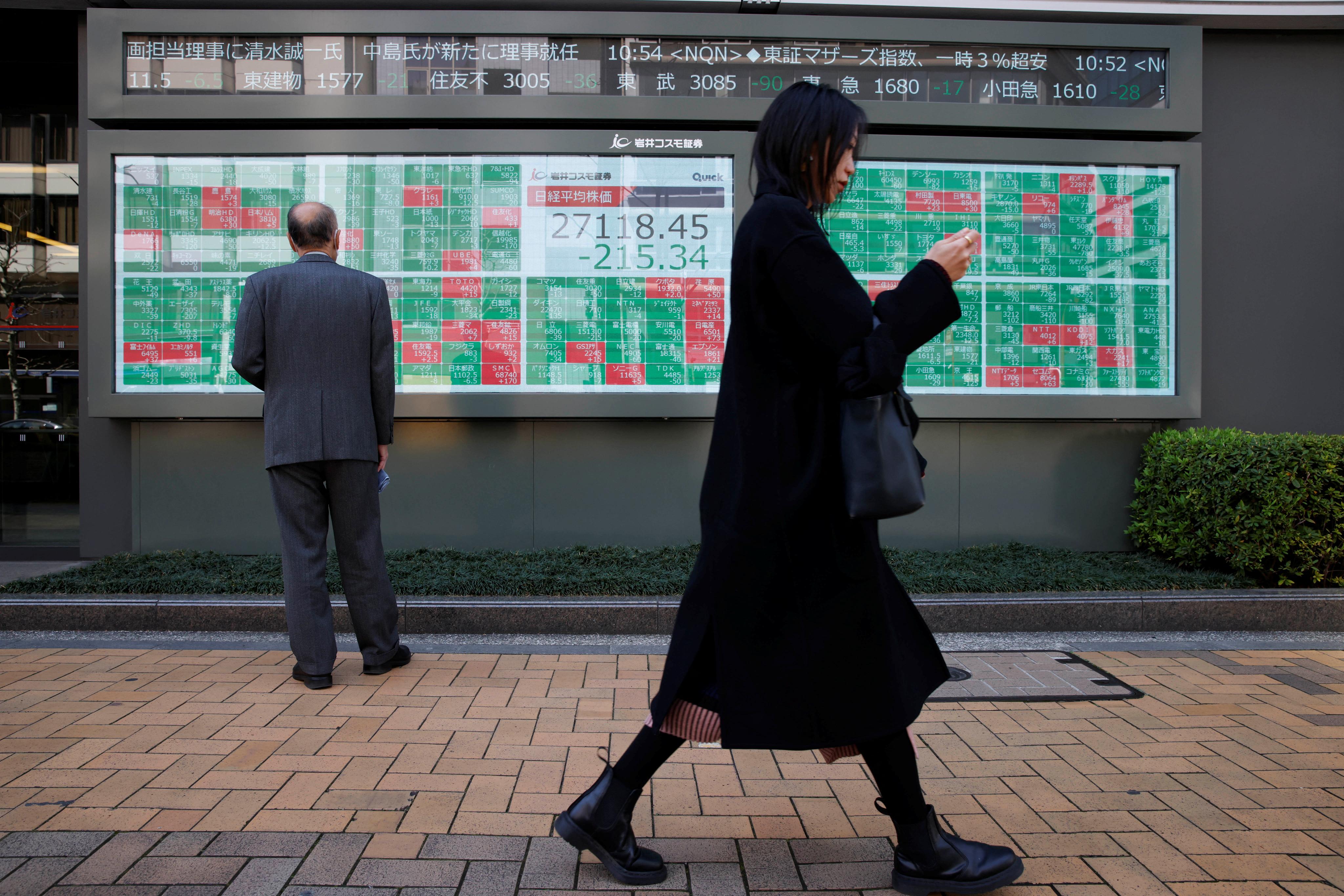
NEW YORK/LONDON/TOKYO, March 27 (Reuters) - Global share markets advanced cautiously on Wednesday, led by an early rally in Japanese stocks as the yen sagged to its weakest since 1990, prompting intervention fears, while benchmark U.S. Treasury yields fell after a strong seven-year note auction. Trading was subdued with the dollar stuck in a narrow range below its overnight high against the yen as markets marked time ahead of Friday's much-anticipated U.S. inflation report, that few will be around to digest at the start of the long Easter weekend in the United States and many other countries. The yen, which has lost more than 7% in value against the dollar this year already, weakened as far as 151.975 to the dollar, prompting Japan's three main monetary authorities to hold an emergency meeting on Wednesday to discuss the currency. Market participants took this as a signal officials were ready to intervene in the market to stop what they described as disorderly and speculative moves in the yen, a carry-trade favorite for speculators to short against other currencies because of its lower interest rates. "The news this morning was the Japanese yen. They're always concerned, even well before this for so many years, about hedge funds coming in and taking advantage of the yen," said Quincy Krosby, chief global strategist at LPL Financial, in Charlotte, NC. "So they typically come out with the warning to notify the market that 'we could come in and thwart your ambition in our currency market'." The yen has been sliding despite the Bank of Japan's first interest rate hike for 17 years last week, as traders expect very gradual tightening and possible delays to long-expected Federal Reserve easing. BOJ board member Naoki Tamura reinforced the dovish outlook on further tightening on Wednesday, saying the central bank should "move slowly but steadily toward policy normalisation". The stocks rally ramped up late in Wall Street's session. The Dow Jones Industrial Average (.DJI) , opens new tab rose 1.22%, to end at 39,760.08, outpacing the other main indexes because of a strong rally in Merck (MRK.N) , opens new tab after the U.S. Food and Drug Administration approved its therapy for adults suffering from a rare lung condition. The S&P 500 (.SPX) , opens new tab gained 0.86%, closing at 5,248.49 and the Nasdaq Composite (.IXIC) , opens new tab gained 0.51% to 16,399.52. The Nikkei (.N225) , opens new tab closed 0.9% higher. MSCI's gauge of stocks across the globe (.MIWD00000PUS) , opens new tab rose 0.59%, while Europe's STOXX 600 (.STOXX) , opens new tab index added 0.13%. "It's choppy, directionless trading, and there's a good reason for that: we've hit that time of the quarter when rebalancing flows are impacting the market," said Tony Sycamore, a strategist at IG. Another reason is that two key events - the release of the U.S. Federal Reserve's favoured Personal Consumption Expenditures Inflation Index and public comments from Fed Chair Jerome Powell - come on Friday, when most markets are closed for a holiday, he added. Good Friday is a market but not a government holiday in the United States. DOLLAR/YEN IN FOCUS Against the yen , the dollar eased 0.15% to 151.32. The dollar index was down 0.14% at 104.28, just below Friday's five-week high of 104.49, while the euro was down 0.04% at $1.0826. "If there's any kind of intervention, it only has a significant lasting impact if the direction of travel has already begun to turn," Guy Miller, chief market strategist at Zurich Insurance Group, said. U.S. 10-year Treasury yields were 4.6 basis points lower at 4.188%. They had fallen as far as 4.182%, the lowest in two weeks, after the Treasury easily sold $43 billion of seven-year notes amid expectations that the Federal Reserve will be lowering rates soon. Kim Rupert, managing director of global fixed income at Action Economics in San Francisco, described the auction as "stellar." "It's a good time to pick up some yield," she said. Traders are trying to gauge which of the big central banks - the Fed, ECB or Bank of England - will be first to cut rates this year. Meanwhile, Sweden's Riksbank left interest rates unchanged but indicated it was likely to start easing monetary policy in either May or June. Spot gold rose 0.73% to $2,194.43 an ounce as it continued to search for a short-term floor following its surge to a record $2,222.39 last week. U.S. gold futures rose 0.67% to $2,191.70 an ounce. Cryptocurrency bitcoin fell 1.11% to $69,038.01. Oil fell for a second day after a report that crude stockpiles surged in the U.S., the world's biggest oil user, and on signs major producers are unlikely to change their output policy at a technical meeting next week. Brent crude futures settled at $86.09 per barrel, down 0.19%. U.S. crude futures settled down 0.33% at $81.35 a barrel. Get a look at the day ahead in U.S. and global markets with the Morning Bid U.S. newsletter. Sign up here. https://www.reuters.com/markets/global-markets-wrapup-1-2024-03-27/
2024-03-27 07:03
LONDON, March 27 (Reuters) - As so often with markets, it may be time to get a bit anxious when all around see nothing but blue skies. Trot out almost any macro market metric you care to think of these days and there appears to be a positive twist - at least for record high stock markets that have clocked up more than 10% gains for a first quarter that was marked at the outset by much investor angst and trepidation. U.S. stocks are expensive but not at extremes, it's argued, and earnings forecasts for next year are rising smartly to near 14%. U.S. economic growth is slowing a bit but recession this year now seems far fetched. Still-high interest rates are set to start falling over the summer as somewhat sticky inflation subsides again. And implied volatility gauges in stock (.VIX) , opens new tab, bond (.MOVE) , opens new tab and currency markets (.DBVIX) , opens new tab are unusually subdued. The picture outside the United States may be patchier, but stocks in Europe or Japan are cheaper too and the economic growth nadir in both areas may already have passed. European rates may even start falling before U.S. equivalents. What's more, the big bugbear of the past 18 months for many - stock index gains that had been overly concentrated in a handful of Big Tech and AI-infused winners - is starting to resolve and gains are clearly broadened out as recession fears fade and rate cuts near. From the trough of last October's bond-related shakeout, the benchmark S&P500 (.SPX) , opens new tab has gained 25% in just 5 months. But the equal-weighted version of the index (.EWGSPC) , opens new tab - which corrects for the outsized performance of leading megacaps - has jumped 23% in that time, Russell 2000 (.RUT) , opens new tab small caps have rebounded 26% and Japanese (.N225) , opens new tab and euro zone blue chips (.STOXXE) , opens new tab are up 28% and 25% respectively in dollar terms. Reflected in those stellar gains, the hand-wringing of the early part of the new year seems to have stopped completely. The most recent Bank of America global fund manager survey has stock allocations at two-year highs and the highest 'risk appetite' gauges since November 2021. Prior to November there had been a net underweight position in equity for 18 months straight - the longest gloomy streak since crash of 2008/09. Have all the doubters turned to believers? And have the bears finally capitulated after 18 months of bruising underperformance? If they have, it unnerves some asset managers who have been happy to swim against the early-year pessimism - even those who mostly agree with the bullish thesis. Swiss private wealth manager Julius Baer's chief investment officer Yves Bonzon said he is starting to wobble on his still-overweight equities position - fearing a combination of herding consensus, a seasonal lull in equity demand over the summer and the upcoming U.S. election uncertainty. "We've been tempted for the best part of four weeks to reduce at the margin equity risk and hedge," he said. "We refrained from doing do so so far, but if you were to force me to add or reduce equities I'd be tempted to slightly reduce." "There's going to be a consolidation phase between now and November in the markets - a 10-15% correction could happen at any time and would, I'd argue, be healthy," he added. "Shocks are by definition impossible to foresee (but) markets are probably more vulnerable than we have been to an external shock than at any point since COVID hit in 2020." BACK TO THE FUTURE Curiously, a 10% correction of the S&P500 from current levels would only leave it roughly back at where end-2024 consensus forecasts were as recently as November, according to Reuters global equity polls. That end-2024 median forecast has been revised up sharply in last month's polls to 5,100 and to 5,300 for the end of 2025. But we're already there for the most part. What to do - keep riding the wave or hedge bets a bit? With implied 30-day equity volatility captured by Wall St's VIX index (.VIX) , opens new tab just 3 points from record lows, there may be some temptation to hedge equity portfolios with options. But many asset managers have used punchy short-term cash interest rates of more than 5% as effective hedge instead. And many are now both overweight equities and cash simultaneously. According to data from the Investment Company Institute, U.S. money market fund assets topped $6 trillion this month for the first time ever - almost a $1 trillion more than they were a year ago and almost twice pre-pandemic levels. And that's one key reasons why investors are reluctant to turn tail on equities short of some dramatic about turn on the benign macro economic picture. The assumption is that cash stash is there until the Fed finally starts to cut short-term interest rates - and futures have that penciled in for June. Then it starts to stream out to either bonds or equity. If the Fed were to hesitate in easing in the second quarter, then it could be a bumpy summer. U.S. election uncertainty then hoves into view to complicate any bounceback - even if you believe the bullish economic backdrop holds true through 2025 regardless of the result. AXA Investment Managers' Chris Iggo points out the average return of the S&P 500 in U.S. Presidential election years has been around 11%. And that's what it's done already in 2024. But "if we are now in a benign growth cycle – then financial market returns could be more like their long-term averages," he wrote. "That means slightly higher for bonds than in recent years and slightly less for equities than over the last year. But good overall." Bullish and bearish at the same time perhaps. The opinions expressed here are those of the author, a columnist for Reuters. Get a look at the day ahead in U.S. and global markets with the Morning Bid U.S. newsletter. Sign up here. https://www.reuters.com/markets/nagging-thoughts-stock-market-correction-mike-dolan-2024-03-27/
2024-03-27 06:28
MOSCOW, March 27 (Reuters) - Most rescue efforts have been suspended at a gold mine in Russia's far east, where 13 miners were trapped by a rock fall on Monday, due to the risk of another collapse, state news agency TASS reported on Wednesday. The Pioneer gold mine, one of Russia's largest, is in the Amur region which borders China, about 5,300 km (3,300 miles) east of Moscow. Emergency workers would study water deposits discovered at the bottom of four shafts, the emergencies ministry said in a statement posted on the messenger app Telegram. "This will allow us to establish a complete picture of the entire depth of the mine and make a decision on further work," it added. The ministry earlier said that the mine was probably flooded. The Reuters Daily Briefing newsletter provides all the news you need to start your day. Sign up here. https://www.reuters.com/world/europe/most-rescue-efforts-russian-gold-mine-have-been-suspended-due-risk-another-2024-03-27/

2024-03-27 06:18
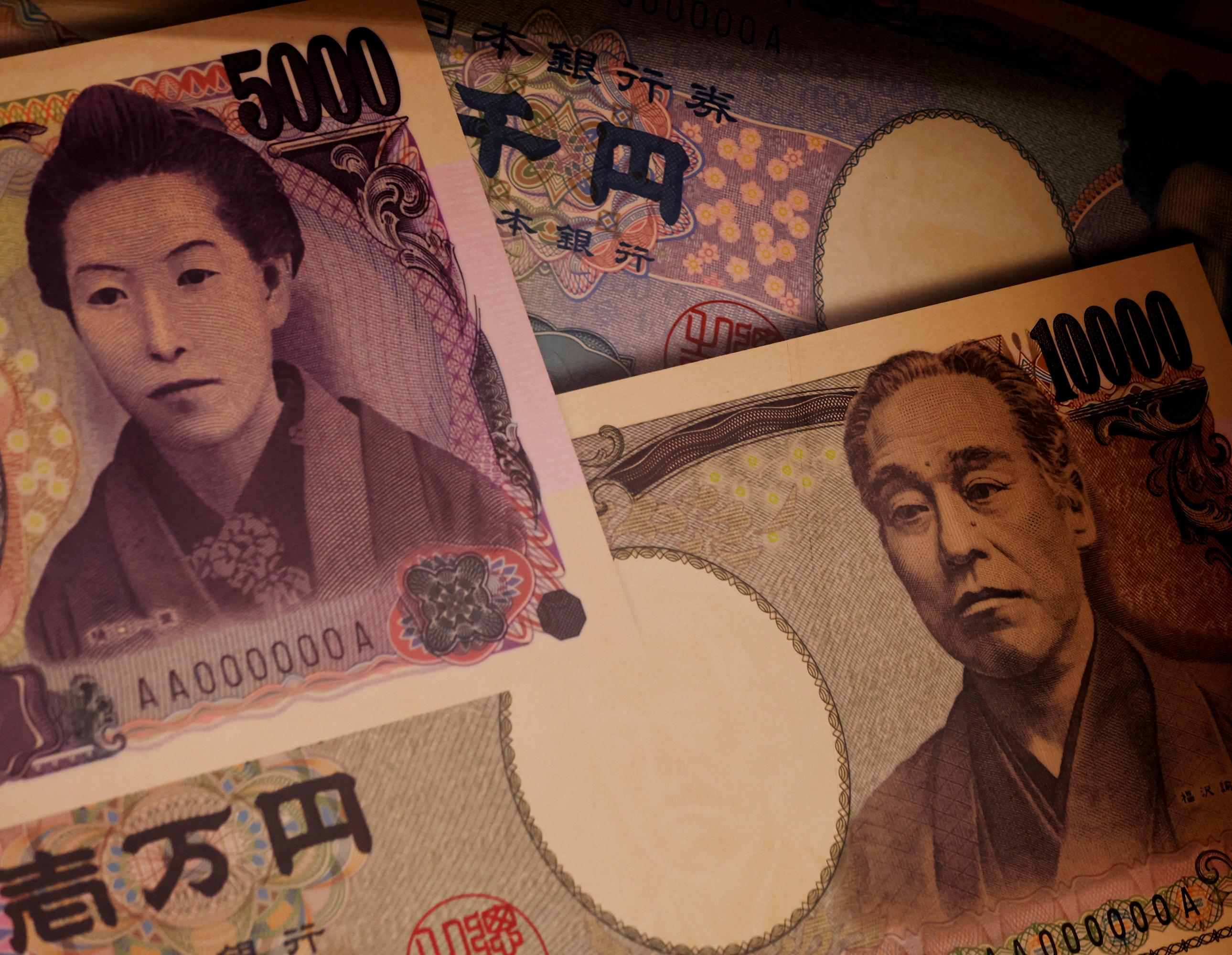
Yen comes off 34-year low of 151.97 per dollar Rhetoric similar to that ahead of previous intervention in Oct 2022 Analysts warn yen weakness risks domino effects TOKYO, March 27 (Reuters) - Japan's three main monetary authorities held an emergency meeting on Wednesday to discuss the weak yen, and suggested they were ready to intervene in the market to stop what they described as disorderly and speculative moves in the currency. In a sign of growing urgency to put a floor under the yen after the currency fell to a 34-year low against the dollar, the Bank of Japan, the Finance Ministry and Japan's Financial Services Agency held a meeting late in Tokyo trading hours. In a briefing afterwards, top currency diplomat Masato Kanda said he "won't rule out any steps to respond to disorderly FX moves". Kanda also said the BOJ would respond through monetary policy if currency moves affected the economy and price trends. The dollar slipped against the yen on news of the meeting and was last at 151.06 after Kanda spoke. Earlier, the yen was at 151.97, weaker than the 151.94 level at which Japanese authorities stepped in during October 2022 to buy the currency. The yen has continued to lose ground despite a historic shift away from negative interest rates by the BOJ last week. A weaker yen makes exports from the world's fourth-largest economy cheaper, but can push up prices of energy and other Japanese imports, fuelling inflation and making the cost of living higher. That undermines the BOJ's objective of achieving a sustainable 2% inflation level via wage growth and better household purchasing power, rather than cost-push inflation. Earlier in the day, Finance Minister Shunichi Suzuki said authorities could take "decisive steps" against yen weakness - language he hasn't used since 2022 when Japan last intervened in the market. He made his remarks shortly after the dollar spiked on strong U.S. data. "Now we are watching market moves with a high sense of urgency," he told reporters. Christopher Wong, a currency strategist at OCBC in Singapore, said markets were gingerly testing to see where's the line for Tokyo. "I think that the risk of intervention is quite high, because this is a new cycle high," he said, adding that if Tokyo doesn't act, it would just encourage people to push the dollar/yen exchange rate a lot higher in the next few days. DOMINO EFFECT Bank of Japan Governor Kazuo Ueda said on Wednesday that the central bank would also keep a close eye on currency developments. "Currency moves are among factors that have a big impact on the economy and prices," Ueda told parliament, when asked about the yen's recent sharp declines. National Australia Bank forex strategists said ripples from the yen's decline were being felt elsewhere and said that a recent sharp drop in China's yuan may be a policy response to protect the competitiveness of Chinese exports. "It's not just a yen story. It has a domino effect that causes downside risk to other currencies," said NAB strategist Rodrigo Catril. While the BOJ raised interest rates for the first time since 2007 last week, markets now believe the next hike may be some time away. That has reinforced the yen's use in carry trades, in which investors borrow in a currency with low interest rates and invest the proceeds in a higher-yielding currency. Japanese investors can also get much stronger returns abroad, depriving the yen of support from repatriation flows. For the current quarter that ends later this week, the yen is the worst-performing major currency, down more than 7% on the dollar. Keep up with the latest medical breakthroughs and healthcare trends with the Reuters Health Rounds newsletter. Sign up here. https://www.reuters.com/markets/currencies/japan-finmin-suzuki-take-decisive-steps-vs-excessive-yen-moves-2024-03-27/