
2024-03-20 14:18
March 20 (Reuters) - Investors are flocking to U.S. medium-term government bond funds and helping push their assets to record highs, as uncertainty about the Federal Reserve's policy path prompts them to seek the sweet spot between income and protection. According to Morningstar Direct data, U.S. medium-term government bond funds, which include Treasuries and debt issued by government-linked agencies, attracted $9.8 billion in the first two months of this year. That compared with just $2.3 billion for long-term government funds and an outflow of $3.5 billion from short-term government bond funds. Assets under management (AUM) at U.S. medium-term government bond funds stood at a record $252 billion at the end of February, up 2% this year, the data showed. By contrast, the AUM at U.S. short-term and long-term government bond had dropped 3.8% and 2.7% to $93.4 billion and $158.3 billion respectively. The rush into medium tenors has been driven by shifting expectations for Fed policy. In early 2023, as the Fed's swift policy tightening caused the yield curve to invert, investors sought short-term bonds for their yields. Bond prices move inversely with yields. So, as talk of rate cuts grew in the second half of last year, investors flocked to long term bonds whose yields would tend to fall more, hence boosting their prices and yielding capital gains. The scenario has changed again this year. As the Fed contemplates cutting rates but inflation remains sticky, markets have gone from pricing six rate cuts in 2024 at the end of December to now expecting just three rate cuts - reshaping investor strategies in the bond market once more. "Some of this uncertainty in the rate path could be a driver of moving towards the middle of the curve, as investors want to have duration exposure, but don’t feel confident enough in the Fed path to be long on the yield curve," said Michael Parnell, senior strategic research analyst at Verus. The U.S. central bank is likely to keep borrowing costs unchanged at its Wednesday meeting, while new projections may hint at a slower and delayed approach to future rate cuts. Analysts say medium-term bonds offer the best of both scenarios, helping investors tie up current high yields for a reasonably long period of four to 10 years while mitigating the risk of big price losses on longer tenor bonds should yields keep rising. "Medium-term bond funds could continue to attract more flows over the next few quarters as they present a nice income opportunity and an appealing risk and reward profile for price action relative to duration, culminating in an attractive total return opportunity," said Karen Manna, portfolio manager at Federated Hermes. Get a look at the day ahead in U.S. and global markets with the Morning Bid U.S. newsletter. Sign up here. https://www.reuters.com/markets/us/policy-uncertainty-drives-investors-into-us-medium-term-bond-funds-2024-03-20/

2024-03-20 13:53
NEW YORK, March 19 (Reuters) - Nasdaq (NDAQ.O) , opens new tab said on Tuesday that Borse Dubai would sell shares worth $1.6 billion in the U.S. stock exchange operator, ceding its spot as the company's top shareholder to private equity firm Thoma Bravo. The move sent shares of Nasdaq down nearly 4% in trading before the bell on Wednesday. Borse Dubai will sell nearly 27 million Nasdaq shares at $59 each, a discount of more than 5% to the stock's last closing price. The deal will reduce Borse Dubai's stake in Nasdaq to 10.8% from 15.5% and make it the company's second-largest shareholder. With a 12.5% stake, Thoma Bravo would become the biggest shareholder in the exchange. Borse Dubai said it planned to agree to a lock-up period of 18 months for its remaining shares if the current sale is completed. As long as it owns at least 10% stake in Nasdaq, it will also have the right to designate a nominee to the company's board of directors. Get a look at the day ahead in U.S. and global markets with the Morning Bid U.S. newsletter. Sign up here. https://www.reuters.com/markets/us/nasdaq-stock-falls-borse-dubai-set-sell-shares-secondary-offering-2024-03-20/

2024-03-20 12:47
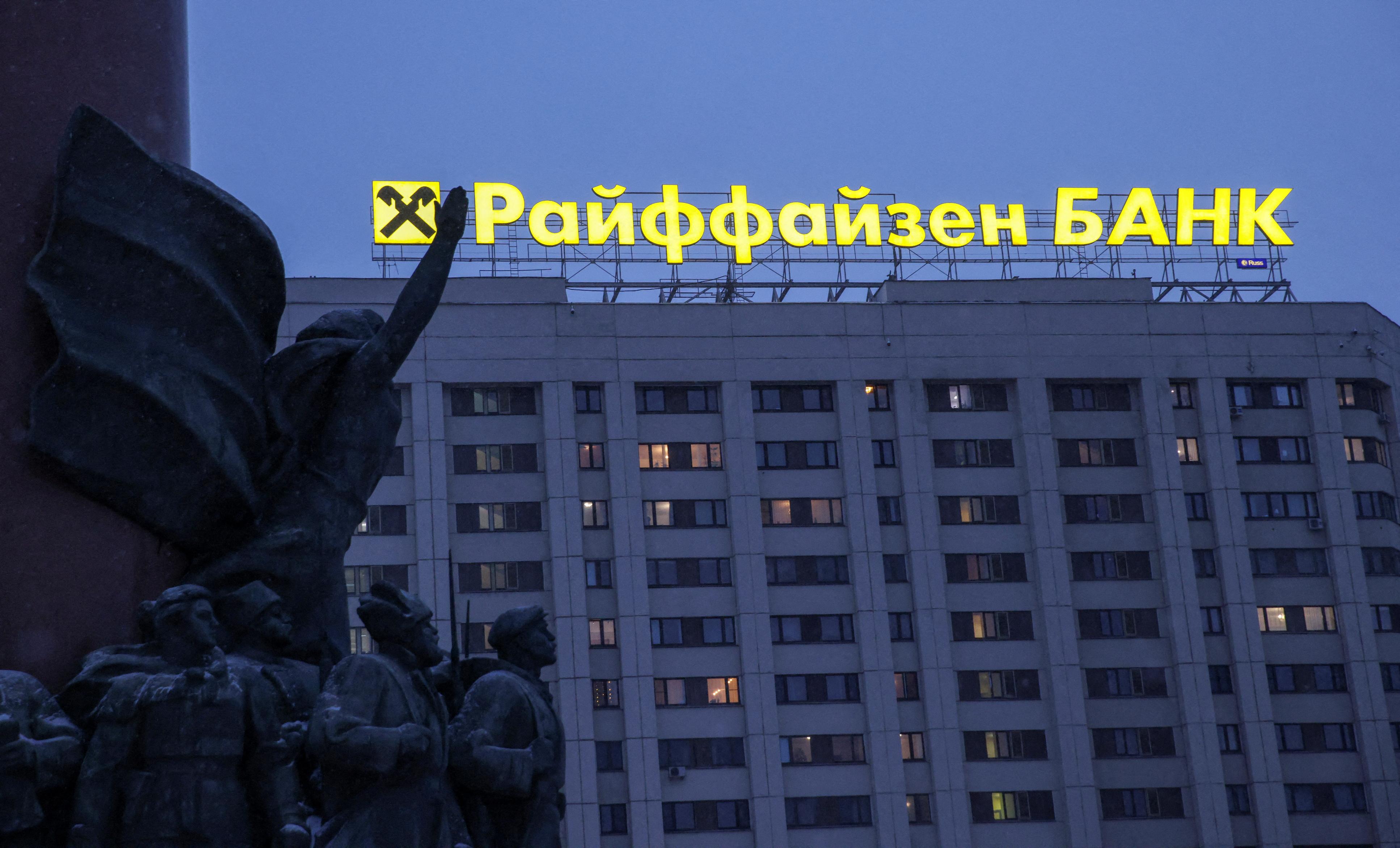
Raiffeisen planned to buy 1.5 bln eur Deripaska industry stake US authorities warn Austria off deal Department of Justice looks into Raiffeisen's Russia links Bank drops bond sale, memo shows, after Reuters report Raiffeisen shares drop as much as 16% VIENNA, March 20 (Reuters) - The United States is pressing Austria's Raiffeisen Bank International, the biggest Western bank in Russia, to drop plans to buy a 1.5 billion euro ($1.6 billion) industrial stake of a Russian tycoon, several people with direct knowledge of the talks said. Washington's intervention is likely to derail one of the biggest Western deals in Russia since the start of the Ukraine war and piles more pressure on the Austrian group that handles billions of euros of international payments for Russians, two of the people said. The news rattled investors. Raiffeisen is buying the stake in Vienna-based Strabag from a company the construction group identified as controlled by Oleg Deripaska. The bank billed the deal, which is routed via Russia, as a means of unlocking some of the billions of euros stranded in Russia and potentially loosening its ties. The news in December prompted a rally in the bank's stock, which has been hit hard due to its Russia links. In recent weeks, senior U.S. Treasury officials have underscored their concerns about the transaction in meetings with the bank and Austrian authorities, the people said. They pointed out that Deripaska is sanctioned. U.S. government officials, who believe that Deripaska will benefit from the sale, have demanded the bank give details about the individuals and companies involved in the arrangement, the people said. Should Raiffeisen press ahead regardless and the deal is proven to fall foul of U.S. sanctions, Washington could impose penalties on the bank, two of the people said. In light of the U.S. position, one person said Austrian authorities would hold off on giving the green light, while another said the bank itself was preparing to drop the deal. A spokesperson for the bank said it had "diligently verified the compliance of the Strabag transaction with all applicable sanctions, prior to signing" and had in recent weeks "briefed all relevant authorities, including the U.S. Treasury and OFAC (Office of Foreign Assets Control)". "It goes without saying that RBI will not proceed with any deal which would be in breach of sanctions, or expose RBI to the risk of sanctions," said the spokesperson. A spokesperson for Deripaska pointed to earlier remarks, where she said he had no control over the company holding the Strabag stake, describing the Western sanctions as misguided and based on false accusations. CLOSE TIES Two years after the outbreak of war, Raiffeisen's continued presence underlines the depth of relations between Austria and Russia, connected with Russian gas pipelines, and with Vienna serving as a hub for cash from Russia and former Soviet states. The bank is a critical financial lifeline for millions of Russian customers who want to send euros or dollars abroad. The conversations are taking place against a backdrop of continued scrutiny by regulators of Raiffeisen and its Russian connections, which started more than a year ago when U.S. sanctions enforcer OFAC started to look into the bank's Russia business. The U.S. Department of Justice’s Bank Integrity Unit, which is part of the criminal division, has also been looking into Raiffeisen over its Russia business, said one person familiar with the matter, who described the scrutiny as ongoing. Another person said that a senior DOJ official had been in regular contact with the Austrian bank concerning Russia and had often visited Vienna in this regard. The Department of Justice declined to comment. Raiffeisen shares tumbled after the Reuters report, at one point trading down roughly 16%. Raiffeisen also scrapped the sale of a 650 million euro bond, according to one of the banks organising that process, which circulated a memo seen by Reuters blaming "adverse market reaction to the latest headlines". So far, key Austrian officials, irked by what they see as U.S. bullying of a small, neutral country, have fought the bank's corner because it is part of an influential industrial group that underpins the economy. But two people familiar with government thinking said officials were not set on defending its latest deal over the stake in Strabag, which built the Olympic stadium for the Sochi winter games and luxury apartments in Moscow. A spokesperson for the European Commission, which oversees EU sanctions on oligarchs including Deripaska, said it was aware of the transaction and "has asked for clarifications from the Austrian authorities, whose replies are pending". The Commission was "in close contact with the U.S. authorities", the spokesperson said, adding: "In general, under EU sanctions the assets of individuals and entities subject to asset freeze must be frozen, i.e. it is essentially prohibited to deal with those assets". Recently, Austria pressured Ukraine to remove RBI from a Ukrainian blacklist, holding out on backing fresh EU sanctions on Russia until it did, people familiar with the situation have told Reuters. Austria and RBI wanted it to be taken off Kyiv's "international sponsors of war" list, which sets out to shame companies doing business in Russia. Although Italy's UniCredit also has a business in Russia and is similarly reluctant to leave, RBI is far larger and has become a test of Western resolve to end ties with Russia. Russian authorities have made it clear to RBI, which has around 2,600 corporate customers, 4 million local account holders and 10,000 staff, that they wish it to stay because it enables international payments. RBI had said it intended to spin off its Russian business, but two years into war, little has changed. ($1 = 0.9226 euros) Get U.S. personal finance tips and insight straight to your inbox with the Reuters On the Money newsletter. Sign up here. https://www.reuters.com/markets/deals/washington-pressures-austrias-raiffeisen-drop-russian-tycoon-deal-sources-say-2024-03-20/
2024-03-20 12:22
LONDON, March 20 (Reuters) - The northern hemisphere has experienced the warmest winter on record, with the unusual warmth concentrated around the Atlantic Basin, which has produced an enormous surplus of gas and slump in prices since October. Surface temperatures on land were +2.65°C above the 20th century average between December and February, according to data compiled by the U.S. National Oceanic and Atmospheric Administration (NOAA). Chartbook: Northern hemisphere winter 2023/24 , opens new tab Record warmth in the winter of 2023/24 beat previous highs of +2.44°C in 2019/2020 and +2.61°C in 2015/16 - also winters characterised by surplus inventories and slump in gas prices. Global warming, strong El Nino conditions in the Pacific, a strongly positive North Atlantic Oscillation, and the solar activity cycle moving towards its 11-year peak, all contributed to exceptional warmth this winter. NORTH AMERICA Europe has received most attention because of the regional gas market's disruption following Russia's invasion of Ukraine, but the most abnormal weather occurred in North America. Temperatures across North America were +3.43°C above the long-run average between December and February ("Climate at a glance , opens new tab", National Centers for Environmental Information, March 2024). North America experienced record warm anomalies in both December (+4.66°C) and February (+3.59°C) slashing heating demand for both gas and gas-fired electricity. U.S. gas inventories started the heating season just 64 billion cubic feet (bcf) (+2% or +0.24 standard deviations) above the prior 10-year seasonal average on Oct. 1. Inventories were still only 129 bcf (+4% or +0.46 standard deviations) above the 10-year seasonal average at the end of November. But the surplus had swelled to 307 bcf (+10% or +1.15 standard deviations) by the end of December following a run of abnormally warm weather. Colder temperatures caused the surplus to narrow temporarily in January, particularly during the very cold spell between Jan. 13 and Jan. 22. But the surplus ballooned again to 519 bcf (+29% or +1.31 standard deviations) by the end of February as temperatures reverted to well above normal. With mild weather continuing into March the surplus had bloated to an enormous 606 bcf (+35 or +1.35 standard deviations) by March 8. U.S. front-month futures prices averaged almost $3.19 per million British thermal units in October, putting them in the 13th percentile for all months since 1993 once inflation is taken into account. By February average inflation-adjusted prices had fallen to a record low of $1.80 as persistent warmth and the relentless build up of surplus inventories sent the market into a tailspin. EUROPE AND ASIA Europe also experienced a very warm winter, with temperatures +2.73°C above the long-run average, making the winter the second warmest on record after 2019/20 (+3.32°C). A strongly positive North Atlantic Oscillation directed strong westerly winds into Northwest Europe bringing lots of warm and moisture-laden air from the Atlantic. The temperature anomaly may not have been as extreme as North America, but coupled with prices well above the pre-invasion average, it was enough to leave the region with record seasonal inventories by the end of February. Inventories across the European Union and the United Kingdom started the heating season 167 terawatt-hours (TWh) (+18% or +1.70 standard deviations) above the 10-year average on Oct. 1. By Feb. 29, the surplus had swollen to 269 TWh (+60% or +2.08 standard deviations), according to data from Gas Infrastructure Europe. Europe's front-month futures averaged almost 46 euros per megawatt-hour (88th percentile for all months since 2010 in real terms) in October, but had slumped to an average of just 26 euros (48th percentile) in February. By contrast to North America and Europe, winter temperatures across Asia were closer to normal, at least for the last two decades. Asia's temperatures averaged +1.80°C above the long-term average, but that made it only the 10th warmest winter on record. OODLES OF GAS North America, Europe and Asia combined accounted for almost two-thirds of global gas consumption in 2022 ("Statistical review of world energy , opens new tab", Energy Institute, 2023). North America and Europe alone accounted for 40% of worldwide consumption, with a heavy weighting towards the winter months because of heating demand. Exceptional warmth around the Atlantic Basin in winter 2023/24 therefore occurred in precisely the area to maximise the impact on gas consumption, inventories and prices. When historians ask why Russia's invasion of Ukraine and sanctions imposed in response did not cause shortages and a more severe and prolonged spike in prices, they are likely to cite extraordinarily warm winters in both 2022/23 and 2023/24 rather than policy actions as the primary reason. Europe's gas consumers got very lucky in the winter of 2023/24 and have seen prices normalise. For the same reason, Asia's importers are now benefiting from improved availability and much lower prices. Conversely, North America's producers have been pushed into a deep slump as they struggle to sell in a market awash with too much gas. Next winter is very likely to be colder in North America and Europe. In the meantime, lower prices will result in slower or no production growth in the United States, which should cause the market to tighten gradually over the next 12 months. Related columns: - Europe gets lucky with a mild, windy winter (March 13, 2024) - Europe's mild winter leaves gas stocks at record high (March 7, 2024) - El Niño pushes real U.S. gas prices to multi-decade low (February 16, 2024) - Europe’s swollen gas stocks drive prices lower (February 13, 2024) John Kemp is a Reuters market analyst. The views expressed are his own. Follow his commentary on X https://twitter.com/JKempEnergy , opens new tab Get a look at the day ahead in U.S. and global markets with the Morning Bid U.S. newsletter. Sign up here. https://www.reuters.com/markets/commodities/northern-hemispheres-record-winter-warmth-slashes-gas-consumption-2024-03-20/

2024-03-20 12:16
March 20 (Reuters) - Chipotle Mexican Grill's (CMG.N) , opens new tab stock breached the $3,000 mark for the first time on Wednesday and closed 3.5% higher after the burrito chain's board approved a 50-for-1 stock split, hoping to entice investors wary of its lofty per-share price. Shares of the California-based company have rallied to record levels over the past year, powered by strong earnings owing to a solid demand for burritos and rice bowls among its relatively wealthy customer base. A stock split lowers the price of shares without affecting the company's valuation, making them more affordable for individual investors. Based on Wednesday's closing price of $2,895, its highest close ever, the company's stock would trade at around $58 after the split. Chipotle has around 27.4 million shares outstanding. If the split is approved at the upcoming annual meeting on June 6, its shareholders will receive an additional 49 shares for each share held. As of Tuesday's close, Chipotle had the fourth-highest-per-share value on the S&P 500 index. Its market value was $76.71 billion. The split, the first in its 30-year history, "will make our stock more accessible to employees as well as a broader range of investors," said Chipotle's Chief Financial and Administrative Officer Jack Hartung on Tuesday. CEO Brian Niccol also announced a special one-time equity grant for all restaurant general managers as well as crew members with more than 20 years of service. "They're also trying to do what Walmart has done in the sense that they want to give employees more economic ownership," said Thomas Hayes, chairman at hedge fund Great Hill Capital. Retail giant Walmart (WMT.N) , opens new tab undertook a 3-for-1 share split that went into effect beginning Feb. 26 and has given the employees the option of buying the stock through payroll deductions. "Chipotle's stock split should ease liquidity in the stock given how high the share price has risen over the past years. Otherwise, the economics of the business remain just as compelling," said Jim Sanderson, an analyst with Northcoast Research. The fast-casual Mexican chain went public in January 2006 at $22 per share. Its forward price-to-earnings multiple (P/E), a common benchmark for valuing stocks, is 49.72, higher than industry peers including Starbucks (SBUX.O) , opens new tab and McDonald's (MCD.N) , opens new tab that have a P/E ratio of 20.89 and 22.24, respectively. The Reuters Daily Briefing newsletter provides all the news you need to start your day. Sign up here. https://www.reuters.com/business/retail-consumer/chipotle-jumps-first-ever-stock-split-shares-hover-record-high-2024-03-20/
2024-03-20 12:13
WARSAW, March 20 (Reuters) - Polish farmers blocked roads with tractors and flares on Wednesday in escalating protests against EU environmental regulations and cheap food imports from neighbouring Ukraine which the bloc provisionally agreed to prolong. Placards depicted a farmer swinging from a gallows next to wind farms and an EU-emblazoned executioner with the words: "Green Deal equals death of Polish agriculture." Farmers in Poland and elsewhere in the bloc have been protesting in recent months , opens new tab to demand the re-imposition of customs duties on agricultural imports from Ukraine that were waived after Russia's invasion in 2022. They say Ukraine's farmers are flooding Europe with cheap imports that leave them unable to compete. Farmers also want changes to restrictions placed on them by the bloc's Green Deal to tackle climate change. With hundreds of protests planned, Reuters footage from Zakret, east of Warsaw, showed farmers blocking ways into the capital. Tractors lined roads mounted with Polish flags while red flares were set off. On Wednesday, the EU reached provisional agreement to extend Ukrainian food producers' tariff-free access to its markets until June 2025 - albeit with new limits on grain imports. Polish protest leaders said they were not happy with the latest deal as it included the last few years as a reference for import limits. They want quotas based on figures from well before the war in Ukraine began, when imports were much lower. "We demand quotas and that they be calculated for the period from 2000, and not as Ukraine wants 2022-2023, because that was when the (import) levels were the highest. This does not fully satisfy us, because it is not a good solution," Slawomir Izdebski, leader of the OPZZ farmers' union, told Reuters. Polish police said they knew of more than 580 protests planned for Wednesday, with an estimated participation of 70,000 people. Last Friday, the European Commission also offered concessions to farmers as it proposed an easing of rules on leaving land fallow or rotating crops. Farmers in the Czech Republic held similar protests. They drove an estimated 1,600 tractors and other agricultural machinery onto the streets, Barbora Pankova, a spokesperson for the Czech Agrarian Chamber, told Czech Television. The Reuters Daily Briefing newsletter provides all the news you need to start your day. Sign up here. https://www.reuters.com/world/europe/giving-away-apples-polish-farmers-stage-more-food-protests-2024-03-20/


