2024-03-09 06:32
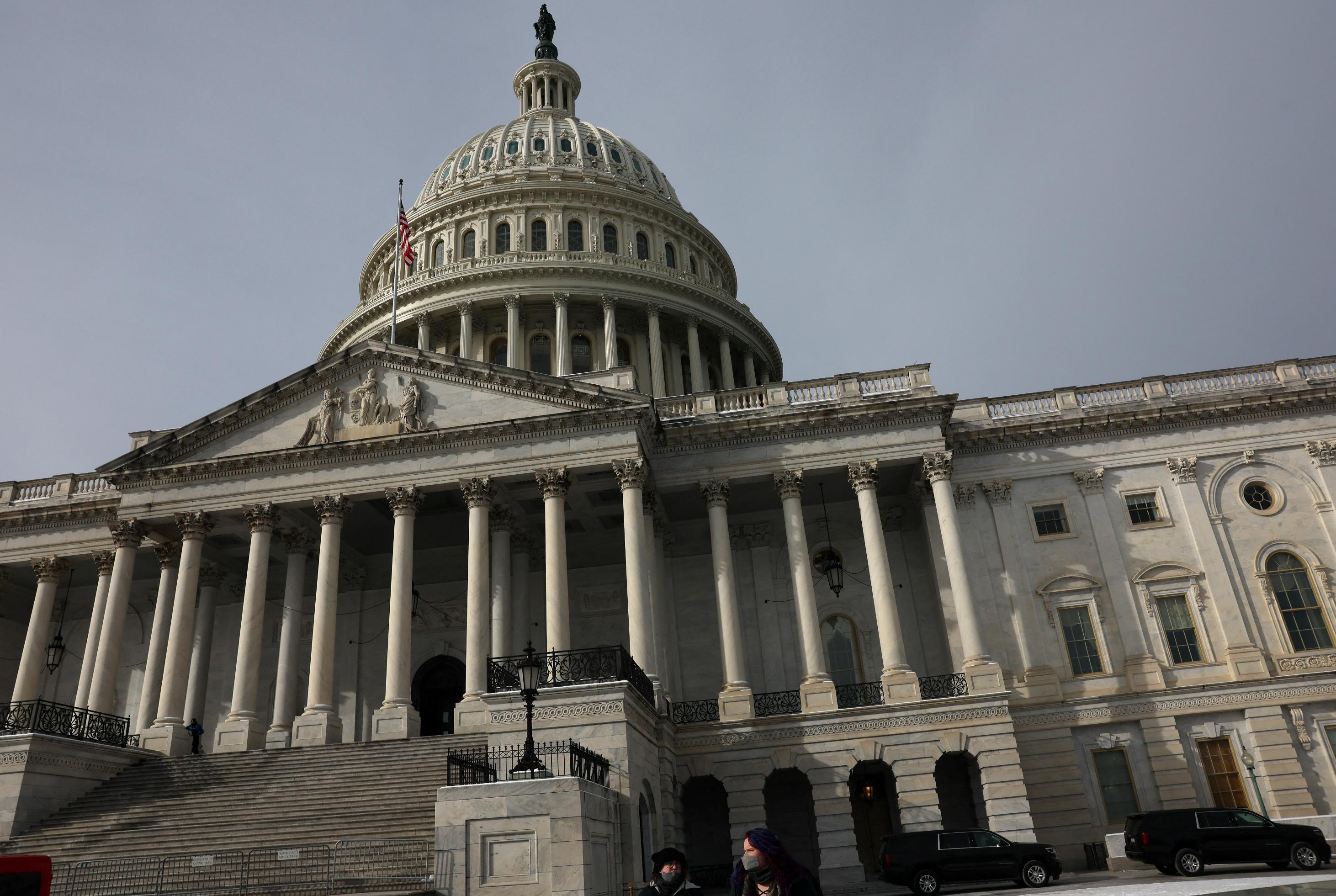
WASHINGTON, March 8 (Reuters) - The U.S. Senate narrowly averted a partial government shutdown on Friday, as the chamber approved spending legislation for several government agencies just hours before current funding was due to expire. By a bipartisan vote of 75-22, the Senate approved a $467.5 billion spending package that will fund agriculture, transportation, housing, energy, veterans and other programs through the end of the fiscal year on Sept. 30. The package now heads to Democratic President Joe Biden to sign into law. Funding for those programs was due to expire at midnight. The vote partially resolves a bitter, months-long battle over government spending that at one point left the Republican-controlled House of Representatives leaderless for three weeks. "To folks who worry that divided government means nothing ever gets done, this bipartisan package says otherwise," Senate Democratic Leader Chuck Schumer said ahead of the vote. The package easily passed the Republican-controlled House of Representatives earlier this week. But action in the Senate was delayed as some conservative Republicans pressed for votes on immigration and other topics. They all failed. Congress must still work out a deal on a much larger package of spending bills, covering the military, homeland security, health care and other services. Funding for those programs expires on March 22. Taken together, the two packages would cost $1.66 trillion. Far-right Republicans had pushed for deeper spending cuts to tame a $34.5 trillion national debt. All these measures were supposed to have been enacted into law by last Oct. 1, the start of the 2024 fiscal year. While Congress rarely meets that deadline, the debate this year has been unusually chaotic. Congress so far has had to approve four temporary funding bills to keep agency operations limping along at their previous year's levels. The spending bills include $241.3 million in earmarks - local projects secured by individual lawmakers - requested by Democratic Senator Dianne Feinstein. She died on September 29, 2023, two days before the start of the fiscal year. https://www.reuters.com/world/us/us-senate-poised-pass-spending-package-averting-government-shutdown-2024-03-08/
2024-03-09 06:10
March 8 (Reuters) - Federal Reserve policymakers weighing when to start interest-rate cuts got fresh reasons on Friday to remain on standby, after a government report showed robust job growth in February but also signs of labor market cooling that could help the Fed's battle with inflation. U.S. employers added 275,000 jobs last month, a Labor Department report showed on Friday, handily beating the 200,000 that economists expected. But the report's revisions of prior months' estimates showed smaller job gains in January and December than had earlier been thought, and other details of the report suggested a rebalancing in the labor market continues. The U.S. unemployment rate rose to 3.9%, its highest in two years, though still below levels the Fed sees as sustainable in the long-run. And wage growth has continued to edge down, rising 4.3% in February from a year earlier, down from 4.4% in January. Fed policymakers won't see that growth as consistent yet with their 2% inflation goal, but it is moving in the right direction. In testimony on Capitol Hill this week, Fed Chair Jerome Powell said he feels the economy is healthy and policymakers are "not far" from having enough confidence on inflation's downward direction to start reducing interest rates. Friday's report showing the labor market is still strong but easing slowly "will provide reassurance to the Fed that real economic conditions remain broadly consistent with inflation converging durably towards 2%, and it will be appropriate to cut by June," said Evercore ISI's Krishna Guha. Futures contracts that settle to the Fed policy rate now point to about an 80% chance the Fed will start cutting interest-rates by mid-June, with a little more than a one-in-four chance of a May 1 start. Traders firmed up their expectations for a full percentage point of rate cuts by the end of the year, the equivalent of four quarter-point reductions over the remaining seven Fed policy-setting meetings this year. INFLATION KEY Fed policymakers next meet March 19-20, and are nearly universally expected to keep the policy rate in the current 5.25%-5.5% range, where it has been since last July. Powell said this week that range is likely to be the peak and is putting downward pressure on price pressures. With inflation by the Fed's targeted measure, at 2.4%, still above the Fed's 2% goal, policymakers are looking for further assurance that it is headed durably downward before they decide to cut rates. Instead, since the start of they year, some readings on inflation have been stronger than expected, prompting some Fed policymakers to say they may need to delay rate cuts a bit longer. Fed Governor Christopher Waller, whose takes on monetary policy have proven prescient over the past couple of years, said in February that he wants a couple more months of data to verify progress on inflation, and that strong job gains underscore there is "no rush" to cut rates. Meanwhile policymakers continue to look for any signals the labor market is cracking under the pressure of the highest U.S. policy rate in decades. Analysts said they won't find much in Friday's jobs report. "It is clear that the pace of hiring is cooling, which was to have been expected," wrote Regions Financial Corp Chief Economist Richard Moody. "There is, however, nothing in the data, including the higher jobless rate, that tells us the labor market is on the verge of rolling over." https://www.reuters.com/markets/us/fed-gets-another-reason-not-rush-rate-cuts-2024-03-08/

2024-03-09 05:06
GRIFFITH, Australia, March 9 (Reuters) - Millions of vines are being destroyed in Australia and tens of millions more must be pulled up to rein in overproduction that has crushed grape prices and threatens the livelihoods of growers and wine makers. Falling consumption of wine worldwide has hit Australia particularly hard as demand shrinks fastest for the cheaper reds that are its biggest product, and in China, the market it has relied on for growth until recent years. The world's fifth largest exporter of wine had more than two billion litres, or about two years' worth of production, in storage in mid-2023, the most recent figures show, and some is spoiling as owners rush to dispose of it at any price. "There's only so long we can go on growing a crop and losing money on it," said fourth-generation grower James Cremasco, as he watched clanking yellow excavators strip out rows of vines his grandfather planted near the southeastern town of Griffith. About two-thirds of Australia's wine grapes are grown in irrigated inland areas such as Griffith, its landscape shaped by vine-growing techniques brought by Italian migrants arriving around the 1950s. As major wine makers such as Treasury Wines (TWE.AX) , opens new tab and Carlyle Group's (CG.O) , opens new tab Accolade Wines refocus on more expensive bottles that are selling better, the areas around Griffith are struggling, with unpicked grapes shrivelling on vines. "It feels like an era is ending," said Andrew Calabria, a third-generation vineyard owner and wine maker at Calabria Wines. "It's hard for growers to look out the back window and see a pile of dirt instead of vines that have been there as long as they've known." Nearby, the remains of 1.1 million vines that once comprised one of Australia's largest vineyards were piled in heaps of gnarled and twisted wood as far as the eye could see. Red wine has suffered the most. In regions like Griffith, prices of the grapes going into it fell to an average of A$304 ($200) a ton last year, the lowest in decades and down from A$659 in 2020, data from industry body Wine Australia show. The government, which forecasts lower prices again this year, said it recognises the significant challenges facing growers and is committed to supporting the sector, though many growers say it can do more. Cremasco said some of his red grapes sold for little more than A$100 a ton. To balance the market and lift prices, up to a quarter of the vines in areas such as Griffith must be pulled up, said Jeremy Cass, head of Riverina Winegrape Growers, a farmers' group there. That would destroy more than 20 million vines across 12,000 hectares (30,000 acres), Reuters calculations based on Wine Australia data show, or about 8% of Australia's total area under vine. Growers and winemakers in other regions have also been pulling out vines. "If half the vines in Australia were ripped out, it still might not solve the oversupply," said a wine maker in Western Australia. Still, many growers unwilling to pull up vines are losing money while hoping for the market to turn around. "It's chewing up wealth," said KPMG wine analyst Tim Mableson, who estimates that 20,000 hectares (49,000 acres) of vines need to be taken out nationwide. GIVING IT AWAY Health concerns are prompting consumers worldwide to drink less alcohol and when they do drink wine, they pick pricier bottles. Chile, France and the United States are among the other large wine producers also grappling with oversupply, with even prime areas such as Bordeaux uprooting thousands of hectares of vines. When China blocked imports during a political dispute in 2020, Australia lost its biggest wine export market by value. And unlike Europe, it offers farmers no financial aid to help them destroy vines and excess wine. Even though China is expected to allow imports again this month, that will not mop up the glut, as demand there has fallen much more rapidly than elsewhere. Wine sold for less than A$10 a litre - most of it made from grapes grown in areas like Griffith - accounted for two-thirds of the value of Australian wine exports worth A$1.9 billion in the year to December 2023, Wine Australia says. Some areas are faring better, such as Tasmania and the Yarra Valley in Victoria, which produce more white wines and lighter, more expensive reds that are growing in popularity. But across Griffith there are clusters of metal storage tanks, each holding thousands of litres. "Everyone is trying to clear wine," said Bill Calabria, Andrew's father, adding that wineries were "all but giving it away" to make room for the incoming vintage. Many growers are turning to citrus and nut trees instead. Cremasco hopes for greater profits from the prune trees he is planting in his grubbed-up acreage, while GoFARM, a corporation, is putting in more than 600 hectares (1,500 acres) of almonds nearby, also replacing vines. "There'll be no next generation of family grape growers," Cremasco added. "It'll be all big corporates, and all the local young guys will be working for them." ($1=1.5225 Australian dollars) https://www.reuters.com/world/asia-pacific/australian-farmers-rip-out-millions-vines-amid-wine-glut-2024-03-09/

2024-03-09 05:03
March 8 (Reuters) - Nine people were killed on Friday in a collision between a tractor-trailer truck and a passenger van in central Wisconsin, authorities said. The wreck occurred shortly before 8 a.m. in Dewhurst, a town on state highway 95, when the van entered an intersection from a side road to cross the two-lane highway in the path of the oncoming truck, the Clark County Sheriff's Office said. Dewhurst is about 200 miles (322 km) northwest of the state's largest city of Milwaukee. The van's driver and eight of its nine passengers died, along with the driver of the truck, who was alone in his vehicle, the sheriff's office said in a Facebook post. The lone survivor from the van was taken to hospital with unspecified injuries. Pictures of the scene showed both vehicles heavily mangled by the impact, with the van crumpled on its side. The crash is being investigated, officials said. The names of the victims were not released. https://www.reuters.com/world/us/nine-die-wisconsin-highway-collision-truck-passenger-van-2024-03-09/

2024-03-09 01:16
Unemployment rate rises to 3.9%, wage gains moderate Broadcom down as FY forecast fails to impress Marvell falls on weak Q1 earnings forecast Indexes fall: Dow 0.18%, S&P 0.65%, Nasdaq 1.16% March 8 (Reuters) - The S&P 500 and Nasdaq closed lower on Friday after touching record highs during the session, with high-flying chip stocks going into reverse and a mixed labor market report that showed more new jobs than expected with a rising unemployment rate. The S&P and Nasdaq briefly hit intraday record highs but started to lose steam late morning. The Philadelphia Semiconductor Index (.SOX) , opens new tab sharply underperformed and ended the day down 4% after touching an intraday record high. Artificial intelligence chip darling Nvidia (NVDA.O) , opens new tab closed down 5.6% to snap a six-session winning streak. Early in the session it had been up more than 5%. In the chip index, Broadcom (AVGO.O) , opens new tab sank 7% after its full-year forecast failed to impress investors and Marvell Technology , opens new tab(MRVL.O) , opens new tab tumbled 11.4% after it forecast first-quarter results below market expectations on soft demand. Stocks had opened higher after data showed U.S. job growth accelerated in February, with nonfarm payrolls increasing by 275,000 jobs against an expected 200,000 rise. January jobs numbers were revised lower. Also, the unemployment rate rose to 3.9% in February after holding at 3.7% for three straight months, while wage growth slowed to 0.1% on a monthly basis. "Today is just profit taking," said Brian Price, head of investment management for Commonwealth Financial Network who described the week as "a microcosm of the year so far" with modest pull backs and buyers stepping in. Price pointed to some signs of consumers spending more cautiously, with Costco Wholesale (COST.O) , opens new tab shares closing down 7.6% as quarterly sales fell short of estimates due to tepid demand for higher-margin goods. But Price said "the general bias right now is for the market to continue to move higher, absent negative catalysts." "That's really what the market is hanging its hat on right now, that inflation is going to continue to be benign, that the Fed is going to start to ease." Next week's February data including consumer prices (CPI) and retail sales will offer more cues on the prospects for potential rate cuts. On Thursday, Federal Reserve Chair Jerome Powell said the central bank was "not far" from gaining the confidence inflation is falling sufficiently to begin cutting interest rates. The Dow Jones Industrial Average (.DJI) , opens new tab fell 68.66 points, or 0.18%, to 38,722.69, the S&P 500 (.SPX) , opens new tab lost 33.67 points, or 0.65%, to 5,123.69 and the Nasdaq Composite (.IXIC) , opens new tab lost 188.26 points, or 1.16%, to 16,085.11. The biggest loser among the S&P 500's 11 major sectors was technology (.SPLRCT) , opens new tab, which ended down 1.8%, followed by consumer staples (.SPLRCS) , opens new tab, which fell 0.8%, with a big drag from Costco. For the week the S&P 500 lost 0.26% while Nasdaq fell 1.17% and the Dow dropped 0.93%. "People may be taking some chips off the table. We've had a decent run. Some of the technology names had moved up quite a bit," said Charlie Ripley, Senior Investment Strategist for Allianz Investment Management. "When you've markets which have run up as much as this has since the start of the year, with returns coming in a strong as they have, these types of pull backs are healthy to see." The biggest gainer was real estate (.SPLRCR) , opens new tab, which closed up 1.1% followed by energy (.SPNY) , opens new tab, which added 0.4%. Also on the bright side, Gap (GPS.N) , opens new tab shares finished up 8.2% after the retailer beat Wall Street expectations for fourth-quarter results, buoyed by strong demand on improved product offerings at its Old Navy and namesake brands during the holiday season, and lower markdowns. Advancing issues outnumbered decliners by a 1.25-to-1 ratio on the NYSE where there were 708 new highs and 48 new lows. On the Nasdaq 2,086 stocks rose and 2,192 fell as declining issues outnumbered advancers by about a 1.05-to-1 ratio. The S&P 500 posted 65 new 52-week highs and no new lows while the Nasdaq recorded 351 new highs and 83 new lows. On U.S. exchanges 12.29 billion shares changed hands compared with the 12.08 billion average for the last 20 sessions. https://www.reuters.com/markets/us/futures-steady-before-key-payrolls-test-2024-03-08/

2024-03-09 00:47
SYDNEY, March 9 (Reuters) - Large swaths of Australia on Saturday sweated through severe heatwave conditions that lifted bushfire risk in the country's southeast. The nation's weather forecaster on Saturday had heatwave alerts in place for South Australia, New South Wales, Tasmania, the Australian Capital Territory and Victoria, warning temperatures in some regions could go above 40 degrees Celsius (104 degrees Fahrenheit). In Victoria's capital Melbourne, a maximum temperature of 39 C (102.2 F) was forecast for Saturday, more than 15 degrees above the March mean, forecaster data showed. It was 31.5 C at 11.10 local time on Saturday, the forecaster said. "Extreme fire danger is forecast for Central and South West districts, including Melbourne and Geelong," it said on social media platform X. In New South Wales, Australia's most populous state, there were 19 bush and grass fires burning on Saturday, according to the state's Rural Fire Service agency website. A senior meteorologist at the forecaster, Sarah Scully, told the Australian Broadcasting Corp that hot weather would likely continue until Tuesday "when a much colder air mass and southerly change is forecast". Australia's summer was gripped by an El Nino weather pattern, now easing, in which unusually warm Pacific Ocean temperatures cause heatwaves, cyclones, droughts and wildfires. In February, tens of thousands of people had to evacuate amid an intense heatwave and massive bushfire in Victoria, which faced its worst conditions in four years. https://www.reuters.com/world/asia-pacific/australias-southeast-sweats-heatwave-lifting-bushfire-risk-2024-03-09/