2024-03-07 06:50
One in five long-distance trains running Airport strikes in Frankfurt, Hamburg, Duesseldorf Striking train driver says motivation high COLOGNE, Germany, March 7 (Reuters) - Germany faced strikes on several fronts on Thursday, as train drivers and airport workers walked off the job, causing chaos for millions of travellers and adding to the country's economic woes at a time of looming recession. The strikes are the latest in a wave of industrial actions to hit Germany, where high inflation and staff bottlenecks have soured wage negotiations in key parts of the transport sector, including national rail, air travel and public transport. Industry has warned about the costs of such strikes, after Europe's largest economy contracted by 0.3% in 2023 and the government warned of a weaker-than-expected recovery. A one-day nationwide rail strike costs around 100 million euros ($107 million) in economic output, Michael Groemling, head of economic affairs at IW Koeln, told Reuters during GDL's last strike in late January. Train drivers began a fifth round of strikes in a long-running dispute at 2 a.m. (0100 GMT), after a walkout in the cargo division started on Wednesday evening. Also on strike were airline ground staff at Lufthansa (LHAG.DE) , opens new tab and security staff at some airports. These included Germany's busiest Frankfurt hub, whose operator Fraport said 650 of Thursday's 1,750 planned flights had been cancelled. The train drivers' walkout, set to last until Friday afternoon, marks the beginning of a series of strikes planned by GDL as it pushes for reduced working hours at full pay. "The motivation is high to follow through with the conditions that we have set as GDL members," said train driver Philipp Grams at the picket line in Cologne. Just one in five long-distance trains was running, rail operator Deutsche Bahn said, but passengers showed some understanding. "I don't like it much, but if it makes a difference, if people want to change something, why not?" said Katerina Stepanenko, standing on the platform at Cologne's main station. Deutsche Bahn has accused the union of refusing to compromise. "The other side doesn't budge a millimetre from its maximum position," spokesperson Achim Stauss said. Economy Minister Robert Habeck, however, said he had lost sympathy for the strikers. "It must be possible to find a solution and not push your own interests so radically at the expense of other people; I no longer think that's right," he told broadcaster RTL/ntv. The ADV airport association, meanwhile, warned that strikes in the aviation sector, which on Thursday took place in Hamburg, Duesseldorf and Frankfurt, were damaging Germany's reputation as a centre for business and tourism. Lufthansa ground staff began a two-day strike on Thursday, and further woes were brewing for Germany's flag carrier after cabin crews voted on Wednesday for industrial action, with the UFO union assessing the next steps. Reporting its annual results, Lufthansa warned that strikes were a factor that would lead to a higher-than-expected operating loss in the first three months of 2024. https://www.reuters.com/world/europe/strike-wave-hits-german-rail-airports-disputes-mount-2024-03-07/

2024-03-07 06:28
Jan-Feb iron ore imports at 209.45 mln T vs 194 mln T yr prior Steel products exports up 32.6% y/y in Jan-Feb Steel imports in Jan-Feb fall 8.1% y/y BEIJING, March 7 (Reuters) - China's iron ore imports in the first two months of 2024 climbed 8.1% from the previous year as steelmakers restocked to meet production needs during and after the week-long Lunar New Year holiday. The world's largest iron ore consumer brought in 209.45 million metric tons of the key steelmaking ingredient - a record high for the two-month period, customs data showed on Thursday. The number works out to a monthly average of 104.73 million tons, versus a monthly average of 98.39 million tons in 2023. That compares to 100.86 million tons imported in December. China combines import data for January and February into one release to smooth out the impact of the Lunar New Year holidays, which fell in February this year. Better-than-expected supply in a typically slow-shipment season and an extra day in February due to the leap year aided the annual rise in imports, analysts said. Bookings in November and December for shipments that would arrive in January-February were robust as buyers were worried that iron ore prices which were rising at the time could climb further, analysts said. Buyers also expected ore demand to pick up after the holiday break due to seasonally stronger steel consumption in spring. The higher imports have contributed to a price slump and rising portside inventories in the January-February period, according to analysts. Iron ore prices tumbled by 19% during the two months, while stocks at major ports climbed by more than 16% to 134.9 million tons by end-February, the highest since March 2023, data from consultancy Steelhome showed. "If hot metal output continues to hover at relatively low levels in the coming months, iron ore imports may fall," said Xu Xiangchun, director of content at consultancy Mysteel, referring to the slower-than-expected recovery in ore demand after the Lunar New Year holiday. China's exports of steel products grew 32.6% to 15.91 million tons in the first two months of the year versus the same period a year earlier, the highest level for the period since 2016, the data also showed. China's imports of steel products dropped 8.1% to 1.13 million tons. https://www.reuters.com/markets/commodities/china-jan-feb-iron-ore-imports-jump-pre-holiday-restocking-higher-shipments-2024-03-07/

2024-03-07 06:08
US and European stock indexes hit records ECB keeps rates at 4% Bank of Japan chatter and Japanese data send yen soaring Gold shines at record high, Bitcoin takes a breather Graphic: World FX rates NEW YORK/LONDON, March 7 (Reuters) - Global stock indexes rallied to record highs on Thursday, while government bond yields fell after the European Central Bank held interest rates steady and Federal Reserve Chair Jerome Powell reiterated that easing was likely in 2024 if inflation behaved. The yield on benchmark 10-year U.S. Treasury notes hit a near one-month low then steadied as investors adjusted positions before Friday's release of the February U.S. payrolls report. That is a highly anticipated monthly U.S. economic release because of its centrality to the Fed's high employment and low inflation mandates. While the ECB left its policy rate at a record high, it took a first, small step towards lowering it, saying inflation was easing faster than it anticipated only a few months ago. "We are making good progress towards our inflation target and we are more confident as a result - but we are not sufficiently confident," ECB President Christine Lagarde told a press conference. That sent the pan-European STOXX 600 (.STOXX) , opens new tab to a record high. It closed up 0.99%, while Europe's broad FTSEurofirst 300 index (.FTEU3) , opens new tab rose 20.37 points, or 1.03% In the U.S., Powell on Wednesday testified before the House Financial Services Committee, saying rate reductions would "likely be appropriate" this year "if the economy evolves broadly as expected" and once officials gained more confidence in inflation's steady decline. He repeated those comments before the Senate Banking Committee on Thursday. "The data comes out, the market reacts. Then it's always filtered through 'How does the Fed see this?' Obviously, there is a major focus on the rate cut time table so that tomorrow's release will be important," said Quincy Krosby chief global strategist LPL Financial, referring to the payrolls report. Krosby said the market was not hoping for a blowout number. Rather it was focused on whether wages had leveled off while underpinning a "still resilient labor market." The Dow Jones Industrial Average (.DJI) , opens new tab rose 130.30 points, or 0.34%, to 38,791.35. The S&P 500 (.SPX) , opens new tab gained 52.60 points, or 1.03%, to 5,157.36, a record high close. The Nasdaq Composite (.IXIC) , opens new tab hit an intraday record high and narrowly missed a closing record to end up 241.83 points, or 1.51%, at 16,273.38. MSCI's gauge of stocks across the globe (.MIWD00000PUS) , opens new tab went up 7.55 points, or 0.99%, closing at an all-time high. "It's never been a bad thing to have synchronized global central bank policy. By that I mean the ECB is on a similar trajectory as the Federal Reserve is," said Art Hogan, chief market strategist at B Riley Wealth in New York. Alignment of monetary policies should stabilize currencies, he said. The dollar posted its biggest fall since late December against the yen, which rose on data showing Japanese workers' nominal pay surged in January, after the country's major employment union won big pay hikes in 2024 wage talks. Bank of Japan board member Junko Nakagawa signaled her conviction that conditions for phasing out negative rates were now falling into place. Against the Japanese yen , the dollar fell 0.88% to 148.05. The dollar index fell 0.52% to 102.80, with the euro up 0.47% at $1.0948. "The bond market's up. Commodities are up. Investors are buying everything except the dollar. There's more optimism about the economy. There's more optimism about earnings and there's more optimism about policy," said John Augustine, chief investment officer at Huntington Private Bank, also citing the MSCI world share index's record high. The resurgent yen pulled Japanese stock indexes down from near records. Japan's Nikkei (.N225) , opens new tab fell 492.07 points, or 1.23%, to 39,598.71. MSCI's broadest index of Asia-Pacific shares outside Japan (.MIAPJ0000PUS) , opens new tab ended the day 0.53% higher. The 10-year Treasury note yield continued a week-long slide to its lowest in about a month , opens new tab before steadying a bit. It was last off 1.7 basis points from late Wednesday at 4.087%. That followed a similar drop in German Bund yields . In cryptocurrencies, bitcoin gained 1.17% at $67,244.00, while Ethereum rose 1.21% at $3895.9. Gold prices hit an all-time high , opens new tab on Thursday as Powell's comments fostered expectations for lower U.S. interest rates this year, which would make zero-yield gold more attractive to investors. Spot gold went up 0.46% to $2,158.27 an ounce. U.S. gold futures gained 0.4% to $2,158.90 an ounce. Oil prices ended little changed. , opens new tab U.S. crude slipped 20 cents per barrel to close at $78.93 and Brent settled flat $82.96 per barrel. https://www.reuters.com/markets/global-markets-wrapup-1-2024-03-07/

2024-03-07 05:46
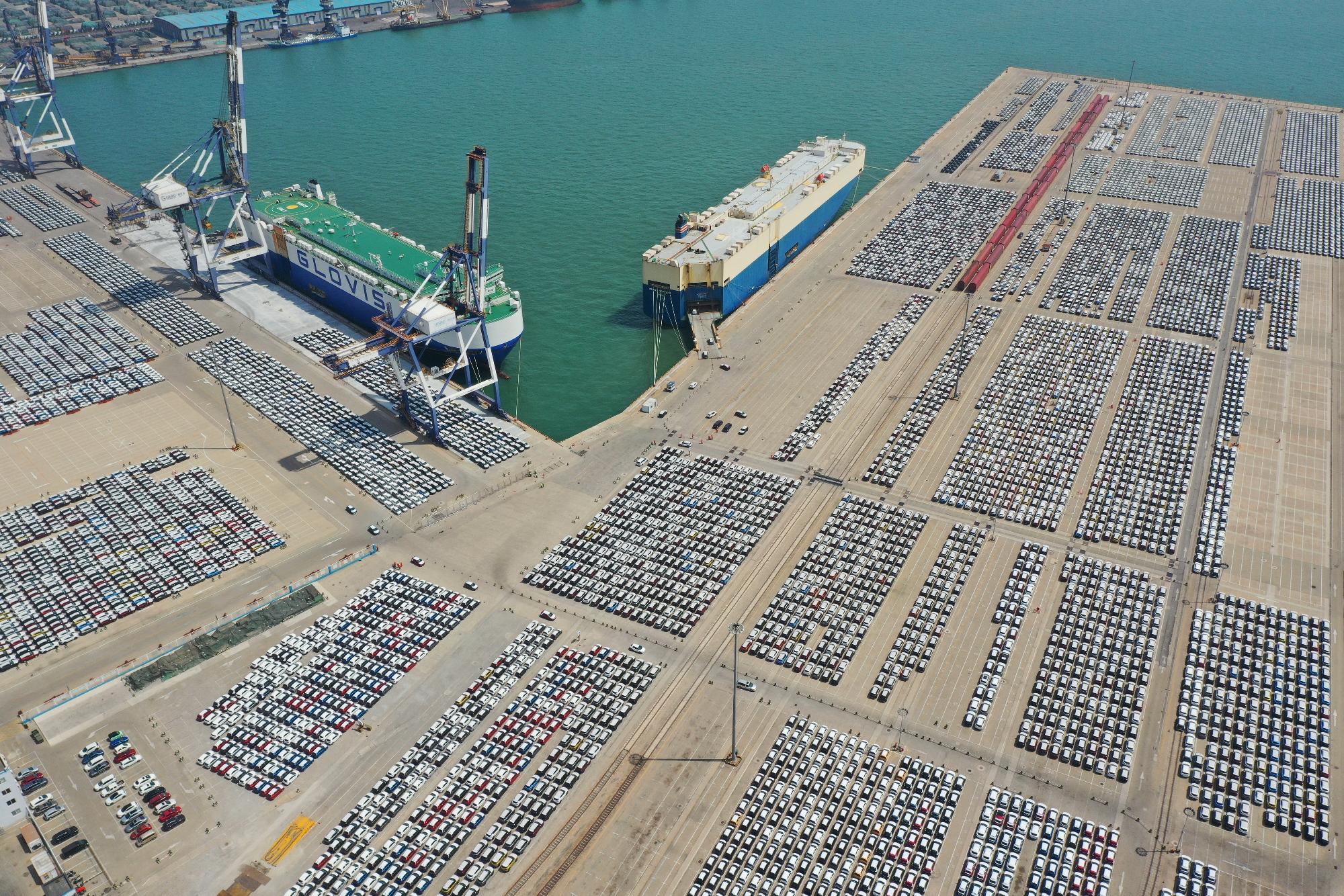
Imports, exports data beat forecasts in boost to economy Global economy rebound buoyed by electronics demand Exporters scope to cut prices increasingly limited, analysts say Exports to US returned to growth, but EU market still weak BEIJING, March 7 (Reuters) - China's export and import growth in the January-February period beat forecasts, suggesting global trade is turning a corner in an encouraging signal for policymakers as they try to shore up a stuttering economic recovery. China's improved export data joins those of South Korea and Germany, and Taiwan, who all saw their shipments top expectations over the first two months of the year, with the Asian economies benefiting from a surge in demand for semiconductors. Exports from the world's second-biggest economy in the two months were 7.1% higher than a year before, customs data showed on Thursday, beating a Reuters a poll that expected an increase of 1.9%. Imports were up 3.5%, compared with a poll forecast for growth of 1.5%. "The better-than-forecast data echoes a recovery in global trade driven by the electronics sector, but also benefits from a low base effect, as export growth in January-February 2023 was -6.8%," said Xu Tianchen, senior economist at the Economist Intelligence Unit. The customs agency publishes combined January and February trade data to smooth out distortions caused by the shifting timing of the Lunar New Year, which this year fell in February. Chinese Premier Li Qiang on Tuesday announced a 2024 economic growth target similar to last year of around 5% and promised to transform the country's development model, which is heavily reliant on exporting finished goods and industrial overcapacity. Policymakers have been grappling with sub-par growth over the past year amid a property crisis and as consumers hold off spending, foreign firms divest, manufacturers struggle for buyers, and local governments contend with huge debt burdens. They will need to see a sustained rebound in exports to be convinced that the crucial growth engine will help bolster the economy. In contrast to the trade data, for instance, manufacturing activity in China in February shrank for a fifth month, according to the government's purchasing managers' index released a week ago, while new export orders decreased for an 11th consecutive month. "After accounting for changes in export prices and for seasonality, we estimate that export volumes rose significantly in January and February, hitting a fresh high," said Huang Zichun, China economist at Capital Economics, in a note. "We doubt the sustainability of this strength, however, since exporters now have more limited scope to reduce prices to secure market share," she added. Some economists, including Huang, point out that at least some of the recent export gains could be attributed to Chinese manufacturers slashing prices to secure orders. STRUCTURAL REFORMS Market reaction to the trade data was largely muted. China's blue chip CSI300 stock index fell 0.32%, while Hong Kong's Hang Seng Index dropped 0.47%. China's trade surplus grew to $125.16 billion, compared with a forecast of $103.7 billion in the poll and $75.3 billion in December. Separate commodities data, also released on the day, showed the Asian giant's imports of crude oil rose 5.1% in the first two months of 2024 year-on-year, as refiners ramped up purchases to meet fuel sales during the Lunar New Year holiday, and copper imports increased by 2.6%. Some cause for optimism can be found in the fact China's overall exports to the United States in January-February returned to growth, rising 5% from a year earlier compared with a decline of 6.9% in December. But outbound shipments to EU still shrank 1.3% in the same period. Global monetary easing expectations may also offer some relief for China's hopes of cranking up exports although economic conditions in many key developed nations look gloomy over the near term. Both Japan and Britain slipped into a recession in the second half of last year, while the euro zone economy has also stalled. Policymakers have pledged to roll out further measures to help shore up growth after the steps implemented since June had only a modest effect, but analysts caution Beijing's fiscal capacity is now very limited and note Li's address to the annual meeting of the National People's Congress failed to inspire investor confidence. Many economists say there is a risk that China may begin flirting with Japan-style stagnation later this decade unless authorities take steps to reorient the economy towards household consumption and market-allocation of resources. "Strong exports help to offset part of the weakness from the property sector," said Zhiwei Zhang, chief economist at Pinpoint Asset Management. "It will likely strengthen policy makers confidence in China’s economy and support their structural policy objectives such as deleveraging the local government financing vehicles." https://www.reuters.com/markets/asia/chinas-jan-feb-trade-beats-forecasts-signals-global-trade-rebound-2024-03-07/
2024-03-07 05:32
A look at the day ahead in European and global markets from Vidya Ranganathan Federal Reserve Chair Jerome Powell was unambiguous overnight, but the European Central Bank meets today and is more divided and hesitant about committing to monetary easing. The ECB is universally expected to keep its policy rate at a record 4.0%, and policymakers are likely to repeat that they need more evidence inflation is under control and that ongoing wage increases will not give it another leg up. ECB President Christine Lagarde's message will be key, for new economic projections are likely to point to lower economic growth and inflation this year, which may require the central bank to tweak its message slightly. Investors have pencilled in three or probably four rate cuts by the end of the year . Interest rate futures are almost fully priced in for a first rate cut from the ECB in June, with a total easing of 88 basis points expected for all of this year. That's more realistic than the 150 bps markets were expecting in January. German data on factory orders and production is due later, and should reinforce the weakness in the euro zone's largest economy and the reason the ECB is so divided. Meanwhile, Asia is extending the broad rally in global stocks and risk assets after Powell kept the door open to interest rate cuts later this year and U.S. bond yields drifted lower , opens new tab Powell stuck to script by saying the Fed still expects to cut rates later this year, even though continued progress on inflation "is not assured". Japan's Nikkei (.N225) , opens new tab, however, is down as the yen jumps to near 149 per dollar, its highest in a month, as momentum builds that a move from the Bank of Japan to end negative interest rates could come as soon as this month. Key developments that could influence markets on Thursday: CENTRAL BANKS-ECB rate decision at 1315 GMT, Lagarde press conference at 1345 GMT DATA - German industrial orders, UK Halifax house prices DEBT AUCTIONS - France: Reopening of 10-year 2033, 10-year 2034, 14-year and 21-year government debt auctions EARNINGS - Admiral Group, Continental AG, Deutsche Lufthansa AG, Hugo Boss AG, ITV PLC, Merck KGaA https://www.reuters.com/markets/europe/global-markets-view-europe-2024-03-07/

2024-03-07 05:13
'Not far' from confidence on inflation- Powell Eyes on U.S. jobs data on Friday Gold's surge could hit Indian wedding season demand Palladium takes a breather after Wednesday's bounce March 7 (Reuters) - Gold raced to an all-time high on Thursday, extending its record run this week as increasing bets for U.S. monetary easing added to sustained tailwinds for bullion from central bank buying and safe-haven demand. Spot gold was up 0.4% at $2,156.93 per ounce as of 02:00 p.m. ET (1900 GMT), hitting record high of $2,164.09 during the Asian trading hours. U.S. gold futures settled 0.2% higher at $2,165.2. Powell said the Fed is "not far" from getting enough confidence that inflation is heading to the Fed's 2% goal to be able to start interest-rate cuts. Traders are now pricing in a 74% chance of a June rate cut, versus around 63% on Feb. 29, the CME's Fedwatch Tool showed. A low-interest rate environment translates into reduced opportunity cost of holding non-yielding gold and weighs on the dollar, making bullion cheaper for overseas buyers. Rate cut bets are driving gold prices and everyone is expecting they will come, said World Gold Council market strategist Joseph Cavatoni. Central banks' gold purchases also continue to be very strong, Cavatoni added. Further market direction could come from Friday's U.S. non-farm payrolls report. In physical markets, the price surge was expected to dampen consumption during the Indian wedding season, but top buyer China could see robust safe-haven demand. Geopolitical risks are also the major driver for bullion, said James Steel, precious metals analyst at HSBC. "We only have a narrow group of assets that investors can really call safe haven, and gold is number one amongst them." Bullion has climbed over $300 since the start of the Israel-Hamas war. However, the latest rally in gold has come alongside a rally in riskier assets. Silver added 0.6% to $24.31, while platinum climbed 1.3% to $919.00 per ounce. Palladium slipped 0.5% to $1,037.00 after surging as much as 12% on Wednesday. https://www.reuters.com/markets/commodities/gold-extends-rally-hit-new-record-powell-hints-rate-cut-2024-2024-03-07/