2024-03-04 07:05
EU has discussed for months possible ban of Russian aluminium Expected to propose another package of import bans - source Loss of Russian aluminium would leave Europe with shortfall Aluminium prices spiked in wake of US sanctions on Rusal in 2018 Middle East accounted for about 9% of global supply in 2023- IAI LONDON, March 4 (Reuters) - European and U.S. buyers will compete aggressively for Middle Eastern aluminium if the European Union bans Russian metal in coming months, sparking price rises reminiscent of 2018 when sanctions were imposed on Rusal. A race for aluminium from Middle Eastern countries, including the United Arab Emirates and Bahrain, will fuel inflation for Western companies in the transport, packaging and construction industries - already facing high raw material and payroll costs. Aluminium is a key ingredient for electric vehicles. Significantly lighter than steel, it is now the metal of choice in a wide range of parts for electric vehicles. The EU has for months discussed sanctions that would ban Russian aluminium. No new sanctions on aluminium were included in its latest package to mark the second anniversary of Russia's invasion of Ukraine, but the bloc is expected to soon propose another package with new import bans, sources said. Middle Eastern producers were responsible for 6.2 million metric tons or nearly 9% of global supplies last year, according to the International Aluminium Institute. Roughly two million of that was shipped to Europe and the United States. The loss of Russian metal would leave Europe with a shortfall of around 500,000 tons, some of which could be offset with the restart of idled capacity in the region. But not all. "Middle Eastern suppliers will not be able to fully substitute Europe's shortfall quickly," said Dmitri Ceres at U.S.-based aluminium trader PerenniAL. Buyers of aluminium in the physical market pay the London Metal Exchange (LME) price plus a premium to cover transport and handling costs and taxes. "European premiums will have to rise to attract metal away from other regions including the United States. Premiums in the U.S. will also have to rise to keep the metal coming," Ceres said. U.S. sanctions on Russian producer Rusal in April 2018 triggered a crisis that saw aluminium on the London Metal Exchange (LME) jump 35% in a few days to seven-year highs. European duty-paid premiums shot up 45% in the following month, while U.S. premiums increased 20% over the same period. EYES ON LME RESPONSE Price rises in the event of a new ban are unlikely to extend as far as those in 2018 due to surpluses in Asia, with Russian supply also likely to be diverted to China, already a major recipient of Russian aluminium after Russia invaded Ukraine. However, the strength of the reaction will depend on whether the LME as a result of EU sanctions decides to ban Russian origin aluminium, which comprises 90% of inventories in LME registered warehouses . "If Rusal's tonnages were no longer accepted in transactions on the LME, given the lack of non-Russian metal in warehouses, physical premiums and LME prices would in all likelihood spike up violently," said Bank of America analyst Michael Widmer. Self-sanctioning and 200% tariffs on U.S. imports have meant many U.S. companies have diversified away from Russia to other countries, including the Middle East. U.S. imports of Russian aluminium dropped to 16,902 tons last year or 0.4% of the total, from 4% in 2022 and nearly 9% in 2018, figures from Trade Data Monitor (TDM) showed. However, even though EU imports of Russian aluminium have dropped, they are still significant. According to TDM, EU imports of Russian aluminium totalled 512,122 tons in 2023 or 8% of the total from 12% in 2022 and 19% in 2018. "EU sanctions on Russian aluminium will mean higher premiums in Europe. U.S. premiums will then have to go up as well to stay competitive," said BNP Paribas analyst David Wilson. "European premiums are already higher, shipping costs of getting the metal from the Middle East and other Asian countries have risen because of the attacks in the Red Sea." Freight costs have climbed due to Houthi militant attacks on vessels in the Red Sea, targeting a route that allows East-West trade to use the Suez Canal. EU imports of aluminium from the Middle East were nearly 1.2 million tons or 18.8% of the total last year, while the U.S. imported more than 800,000 tons or 19.3%. https://www.reuters.com/markets/commodities/europe-battle-with-us-aluminium-if-eu-opts-russian-ban-2024-03-04/

2024-03-04 07:02
BERLIN, March 4 (Reuters) - Germany's economy would contract by at least 1.2% by 2028 should former U.S. President Donald Trump regain office and hike import tariffs as much as he has proposed, the German Economic Institute (IW) argued in a paper on Monday. The IW, which is financed by prominent German business associations and carries weight among Berlin policymakers, published the paper a day ahead of "Super Tuesday", the day in the U.S. presidential primary cycle when the most states vote. The front-runner for the Republican presidential nomination has proposed slapping a 10% tariff on all imports and hiking those on Chinese imports by 40 percentage points to 60% were he to defeat President Joe Biden in the Nov. 5 U.S. election. This tariff shock would temporarily shave 1-1.4% off U.S. economic output in the early years mainly due to higher consumer prices and unemployment weighing on consumption and a confidence shock that would affect investment in the short term, according to the IW study. But improvements in the trade and fiscal balance would allow U.S. gross domestic product to recover to be only slightly negative by 2028. The impact on Europe and particularly on export-oriented countries like Germany would be much more severe, according to the IW study, even as they already struggle with high energy prices and a lack of skilled labour. German GDP would drop by 1.2% by 2028, hit by the fall in exports and a subsequent drop in private investment, the study showed. If China were to retaliate with its own 40 percentage point hike in import duties, it could drop as far as 1.4%. "The EU should prepare for such a scenario now," the IW warned. "The EU should use the remaining term of President Biden to put the trade relations with the US on a more solid footing." This would entail institutionalising the EU-U.S. Trade and Technology Council, signing a critical minerals agreement as well as concluding a deal on the trade of green steel and aluminum, it said. The EU should also sign more free trade agreements with partners such as Australia, the Mercosur, Indonesia, or India. "Second, if Trump was elected and would threaten to implement new trade barriers against the EU, the EU should be able to react," the IW said. "To counter such a threat, the EU should also threaten credible retaliation." https://www.reuters.com/markets/europe/trump-tariffs-would-shave-least-12-off-german-gdp-by-2028-iw-study-shows-2024-03-04/

2024-03-04 06:52
Focus on Powell's testimony on Wednesday London's gold price benchmark hits all-time high U.S. February unemployment rate due on Friday March 4 (Reuters) - Gold prices hit a three-month peak on Monday, driven by increased bets for a June interest rate cut by the U.S. Federal Reserve. Spot gold was up 1.4% at $2,113.28 per ounce as of 02:10 p.m ET (1910 GMT), its highest since Dec. 4, when prices hit an all-time high of $2,135.40. U.S. gold futures settled about 1.5% higher at $2,126.3. Gold surged about $50 over the course of last week, driven by tepid U.S. manufacturing and construction spending, and weaker price pressures. Gold could easily push above the record highs, said Phillip Streible, chief market strategist at Blue Line Futures in Chicago. "(Fed Chair Jerome) Powell speaks two times this week and he could come out and be a bit more dovish ... we could see a miss on the (U.S.) jobs data on Friday," all factors that will help gold, Streible added. Markets are pricing in a 66% chance of a Fed rate cut in June, according to the CME Fed Watch Tool. "If inflation numbers remain tame, gold's going to continue to trend higher," said Jim Wyckoff, senior analyst at Kitco Metals. Gold suffers when high U.S. interest rates to tame inflation raise returns on competing assets such as bonds and boost the dollar, making the metal costlier to buy with foreign currencies. , "Heightened geopolitical tensions around the world have reduced the short-selling appetite, basically all strengthening gold's current buy-on-dips credentials," wrote Ole Hansen, Saxo Bank's head of commodity strategy. London's gold price benchmark hit an all-time high of $2,098.05 per troy ounce at an afternoon auction on Monday, surpassing the previous record of $2,078.40 set on Dec. 28, the London Bullion Market Association said. Platinum rose 1.1% to $897.10 per ounce and palladium gained 0.5% to $960.50. Spot silver climbed 2.8% at $23.79. https://www.reuters.com/markets/commodities/gold-near-two-month-peak-anticipation-builds-june-us-rate-cut-2024-03-04/

2024-03-04 06:19
LONDON, March 4 - The European Central Bank meets on Thursday, with markets eyeing any nudge towards an interest rate cut as inflation weakens. The ECB, expected to hold rates at a record 4%, is navigating a tricky path between keeping rates high long enough to contain inflation while not cutting too late as price pressures ease quickly. "ECB speakers, even if they are of different views on timing, have acknowledged that rate cuts are coming," said Morgan Stanley chief European economist Jens Eisenschmidt. "The March meeting will be the opportunity to change the language in the statement to signal this." 1/ Could the ECB change its communication? The ECB has pushed back against rate cut talk and markets now expect 90 basis points (bps) of cuts this year, versus 150 bps at the start of 2024. Still, easing is on the cards and traders want guidance on the timing of a first move. Slovakia's central bank head, Peter Kazimir, says the ECB will acknowledge an improved inflation outlook on Thursday but must avoid any rate cut commitment yet. "Market pricing (of rate cuts) has moved towards a more sensible direction, decreasing the need for pushback," said Berenberg European economist Salomon Fiedler, adding ECB chief Christine Lagarde will likely reiterate data dependency. 2/ Is there a risk the ECB cuts rates too late? For sure. Delaying rate cuts raises the chance of moving more aggressively later if inflation falls faster than anticipated. Bank of France head Francois Villeroy de Galhau says "acting gradually and pragmatically may be preferable to deciding too late and then having to over-adjust." There's also a case for not rushing. Lagarde has stressed the ECB has to avoid cutting rates too early as that could prolong high inflation. Even Greece's Yannis Stournaras reckons the "optimal timing" might be the end of the first half. "If that's the messaging coming from a Greek central banker, that's probably quite a good indicator that June is going to be when we see action, as opposed to sooner," said Gareth Hill, portfolio manager at Royal London Asset Management. 3/ What's the big deal with wages? Well, the ECB has singled out wages as the single most important factor determining whether it can cut rates. Negotiated wage growth slowed to 4.46% in the fourth quarter from 4.69% in the previous quarter, the highest on record going back to 2005. The more forward-looking Indeed wage tracker peaked in late 2022 but was still at 3.9% in January, above the 3% the ECB says is consistent with the 2% inflation target. First quarter wage data, crucial to the ECB, will only come out in May, so June will be the first occasion policymakers may see enough evidence of slowing wage growth. 4/ What will the ECB's latest forecasts show? Economists expect downward revisions to 2024 growth and inflation forecasts. Euro area growth has hovered around zero for sixth straight quarters and the European Commission just cut its GDP growth forecast for this year to 0.8% from 1.2%. Data on Friday showed inflation in the bloc eased to 2.6% in February from 2.8% a month earlier. "The ECB's forecast for headline inflation should come down as energy prices are around 20% weaker than at the time of the December macro projections," noted Nomura senior European economist Andrzej Szczepaniak. 5/ Does it matter if the ECB cuts before the Fed? Not really. The euro zone economy is weaker than the United States, meaning there's a stronger case for monetary easing. But history suggests that the ECB moves after the Federal Reserve, so who moves first is topical, especially since an early ECB rate cut could pressure the euro. Traders see a high chance that both the ECB and Fed will start cutting rates in June, according to LSEG data, with a slightly higher probability for the ECB. "I don't think there's any sound economic argument to say that the ECB cannot go until the Fed goes," said Barclays head of euro rates strategy Rohan Khanna. https://www.reuters.com/markets/europe/timing-is-everything-five-questions-ecb-2024-03-04/

2024-03-04 05:58
NEW YORK, March 4 (Reuters) - The dollar slipped against the euro on Monday, ahead of this week's news on Britain's budget, a European Central Bank meeting, U.S. jobs data and important political moments in China and the U.S. Investors also eyed Bitcoin , which rose to a more than two-year peak above $65,000 after a quiet weekend, pushed higher in recent weeks by big flows into cryptocurrency exchange-traded funds, most notably in the United States. Bitcoin was last up 6.39% at $66,603. The euro rose 0.15 % to $ 1.08565 , while the dollar index , which measures the currency against six major peers, was down 0.03 % at $ 103.83 . The Japanese yen fluctuated around the closely watched 150-per-dollar level. The dollar was last up 0.28 % at 150.555 yen. Most major currency pairs stuck close to recent trading ranges, as traders shied away from big directional bets ahead of this week's host of potentially market-moving events. "FX markets are - once again - operating with an abundance of caution ahead of lots of new info this week," said Helen Given, FX trader at Monex USA in Washington. "No one wants to get stung on any surprise, so I'd be surprised if flows don't remain muted in the front half of this week," she said. In the United States, Federal Reserve Chair Jerome Powell will testify before lawmakers on Wednesday and Thursday. U.S payrolls data are due on Friday, with forecasts pointing to a still-solid rise of 200,000 jobs after January's barnstorming 353,000 jump. "Payrolls could be the bigger mover as Powell is likely comfortable with current market pricing for Fed cuts, while if we get another strong payrolls after the last blowout report that could affect market expectations (for Fed policy)," said Lee Hardman, senior currency analyst at MUFG. At the start of 2024, markets were pricing in substantial interest rate cuts early this year, but traders have since reduced such bets. Pricing in derivatives markets now reflects expectations the first Fed cut will come in June, with three to four 25 basis point cuts this year, not far from the Fed's projections published in December. The Fed is under no urgent pressure to cut rates given a "prospering" economy and job market, Atlanta Fed President Raphael Bostic said on Monday. Still, some market participants think the dollar's recent gains means further gains may be limited. The dollar index is up 2.4% for the year. "The dollar is in fact running out of room to run up further against most G10 currencies," Monex's Given said. "A lot of the negative economic news out of Europe and the UK has already been priced in by markets, and the story is the same for positive news out of the US," she said. This week also sees Super Tuesday, the biggest day on the calendar of U.S. presidential primaries. Sterling was up 0.32% against the dollar at $1.2693 ahead of the British budget, due on Wednesday. Finance Minister Jeremy Hunt has been trying to dampen speculation about big pre-election tax cuts. Elsewhere, the European Central Bank (ECB) meets on Thursday. Most ECB policymakers have been cautious about suggesting that they will be cutting interest rates soon. On Monday, the Swiss franc jumped briefly after Swiss February inflation came in a fraction higher than expected at 1.2% compared with the previous year, though still below January's level and well within the Swiss National Bank's 0-2% target range. The currency, however, soon gave up those gains and versus the franc, the dollar was up 0.22 % at 0.88495 francs. The Australian dollar was down 0.2 % with traders awaiting local gross domestic product data Wednesday. Given Australia's close economic links with China, the currency will also be shaped by China's annual parliament meeting, which begins on Tuesday and at which authorities will announce the GDP goal and are expected to unveil moderate economic stimulus plans. https://www.reuters.com/markets/currencies/dollar-eases-fed-clues-awaited-bitcoin-hits-2-year-high-2024-03-04/

2024-03-04 05:33
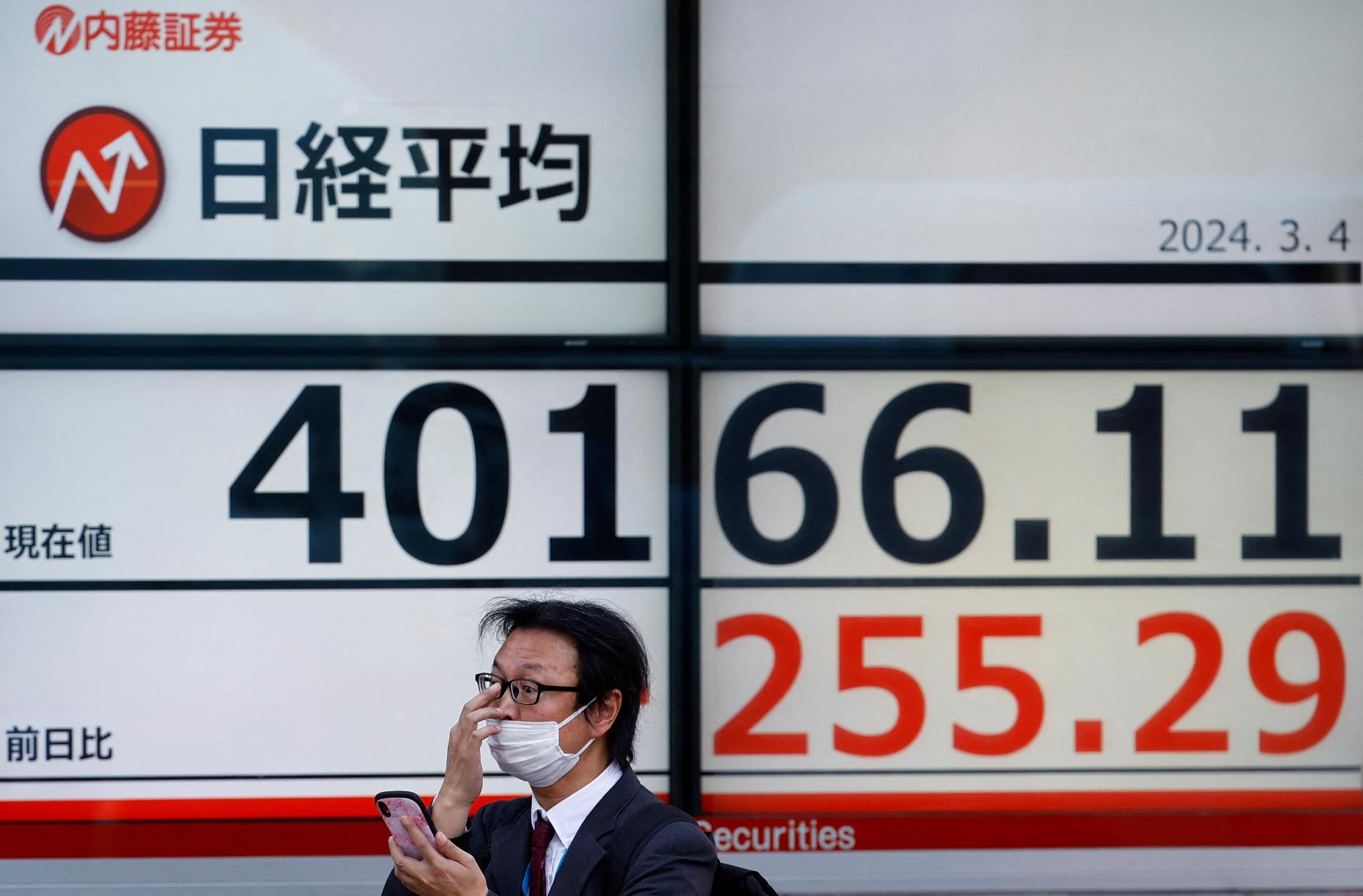
A look at the day ahead in European and global markets from Wayne Cole. It's been a largely risk-on start to a week packed with central bank events and major data that will refine market wagers for when developed world interest rates will finally start falling. Japan's Nikkei (.N225) , opens new tab cleared 40,000 for the first time having now climbed for five weeks in a row as it benefits from tech nearshoring and a flight of foreign funds out of Chinese markets. The current poster child for the market is Tokyo Electron (8035.T) , opens new tab which has surged 55% since the start of the year, carried along by the AI craze. The firm makes equipment for manufacturing semiconductors and flat panel displays, showing how you only have to be tangentially associated with AI to reap the benefits. Investors will face a test on Tuesday when Tokyo area consumer prices are forecast to rise back to an annual 2.5% in February, after base effects delivered a drop to 1.6% in January. The so-called core-core measure excluding food and energy is still seen slowing to 3.1%, from 3.3%. Yet all the market chatter is about how the current wage round is going strongly and will likely lead the Bank of Japan to end negative rates in April, and unwind yield curve control. Japan's government is considering declaring an end to deflation, reports Kyodo news agency, which would be another marker on the road to tightening. An upbeat report on Q4 capex out Monday indicated GDP could be revised to positive from negative, meaning Japan isn't in recession after all. You've got to love the vagaries of economic data. Also kicking off this week is China's National People's Congress (NPC) which might well flag new stimulus measures and set this year's GDP goal at 5%. All eyes will be on U.S. Federal Reserve Chair Jerome Powell when he testifies before lawmakers on Wednesday and Thursday, though analysts assume he will stay in wait-and-see mode on policy given recent upside surprises on inflation. The February payrolls report on Friday could also shift the calculus with forecasts favouring a still-solid rise of 200,000 after January's barnstorming 353,000 jump. The European Central Bank meets Thursday and is considered certain to keep rates at 4.0%, but also lower its outlook for inflation in a nod to eventual cuts. The Bank of Canada is likewise expected to stay on hold this week, with a first cut seen in June or later. Other events of note include President Joe Biden's State of the Union address and the Super Tuesday U.S. primaries. The British government will release its budget on Wednesday but scope seems limited for pre-election giveaways. Over this past weekend, OPEC+ members led by Saudi Arabia and Russia agreed to extend voluntary oil output cuts of 2.2 million barrels per day into the second quarter. That has given oil prices a further modest lift, after U.S. crude added 4.5% last week. Key developments that could influence markets on Monday: - Euro Zone Sentix Index for March - Federal Reserve Bank of Philadelphia President Patrick Harker speaks - American Airlines is scheduled to hold its first investor conference since the pandemic https://www.reuters.com/markets/europe/global-markets-view-europe-2024-03-04/