2024-02-23 11:18
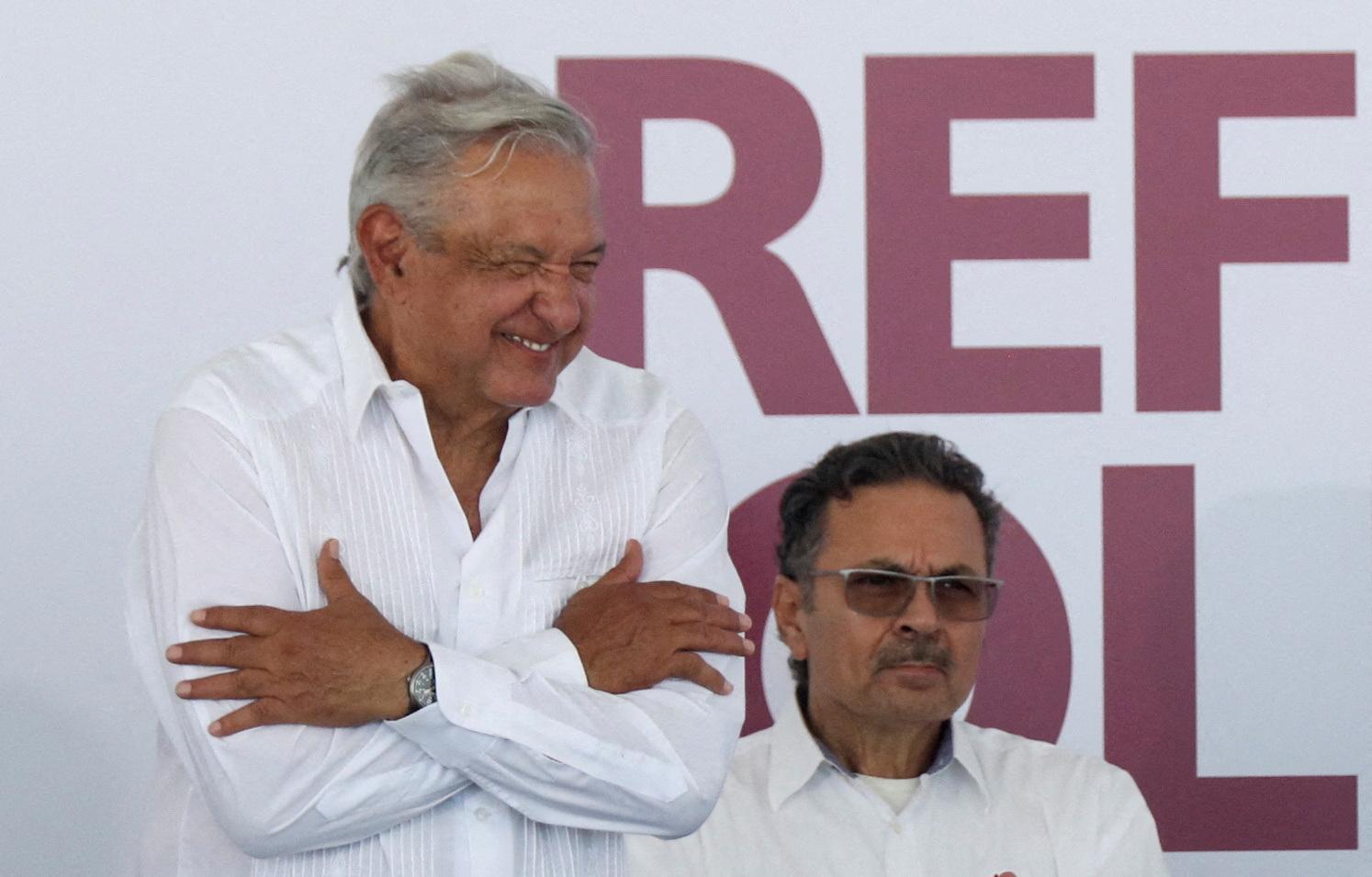
MEXICO CITY, Feb 23 (Reuters) - Mexico's outgoing president has taken steps to promote a smooth hand-off for national oil company Pemex, three sources told Reuters, but the latest moves will likely postpone a day of reckoning for the world's most heavily-indebted oil company. Last week, President Andres Manuel Lopez Obrador rolled out fresh support for Pemex, part of his longstanding goal to make Mexico self-sufficient in the production of motor fuels, unveiling a new tax break worth about $6.4 billion. The boost follows a whopping $90 billion in government support doled out to Pemex since Lopez Obrador took office in late 2018, spanning tax cuts and capital injections, most of it to service a crushing debt load of some $106 billion. The company's distressed finances may fall to former Mexico City Mayor Claudia Sheinbaum, Lopez Obrador's anointed successor and current front-runner in polls ahead of June's election. Mexico's next president takes office in October. A Sheinbaum presidency would look to cut Pemex's dependence on government funds, one source close to her team told Reuters, using tax cuts to free up company spending elsewhere. Sheinbaum has also committed to pursing Lopez Obrador's oft-repeated but vague goal of "energy sovereignty." A source close to Pemex, meanwhile, said the latest round of support will be used to cover $17.2 billion in debts to service providers, such as Halliburton (HAL.N) , opens new tab and Baker Hughes (BKR.O) , opens new tab. "All this is part of a strategy of orderly transition aimed at a soft landing for the next administration," said a high-ranking Pemex source, who spoke on condition of anonymity. Priorities that already enjoy Lopez Obrador's "seal of approval," however, could constrain his successor, the source added. The popular president declared victory on his Pemex policy earlier this week. "I believe that we've already rescued Pemex," said Lopez Obrador, touting a reduction in its financial debt compared to six years ago. Those liabilities fell nearly 7%, from 1.99 trillion pesos in 2018 to 1.86 trillion, as of last September. 'FISCAL FAILURE' According to calculations from the Mexican Institute for Competitiveness (IMCO) based on Pemex data, the company has to make $53 billion in regular debt payments between October and September 2027. Debt payments this year alone reach almost $11 billion. Pemex also faces debt maturities of some $35 billion, mostly tied to its bonds, between 2025 and 2030. "Despite everything given to it, 2024 and 2025 debt pressures are very strong," said IMCO economist Jesus Carrillo. "Pemex has been (Lopez Obrador's) fiscal failure... a rescue that never came," he added. Neither Pemex, the president's office nor the finance ministry responded to requests for comment for this story. Some sources acknowledged that measures of success have been scaled back but said that some progress has been made. "The idea is to leave Pemex better than we found it," said one company source, admitting that "many problems have not been solved." The source close to Sheinbaum's team pointed to the gradual slashing of the company's profit-sharing DUC tax, one of the most important for state coffers, from a 65% to 30%. The source added that the tax cuts seek to ensure that Pemex can keep more of its own revenue, and stop being a "burden" on state finances. Still, the oil company's crude output - overwhelmingly its main source of income - has continued to slide during Lopez Obrador's term, from 1.8 million barrels per day (bpd) to 1.6 million bpd, despite his pledge to grow it. And while that decline has been partially offset by booming condensate output, the president's top priority of refining more oil at home has fallen short of his initial goal. Domestic refining is up to about 791,000 bpd, but still far from his goal of processing at least 1 million bpd. "There is awareness within Pemex that the goals won't be met this year," said one company source. "But in an election year, promises abound." https://www.reuters.com/business/energy/fallout-mexican-presidents-pemex-rescue-set-greet-successor-2024-02-23/
2024-02-23 11:17
KYIV/WARSAW, Feb 23 (Reuters) - A Ukrainian government delegation visited the border with EU member Poland on Friday amid protests and blockades of cargoes from Ukrainian producers by Polish farmers, but the prime minister said they were not met by any officials from Warsaw. Farmers have stepped up their protests this week by temporarily blocking almost all traffic with Ukraine. President Volodymyr Zelenskiy had asked Polish Prime Minister Donald Tusk, President Andrzej Duda and EU officials to come to the border to discuss the matter. "The Ukrainian government is here (on the border) today," Prime Minister Denys Shmyhal said on Telegram. "But, unfortunately...a meeting with Polish officials did not take place." The Polish prime minister's office referred to Tusk's comments on Thursday when he said the two governments would meet in Warsaw on March 28. Shmyhal said the issue should be resolved "much earlier". "Otherwise, Ukraine reserves the right to apply mirror measures at checkpoints," he added. Farmers across Europe have been demonstrating against constraints placed on them by EU measures to tackle climate change, as well as rising costs and what they say is unfair competition, particularly from Ukraine after the EU in 2022 waived duties on Ukrainian food imports to help it following the Russian invasion. ACTION PLAN Shmyhal said Kyiv has developed a five-step plan "of mutual understanding" aimed at finding a compromise. "The blockade hits the entire Polish-Ukrainian trade and the economy of our countries. Not only Ukraine is losing from it, but Polish entrepreneurs who export goods worth $12 billion annually to our market are losing from it." The plan envisages Ukraine's agreement to European Commission proposals to restrict exports of poultry, eggs and sugar, as well as appeals to the EU to ban Russian agrarian exports. Kyiv is also ready to apply a verification mechanism to grain, corn, sunflower and rapeseed exports. A round-the-clock trilateral body should be established to find a fast resolution, Shmyhal said. Polish farmers have broad public support for their protests, leaving Tusk facing a difficult balancing act between addressing their concerns and maintaining the government's support for Ukraine as the war with Russia enters its third year. "I know that the protesting farmers are not anti-Ukrainian, there may be one or two incidents but we will deal with that," Tusk said on Friday. Polish police said they were investigating the latest of several incidents in which a load of rapeseed was spilled from three train trucks carrying cargo from Ukraine. Ukrainian Deputy Prime Minister Oleksandr Kubrakov said those responsible for the incident must be held accountable, adding that the cargo had been heading to Germany. In a bid to bring the reality of war home to the Polish protesters, the Ukrainian Agrarian Council said its members had brought farm machinery destroyed by Russia to the border. https://www.reuters.com/world/europe/ukrainian-rapeseed-spilled-train-polish-border-2024-02-23/

2024-02-23 11:04
Dollar heads for first weekly fall in nearly 2 months Fed's Waller sees 'no rush' to cut interest rates Silver and platinum set for weekly losses Feb 23 (Reuters) - Gold prices were set for a weekly gain on Friday, buoyed by a softer dollar and safe-haven demand from escalating tensions in the Middle East, even as U.S. Federal Reserve officials bruised hopes of early rate cuts this year. Spot gold was up 0.8% to $2,040.69 per ounce as of 01:51 p.m. ET (1851 GMT), and was on track for a 1.4% weekly rise. U.S. gold futures settled 0.9% higher at $2,049.4. The dollar index (.DXY) , opens new tab edged down 0.1% and was heading for its first weekly dip in almost two months as investors took a breather from a recent rally built on expectations the Fed would delay rate cuts. U.S. Treasury yields also were down for the week, making greenback-priced bullion less expensive to overseas buyers. "Gold is up primarily on the fact that the U.S. dollar is a little weaker," said Bob Haberkorn, senior market strategist at RJO Futures. "It's a delicate walk right now in the precious metals market, but there is a lot of safe-haven buying despite the rates being as high as they are." Fed Governor Christopher Waller said on Thursday that he was in "no rush" to cut rates, firming investor bets against U.S. interest rate cuts before June. Most policymakers at the Fed's last meeting were concerned about the risks of cutting interest rates too soon, minutes showed. Recent data showing higher-than-expected U.S. consumer and producer prices also dashed speculation about an early interest rate cut, further weighing on bullion. Lower interest rates boost the appeal of holding non-yielding bullion. "More hawkish comments from Fed officials overnight have been a modest drag for the yellow metal," said UBS analyst Giovanni Staunovo. Meanwhile, a surge of interest in bitcoin exchange-traded funds (ETFs) is prompting investors to swap out holdings in gold-backed ETFs. Spot platinum lost 0.1% to $901.21, palladium rose 1.9% to $986.56. Silver was up 1% to $22.98, but was down 1.8% so far in the week. https://www.reuters.com/markets/commodities/gold-set-weekly-gain-weak-dollar-middle-east-woes-lift-appeal-2024-02-23/

2024-02-23 11:03
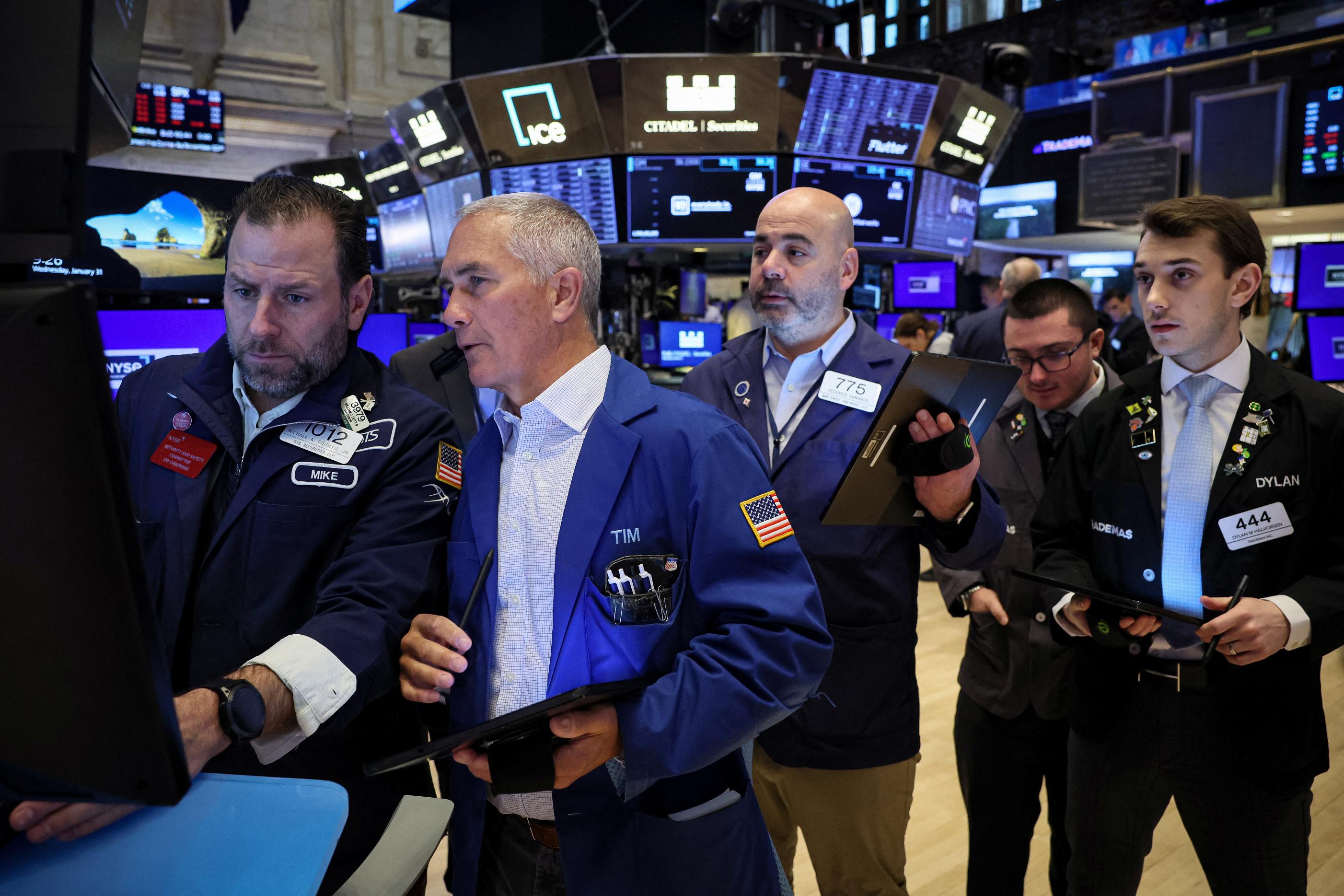
A look at the day ahead in U.S. and global markets from Mike Dolan Global stocks captured by MSCI's all-country index (.MIWD0000PUS) , opens new tab surpassed 2022's peaks on Friday and soared to new records - leaving bonds unloved. As the dust settles on another Nvidia-led (NVDA.O) , opens new tab AI feeding frenzy on Wall Street, interest rate markets have sulked back to mid-December settings - dragged there by the ebullience of the wider economy and a stubborn Federal Reserve. With U.S. labor markets still in fine fettle, corporate profit growth in double digits and surging stocks loosening financial conditions again, rate futures now finally agree with what the Fed told them in December - only 75 basis points of rate cuts are likely this year and not starting until second half of 2024. Kicking and screaming, bond markets have dialled back the clock to December too - with 2-year Treasury yields hitting their highest since December 11, just before the Fed meeting that month, and 10-year yields hitting the highest since November. The dollar (.DXY) , opens new tab was firmer. The contrast with the stock market couldn't be starker, and it sees a breakdown in a long-running correlation of both asset classes - a return to normal patterns in some respects. Sparked by Nvidia's latest blowout earnings report, its 15% stock surge and general excitement about a "tipping point" in generative artificial intelligence, Thursday was the best day in more than a year for Wall St's main stock indexes. That catapulted the S&P500 (.SPX) , opens new tab, Dow Jones (.DJIA) , opens new tab back to record closing highs and the Nasdaq (.IXIC) , opens new tab came within 1% of a new all-time peak too. With annual profit growth of S&P500 companies through the fourth quarter now running at more than 10%, the main indexes are now up 6-7% for 2024 so far - and we're still in February. World stocks have followed suit, with Japan's Nikkei (.N225) , opens new tab finally vaulting 1989 peaks on Thursday before taking Friday off for a holiday. More subdued Chinese stock indexes (.CSI300) , opens new tab eked out only another marginal gain - but they have now closed higher for nine sessions straight, lifted by some hopes the authorities were finally getting a grip on the property sector bust and spluttering economy. The scale of the problem was clear in data showing China's new home prices continuing their downward trend with a drop of 0.3% in January, even though the pace of that decline slowed from the prior month and the biggest cities saw some stabilisation. Expecting further monetary stimulus ahead, ten-year Chinese government bond yields fell to 2.39% - the lowest since June 2002 - and the yuan weakened. In Europe, German business morale brightened in February, in line with analysts' expectations. But it's badly needed as it was also confirmed that the German economy shrank by 0.3% in the final three months of 2023. In banking, Standard Chartered's stock (STAN.L) , opens new tab surged 8% after its results as chief executive Bill Winters acknowledged the bank's underwhelming share price and vowed to fix it as the lender announced increased dividends, a fresh $1 billion buyback and an 18% increase in annual profit. Key diary items that may provide direction to U.S. markets later on Friday: * Federal Reserve Board Governor Christopher Waller speaks * European Union and Eurogroup finance ministers meet in Ghent, with European Central Bank President Christine Lagarde * President of Argentina Javier Milei meets U.S. Secretary of State Antony Blinken in Buenos Aires * U.S. corp earnings: Warner Bros Discovery, Intuit https://www.reuters.com/markets/us/global-markets-view-usa-2024-02-23/
2024-02-23 10:47
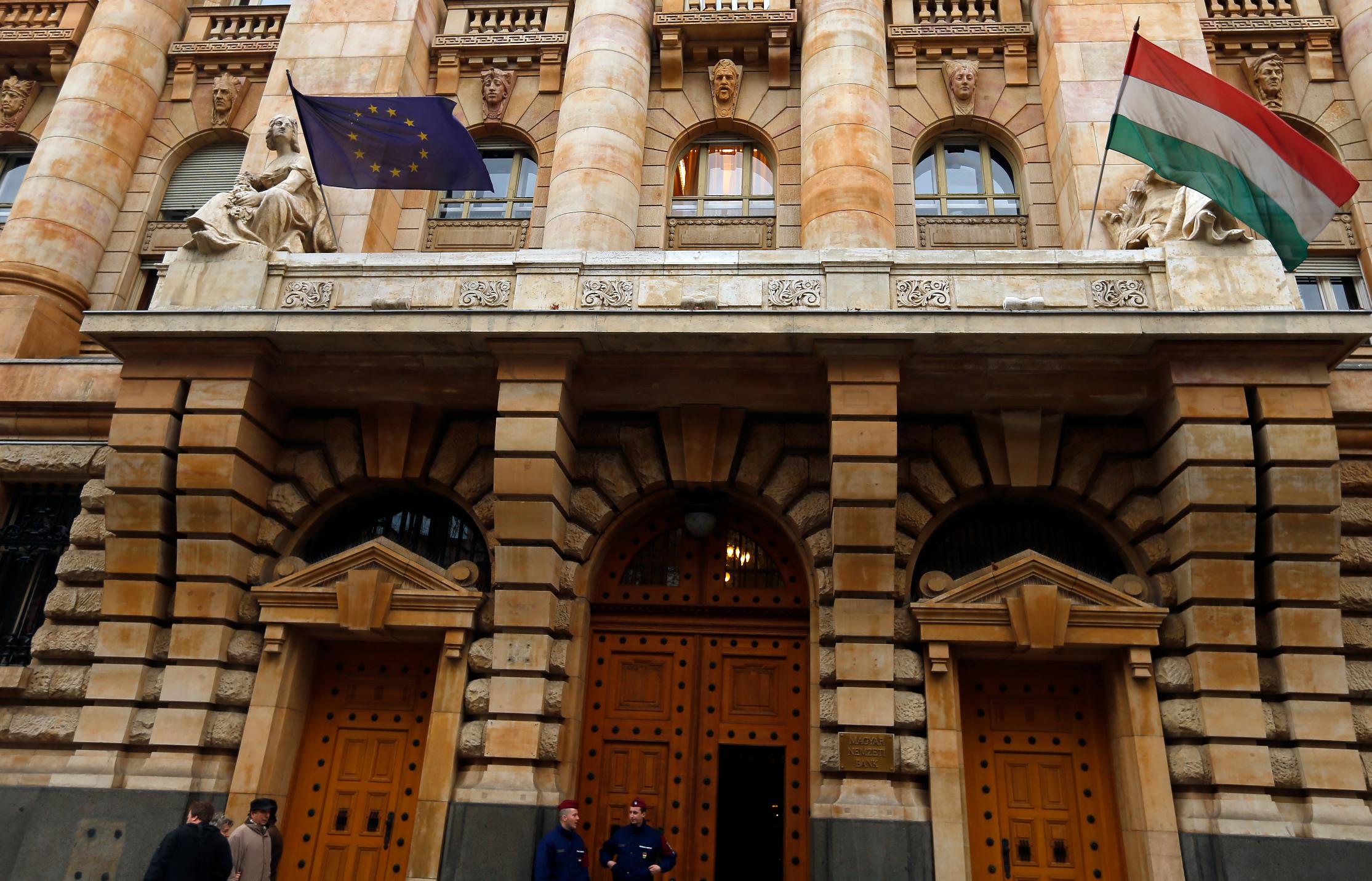
BUDAPEST, Feb 23 (Reuters) - - The National Bank of Hungary is likely to ramp up the pace of rate cuts to 100 basis points, slashing its base rate to 9% on Tuesday, after weaker-than-expected growth and inflation figures since its last meeting, a Reuters poll showed. The NBH, which has faced strong government pressure to cut rates faster to help the economy, held off on larger cuts last month amid a rise in market risks after its mid-January guidance that a sharp fall in inflation could help accelerate easing. Hungary's headline inflation fell to an annual 3.8% in January from the European Union's highest levels of over 25% a year ago, while an economic recovery that started in the third quarter stalled in the last three months of 2023. Deputy Governor Barnabas Virag told news website index.hu on Thursday that options for a 75-bp and 100-bp rate cut would both be on the table next week. The median forecast of a Feb. 19-23 Reuters survey projects a 100-bp cut to 9% (HUINT=ECI) , opens new tab, although seven out of 17 economists have pencilled in just a 75-bp reduction. "We continue to expect the NBH to lower its key policy rate by 100 bps to 9% but also still see significant risks for the central bank to err on the side of caution and maintain a steady 75-bp pace," Morgan Stanley economists said in a note. "We expect the base rate to reach 6.25% in June, when we think that the NBH is likely to take a pause for the rest of the year." A 100-bp cut next week would mean the NBH will have halved its main rate from 18% in an easing cycle launched last May, aided by a retreat in price growth and the recovery of the forint from record lows hit in October 2022. But with annual inflation seen rebounding to 5.4% by the end of the year, the scope for further aggressive cuts is narrowing. Economists polled by Reuters see Hungary's base rate at 6% at the end of 2024, suggesting next to no room for rate cuts in the second half if the NBH manages to deliver on its guidance to cut its base rate to 6-7% by the middle of the year. Deeper cuts amid a projected rebound in inflation could upend the bank's strategy of keeping interest rates above the level of price growth. https://www.reuters.com/markets/europe/hungarian-central-bank-seen-stepping-up-rate-cut-pace-100-bps-2024-02-23/
2024-02-23 10:21
WARSAW, Feb 23 (Reuters) - Polish rate-setter Henryk Wnorowski said that while the central bank was well advised to stay put for now, he would not rule out interest rate cuts later this year with inflation likely to return to its target in March. The National Bank of Poland has kept its main interest rate at 5.75% since October and Governor Adam Glapinski has said it could remain there for the rest of the year given "very high uncertainty" over the outlook for inflation. "Currently, a 'wait and see' approach is highly advisable," Wnorowski told Reuters. "We are observing all incoming data and assessing the situation, and if it turns out that such a possibility or necessity is possible, I do not rule out interest rate cuts this year," he said in remarks cleared for publication on Friday. Polish inflation, one of the highest in the European Union, peaked at 18.4% a year ago and has been coming down since. It last stood at 3.9% in January. Wnorowski said he expected inflation to keep trending lower this month and next, when it should fall to the mid-point of the central bank's 1.5%-3.5% target range. "In March it will most likely be exactly on point, within the inflation target. I think it will be around 2.5%, maybe even 2.4%." Next month's preliminary inflation data will be published on March 29. The next meeting of the 10-member Monetary Policy Council, in which Wnorowski is considered a moderate member, will be held on March 5-6 when the policymakers will review the bank's new inflation projection. The central bank's caution reflects uncertainty over whether the government will extend or modify policies implemented to help households cope with soaring prices. A suspension of value-added tax on food expires at the end of this quarter, while another law designed to curb energy prices is currently set to remain in force until the end of the second quarter. Wnorowski said the expiry of such schemes could drive up inflation in the second half of the year, with some estimates that it will accelerate to 6%. However, in his opinion, inflation will be lower. Wnorowski also criticised the ruling coalition's plans to bring Glapinski before the State Tribunal, saying they were harmful for the image of the central bank and the country. "Financial markets are observing this, and these unnecessary attacks make it harder for all of us to work and perform our tasks," he said. https://www.reuters.com/markets/europe/polish-cbanker-wnorowski-does-not-rule-out-rate-cuts-this-year-2024-02-23/