2024-02-19 17:02
PRAGUE, Feb 19 (Reuters) - Hundreds of Czech farmers drove their tractors into downtown Prague on Monday, disrupting traffic outside the Agriculture Ministry, as they joined protests against high energy costs, stifling bureaucracy and the European Union's Green Deal. Farmers across Europe have taken to the streets this year, including in Poland, France, Germany, Spain and Italy, to fight low prices and high costs, cheap imports and EU climate change constraints. Czech farmers are planning to join protests this week, although major agricultural associations distanced themselves from Monday's action, in which tractors blocked one lane of a major road through Prague, slowing but not completely snarling traffic. Several hundred whistling and jeering protesters gathered outside the Agriculture Ministry yelling "Shame" and "Resign". "We came today mainly because of the bureaucracy around farming, the paperwork is on the edge of what is bearable," 28-year-old farmer Lukas Melichovsky said while in the line of tractors. Another farmer, Vojtech Schwarz, said cheaper imports did not face the same scrutiny as domestic production: "They have a different starting line because we are overseen by a million officials," he said. The government has said the organisers of Monday's demonstration have little to do with real farming. "Today's demonstration does not have much in common with the fight for better conditions for farmers," Prime Minister Petr Fiala said on X social media platform, adding some of its organisers were pro-Russian or had other political aims. "We are negotiating with those who represent farmers," Fiala said. The Agrarian Chamber (AK) plans protests alongside other European farmers at border crossings on Thursday and was not part of Monday's tractor protest. Its main complaints are EU farm policy, market distortions and low purchase prices coming from surpluses amid cheap imports from outside the bloc. Farmers also complain of costs associated with the EU's climate change fight laid out in the Green Deal, which sets out agricultural regulations for the bloc's 27 members for decades. "Farmers are desperate in this hopeless situation and do not know what they should expect in the near future, let alone the distant one," AK president Jan Dolezal said last week. In Slovakia, farmers were due to protest this week to push the government to help the sector, angry over late subsidies, uneven aid or cheaper non-EU imports, including from Ukraine. Tractors took to some streets already on Monday, with TASR news agency reporting farmers had blocked the main border crossing between Ukraine and Slovakia for one hour. Earlier this month, Polish farmers blocked roads across the country and at border crossings with Ukraine, kicking off a month-long general strike to protest against EU policies. https://www.reuters.com/world/europe/tractors-roll-into-downtown-prague-czech-farmers-join-protests-2024-02-19/

2024-02-19 12:31
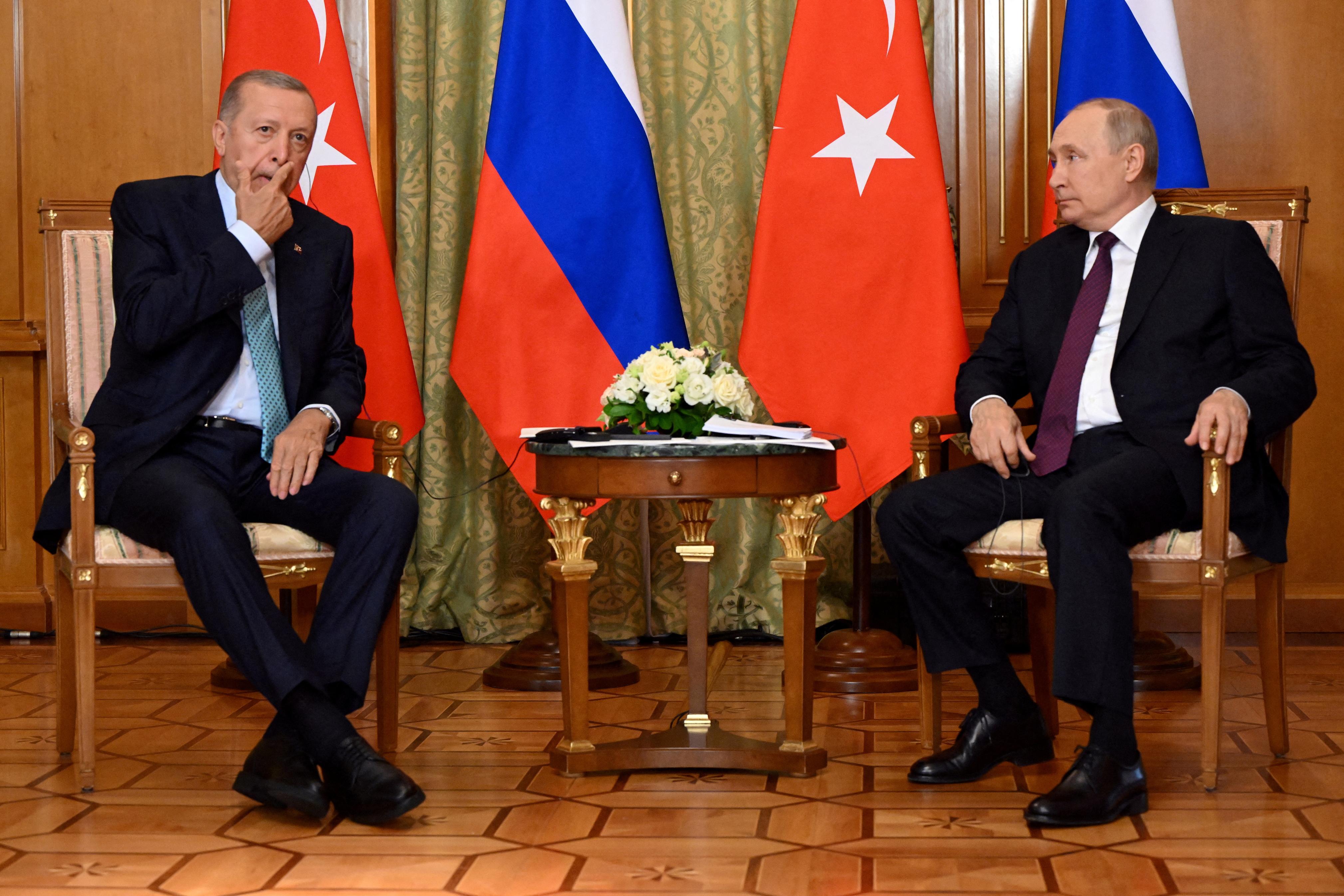
December executive order complicated payments in both directions Turkish banks reviewing business, tightening compliance Crude supplies not disrupted, few cargoes delayed, sources say U.S. official says encouraged by reports of tightened compliance ISTANBUL, Feb 19 (Reuters) - A U.S. threat to hit financial firms doing business with Russia with sanctions has chilled Turkish-Russian trade, disrupting or slowing some payments for both imported oil and Turkish exports, according to seven sources familiar with the matter. The U.S. executive order in December did not explicitly target energy but it has complicated some Turkish payments for Russian crude as well as Russian payments for a broader range of Turkish exports, the sources said. U.S. sanctions aim to reduce the Kremlin's revenue and disrupt its war in Ukraine without choking Russian oil flows to global markets, to avoid a politically sensitive jump in U.S. gasoline prices with President Joe Biden , opens new tab seeking re-election in November. However, similar payment problems to those now faced by Turkey have already disrupted Russian oil supplies to India and complicated those to the United Arab Emirates and China, according to oil traders. Russia is the top crude and diesel exporter to energy-poor NATO member Turkey, supplying 8.9 million metric tons of crude and 9.4 million tons of diesel to its Black Sea neighbour in the 11 months to November. The emerging payment issues are due to Turkish banks reviewing business and tightening compliance with Russian clients, four of the sources said. They have not disrupted Turkey's crude supplies, delaying only a small number of cargoes, two oil industry sources said. A source with a Russian oil major said Russian oil exporters have not received payments from Turkey for two to three weeks. "It has become difficult to make some energy payments to Russia, especially after the new sanctions (threat) at the end of December. Some payments were disrupted," a Turkish source familiar with the payments issue said. "The originally agreed upon method had to be changed or the payment had to be postponed, but the shipment continued. There may be problems on a cargo-by-cargo basis," the source said. The industrial and financial sector sources discussed the payment and trade disruption under condition of anonymity given they are not authorised to speak about the sensitive matter. "Payment issues began after December. The focus is not on oil imports, but it is unsettling. It has not impacted day-to-day functioning but reminds us that a problem could arise any time," a Turkish oil industry source said. The Turkish Treasury declined to comment when asked about the issue. Turkey's banking watchdog BDDK did not immediately respond to a request for comment. Ankara opposes Western sanctions on Moscow even as it has criticised Russia's invasion of Ukraine two years ago. It has managed to maintain close ties with both Moscow and Kyiv throughout the conflict. Though Ankara has said the sanctions will not be circumvented on Turkish soil, Washington ramped up pressure last year to halt the transit of dual-use goods that Russia could use on the battlefield, and has warned that Turkish banks and companies could be hit by secondary U.S. sanctions. "EXTREMELY METICULOUS" The disruption to Russian-Turkish payments began when Biden signed the executive order on Dec. 22 threatening firms helping Russia circumvent sanctions with the risk of losing assess to the U.S. financial system. Financial institutions doing business on behalf of those targeted by U.S. sanctions are at risk, the order said. On Feb. 1, the Kremlin said it was aware of Turkish banks tightening rules on Russian clients due to "aggressive" U.S. pressure, and that it was working with Turkey to find solutions. Russian Central Bank Governor Elvira Nabiullina said on Friday that there were additional difficulties in foreign trade transactions related to settlements and logistics. One Turkish banker said banks carry out "extremely meticulous" procedures regarding sanctions, with compliance departments closely examining all transactions. "This issue is very sensitive and banks' compliance departments are on top of it," another banker said. A senior U.S. State Department official told Reuters it was encouraged by reports that Turkish banks are reviewing existing business and tightening their compliance programmes for Russian clients. "The President's Dec. 22 amendment to our Russia sanctions authority re-affirmed what we've said previously: that foreign financial institutions are responsible for ensuring they do not process transactions that benefit Russia's military or otherwise enable circumvention of our measures." "We have had extensive discussions with our Turkish partners over the last year. We will analyse January trade data once available and look forward to continuing those conversations," the official said. Initial data showed Turkish exports to Russia fell 39% year-on-year to $631 million in January, having increased 16.9% last year to $10.9 billion. Imports from Russia fell 20.2% in January to $4 billion, having dropped 22.5% in 2023 to $45.6 billion. Crude imports from Russia jumped more than two fold to 12 million tons in 2022. It supplied 8.9 million tons of oil to Turkey in Jan-Nov 2023, down 20% from the year before but still above the pre-war average. But much of the impact was on non-oil trade, sources said. "Exports of machinery, in particular, stopped simply because of the similarity with military equipment," the first source familiar with the issue said. "The real problem arises not with the payment that Turkey should make, but with the payment that Turkey will receive. This shows the high level of hesitation Turkish banks have towards sanctions," the source said. https://www.reuters.com/markets/turkish-russian-trade-hit-by-fresh-us-sanctions-threat-2024-02-19/
2024-02-19 12:29
Feb 19 (Reuters) - A Greece-flagged, U.S.-owned cargo ship reported two missile attacks on Monday in the Gulf of Aden and called for military assistance, Greek shipping ministry sources and British maritime security firm Ambrey said. Separately, Britain's maritime agency (UKMTO) said it had received a report from a vessel located 100 miles east of Yemen's port of Aden indicating an explosion close to it. The Sea Champion, with 23 crew members, was sailing from Argentina to Aden carrying grain when it was attacked, Greek shipping ministry sources told Reuters. There were two attempted attacks with missiles which exploded 10-15 metres from the ship, damaging a window, the sources added. Both Ambrey and UKMTO (United Kingdom Maritime Trade Operations) said the vessel and its crew - including five Greek members - were safe and proceeding to the next port of call. Iran-aligned Houthi forces have carried out drone and missile attacks on shipping in the Red Sea and Gulf of Aden since November in what they say is support for Palestinians in the war between Israel and Hamas militants in the Gaza Strip. https://www.reuters.com/world/middle-east/us-owned-ship-reports-missile-attack-off-yemen-ambrey-says-2024-02-19/

2024-02-19 12:27
Feb 19 (Reuters) - Goldman Sachs upgraded its rating on global equities to "overweight" on prospects of economic growth and recovery in manufacturing activity, after starting the year with a "neutral" rating across assets. Recent data has shown signs of improvement in global manufacturing activity, including in the United States, and market participants will assess incoming economic data to determine the trajectory of interest rate cuts of major central banks. "We expect growth to become a more important driver of risk appetite and equity/bond correlations should be more negative this year," Goldman said in a note dated Feb. 16. The brokerage added that monetary policy easing cycles have historically been supportive for risky assets but may be less so this year, "as markets have already pre-traded much of the rates relief." Traders see about a 51.3% chance for the U.S. Federal Reserve to cut interest rates by 25 basis points in June, according to the CME FedWatch tool. However, the potential for global earnings growth remains 'relatively muted' due to falling revenue growth and minimal room for margin improvement, Goldman said, although adds that global economic growth creates 'upside risks' to earnings growth. "While equities have digested higher bond yields so far with better growth, there is a risk of shifting back to a ‘good news is bad news’ regime," Goldman cautioned. The brokerage also downgraded global credit assets to "underweight" from "neutral." "Tight credit spreads are likely to become a speed limit to returns," the brokerage noted. Goldman reiterated its "neutral" rating on longer-dated global bonds and commodities. https://www.reuters.com/markets/goldman-raises-global-equities-overweight-economic-growth-prospects-2024-02-19/

2024-02-19 11:25
RIYADH, Feb 19 (Reuters) - Saudi Arabia's non-oil growth is expected to come in above 5% in the medium term, Finance Minister Mohammed Al Jadaan said on Monday, slightly lower than the 6% figure previously projected, but likely to outperform the wider region this year. "If you look at the non-oil GDP, it is growing at very healthy numbers: 4% and north of 4%. We are expecting 5%-plus in the medium term," Jadaan told delegates at the Saudi Capital Markets Forum in Riyadh. "That is very strong growth." The world's top oil exporter is accelerating plans to diversify its economy away from oil under a plan known as Vision 2030. It aims to develop sectors such as tourism and industry, expand the private sector and create jobs. Non-oil activities vastly outperformed oil sector expansion last year, lifting overall growth which had slowed sharply on the back of cuts to oil production and lower prices. The International Monetary Fund in January forecast non-oil growth in the oil and gas exporting Gulf Cooperation Council (GCC) states - of which Saudi Arabia is a member - at below 4% this year, projecting 3.9% in 2024 and 4% in 2025. The IMF also slashed its 2024 GDP growth forecast for the kingdom to 2.7% but said that non-oil growth was still expected to remain "robust". Jadaan had said in October that non-oil GDP was expected to grow by around 6% in 2023 and beyond, possibly to 2030. Non-oil GDP grew 4.6% in 2023, while overall GDP contracted 0.9%. The government expects higher spending in the coming years, which analysts have said will drive domestic growth and support non-oil GDP but will also tilt the kingdom into a fiscal deficit of about 2% this year. But Jadaan said Saudi Arabia's economic and social reforms - including significantly narrowing fiscal deficits - had allowed it to be better equipped to deal with external shocks such as the COVID-19 pandemic and geopolitical risks. "We transform socially. We transform economically. We transform in fiscal policy, where we brought all the budget deficits down from 15% to 2% or even less than that. That is how a country becomes more resilient and deals with these shocks," he said in Riyadh. https://www.reuters.com/world/middle-east/saudi-arabia-expects-more-than-5-medium-term-non-oil-growth-minister-says-2024-02-19/
2024-02-19 11:06
FRANKFURT, Feb 19 (Reuters) - German homes are still overvalued despite a fall in prices last year as the cost of mortgages spiked, the country's central bank said on Monday. Germany's decade-long property boom has unravelled since a sudden bout of inflation forced the European Central Bank (ECB) to hike interest rates, while the domestic economy was hit by more expensive energy imports and sluggish exports. The price of owner-occupied residential property fell by just over 4% last year according to industry data. The German statistics office put the decline at 8.9% for the first nine months of the year. Yet the Bundesbank, the ECB's biggest shareholder, estimated that prices were still 15-20% above where they should be based on Germany's current demographic and economic situation. "The overvaluation may not have been fully corrected yet despite a considerable reduction," the Bundesbank said in its monthly report. "This continues to pose a certain risk of price corrections." It said the price-to-income ratio was 20% higher than its reference value while the long-term relationship between property prices, interest rates and incomes showed an overvaluation of between 10% and 15%. For flats in German cities, the relationship between purchase price and rent lay 20% above its long-term average, the Bundesbank said. As people were less able to afford to buy, they turned to renting. Renting a city flat was 5.5% dearer according to Bulwiengesa, a property consultant and analysis firm. New lease contracts were 6.3% more expensive for multi-family homes, according to data from Germany's association of Pfandbrief banks. The ECB is widely expected to start cutting rates this year and even Bundesbank President Joachim Nagel, an early supporter of rate hikes, said the "greedy beast" of inflation had now been tamed. https://www.reuters.com/world/europe/german-homes-are-still-overvalued-despite-price-drop-bundesbank-2024-02-19/