2024-01-03 06:11
WAJIMA, Japan, Jan 3 (Reuters) - Rescuers raced against the clock on Wednesday searching for survivors of an earthquake in western Japan that killed at least 65, while evacuees continued to wait for further aid amid freezing temperatures and heavy rain. The quake with a preliminary magnitude of 7.6 struck the Noto peninsula on New Year's Day, levelling houses and cutting off remote areas from aid. Heavy rain was forecast in the quake-hit areas on Wednesday, raising fears of landslides that could further hinder efforts to free many more people still trapped under rubble. Severed roads, damaged infrastructure, and the remote location of the hardest-hit areas have complicated rescue efforts. The full extent of damage and casualties remains unclear two days after the quake. Satellite images from Maxar Technologies showed extensive damage in coastal areas, revealing destroyed buildings and capsized boats. In Suzu, a town of about 13,000 people near the quake's epicentre, 90% of houses may have been destroyed, its mayor said on Tuesday, calling the damage "catastrophic". Ishikawa prefecture has confirmed 65 deaths, up from 55 late on Tuesday, making the earthquake the deadliest in Japan since at least 2016. Some cities have reported additional deaths, putting the total number of fatalities at 73, according to Kyodo news agency. Smaller quakes continue to hit the peninsula. Firefighters from Osaka and Nara prefectures pressed on despite the rain and aftershocks in hard-hit Wajima city, searching for a woman trapped in a wooden structure squashed by a seven-floor building that toppled over in the quake and landed on its side. The rescuers were removing rubble to try to reach the woman, who was not showing any vital signs, a firefighter said. They dashed out from under the collapsed building as an earthquake warning alarm sounded yet again on Wednesday evening. About 500 tremors have been detected since the first quake on Monday, according to the Japan Meteorological Agency. The government opened a sea route to deliver aid and some larger trucks were now able to reach some of the more remote areas, Prime Minister Fumio Kishida told a press conference following a national disaster response meeting. "It's been over 40 hours since the initial quake. This is a battle against time, and I believe now is a crucial moment in that battle," he said. NO FOOD OR WATER More than 33,000 people have evacuated their homes and some areas have no access to water or electricity and have spotty mobile signals, according to Ishikawa prefecture. The mayors of the hardest-hit cities demanded the government clear roads and deliver aid swiftly at a regional emergency disaster meeting held on Wednesday morning. "Even those who narrowly escaped death can't survive without food and water," said Masuhiro Izumiya, the mayor of Suzu. "We haven't received a single loaf of bread." Shigeru Sakaguchi, mayor of Wajima city, said he was grateful for the government's efforts but had received only 2,000 meals for some 10,000 evacuees so far. "Some people are very cold because there are areas that have no access to electricity and therefore heating," he said. Many roads were severed and several areas outside of the city centre could only be reached by helicopter, he added. https://www.reuters.com/world/asia-pacific/japan-quake-survivors-face-freezing-rain-threat-landslides-2024-01-03/

2024-01-03 05:33
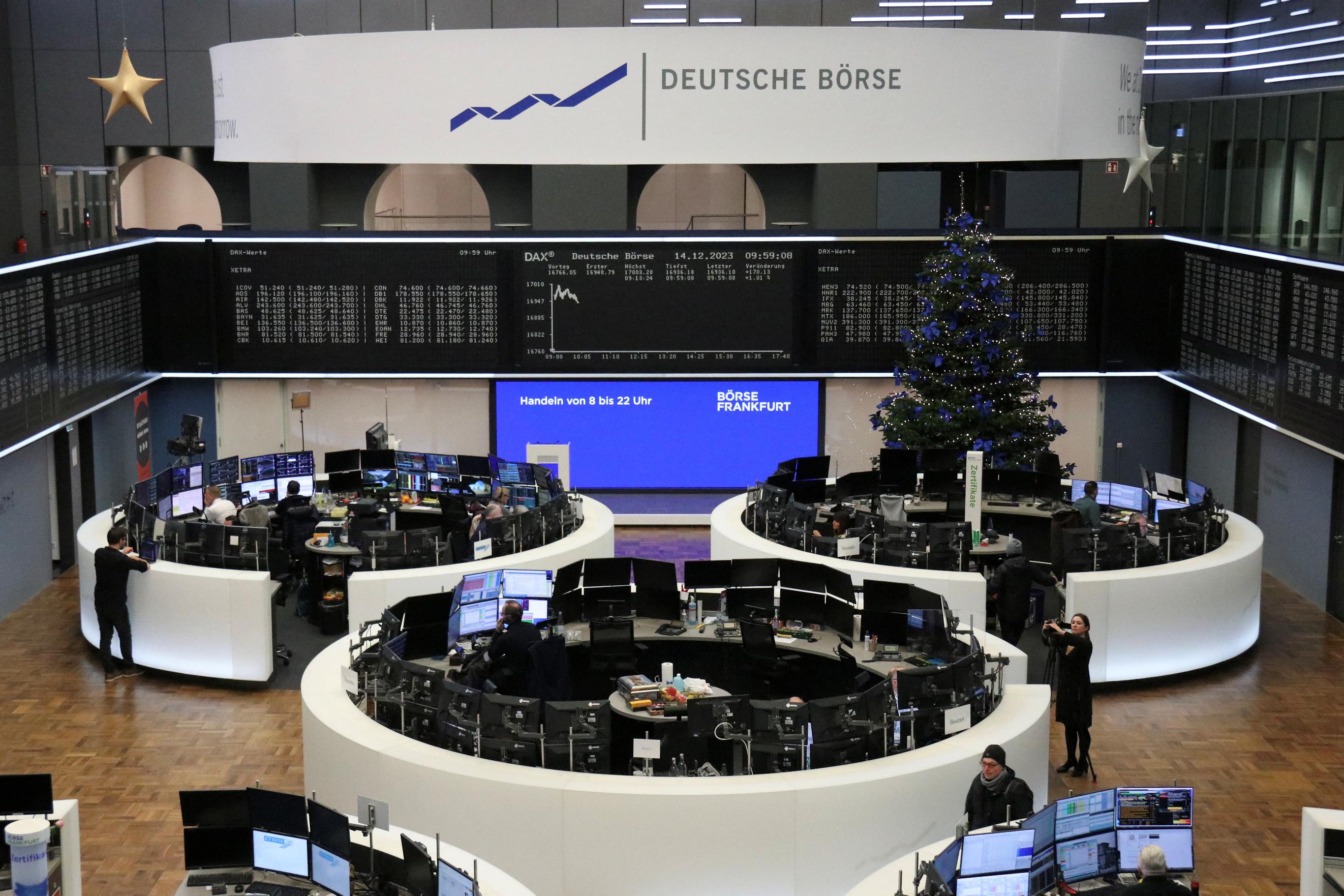
A look at the day ahead in European and global markets from Ankur Banerjee. The risk rally that has been raging since the Federal Reserve's dovish tilt in December is pausing for breath as 2024 awakes markets to the prospect the central bank's interest rate cuts may not be as aggressive as investors expected. Markets had been pricing in as much as 160 basis points of cuts in 2024, double than what Fed projected, but the New Year has led traders to reassess their outlook, with markets now pricing in less than 150. That reassessment might end up being temporary and traders may go back to expecting deep rate cuts. However, if risky assets' early stumbles this year are anything to go by we could be in for some surprises. The economic calendar is filling up. Minutes from the Fed's last meeting are due later on Wednesday and will help traders gauge the central bank's thinking around monetary easing as a slew of labour data this week. Asian shares extended a global sell-off on Wednesday, with the MSCI's broadest index of Asia-Pacific shares outside Japan (.MIAPJ0000PUS) down 1.3% on the day after a near 1% drop on Tuesday, its steepest two-day percentage decline since October. The dollar , on the other hand, remained buoyant, lifted by rising Treasury yields, keeping pressure on the Japanese yen and the euro . Bitcoin shrugged off the cautious mood and was 0.6% higher at $45,255, not far from a 21-month top of $45,922 hit on Tuesday. Futures suggest the dark mood will carry on into Europe with a lower open expected. In corporate news, the EV battle continues to heat up with China's BYD (002594.SZ) claiming the spot as top EV maker, dislodging Tesla (TSLA.O) even though the U.S. automaker delivered a record number of vehicles in the fourth quarter. Tesla delivered 494,989 EVs in the October-to-December period, falling short of the 526,409 vehicles that Warren Buffett-backed BYD moved. Key developments that could influence markets on Wednesday: Economic events: Germany unemployment data for December https://www.reuters.com/markets/europe/global-markets-view-europe-2024-01-03/
2024-01-03 04:58
MUMBAI, Jan 3 (Reuters) - The Indian rupee was little changed on Wednesday, even as Asian currencies fell pressured by an uptick in Treasury yields as traders moderated bets on potential rate cuts in the U.S. this year. The rupee was at 83.33 as of 10:15 a.m. IST, barely changed from its close at 83.3175 in the previous session. The dollar index jumped 0.8% on Tuesday and the 10-year U.S. Treasury yield rose 8 basis points to 3.94% amid paring of expectations of interest rate cuts by the Federal Reserve. Investors are currently pricing in a near 75% chance of a Fed rate cut in March, down from about 85% a week earlier, according to CME Group's FedWatch tool. Asian currencies were mostly lower, with the Korean won and Malaysian ringgit leading losses down by 0.5% and 0.6%, respectively. "There is decent selling interest (for USD/INR) near 83.35," a foreign exchange trader at a foreign bank said. Traders don't expect to see sharp moves for the rupee on expectations that the Reserve Bank of India (RBI) will intervene to cap losses. The RBI's two-sided intervention has kept the rupee in a tight range over the last two months. The central bank has capped losses near the 83.40 handle while also stepping in to absorb dollar inflows which has limited gains in the local unit. "Some weakness will be on the cards" for the rupee on Wednesday amid pressure on regional currencies, Dilip Parmar, a foreign exchange research analyst at HDFC Securities said. Key U.S. data releases this week are also likely to impact investors' expectations, starting with the ISM Manufacturing purchasing managers' index (PMI) data due later in the day. The minutes from the Fed's December policy meeting will also be released later on Wednesday and will offer clues on policymakers' thinking about potential easing of policy rates. https://www.reuters.com/markets/currencies/rupee-flat-even-asian-peers-slip-uptick-us-yields-2024-01-03/

2024-01-03 04:53
DUBAI, Jan 3 (Reuters) - Iranian-backed Houthi militants fired two anti-ship ballistic missiles into the Southern Red Sea, though no damage was reported, the U.S. Central Command (CENTCOM) said late on Tuesday. The Houthis, who control much of Yemen including the capital, have since October attacked commercial vessels in the Red Sea they say have Israeli links or are sailing to Israel, in solidarity with Palestinians in Gaza. Multiple commercial ships in the area reported the impact of the missiles in surrounding waters, CENTCOM added. Britain's United Kingdom Maritime Trade Operations Authority earlier reported up to three explosions one to five nautical miles from a merchant vessel in the Bab al-Mandab strait, 33 nautical miles east of Eritrea's Assab, with no reports of damage. Several shipping lines have suspended operations through the Red Sea waterway in response to the attacks, instead taking the longer journey around Africa. The Houthis have vowed to continue their attacks until Israel halts the conflict in Gaza, and warned that it would attack U.S. warships if the militia group itself was targeted. https://www.reuters.com/world/middle-east/us-says-no-damage-reported-after-latest-houthi-attack-red-sea-2024-01-03/

2024-01-03 04:26
LAUNCESTON, Australia, Jan 3 (Reuters) - China's flow of crude oil into inventories faded over the second half of last year as the world's top importer reduced purchases in response to higher prices. China's available crude was almost in balance with refinery processing in November, with a statistically insignificant 20,000 barrels per day (bpd) being added to inventories. China doesn't disclose the volumes of crude flowing into or out of strategic and commercial stockpiles, but an estimate can be made by deducting the amount of crude processed from the total of crude available from imports and domestic output. The total volume of crude available to refiners in November was 14.51 million bpd, consisting of imports of 10.33 million bpd and domestic production of 4.18 million bpd. Refinery throughput was 14.48 million bpd, down from 15.05 million bpd in October and the lowest daily level since the January-February period in 2023. Subtracting the refinery processing from the total available crude leaves a gap of just 20,000 bpd of crude that went into storage tanks, down from the 560,000 bpd that went to stockpiles in October. However, October was something of an aberration as China's flows of crude into storage slowed sharply over the second half of 2023. In the five months from July to November a total of about 240,000 bpd was added to inventories. In two of those months, July and September, China's refineries actually processed more crude than what was available from imports and domestic output, thereby drawing on inventories. The weak storage flows in the July to November period are in stark contrast to the robust additions in the first half of the year, when 950,000 bpd was added to stockpiles. This means that flows into storage tanks dropped by 710,000 bpd in the July to November period from what was added in the first six months of 2023. The sharp slowdown is a reflection of lower imports, rather than a drop in refinery processing. China's crude imports have eased in the second half, most likely as a result of the higher global prices for oil, largely sparked by the decision in late June by OPEC+ leaders Saudi Arabia and Russia to jointly cut output by a further 1.3 million bpd. That move sent benchmark Brent crude futures from a low of $71.57 a barrel on June 28 to a high for 2023 of $97.69 on Sept. 28. Given the lag between when cargoes are arranged and physically delivered, it was always likely that China's crude imports would slow, and they did from September onwards. However, the price of crude has since eased, partly as a result of concerns over global economic growth and partly because Chinese imports did not match the robust demand forecasts provided by the International Energy Agency, the Organization of the Petroleum Exporting Countries and other analysts. IMPORT REBOUND? Brent ended last year at $77.04 a barrel and has continued to drift lower in the new year, finishing at $75.89 on Jan. 2. This makes it more likely that Chinese refiners will buy more crude and build inventories again. There may be some early evidence of this as Refinitiv Oil Research expects China's December imports to rise to 11.85 million bpd from November's customs figure of 10.33 million bpd. December-arriving cargoes would have largely been secured in October, at a time when Brent prices were falling sharply, from the September peak to a low in October of $83.44 a barrel. However, it's likely that oil prices will have to remain subdued for China's refiners to ramp up imports in the first half of 2024. Other factors will have to be supportive as well, such as whether domestic fuel consumption will increase on the back of a rebound in construction and increased local and international travel. Official policy with regards to exports of refined fuels will also be key, and initial indications are that 2024 will be largely a repeat of 2023. Exports of refined fuels rose 26.5% in the first 11 months of 2023 compared to the same period a year earlier as refiners sought to use higher quotas to take advantage of strong margins for some products, especially diesel. The first batch of quotas for 2024 were announced on Dec. 29, with Beijing allocating 19 million metric tons, a volume unchanged from the first tranche of 2023. It's likely that these quotas will be used rapidly, given a lack of allocations toward the end of 2023 prevented refiners from exporting as much as they probably would have liked. The opinions expressed here are those of the author, a columnist for Reuters. https://www.reuters.com/business/energy/china-crude-flows-storage-poised-pick-up-after-half-year-lull-russell-2024-01-03/

2024-01-03 03:09
Protests shut production at key Libyan oilfield Yemen's Houthis 'target' container ship Upcoming - U.S. oil inventory data from API at 4:30 p.m. EST NEW YORK, Jan 3 (Reuters) - Oil prices climbed on Wednesday, settling up about 3% after a disruption at Libya's top oilfield added to fears that mounting tensions in the Middle East could disrupt global oil supplies. Brent futures rose $2.36, or 3.1%, to settle at $78.25 a barrel. U.S. West Texas Intermediate (WTI) crude rose $2.32, or 3.3%, to settle at $72.70. Both crude benchmarks settled higher for the for the first time in five days with the biggest daily percentage gain for WTI since mid November. "Oil is trading ... higher today, buoyed it would appear by protests at Libya's largest oilfield and further attacks in the Red Sea," said Craig Erlam, senior market analyst UK & EMEA, at data and analytics firm OANDA. In OPEC member Libya, protests forced a shutdown of production at the 300,000 barrel per day (bpd) Sharara oilfield. Oil prices also climbed after Israel intensified its bombing of the Gaza Strip after its war with the Iran-backed Palestinian Hamas group stretched into Lebanon with the killing in Beirut of Hamas' deputy leader. Israel has neither confirmed nor denied responsibility. The head of Lebanon's armed group Hezbollah, also backed by Iran, warned the killing of Hamas' deputy chief was "a major, dangerous crime about which we cannot be silent". In the Red Sea, another Iran-backed group, the Houthis in Yemen, continued to attack vessels, prompting concerns that a wider Middle East conflict could develop and close crucial oil transport waterways like the Red Sea and Persian Gulf. In OPEC member Iran, two explosions killed more than 100 people and wounded scores at a ceremony to commemorate top commander Qassem Soleimani who was killed by a U.S. drone in 2020. The Organization of the Petroleum Exporting Countries (OPEC) said cooperation and dialogue within the wider OPEC+ oil producer alliance will continue after Angola last month announced it would leave the group. OPEC+, which includes OPEC and allies like Russia, said it plans a Feb. 1 meeting to review implementation of its latest oil output cut. FED AND OIL INVENTORIES Federal Reserve officials appeared increasingly convinced inflation was coming under control, according to the minutes of U.S. central bank's December meeting. The Fed is widely expected to keep rates on hold in January. Traders have priced in a 65.7% chance of a 25 basis point rate cut in March, according to CMEGroup's FedWatch tool. Lower interest rates reduce consumer borrowing costs, which can boost economic growth and demand for oil. The American Petroleum Institute (API), an industry group, and the U.S. Energy Information Administration will release their oil inventory reports one day later than usual due to the New Year holiday with API expected around 4:30 p.m. EST on Wednesday and EIA on Thursday. Analysts forecast U.S. energy firms pulled about 3.7 million barrels of oil from storage during the week ended Dec. 29. EIA/A , That compares with a build of 1.7 million barrels in the same week last year and a five-year (2018-2022) average decline of 4.0 million barrels. https://www.reuters.com/markets/commodities/oil-prices-rise-sustained-red-sea-shipping-tensions-2024-01-03/