2023-12-21 15:55
Dec 21 (Reuters) - U.S. new-vehicle sales are expected to rise about 13% in December from a year earlier, driven by strong discounts and vehicle availability, industry consultants J.D. Power and GlobalData said in a joint report on Thursday. Total new-vehicle sales, which include retail and non-retail transactions, are estimated to reach about 1,396,700 units in December, a 13.2% increase from a year ago, according to the report. The automotive industry is set to enjoy a robust year as total sales were just under 15.5 million, a significant 12.8% increase from last year's sales, the report said. Inventory levels are also currently at their highest since the early spring of 2021, leaving dealers and automakers scurrying to make way for new models, which are set to pour in by January. Car dealers are providing generous incentives and discounts during winter sales, aiming to clear stocks of older vehicles and capitalize on sustained demand. The report estimates incentive spending per unit to reach $2,458 in the month, up from $1,289 last year, encouraging consumers to spend about $50.4 billion on new vehicles, up by $2.4 billion. "Sales growth for December is being enabled by improving vehicle availability and affordability," said Thomas King, president of the data and analytics division at J.D. Power. However, the increase in new-vehicle supply and higher interest rates are resulting in falling per-unit dealer profits, although those profits continue to exceed pre-pandemic levels, the report added. The average transaction price (ATP) in the United States for new vehicles in December is expected to be $46,055. The ATP was $47,362 for the same period in 2022. The report projected global demand to grow by 3%, to 92.3 million units, in 2024. https://www.reuters.com/markets/us/us-new-vehicle-sales-rise-13-december-discounts-inventory-report-2023-12-21/

2023-12-21 15:46
LONDON, Dec 21 (Reuters) - After a grim couple of years for developing countries, with rapid interest rate rises prompting a string of defaults, investors say the coming wall of debt maturities looks to be surmountable. Principle payments of emerging markets' sovereign Eurobonds will spike to $78.4 billion in 2024, from $43.6 billion this year, according to JPMorgan. The bill due for lower-rated emerging sovereigns will surge to over $65 billion in total for 2024 and 2025 combined, up from just over $8 billion this year. Countries will need to either find the cash to pay, or a new lending source to refinance. Investors, though, are sanguine. They say the U.S. Federal Reserve's recent pivot away from monetary tightening is likely to unleash more cash for riskier assets, including emerging market debt. "As we see things today, we don't necessarily believe we will get a whole wave of EM defaults," said Robert Simpson, portfolio manager at Pictet. BACK TO THE MARKET Dangers lurk – including a possible developed-world recession, escalation of ongoing wars and the potential return of U.S. President Donald Trump – meaning emerging economies will need to be nimble, quick and careful with their finances to make it through. Much of the debt was taken out during the halcyon days of 2020 or 2021, when lending at the lowest coupons to emerging markets became "a competitive sport", according to Yvette Babb, portfolio manager at William Blair. "It's very unlikely to go back to that. Low-income countries cannot rely on the same degree of capital market appetite for Eurobond issuance," Babb told Reuters, adding the market had been growing when global markets hit the tightening cycle. But the mix of countries with debt due is assuaging some concerns. Gulf countries such as Bahrain, with around $2 billion coming due, face maturities - but are swimming in cash amid elevated oil and gas prices. Turkey, whose pivot back to orthodox monetary policies has improved its borrowing prospects, also has some $8 billion maturing in 2024, according to JPMorgan. But it will have no trouble, investors said, between its plans to issue $10 billion internationally and source the remainder on domestically. And the limited sovereign bond issuance in 2023, amid the rapid-fire interest rate rises and a global bond market roller coaster, leaves space for more lending next year. "Investors have the capacity, cash and liquidity," said Alexis Taffin de Tilques, head of debt capital markets CEEMEA, with BNP Paribas. "Not only does that mean that there is amplified demand in the market today, but also that there is sufficient scope to roll over." Frank Gill, a sovereign analyst with S&P, said global rate cuts could re-open market access for many countries, which could test the market early in 2024. AFRICA LOCKED OUT Still, the combination of elevated interest rates and low credit ratings will keep some African sovereigns out of international bond markets. Ghana and Zambia remain in default, and Ethiopia looks set to follow suit within days. Kenya, Tunisia and Egypt have significant maturities due in 2024. Kenya plans to buy back up to a quarter of its $2 billion bond, due in June, with the help of loans from the Trade & Development Bank and the African Export-Import Bank. Tunisia has another $850 million due in February, while Egypt's newly re-elected President Abdel Fattah al-Sisi is expected to make sharp currency devaluations, sell more state assets and potentially increase borrowing from the International Monetary Fund. "There is also for these countries a lot of multilateral financing coming through," Simpson of Pictet said. "The involvement of these kinds of institutions will be bigger and on a longer-term basis than they have been in the past... the market will have to focus with laser precision how things develop in these countries." The risk premium investors demand to hold emerging market hard-currency debt, rather than super-safe U.S. Treasuries, fell to as low as 386 basis points this week, its narrowest since February 2022. The U.S. dollar's strength is also easing, and is expected to keep falling in 2024 if the Fed begins cutting rates. A weaker dollar makes foreign-currency debt more manageable for emerging markets. Still, a string of risks loom; a return of Donald Trump to the White House, for example, could send investors fleeing to safe havens, boosting the dollar and denting emerging markets. "Things are better, but we're still living in a world of high rates and uncertainty," one banker told Reuters. "Fundamentals are still very difficult, very challenging and rates are still very high." https://www.reuters.com/markets/emerging-market-debt-wall-looks-scalable-investors-warm-risk-2023-12-21/

2023-12-21 15:34
Big tech drives world stocks up over 20% in 2023 Wild round trip for interest rate markets Dollar has laid low, yen, yuan, EMs have suffered Economies that contribute 60% of world GDP vote next year Graphic: World FX rates LONDON, Dec 29 (Reuters) - This year might go down as one of the most unusual ever in financial markets - mainly because everything seems to have come good despite a lot of turbulence and many predictions turning out to be wrong. Take equity markets. World stocks (.MIWD00000PUS) are more than 20% higher despite the highest interest rates in decades and a mini crisis that wiped out one of Europe's best known banks - Credit Suisse - along with a few smaller ones in the U.S. In the bond markets, just a few months ago investors were expecting the Fed & Co to raise rates and leave them there while recessions rolled in. Now bond markets are looking to central banks to embark on a rate-cutting spree with inflation apparently beaten. Other areas of the markets have experienced wild gyrations that are baffling to explain. Bitcoin is up nearly 160% on the year. Some of the most beaten up emerging market bonds have achieved triple-digit gains while the "magnificent seven" tech giants (.NYFANG) have seen a 97% surge when lumped together. "If you'd told me at the start of year that we would have a U.S. regional banking crisis and Credit Suisse would cease to exist, then I'm not sure we would have guessed that we would see the year we've had for risk assets," PIMCO's CIO for Global Fixed Income, Andrew Balls, said. The result has been 3.5%-6.5% returns from top government bonds and a $10 trillion rally in world stocks (.MIWD00000PUS), (.FTAWORLDSR), although that has been ominously top heavy. Meta (META.O) and Tesla (TSLA.O) have soared 197% and 105%. The Nasdaq (.IXIC) is on the cusp of its strongest year in two decades, while AI's demand for semiconductor chips has catapulted Nvidia (NVDA.O) nearly 240% higher into the $1 trillion dollar club. But it has been a bumpy ride. In March, the collapse of Silicon Valley Bank, a mid-sized U.S. lender, and the rescue of 167-year-old Credit Suisse triggered a slide in world shares where they lost all of the 10% gains made in January. The scramble for safety pushed gold up 7% and U.S. and European government bond yields - the main drivers of global borrowing costs - recorded their biggest monthly drop since the 2008 financial crisis. The steady climb in interest rates around the world then kept investors sweating through the summer, and in October Hamas' attacks in Israel ratcheted up geopolitical tensions. ROUND-TRIPPING In the forex markets, the dollar is down a barely-noticeable 2% on the year. But Japan's seeming reluctance to raise interest rates and China's sputtering economy mean the yen and yuan are down 7.5% and 3% respectively. As usual, the outsized moves have been in emerging markets. Turkey's efforts to tackle its economic problems following Tayyip Erdogan's re-election have not been made any easier by another 35% dive in the lira. Egypt has devalued its currency 20%, Nigeria has cut the naira by 50% and Argentina's new president Javier Milei has just slashed the peso in half. On the upside, Colombia and Mexico's pesos are up 25% and 15%. Poland's zloty is up nearly 12%, followed by the best performing major economy currency, the safe-haven Swiss franc , which has jumped 10% to score its strongest year since 2010. "Once the dollar starts to move down there could be a lot of fuel for that to continue," DoubleLine's Bill Campbell said, referring to a potential weakening of the dollar in 2024 and also questioning what a potential return to power by Donald Trump might mean. One of the most remarkable round trips is that the key 10-year U.S. Treasury yield will end the 2023 almost exactly where it started despite touching 5% in October. BofA calculates that the battle against inflation has produced around 125 interest rate hikes globally this year versus 60 cuts. If the previous 18 months are added the total is 510 hikes compared with just over 1,370 cuts since the global financial crash in 2008. And cuts will start to dominate again next year with roughly 150 now expected compared with 40 hikes. "Everyone expects a soft landing to happen, everyone expects bond yields to be lower and everyone expects Fed rate cuts," BofA strategist Elyas Galou said, highlighting the group think the bank's investor surveys showed. The big discrepancy though is that the Fed has only cut rates when unemployment is as low as it now five times the last 90 years. ELECTION FEVER Japan's Nikkei (.N225) has surged 20% in dollar terms, or 28% in yen terms, setting it up for its best year in a decade. Property woes have continued to drag on China, which has had a knock-on impact on oil, which is down almost 8% on the year. Gold has jumped 11.5%. Other standouts include El Salvador bonds, which are now battling out of default and have returned 117% on the year. U.S. sanctions relief has seen Venezuela's bonds vault 157% and Pakistan and Sri Lanka's have made 100% and 71%. Next year won't be quiet on the political front. There are more than 50 major elections scheduled next year, including in the United States, Taiwan, India, Mexico, Russia and probably Britain. That means countries that contribute 80% of world market cap and 60% of global GDP will be voting. Taiwan kicks it off with elections on January 13, followed just a few days later by the New Hampshire primary for the 2024 U.S. Presidential race. Other dates for the diary include the Fed's first rate cut, which is pencilled in for March 20, while OPEC and G7 meetings are scheduled for June. "This is an era of boom and bust," BofA Galou said. "We are not out of the woods." https://www.reuters.com/markets/global-markets-yearend-pix-2023-12-21/
2023-12-21 12:28
LUANDA, Dec 21 (Reuters) - Angola has announced it is leaving the Organization of the Petroleum Exporting Countries (OPEC), local news agency ANGOP reported on Thursday, citing the oil minister. Nigeria and Angola were among several countries given lower targets at the last OPEC+ meeting in June after years of failing to meet the previous ones. As of October, Angola was pumping less than its quota for 2024, according assessments by independent sources cited by OPEC. https://www.reuters.com/world/africa/angola-says-it-is-leaving-opec-angop-news-agency-2023-12-21/
2023-12-21 12:09
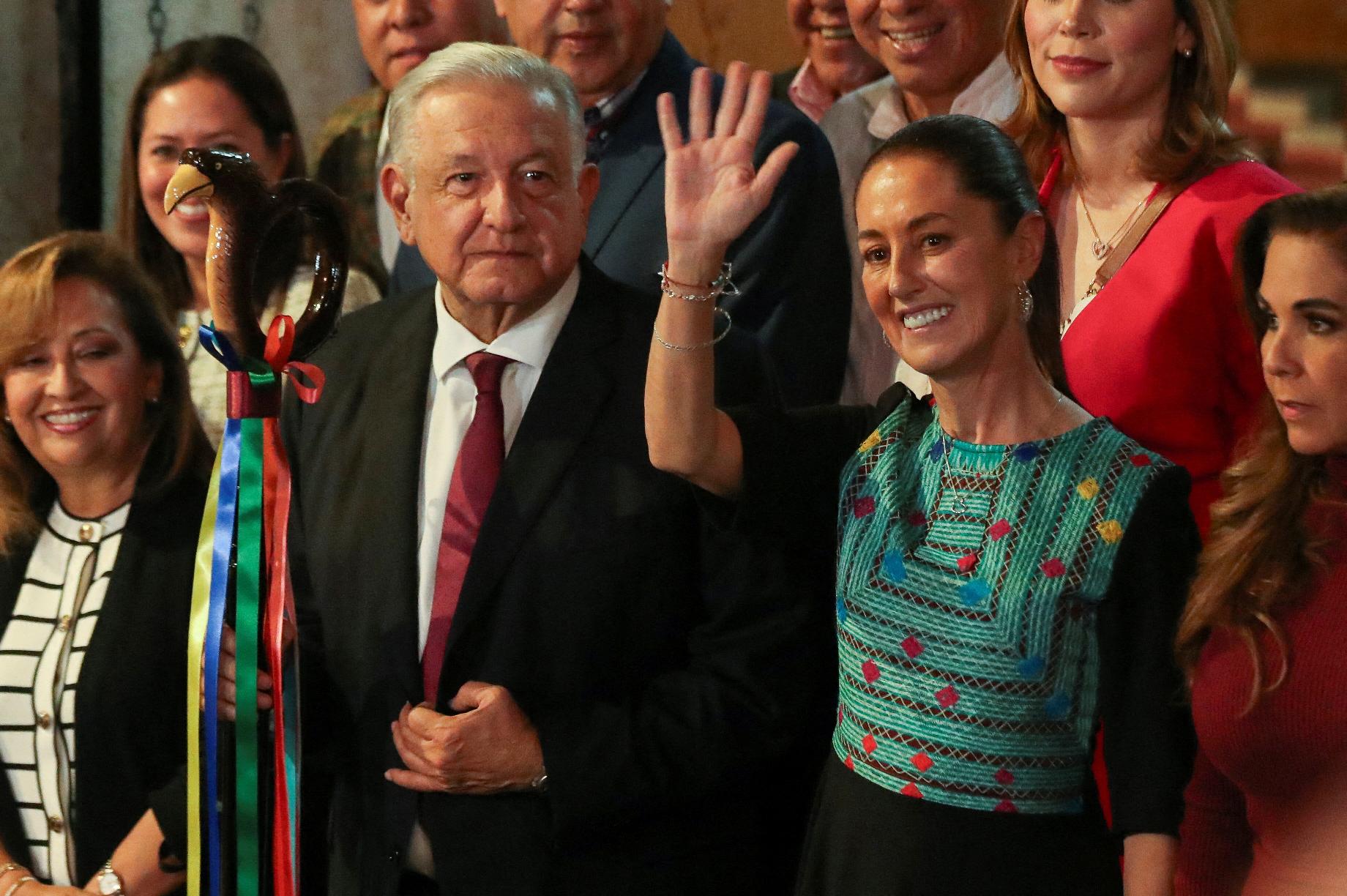
MEXICO CITY, Dec 21 (Reuters) - The favorite to be Mexico's next leader will likely be more open than her mentor President Andres Manuel Lopez Obrador to private investment in energy in order to help fund her renewable power push at a time of tighter public finances, aides, officials and executives said. Former Mexico City Mayor Claudia Sheinbaum, front-runner to become Mexico's first woman president in June elections, plans to boost clean energy usage while upholding Lopez Obrador's pledge to keep at least 54% of power generation in state hands. The president's drive to tighten state control of energy has been one of the most contentious aspects of his agenda, and the next administration's approach could go a long way to defining its economic fortunes, analysts say. Sheinbaum has diverged little from Lopez Obrador on energy except for her vigorous advocacy of renewables. But aides told Reuters she would have scope to lift private investment because the state should control significantly more than the 54% threshold by the time she took office. "The role of private investment is going to be really important," a close ally of Sheinbaum said. Sheinbaum has given few details of her energy plans, but key pointers to how she views the challenge emerged from Reuters' conversations with some two dozen serving and former officials, executives, politicians and aides privy to discussions with her. They said they expected her to be more pragmatic about tapping private capital once in power, citing her awareness of factors including budget constraints, rising energy demand, and the need to avoid disputes like those that erupted under Lopez Obrador which could cost the state billions of dollars. Sheinbaum has a lead of more than 20 points in most opinion polls over opposition rival Xochitl Galvez, who has pitched a more aggressive opening of the energy sector to private capital. Responding to a request for comment, her campaign said Sheinbaum saw state control of at least 54% of power generation as "fundamental" and that she had no intention of changing it. "In that sense, she guarantees there will be room for public and private investment," it said in a statement to Reuters, which had sought comment on the key points of this article. Her campaign did not address most of them, saying only there was information that was "imprecise" without elaborating. Privately, allies of Sheinbaum said Lopez Obrador's policies have made some foreign firms wary about "nearshoring" - moving operations to Mexico from Asia or elsewhere - and that funding her renewables plan with public money alone will be tough. Three aides noted that Lopez Obrador's recent purchase of Iberdrola energy assets should mean that as much as two-thirds of power generation is in public hands by the end of his term, giving Sheinbaum leeway to increase private investment. Lopez Obrador has spent billions propping up Mexico's fossil fuel-dependent energy giants, oil firm Pemex and power utility CFE. Sheinbaum, an energy expert decorated for her work on climate change, is emphatic about protecting the environment. "We will accelerate the energy transition to renewable sources of energy, guaranteeing energy sovereignty," the 61-year-old scientist said in November. ARBITRATION Lopez Obrador recently cut Pemex's tax burden, meaning Sheinbaum should not have to spend as much keeping the company afloat, her aides said. Since taking office in 2018, Lopez Obrador, restricted by law to one term, has cast his government as defender of a poor majority over a wealthy, corrupt minority bent on carving up state-owned assets like Pemex and CFE for its own gain. His policies have sparked clashes with investors. The Economy Ministry currently lists more than two dozen active or planned investor disputes against Mexico. Most do not detail damages sought, but eight of them total over $6 billion, including $1.9 billion U.S. firm Vulcan Materials is seeking. Beyond that are private commercial suits and a broader dispute under a North American trade deal that the U.S. and Canada launched over treatment of their energy firms which could end up costing Mexico billions, economists say. Privately, Sheinbaum has sought to reassure investors they will have the legal certainty many feel has been lacking under Lopez Obrador, aides and executives say. Andres Rozental, a business consultant and former Mexican deputy foreign minister who has attended closed-door business meetings with Sheinbaum, said she seemed "more cognizant of the need for Mexico to change its energy policy." In a recent private meeting with executives in the state of Jalisco, a recording of which Reuters heard, Sheinbaum said she had never opposed private investment but that she, like Lopez Obrador, was against corruption that bred inequality. She highlighted opportunities presented to Mexico by nearshoring and the need for infrastructure to support economic growth and social development. NEARSHORING Some energy firms have avoided suing Mexico, hoping the next government will be different, said Carlos Vejar, an arbitration attorney at White & Case and former Mexican trade negotiator. But Vejar said he had never seen so many active arbitration cases against Mexico. "This all adds to the pressure for the next administration to change policy", he said. Mexico's economy is poised to grow around 3.5% this year, lifted by signs of nearshoring investment. Still, a lack of green energy infrastructure has given pause to some multinationals eager to reduce their carbon footprints. "I think we're not understanding the profundity of what the opportunity of nearshoring, relocalization means," Foreign Minister Alicia Barcena said last month, saying Mexico needed to "get a move on" or risk losing out to rivals like Vietnam. In 2024, election year spending is set to widen Mexico's budget deficit, which along with the makeup of Congress, could steer political debate toward private investment. Nearshoring has increased demand for energy infrastructure, and state firm CFE cannot meet it alone, said Rafael Espino, a senator in Sheinbaum's National Regeneration Movement (MORENA). "Energy supply is extremely important to protect nearshoring," he said. "There's not enough public money to invest, there need to be schemes to lift private investment." https://www.reuters.com/world/americas/mexicos-sheinbaum-spurs-hope-more-private-investment-energy-after-lopez-obrador-2023-12-21/
2023-12-21 12:04
BEIJING, Dec 21 (Reuters) - (This Dec. 21 story has been corrected to clarify that the ban was on the export of technology to make rare earth magnets and that the ban on technology to extract and separate critical materials was already in place, in paragraphs 1 and 6. It also removes context and the comment on rare earth processing operations, in paragraphs 3 and paragraphs 18-20) China, the world's top processor of rare earths, banned the export of technology to make rare earth magnets on Thursday, adding it to a ban already in place on technology to extract and separate the critical materials. Rare earths are a group of 17 metals used to make magnets that turn power into motion for use in electric vehicles, wind turbines and electronics. "This should be a clarion call that dependence on China in any part of the value chain is not sustainable," said Nathan Picarsic, co-founder of the geopolitical consulting firm Horizon Advisory. China's commerce ministry sought public opinion last December on the potential move to add the technology to prepare smarium-cobalt magnets, neodymium-iron-boron magnets and cerium magnets to its "Catalogue of Technologies Prohibited and Restricted from Export." In the list it also banned technology to make rare-earth calcium oxyborate and production technology for rare earth metals, adding them to a previous ban on production of rare earth alloy materials. The catalogue's stated aims include protecting national security and public interest. China has significantly tightened rules guiding exports of several metals this year, in an escalating battle with the West over control of critical minerals. It introduced export permits for chipmaking materials gallium and germanium in August, followed by similar requirements for several types of graphite since Dec. 1. "China is driven to maintain its market dominance," said Don Swartz, CEO of American Rare Earths (ARR.AX), which is developing a rare earths mine and processing facility in Wyoming. "This is now a race." WEST STRUGGLES The move to protect its rare earth technology comes as Europe and the United States scramble to wean themselves off rare earths from China, which accounts for nearly 90% of global refined output. China has mastered the solvent extraction process to refine the strategic minerals, which MP Materials (MP.N) and other Western rare earth companies have struggled to deploy due to technical complexities and pollution concerns. Shares of MP, which has slowly begun increasing rare earths processing in California, jumped more than 10% on Thursday after China's move. The company did not immediately respond to requests for comment. Ucore Rare Metals (UCU.V) said on Thursday that it had finished commissioning of a facility to test its own rare earths processing technology, which is being funded in part by the U.S. Department of Defense. "New technologies will be needed to outmaneuver the Chinese grip on these important areas," said Ucore CEO Pat Ryan. Ucore's stock rose more than 16%. It is not clear to what extent China's rare earths technology is actually being exported. Beijing has discouraged its export for years, said Constantine Karayannopoulos, former CEO of Neo Performance Materials (NEO.TO), which separates rare earths in Estonia. "This announcement just formalises what everyone knew to be the case," Karayannopoulos said. https://www.reuters.com/markets/commodities/china-bans-export-rare-earths-processing-technologies-2023-12-21/