2023-12-19 20:30
NEW YORK, Dec 19 (Reuters) - The U.S. Environmental Protection Agency has asked the White House to approve a rule that would allow expanded sales of higher-ethanol gasoline to be sold in certain Midwestern states, after governors from those states requested it. The request has been stalled after the oil industry warned the Biden administration that allowing E15, or gasoline with 15% ethanol, in select states would lead to supply chain issues and, therefore, higher gasoline prices. Inflation and the health of the economy are key vulnerabilities for President Joe Biden's 2024 re-election bid. The EPA proposed in March that E15 could be sold year-round in Illinois, Iowa, Minnesota, Missouri, Nebraska, Ohio, South Dakota, and Wisconsin, after the states petitioned for it. Late on Monday, it sent the proposal, which includes an effective date for all states of April 28, 2024, to the White House for final review. Ethanol, a domestically produced alternative fuel most commonly made from corn, is cheaper by volume than gasoline. Adding more of it to the fuel mix can also lower prices by increasing overall supply. But the U.S. government restricts sales of E15 gasoline in summer months due to environmental concerns over smog. The ethanol industry for years has pushed to lift the restrictions on E15 sales nationwide, arguing the environmental impacts have been overstated. Oil refiners including HF Sinclair Corp (DINO.N) and Phillips 66 (PSX.N), meanwhile, have warned that a patchwork approach to approving E15 sales would complicate fuel supply logistics and raise the risk of spot shortages. Ethanol groups say they prefer a nationwide legislative fix to allow for expanded E15 sales, versus the regional approach. https://www.reuters.com/business/environment/us-epa-sends-midwest-ethanol-expansion-request-white-house-2023-12-19/
2023-12-19 20:09
Canadian dollar strengthens 0.4% against the greenback Touches its strongest since Aug. 4 at 1.3334 Canada's annual inflation rate holds steady at 3.1% Canada-U.S. 2-year spread narrows by 3 basis points TORONTO, Dec 19 (Reuters) - The Canadian dollar strengthened against its U.S. counterpart on Tuesday as investors reduced bets on the Bank of Canada shifting to interest rate cuts in the coming months after domestic data showed inflation unexpectedly holding steady in November. The loonie was trading 0.4% higher at 1.3340 to the greenback, or 74.96 U.S. cents, after touching its strongest intraday level since Aug. 4 at 1.3334. Canada's annual inflation rate remained at 3.1% in November, surprising analysts who had forecast inflation would ease to 2.9%. CPI-median and CPI-trim, two measures of core inflation closely watched by the BoC, also held steady at 3.4% and 3.5%, respectively. The underlying inflation readings "leaned more toward continued hike risk" than toward the market's expectation for a cut by March or April, Derek Holt, head of capital markets economics at Scotiabank, said in a note. A cut in the coming months "would be a major policy error right into the thick of the Spring housing market and Winter government budget season," Holt added. Money markets see a roughly 40% chance the BoC will begin easing in March, down from 50% before the data. This month, the central bank held its benchmark rate at a 22-year high of 5% and left the door open to another hike, saying it was still concerned about inflation while acknowledging an economic slowdown. Adding to support for the loonie, the price of oil, one of Canada's major exports, settled 1.3% higher at $73.44 a barrel amid concerns about supply disruptions and the U.S. dollar (.DXY) lost ground against a basket of major currencies. The Canadian 2-year yield rose 1.2 basis points to 4.007%, while the gap between it and its U.S. equivalent narrowed by 3 basis points to 43.2 basis points in favor of the U.S. note. https://www.reuters.com/markets/currencies/canadian-dollar-rallies-cpi-data-cools-rate-cut-bets-2023-12-19/

2023-12-19 19:58
WASHINGTON, Dec 19 (Reuters) - The U.S. bought 2.1 million barrels of crude oil, the Energy Department said on Tuesday, to help replenish the Strategic Petroleum Reserve (SPR) after the largest sale in history last year. The department said it bought the oil, for delivery in February, for an average of $74.23 a barrel, below the average of $95 a barrel that oil sold for in 2022. The administration of President Joe Biden had conducted sales last year, including a record one of 180 million barrels, to help control oil prices after Russia, a large crude exporter, invaded Ukraine. The U.S has now purchased about 11 million barrels for replenishment after last year's sales. About 4 million barrels are also coming back to the SPR by February as oil companies return oil that had been loaned to them through a swap. On the latest transaction, Sunoco Partners Marketing & Terminals LP sold 900,000 barrels to the SPR, while Macquarie Commodities Trading US LLC and Phillips 66 Co (PSX.N) each sold 600,000 barrels, the Energy Department said on its website. The Energy Department had already secured the cancellation of 140 million barrels in congressionally mandated sales from the SPR scheduled from late this year through late 2026. The cancellation "has led to significant progress toward replenishment," the department has said. https://www.reuters.com/markets/commodities/us-buys-2-million-barrels-oil-strategic-petroleum-reserve-2023-12-19/

2023-12-19 19:46
OTTAWA, Dec 19 (Reuters) - Canada on Tuesday released final regulations mandating that all passenger cars, SUVs, crossovers and light trucks sold by 2035 must be zero-emission vehicles (ZEVs), part of the government's overall plan to combat climate change. ZEVs must make up at least 20% of all cars sold by 2026 and at least 60% by 2030. Industry officials say electric vehicles (EVs) represented 12.1% of new vehicle sales in the third quarter of 2023. Environment Minister Steven Guilbeault said the regulations provided industry with the certainty it needed to address the issue of limited availability of EVs. "(This) ensures Canadians have access to our fair share of the global supply of these vehicles," he told a televised news conference in Toronto. Transportation accounts for about 22% of Canada's greenhouse gas emissions. The rules are similar to those adopted by California, which says 100% of new cars sold in 2035 must be plug-in hybrid electric vehicles (PHEV), EVs or powered by hydrogen fuel cell. A total of 17 U.S. states have agreed to adopt the regulations. Global EV sales now make up about 13% of all vehicle sales and are likely to rise to between 40%-45% of the market by the end of the decade, according to the Paris-based International Energy Agency. According to the data platform Statista, Tesla accounted for 36.7% of EV sales in Canada in 2022, with Hyundai in second place with 11.1%. The Canadian automobile industry says the regulations are too ambitious, noting the higher cost of electric vehicles. It also complains that the charging network is incomplete, especially in rural areas. Canada, the world's second largest country, has a population of just 40 million people. "Achieving higher ZEV sales levels depends on favorable market conditions, stronger consumer purchase incentives ... widespread charging infrastructure (and) expanded grid capacity," said Brian Kingston, President of the Canadian Vehicle Manufacturers’ Association. The government's charging effort is focused on building EV ports in populous public areas and multi-family residential buildings, which experts warn may not be enough to rapidly increase adoption. In an effort to address complaints that EVs are impractical in remote and northern areas, where cold conditions can cut the efficiency of batteries, PHEVs with an all-electric range of 80 km or more will remain eligible for sale in 2035 and beyond. Canada has missed every emissions reduction target it has ever set. Prime Minister Justin Trudeau says fighting climate change is one of his Liberal government's top priorities. His emissions reduction plan is flawed and will not reach the target of cutting greenhouse gas output by 40% to 45% below the 2005 level by 2030, a top watchdog said last month. https://www.reuters.com/sustainability/climate-energy/canada-says-all-cars-trucks-must-be-zero-emission-by-2035-industry-unhappy-2023-12-19/
2023-12-19 19:18
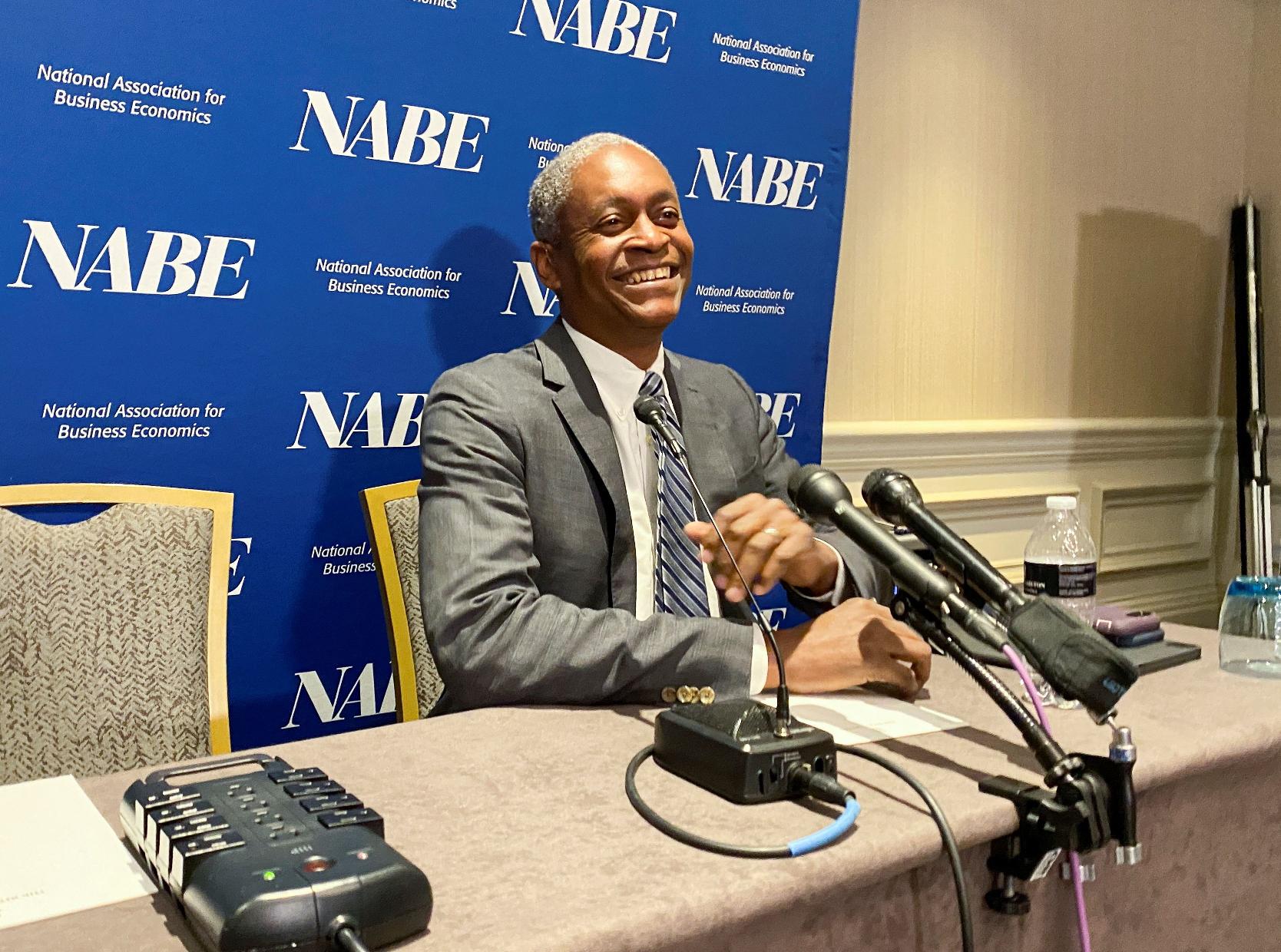
ATLANTA, Dec 19 (Reuters) - There is no current "urgency" for the Federal Reserve to reduce U.S. interest rates given the strength of the economy and the need to be sure that inflation will return to the central bank's 2% target, Atlanta Federal Reserve President Raphael Bostic said on Tuesday. Inflation "is going to come down relatively slowly in the next six months, which means that there's not going to be urgency for us to start to pull off of our restrictive stance," Bostic said in comments to the Harvard Business School Club of Atlanta. Bostic repeated that he expects two quarter-point rate cuts likely in the second half of the year, but emphasized that in the meantime inflation remains too high - and the Fed's policy path depends on it continuing to slow. "This economy is far stronger than I would have imagined it would be 12 months ago, and I'm really grateful for that," Bostic said, citing an unemployment rate that has remained below 4% throughout the Fed's ratcheting up interest rates by 5.25 percentage points to quell inflation. Households and businesses "have been able to absorb a lot," he said. Bostic's comments counter what is currently a strong conviction among investors that the Fed will cut the benchmark policy rate at its March meeting, a view given a more than two-thirds probability according to data compiled by the CMEGroup's FedWatch. "Inflation is still too high...So we have to continue to work to get inflation back down to that 2% level" targeted by the central bank, Bostic said. Inflation by the Fed's preferred Personal Consumption Expenditures price index was 3% in October on an annual basis, though over short three and six month horizons it is only around 2.5%. Timing the cuts will be important, he said. The Fed's benchmark rate will need to be lowered enough in advance of inflation returning to target that the economy can "coast into the 2%," and not suffer an unnecessary blow in terms of rising unemployment, Bostic said. "We got to be careful, because my goal is really to position our policy to minimize the amount of pain that folks have to go through," while getting inflation back to target, Bostic said. "That's the strategy." https://www.reuters.com/markets/rates-bonds/feds-bostic-no-urgency-rate-cuts-2023-12-19/
2023-12-19 18:04
Dec 19 (Reuters) - Bankrupt crypto exchange FTX Trading on Tuesday announced a settlement with liquidators for FTX's Bahamas unit, resolving a long-simmering dispute over whether the company's U.S. bankruptcy proceedings should take precedence over the Bahamian liquidation. FTX and FTX Digital Markets have agreed to pool their assets and harmonize their approach to valuing customer claims to ensure equal treatment for customers in either country's insolvency process. The settlement will allow most customers of FTX.com's international crypto exchange to choose whether to seek repayment from either the U.S. bankruptcy or the Bahamian liquidation, according to FTX. FTX's CEO John Ray, who took control of the company from convicted FTX founder Sam Bankman-Fried, said that the agreement is a critical milestone in the company's effort to repay customers. "The unique challenges raised by the conflicting filings of the FTX Debtors and FTX Digital Markets have been some of the toughest the team has faced," Ray said in a statement. "But we recognized at the beginning that we have an overlapping constituency: FTX.com customers." The Bahamian liquidators, Brian Simms and Peter Greaves, said in a statement that the agreement will avoid "years of protracted litigation and expense" and "accelerate the return of funds to customers." FTX had been at odds with Bahamian officials ever since filing for bankruptcy protection on Nov. 11, with a hole in its balance sheet that left its 9 million customers facing billions in potential losses. FTX had sued the Bahamian liquidators in March, seeking a ruling that the liquidators had wrongly claimed ownership of the exchange's assets. Under the agreement, FTX's U.S. based bankruptcy team will take the lead on asset recovery efforts, including any potential sale of the FTX.com exchange or its intellectual property. The Bahamian liquidators will be in charge of selling real estate assets in the Bahamas and pursuing certain litigation claims. The settlement also includes an agreement to FTX's proprietary crypto token FTT as equity in FTX, which would be wiped out in the company's bankruptcy. The value of FTT tokens had been a point of contention between the two sides last year, when FTX's U.S. team alleged that most of the assets seized by the Bahamian liquidators were valueless FTT tokens. FTX, which collapsed in November 2022, has committed to using at least 90% of its assets to repay customers. The company plans to pay customers back in U.S. dollars, rather than in cryptocurrency. https://www.reuters.com/technology/ftx-digital-markets-reaches-settlement-with-debtors-2023-12-19/