2023-12-12 11:12
SARAJEVO, Dec 12 (Reuters) - Bosnian towns have topped the world air pollution charts since last weekend, with the capital Sarajevo declaring an air quality warning and experts blaming residential solid fuel burning and transportation for the increase. Despite Sarajevo authorities' pledge to make the city carbon-free by 2035, a cost of living crisis has forced people to choose cheaper solid fuels for home heating and to drive older cars with higher emissions of pollutants, experts say. The use of gas in the capital has fallen 18% so far this year from the last due to higher prices, the data show. Most people would rather use more ecological fuels but they use what they can afford, said Enis Krecinic, an environmental expert at the Hydro-Meteorological Institute of Bosnia´s autonomous Bosniak-Croat federation. "The social aspect influences what people will use to heat their homes, what cars they will drive, what fuel they will choose," Krecinic told Reuters. Bosnia has among the highest levels of fine particulate matter (PM2.5) pollution in Europe, to which the burning of solid fuel for home heating and the transport sector contribute about 50% and 20% respectively, according to the World Bank. The country, and especially Sarajevo, which is nested in a valley among mountains, has suffered from poor air quality for decades. Despite the closure of its mining and heavy industry Bosnia remains one of the most polluted countries in Europe. Krecinic said Sarajevo was at risk during winter months due to temperature variations but that other cities, such as Zenica located in the central Bosnian "coal valley", have had more days of excessive pollution during the calendar year. Physicians say that exposure to fine particulate matter poses serious health risks, leading to respiratory infections, cancer, cardiovascular diseases and premature deaths. "Absolutely the air pollution ... in Sarajevo brings about changes and health difficulties, such as pneumonia, for both young and old," said Teufik Hadziosmanovic, a lung specialist. https://www.reuters.com/business/environment/bosnian-cities-top-world-air-pollution-charts-no-quick-fix-sight-2023-12-12/

2023-12-12 11:12
A look at the day ahead in U.S. and global markets from Mike Dolan Tuesday's consumer price inflation update may not have to wow the gallery to keep the U.S. disinflation glow alive and persuade the Federal Reserve that its job is done. With Fed policymakers starting their two-day meeting on Tuesday, the November CPI release drops right on to the table in front of them. On the face of it, there may be no great thud. Annual headline inflation is expected to have slipped back to 3.1%, its lowest since June, and the "core" rate, excluding food and energy, is forecast to remain stuck at 4.0% But economists say this seeming stasis may mask underlying disinflation momentum. Deutsche Bank points out that if core CPI comes in with gains of 0.3% over the month and 4.0% over the year, that would bring the six-month annualised rate as low as 2.8% - the first sub-3% reading since March 2021. What's more, inflation expectations are ebbing, supply distortions easing, oil prices are still falling year-on-year, used-car sales that were a post-pandemic irritant are plummeting, and China is struggling with persistent deflation. After the University of Michigan's December household survey showed an impressive retreat in inflation expectations last week, the New York Fed's equivalent measure chimed on Monday - showing U.S. consumers' one-year inflation outlook softening to 3.4%, its lowest in more than two years. Little surprise then perhaps that U.S. Treasuries are rallying into Tuesday's big release - despite a sticky 10-year note auction on Monday. Ten-year yields are down 4 basis points from Monday's close to trade about 4.18% in European trade. The long bond also rallied into Tuesday's key report, with yields dropping 5bp ahead of a $21 billion auction of 30-year paper later in the day - even though the most recent 30-year auction struggled badly. However, the NY Fed's measure of so-called "term premium" demanded for holding long-term bonds has fallen back over the past week to its most negative since September. The disinflation and "peak rates" picture and data showing U.S. employment still in rude health spurred the S&P500 (.SPX) to new closing highs for year on Monday - topping year-to-date gains of 20% for the first time in 2023. Stocks futures held those gains ahead of the bell on Tuesday. Asia and European bourses were firmer too - with MSCI's all-country index (.MIWD00000PUS) hitting four-month highs. The dollar (.DXY) was a touch lower. Stoking the more positive price picture overseas, British wage growth slowed by the most in almost two years -- good news for the Bank of England ahead of its policy meeting on Thursday. Even though annual oil price losses deepened amid mounting concern over excess supply and slowing demand, spot prices held up after news of an attack by Iran-aligned Houthis on a chemical tanker stirred Middle East tensions. China's markets were firmer too, meantime, as the country's leaders started a closed-door meeting on Monday to discuss economic targets and map out stimulus plans for 2024. The annual Central Economic Work Conference, during which President Xi Jinping and other top officials are expected to chart the course for the world's second-largest economy next year. This is likely to end on Tuesday. The CSI 300 Real Estate Index (.CSI000952) jumped 4.2% as investors await fresh policy support. China's Country Garden Holdings (2007.HK) is likely to avoid its first default on yuan bonds after most holders of a local note agreed not to demand repayment this week, Bloomberg News reported. Key developments that should provide more direction to U.S. markets later on Tuesday: * U.S. Nov consumer price index, Cleveland Fed CPI cut, Nov NFIB small business survey, Federal Budget statement. * Federal Reserve's Federal Open Market Committee starts 2-day meeting * U.S. Treasury auctions $21 billion of 30-year bonds * U.S. corporate earnings: Johnson Controls, Frequency Electronics, EMCORE, Champions Oncology, MamaMancini's https://www.reuters.com/markets/global-markets-view-usa-2023-12-12/

2023-12-12 10:59
Dec 12 (Reuters) - U.S. short-term financing markets saw a three-day spike in interest rates at month-end. That's left Wall Street wondering whether the financial system is running out of cash. A spike in repurchase agreements, or repo, where investors borrow against Treasury and other collateral, can be a sign that cash is getting scarce. Markets need a minimum amount of liquidity to function smoothly. Eventually, the elevated level of the interest rate, called the Treasury GCF Repo Index , between Nov. 30 and Dec. 4 was explained by factors other than cash scarcity, such as month's end book-closing by banks and hedge fund trading, interviews with more than half a dozen bank executives and market participants show. But it set Wall Street abuzz. The U.S. Federal Reserve is draining hundreds of billions from the financial system by selling bonds in a process called quantitative tightening (QT) to normalize monetary policy after the pandemic-era stimulus. That has caused concern that cash levels could be approaching a tipping point, the executives said. One problem for the market is that there is no consensus on how much cash in the system is too little, and so there is no telling when that level might be breached. Estimates vary widely, adding to the jitters. Tell Alessio, treasurer at regional lender Cadence Bank (CADE.N), said while they have access to ample liquidity they are watching for the threshold below which market functioning could be disrupted. "We actively monitor the repo markets for leading indicators of what that lower boundary is," Alessio said in an email. The interviews with bank executives, some of whom requested anonymity to speak freely, also provide a flavor of a Fed survey of senior finance officers. The executives work at banks that combined oversee several hundred billion dollars of assets. In the survey, the Fed polls for information such as the lowest comfortable level of reserves (LCLOR), below which the financial system starts to get impacted. The Fed did the last survey in September but has not released results, leaving only data from May in the public domain. Two sources at a major U.S. bank said their LCLOR was up by 20% to 30% above what they were before the March banking crisis. Their reasons ranged from market volatility to tighter regulation. The May survey found that the crisis had led some banks to raise reserves. Three of four mid-sized bank executives said their cash levels have returned to normal after increasing many-fold in March and April, while one said it had higher levels. They all said they were being more conservative in business. Raj Singh, CEO of BankUnited (BKU.N), said his bank had increased cash levels to $2 billion during the banking crisis, but had brought it down to pre-March levels of around $400 million by the summer. Amalgamated Bank (AMAL.O) CFO Jason Darby said they had increased coverage of the riskiest portion of their uninsured deposits to over 200% from 185% after March. Such deposits come from its newer customers, who have been with the bank for less than five years. "It feels like the events of March are literally only yesterday," Darby said. "That's the way we've been thinking about trying to manage our business conservatively." HOW MUCH IS NEEDED? Estimates of the minimum amount of bank reserves needed range from about $2.5 trillion to $3.3 trillion. Such reserves currently total nearly $3.5 trillion; another $820 billion or so is held by entities like money market funds. One treasurer at a mid-sized bank calculated the threshold to be around $2.9 trillion to $3 trillion, while an executive at a large bank said it might be in the middle- to higher-end of the range in the short term. The large bank executive said a survey of financial officers showed most expected to hit the threshold around the middle of next year. But it also underscored the uncertainty: Some expected it could be breached as early as February or March. Fed Chair Jerome Powell has said the bank sees no reason to change the pace of QT. "It's hard to make a case that reserves are even close to scarce at this point," he said last month. In broad strokes, financial system liquidity is the sum of reserves held by banks and money parked overnight with the Fed by money market funds and others, called a reverse repo. The levels are affected by the Fed's balance sheet and the Treasury Department's general account, where it keeps cash to pay the U.S. government's bills. The last time the financial system found out liquidity had dipped too low was in 2019, when bank reserves hit around $1.5 trillion. The Fed had to step in. Since then, the threshold has likely increased, in part due to the growth in economic activity and tighter regulations, the executives said. AN ESTIMATE The mid-sized bank's treasurer said he looks at the ratio of cash held by domestic banks and their assets, setting his lowest comfortable level at around 9%. The treasurer draws from 2019, when the ratio fell well below that for a sustained period and markets were affected. It again breached 9% ahead of the March crisis. The ratio is now above 10%. Roughly $200 billion to $230 billion of cash drain would bring it down by a percentage point, the treasurer estimated. But before bank reserves get hit, the system has a buffer in the Fed's reverse repo facility, leading to questions about whether that can be drained to zero. A New York Fed survey shows Wall Street expects the Fed to stop QT when the facility hits $625 billion. Meanwhile, more tests to liquidity are likely in the coming weeks, keeping Wall Street on edge. Year-end cash needs still have to be sorted. Early next year, the Treasury will lay out plans for debt issuance that would eat into cash. Then, the tax season will be upon us with more cash needs, said John Velis, forex and macro strategist for the Americas at BNY Mellon. "That's another thing to keep in mind as a wild card," he said. https://www.reuters.com/markets/us/market-wall-street-eyes-waning-cash-pile-with-anxiety-2023-12-12/
2023-12-12 10:18
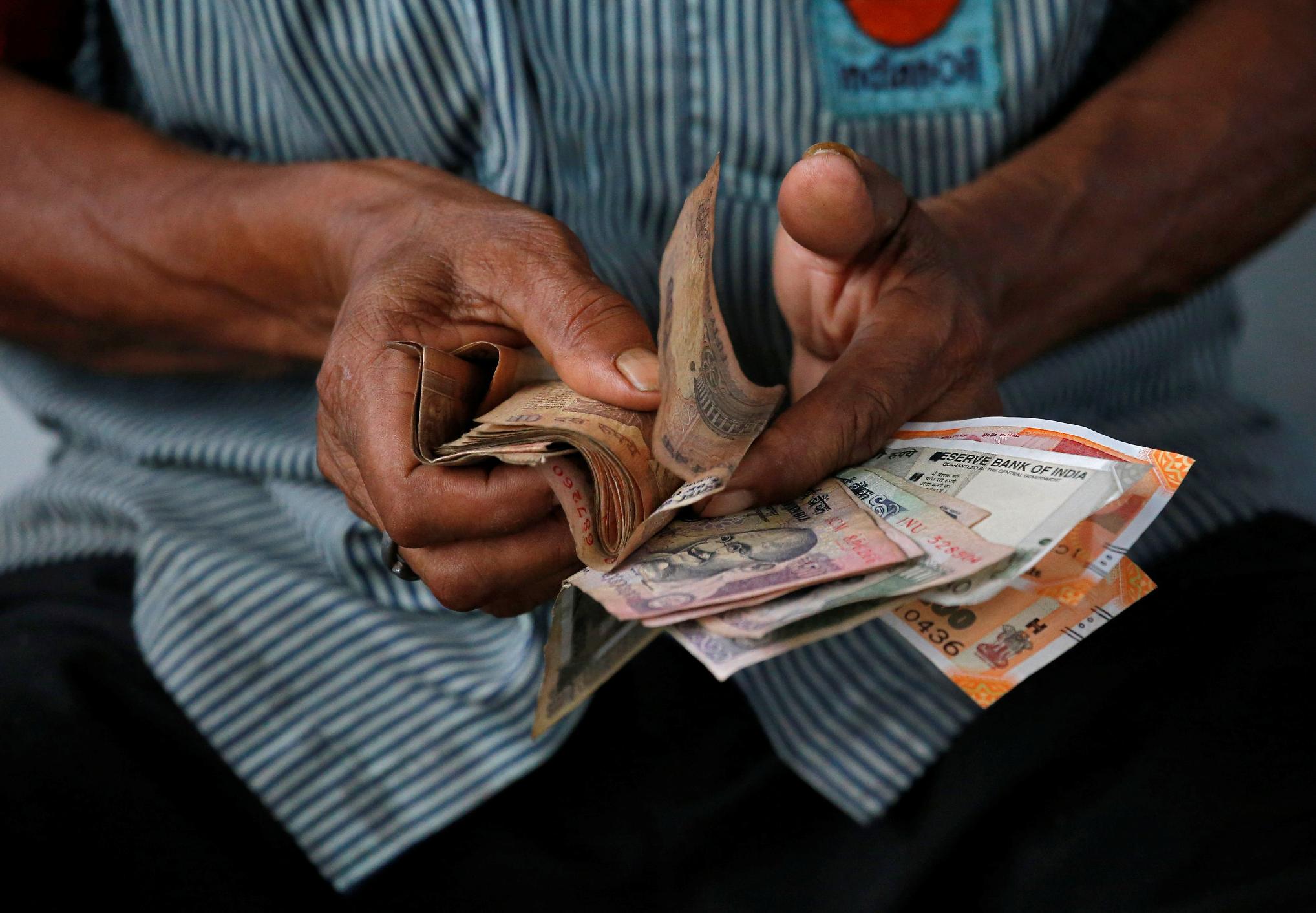
MUMBAI, Dec 12 (Reuters) - The Indian rupee ended little changed on Tuesday and hovered in a tight range tracking subdued moves in its Asian peers as markets await a key U.S. inflation report. The rupee closed at 83.3875 against the U.S. dollar, barely changed from its close at 83.3925 in the previous session. The unit hovered between 83.36 and 83.39 on Tuesday. Most Asian currencies were rangebound except for the Thai baht, which was down 0.8%. The dollar index fell 0.2% to 103.8. Meanwhile, rupee forward premiums rose with the 1-year implied yield rising 5 bps to 1.65% after having receded sharply on Monday. "Market is largely muted ahead of the U.S. CPI ... but don't expect the rupee will move sharply either way," a foreign exchange trader at a private bank said. U.S. inflation data due later in the day is expected to show that the core Consumer Price Index (CPI) rose to 0.3% month-on-month in November, up from 0.2% in October, according to a Reuters poll. India will also report retail inflation data on Tuesday and economists polled by Reuters estimate that year-on-year CPI rose to 5.70% in November, up from 4.87% in October. While there might be a "knee-jerk reaction" to the U.S. inflation number, commentary from the Federal Reserve is likely to be the more important cue for the rupee, said Dilip Parmar, a foreign exchange research analyst at HDFC Securities. The Fed will deliver its policy decision on Wednesday and is widely expected to keep rates unchanged, with investors keeping a keen eye on the central bank's forward-looking projections and commentary. While the Reserve Bank of India routinely intervenes to defend the rupee, the central bank's simultaneous purchase and sale of U.S. dollars in recent weeks has left bankers puzzled, Reuters reported earlier on Tuesday. https://www.reuters.com/markets/currencies/rupee-ends-flat-tracking-subdued-asia-fx-us-cpi-data-focus-2023-12-12/
2023-12-12 10:07
U.S. CPI advanced by 3.1% in November Markets expect Fed to stay put on rates on Wed Dec 12 (Reuters) - Gold prices on Tuesday pared gains on news that U.S. consumer prices rose unexpectedly in November, while traders focused on key central bank policy meetings for clues on monetary policy. Spot gold was steady at $1,978.68 per ounce, as of 1:55 p.m. ET (1855 GMT), after rising about 0.5% ahead of the data release. U.S. gold futures settled little changed at $1,993.20. The consumer price index (CPI) rose 3.1% in November on an annual basis, in line with economists' expectations. The CPI edged up 0.1% on a month-on-month basis in November. "Inflation data was in line with the expectations, but people really needed to see a strong down tick in order to cement the those marked interest rate cuts," said Phillip Streible, chief market strategist at Blue Line Futures in Chicago. "Gold will be stuck between $2,050 on the upside and $1,950 on the downside. Weak economic data and geopolitical tension could boost prices." All eyes turn towards the Fed's two-day monetary policy meeting that will end on Wednesday with its interest rate decision and the release of its summary economic projections. The Fed is widely expected to leave rates unchanged this week, with about an 80% chance of a rate cut in May, CME FedWatch Tool shower. Lower interest rates tend to support zero-yielding gold. "If a recession does occur, the dollar could weaken and that would help to propel the gold price to new highs," Heraeus Metals said in its 2024 outlook. "Gold is forecast to trade between $1,880-$2,250." The dollar (.DXY) pared losses after CPI data. A stronger dollar makes gold more expensive for other currency holders. Traders will also keep a tab on the policy meetings of the European Central Bank and Bank of England on Thursday. Silver fell 0.3% to $22.73 per ounce, while platinum rose 1.8% to $926.03. Palladium climbed 2% to $976.22. https://www.reuters.com/markets/commodities/gold-prices-rise-dollar-retreats-ahead-us-inflation-data-2023-12-12/

2023-12-12 09:49
MUMBAI, Dec 12 (Reuters) - The Indian central bank's simultaneous purchase and sale of U.S. dollars in recent weeks has puzzled bankers, who speculate there may be multiple objectives behind the operations. The Reserve Bank of India (RBI) has been buying dollars amid hefty foreign inflows, and has, at the same time, been selling them to prevent the rupee breaching its record low, several traders said. Overseas investors have pumped in $3.7 billion into Indian equities and $800 million into debt in the six sessions in December, according to the National Securities Depository. Still, the rupee is nearly unchanged month-on-month and has traded in a narrow 15-paisa range. The currency's inability to appreciate points to the RBI absorbing the inflows, several traders and treasury officials said. "It has to be the RBI (absorbing the flows)," a senior treasury official at a large private sector bank said. "The price action and what I see on the screen clearly point to the RBI," this person said, referring to the heavy buying interest and the smallest of dips in the dollar/rupee not sustaining. The RBI did not immediately respond to an email by Reuters seeking comment. The rupee was at 83.38 to the dollar on Tuesday, just shy of its lifetime low of 83.42. The unit has been trading near its record low despite expectations the Federal Reserve will cut rates as soon as March next year. Meanwhile, Asian peers have rallied. "It's puzzling - RBI's heavy both-side intervention," head of proprietary FX trading at a bank said. On the one hand, the RBI is selling dollars to make sure the rupee does not weaken and at the same time it is "absorbing any kind of downward draft (on USD/INR)," this person said. It's a "peculiar kind of strategy" that the RBI is following which has left the market confused, Abheek Barua, chief economist at HDFC Bank said. "The way I can rationalize it is by thinking in terms of FX reserves and that of rupee liquidity," Barua said. RBI's forex market intervention has several implications beyond the dollar/rupee rate. Buying dollars flowing into the local market boost India's forex reserves and add to the rupee liquidity in the banking system. Selling dollars does the reverse. India's FX reserves have climbed to a more-than-four-month high of $604 billion, data released last Friday showed. Banking system liquidity, which was in a large deficit in November, has moved to a surplus in December. The RBI reinforcing its "low volatility regime" for the rupee and the currency's overvaluation could also be reasons for the simultaneous buying and selling of the dollar, the treasury official at the private bank said. According to the RBI's latest monthly bulletin, the rupee was overvalued by about 5% against a basket of 40 currencies. https://www.reuters.com/world/india/india-cenbank-aiming-multiple-targets-with-simultaneous-purchase-sale-dollars-2023-12-12/