2023-12-06 14:21
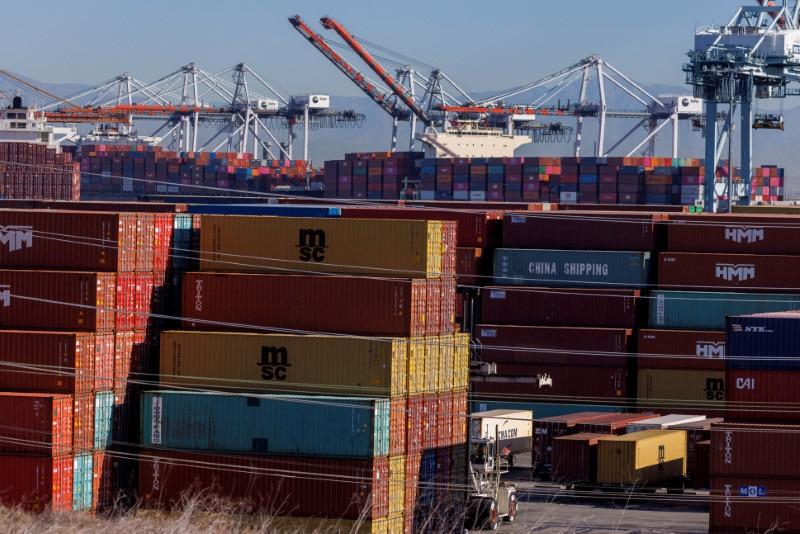
WASHINGTON, Dec 6 (Reuters) - The U.S. trade deficit widened more than expected in October as exports declined, likely positioning trade to be a drag on economic growth in the fourth quarter. The trade deficit increased 5.1% to $64.3 billion, the Commerce Department's Census Bureau said on Wednesday. Data for September was revised to show the trade gap rising to $61.2 billion instead of $61.5 billion as previously reported. Economists polled by Reuters had forecast the trade deficit increasing to $64.2 billion in October. Exports of goods and services fell 1.0% to $258.8 billion. Goods exports decreased 1.8% to $173.5 billion. Consumer goods exports decreased $2.1 billion, led by gem diamonds and pharmaceutical products. Exports of motor vehicles, parts and engines decreased $0.9 billion. But exports of industrial supplies and materials increased $1.2 billion. At $51.2 billion, capital goods exports were the highest on record. Exports of services rose $0.6 billion to $85.3 billion, lifted by transport, financial and other business services. But travel services exports fell. Imports of goods and services gained 0.2% to $323.0 billion. Goods imports edged up 0.1% to $263.3 billion, potentially flagging softening domestic demand amid higher interest rates. Capital goods imports increased $1.8 billion amid rises in computers, drilling and oilfield equipment. Imports of motor vehicles, parts and engines fell $1.0 billion. Imports of services increased $0.2 billion to $59.8 billion, supported by a rise in travel. Trade was neutral to the economy's 5.2% annualized growth rate in the third quarter. Growth estimates for the fourth quarter are mostly below a 2% pace. https://www.reuters.com/markets/us/us-trade-deficit-widens-october-weak-exports-2023-12-06/
2023-12-06 13:55
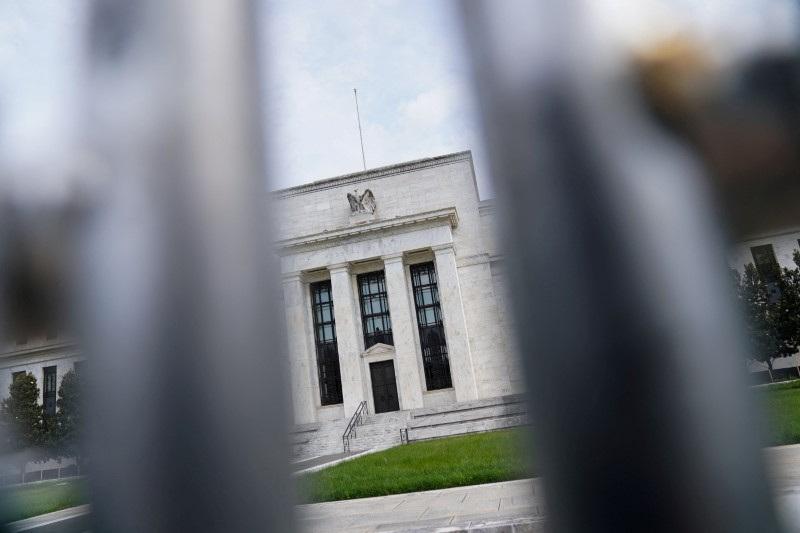
BENGALURU, Dec 6 (Reuters) - The U.S. Federal Reserve will hold interest rates until at least July, later than earlier thought, according to a slim majority of economists in a Reuters poll who said the first cut would be to adjust the real rate of interest, not the start of stimulus. All but five of 102 economists in the Dec. 1-6 Reuters poll said the Fed was done hiking in this cycle, even though Chair Jerome Powell said last week policymakers were "prepared to tighten policy further if it becomes appropriate to do so". The debate has now shifted to how long the federal funds rate will remain in its current 5.25%-5.50% range and how many cuts will be delivered next year, which the survey suggests will be significantly less than what markets are currently expecting. Despite recent strong economic growth and inflation running above target, markets are pricing in around 150 basis points of cuts next year, starting in March, a swift change from the "higher for longer" narrative just a few weeks ago. Economists are less convinced the Fed will start cutting so soon, with slightly more than half, 52 of 102, forecasting no rate cuts until at least July. Nearly three-quarters of forecasters, 72 of 102, predicted 100 basis points of cuts or less next year. The proportion of Fed watchers expecting a cut sometime in the first six months of the year is moving in the opposite direction to markets and has steadily dropped in recent months from more than 70% in September. "We agree the Fed will cut in 2024, but think markets are underestimating how stubbornly high inflation will delay cuts until activity has more clearly slowed," said Andrew Hollenhorst, chief U.S. economist at Citi. Markets have moved sharply. Benchmark 10-year Treasury note yields have dropped sharply in the past month, after crossing 5% in October. The S&P 500 is up over 19% for the year, marking its best month since July 2022 in November. "We expect stronger core ... inflation in coming months to disrupt the slowing-inflation narrative," said Hollenhorst, who expects the Federal Open Market Committee to start cutting in the third quarter of next year. "And even if we are wrong and inflation stays softer, so long as activity holds up, the committee might take the opportunity to bolster their credibility by waiting for even stronger evidence that inflation had sustainably slowed." All inflation measures polled by Reuters - the consumer price index (CPI), core CPI, PCE and core PCE - were predicted to decline gradually but remain above the central bank's 2% PCE target until at least 2025. Still, the interest rate adjusted for inflation - the real rate - would become more restrictive if left unchanged as price pressures fall and poses a risk of slowing the economy too much. Over two-thirds of respondents, 26 of 38, who answered an additional question said adjusting that real rate down would prompt the first Fed rate cut, rather than a need to shift towards stimulating the economy. The world's No. 1 economy, after growing at a strong 5.2% annualized pace last quarter, was expected to lose momentum and expand 1.2% this quarter and average 1.2% in 2024. Still, the economy has held up well against the 525 basis points of hikes in the most aggressive tightening cycle in four decades and was expected to continue to add thousands of jobs, keeping the unemployment rate low and price pressures high. "With the current stance of policy 'becoming more balanced', the courage for the Fed to remain on hold will be challenged," said Ellen Zentner, chief U.S. economist at Morgan Stanley who cautioned not to call next year's moves an easing cycle. "When the Fed begins to cut rates in 2024, it is maintaining a certain level of restrictiveness by following inflation downward ... Cutting versus easing is not just semantics, it's an important distinction." (For other stories from the Reuters global economic poll:) https://www.reuters.com/markets/us/fed-hold-rates-until-least-july-first-cut-not-start-stimulus-wave-2023-12-06/
2023-12-06 13:29
WASHINGTON, Dec 6 (Reuters) - U.S. private payrolls increased less than expected in November as the labor market gradually cools. Private payrolls rose by 103,000 jobs last month, the ADP National Employment Report showed on Wednesday. Data for October was revised lower to show 106,000 jobs added instead of 113,000 as previously reported. Economists polled by Reuters had forecast private payrolls rising 130,000. The ADP report, jointly developed with the Stanford Digital Economy Lab, was published ahead of the release on Friday of the Labor Department's more comprehensive and closely watched employment report for November. The ADP report has been a poor gauge for predicting the private payrolls count in the employment report. The labor market is steadily slowing in the aftermath of 525 basis points worth of interest rate hikes from the Federal Reserve since March 2022. The government reported on Tuesday that job openings fell to more than a 2-1/2-year low of 8.733 million in October. There were 1.34 vacancies for every unemployed person, the lowest since August 2021. According to a Reuters survey of economists, the Labor Department's Bureau of Labor Statistics is expected to report that private payrolls increased by 153,000 jobs in November as about 33,000 striking United Auto Workers union members returned to work. Private payrolls rose 99,000 in October. Total nonfarm payrolls are estimated to have increased by 180,000 in November after rising 150,000 in the prior month. Easing labor market conditions together with ebbing inflation have led financial markets to believe that the Fed's monetary policy tightening campaign was over and that the U.S. central bank could cut rates as soon as next March. The Fed is expected to leave rates unchanged next Wednesday. https://www.reuters.com/markets/us/us-private-payrolls-miss-expectations-november-2023-12-06/

2023-12-06 12:39
MANILA, Dec 6 (Reuters) - The governor of the Philippine central bank said on Wednesday it could either keep interest rates steady or raise them at its policy meeting next week. The central bank, which meets for the last time this year on Dec. 14, kept interest rates steady at 6.5% at its meeting in November after an off-cycle 25-basis point hike on Oct. 26, amid worries that inflation could spiral out of control. "Hawkish means we could either pause or we could hike on December 14," Bangko Sentral ng Pilipinas Governor Eli Remolona told reporters. Even as inflation rose at its slowest pace in 20 months in November, at 4.1% versus the previous month's 4.9%, the central bank said on Tuesday there was a need to keep monetary policy "sufficiently tight until a sustained downtrend" was evident. Barring supply shocks, Remolona said, inflation could return to the central bank's 2%-4% target by December, and remain below 3% in the early part of 2024. Remolona said the central bank will not lower banks' reserve requirement ratio, currently at 9.5%, while it is still hawkish. https://www.reuters.com/markets/asia/philippines-central-bank-may-pause-or-hike-rates-next-meeting-governor-2023-12-06/

2023-12-06 12:03
Dec 6 (Reuters) - Moody's put Hong Kong, Macau and swathes of China's state-owned firms and banks on downgrade warnings on Wednesday as it wasted little time in following up on an identical move the previous day on the mainland government's ratings. Moody's said the moves for Hong Kong and Macau reflected their tight political, institutional, economic and financial links with China under their "One Country, Two Systems" arrangements. Hong Kong, which is rated one notch higher than China at Aa3 versus A1, hit out at the decision saying in a statement that its ties with Beijing were "a source of strength for long-term development." Moody's added that, following imposition of a National Security Law in 2020 and changes to Hong Kong's electoral system, it expected the erosion of the city's autonomy "to continue incrementally". Mainland China's weakening economy would affect Hong Kong's finance-dominated one as well and that weaker growth could also erode the Hong Kong government's fiscal buffers. The ratings agency separately also lowered the outlooks of 26 local government financing vehicles and four state-owned enterprises and put all 30 of them on "review for downgrade", which usually means a decision will be made within three months. Eight Chinese banks had their outlooks cut to negative but they weren't put on review for a downgrade. Those included Agricultural Development Bank of China, China Development Bank and the Export-Import Bank of China (2544.HK), as well as five large state-owned commercial banks: Agricultural Bank of China (601288.SS), Bank of China (601988.SS), China Construction Bank (601939.SS), Industrial & Commercial Bank of China and Postal Savings Bank of China (1658.HK). https://www.reuters.com/markets/asia/moodys-changes-hong-kongs-outlook-negative-stable-2023-12-06/

2023-12-06 12:01
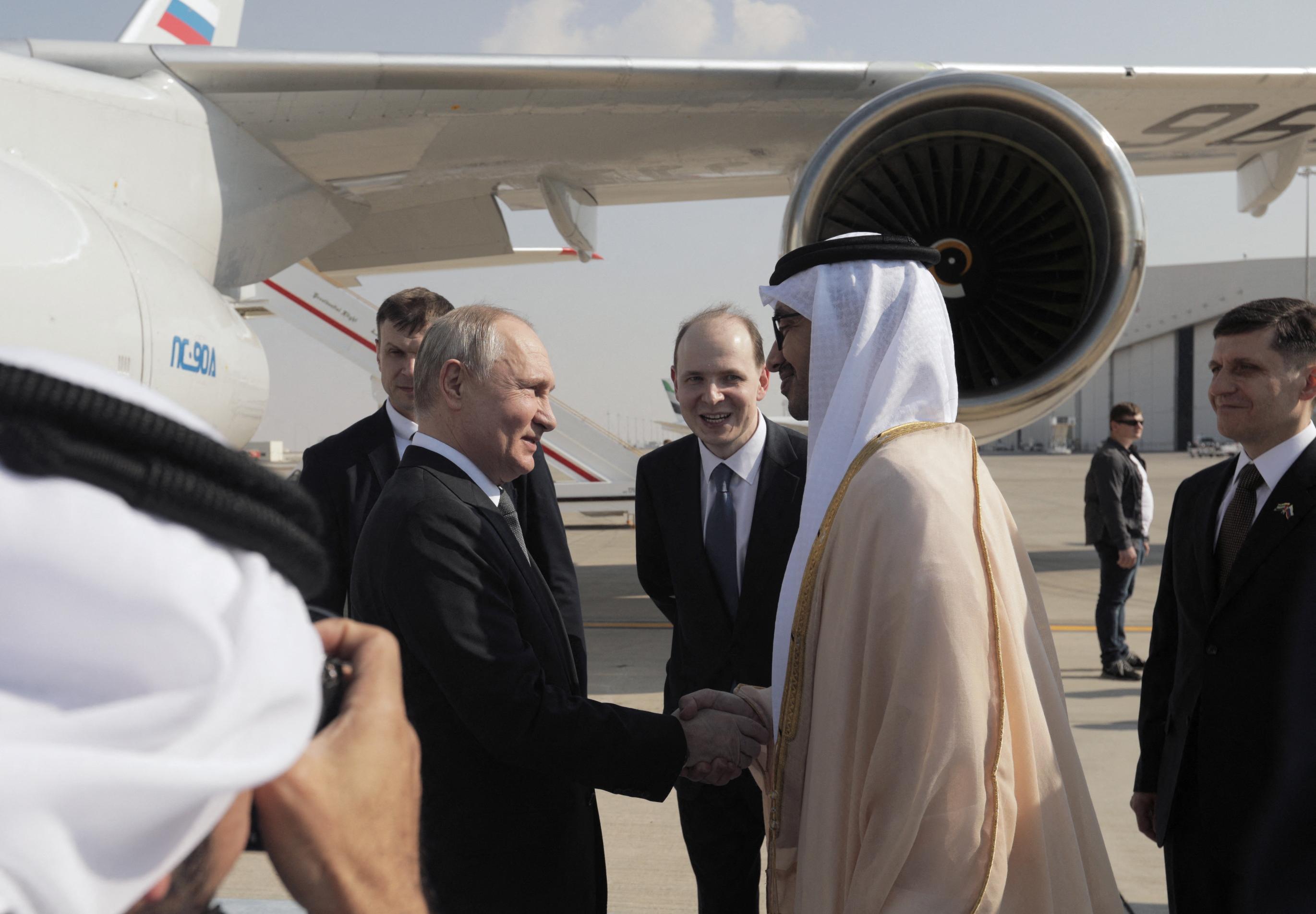
Cooperation within OPEC+ to continue Meeting with MbS in Moscow had been postponed amid oil producer split Putin met Sheikh Mohammed Bin Zayed Al Nahyan in UAE Oil, OPEC+, Gaza, Ukraine on agenda of rare foreign trip Putin to host Iranian president on Thursday RIYADH, Dec 6 (Reuters) - Russian President Vladimir Putin and Saudi Crown Prince Mohammed bin Salman discussed further cooperation on oil prices on Wednesday as members of OPEC+, a Kremlin spokesperson was quoted as saying. A Saudi account of the meeting said the crown prince praised joint coordination between the two countries "that helped remove tensions in Middle East". Putin and the crown prince, de facto ruler of the world's largest crude exporter, had the hastily arranged talks hours after the Kremlin leader visited Saudi Arabia's Gulf neighbour, the United Arab Emirates. Kremlin spokesperson Dmitry Peskov, quoted by Russian news agencies, said cooperation would continue within OPEC+, which includes the Organization of the Petroleum Exporting Countries (OPEC) and allies led by Russia. The meeting took place after a fall in oil prices despite an OPEC+ pledge to cut output further. "We talked again about cooperation in OPEC+," Interfax news agency quoted Peskov as saying. "The parties agree that our countries bear a great responsibility for interaction in order to maintain the international energy market at the proper level, in a stable, predictable state." Putin, who has rarely left Russia since sending troops into Ukraine in February 2022, had also been expected to discuss Ukraine and the conflict in Gaza. The Saudi Press Agency quoted the crown prince as saying: "We share many interests and many files that we are working on together for the benefit of Russia, the Kingdom of Saudi Arabia, the Middle East and the world as well." In remarks at the beginning of their talks, shown earlier on Russian television, Putin thanked MbS, as the crown prince is widely known, for his invitation. He had originally expected him to visit Moscow, "but there were changes to plans". Their next meeting should take place in Moscow, he said, and "Nothing can prevent the development of our friendly relations." Russia's defence ministry had earlier shown the Kremlin chief's Ilyushin-96 aircraft flanked by Sukhoi-35S fighter jets on its flight from Russia to the United Arab Emirates. Putin's delegation included top oil, economy, foreign affairs, space, nuclear energy officials and business leaders. At his first stop in Abu Dhabi, President Sheikh Mohammed bin Zayed al-Nahyan welcomed his "dear friend", while a fly-past of UAE jets trailed the colours of the Russian flag. "Our relations, largely due to your position, have reached an unprecedentedly high level," Putin told him. "The UAE is Russia's main trading partner in the Arab world." Putin said Russia and the UAE cooperated as part of OPEC+, whose members pump more than 40% of the world's oil, adding that they would discuss the Israeli-Hamas conflict and Ukraine. His first face-to-face talks with MbS since October 2019 came days after an OPEC+ meeting was delayed over disagreements - superseding what should have been an MbS visit to Moscow. Putin's last visit to the region was in July 2022, when he met Supreme Leader Ayatollah Ali Khamenei in Iran. The Russian president was due to host his Iranian counterpart Ebrahim Raisi in Moscow on Thursday. CLOSE RELATIONS Putin and MbS, who together control one-fifth of the oil pumped each day, have long enjoyed close relations, though both have at times been ostracised by the West. At a G20 summit in 2018, two months after the murder of Saudi journalist Jamal Khashoggi in a Saudi consulate, Putin and MbS high-fived and shook hands with smiles. MbS has sought to reassert Saudi Arabia as a regional power with less deference to the United States, which supplies Riyadh with most of its weapons. Putin says Russia is locked in an existential battle with the West and has courted allies across the Middle East, Africa, Latin America and Asia amid Western attempts to isolate Moscow. Both MbS and Putin need high prices for oil, the lifeblood of their economies. The question is how much of the burden each should take on to keep prices aloft - and how to verify their contributions. Last month, OPEC+ delayed a meeting by several days due to disagreements over production levels. The Saudi energy minister said OPEC+ also wanted more assurances from Moscow that it would make good on its pledge to reduce fuel exports. Relations between Saudi Arabia and Russia in OPEC+ have been uneasy at times. A deal on cutting exports almost broke down in March 2020, but they managed to make up within weeks and OPEC+ agreed to record cuts of almost 10% of global demand. https://www.reuters.com/world/middle-east/putin-talk-oil-uae-saudi-meet-crown-prince-mohammed-bin-salman-2023-12-06/