2023-11-29 11:34
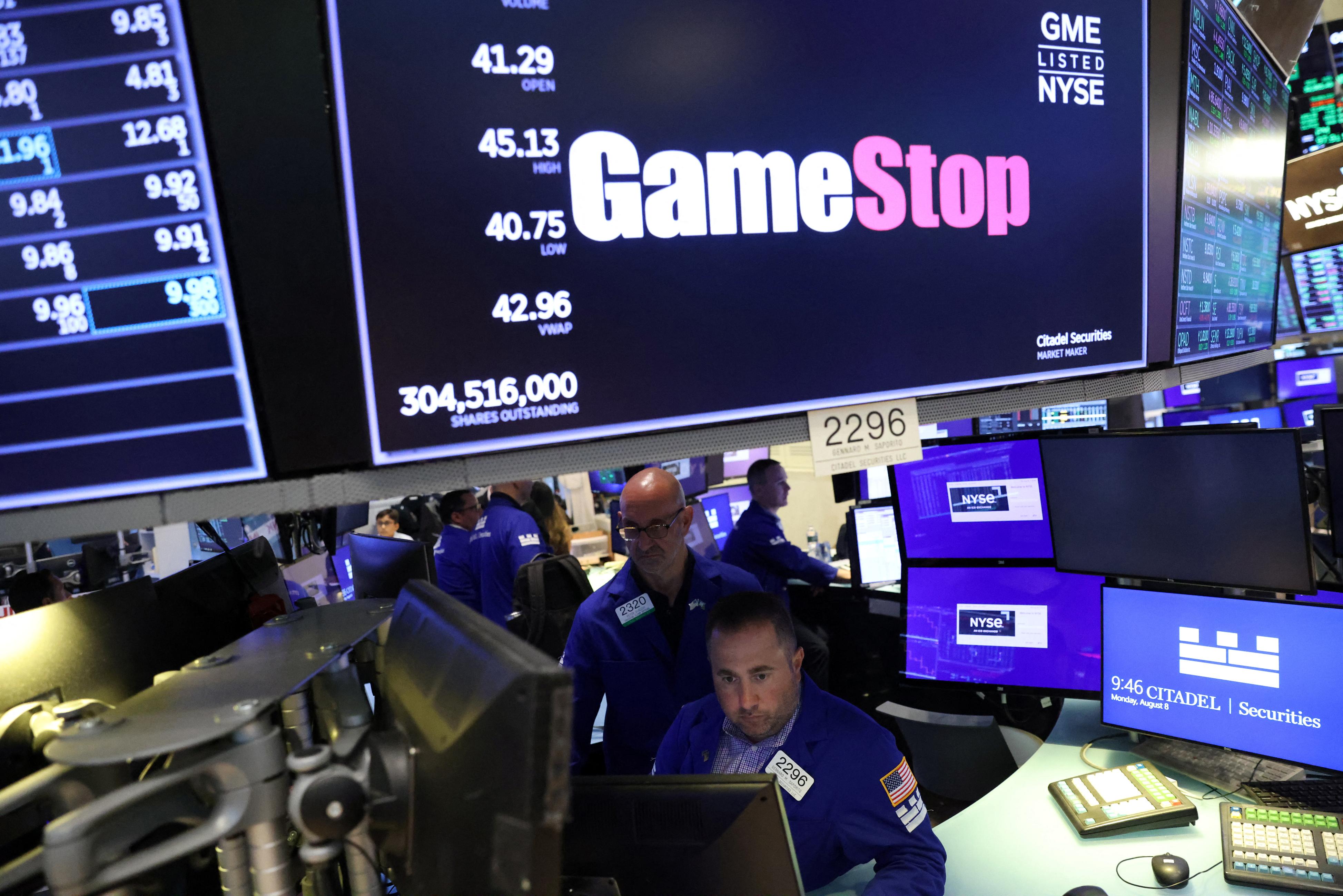
Nov 29 (Reuters) - Retail traders powered a nearly 20% jump in GameStop (GME.N) shares to a two-month high in regular trading on Wednesday, extending a rally ahead of the company's quarterly results next week and underscoring a return in appetite for risk. The meme stock is up nearly 36% over the last two sessions at $15.31. "Speculation is back ... and GameStop is ground zero for speculation," Steve Sosnick, chief strategist at Interactive Brokers, said. AMC Entertainment (AMC.N) and Cathie Wood's ARK Innovation ETF (ARKK.P) - other favorites among retail traders - were up nearly 3.5% and 0.5%, respectively. The recovery in meme stocks comes as the S&P 500 (.SPX) closes in on its highest level for 2023 on hopes U.S. interest rates have peaked, breathing life into speculative trading that has struggled this year. GameStop closed about 13% higher on Tuesday. Individual investors purchased $1.92 million worth of the company's shares on a net basis on Tuesday, their highest since Aug. 6, data from Vanda Research showed. Both stocks were among the most discussed by traders on social media site stocktiwts.com on Wednesday. GameStop is set to post third-quarter results on Dec. 6, with analysts expecting its net loss to narrow to $25.6 million from $93.4 million a year earlier. About 21.6% of GameStop's shares were sold short, according to data and analytics firm Ortex, and bearish investors stand to lose about $200 million on Tuesday and Wednesday combined. "Some short sellers may be concerned both by this price move but also that GameStop will release better-than-expected earnings next week," said Peter Hillerberg, co-founder of Ortex. The surge in GameStop shares was backed by strong options activity. Some 230,000 GameStop options contracts traded by 11:38 a.m. (1638 GMT) with the bulk in call options, typically bought to bet on shares climbing higher. Large purchases of out-of-the-money call options - contracts that are not profitable but stand to gain in value as the stock climbs - can sometimes give an additional lift to a stock's price. "As long as people continue to buy calls that should pressure the stock to continue going higher," said Brent Kochuba, founder of options data platform Spotgamma. "Another 15% or 20% (move) higher is still on the cards." With GameStop shares at around $15, call options betting on the stock finishing higher than $16 by Friday were the most heavily traded GameStop options. Sosnick, however, cautioned that speculative rallies in the recent past have been quick to peter out. Shares of GameStop are down 27% this year through Tuesday's close, while those of AMC have shed 80% of their value in the same period. https://www.reuters.com/markets/us/gamestop-shares-climb-strong-volume-2023-11-29/
2023-11-29 11:27
Futures up: Dow 0.29%, S&P 0.33%, Nasdaq 0.45% Nov 29 (Reuters) - U.S. stock index futures rose on Wednesday as investors remained optimistic about an interest rate cut from the Federal Reserve next year, and multi-month lows in Treasury yields that boosted sentiment. Wall Street indexes ended marginally higher on Tuesday after some positive commentary from the Fed, while upbeat consumer data provided some lift. Fed Governor Christopher Waller, deemed a hawk, on Tuesday hinted at lower interest rates in the months ahead if inflation continued to ease, while Chicago Fed President Austan Goolsbee voiced concerns about keeping interest rates "too high for too long." The remarks sent U.S. Treasury yields to multi-month lows, with the benchmark 10-year note last standing at 4.2956%. "This was the first time a Fed official discussed the possibility of a cut, and that's maybe why market participants ignored comments by Governor Bowman that higher rates may be needed in order to bring inflation back down to the 2% objective," said Charalampos Pissouros, senior investment analyst at XM in a note. Fed Governor Michelle Bowman on Tuesday alluded to the possibility of another rate hike. While a pause in rate hike in the upcoming December meeting has been almost fully priced in, money markets now see a nearly 73% chance of at least a 25-basis point rate cut in May 2024, up from about 65% a day earlier, according to CME Group's FedWatch tool. Megacap stocks edged higher in premarket trading, with Meta Platforms (META.O), Nvidia (NVDA.O) and Alphabet (GOOGL.O) up between 0.5% and 0.8%. Tesla (TSLA.O) added 1.0%, and was on course to rise for the fourth straight session. Traders are awaiting the second estimate of the U.S. GDP, expected later in the day, and the release of the "Beige Book", a snapshot of the U.S. economy, at 2:00 p.m. ET, for further cues on how the economy is faring under restrictive monetary conditions. Focus would also be on any policy comments from Richmond Fed President Thomas Barkin, who is slated for an interview at 10:00 a.m. ET. Preliminary numbers for the personal consumption expenditure (PCE) index - the Fed's preferred inflation gauge- is also due later in the day, ahead of the final numbers on Thursday. At 5:42 a.m. ET, Dow e-minis were up 102 points, or 0.29%, S&P 500 e-minis were up 15 points, or 0.33%, and Nasdaq 100 e-minis were up 71.5 points, or 0.45%. Among single stocks, CrowdStrike Holdings (CRWD.O) added 1.5% before the bell as the firm forecast fourth-quarter revenue above street estimates, driven by resilient demand for its cybersecurity offerings. Okta (OKTA.O) slid 6.4% after the cybersecurity firm said that hackers stole information on all users of its customer support system in a network breach two months ago. NetApp (NTAP.O) jumped 12.6% after the cloud-based data management platform raised its annual profit forecast on resilient demand for its cloud-based data solutions. https://www.reuters.com/markets/us/futures-rise-growing-bets-rate-cuts-next-year-2023-11-29/
2023-11-29 11:22
WASHINGTON, Nov 29 (Reuters) - The U.S. Department of Agriculture on Wednesday said it would start accepting applications for an initial $300 million in funding to help U.S. agricultural exporters break into new markets outside China, Canada, Mexico and the European Union. Agriculture Secretary Tom Vilsack will make the announcement during a meeting of the President's Export Council at the White House, kicking off the first year of the Regional Agricultural Promotion Program (RAPP) established by USDA in October. The RAPP program will provide a total of $1.2 billion over five years to non-profit U.S. agricultural trade groups, State Regional Trade Groups (SRTGs), U.S. agricultural cooperatives, and other state agencies to help them tap new markets and increase market share. “It takes significant investment to open and develop new export markets and this new fund will be dedicated to helping provide that start-up capital so that American exporters can diversify their markets and create new opportunities,” Vilsack said in a statement. U.S. exports of agricultural and related products hit a record $213 billion in 2022, with China acounting for a record 19.2% of the total value, mainly through purchases of soybeans, cotton and beef. Canada, Mexico and Japan rounded out the top four at 16%, 14% and 8%, respectively, of the 2022 U.S. export total. Vilsack said the middle class was growing in many places across South and Southeast Asia, Latin America, the Middle East and Africa, driving demand for high quality products. "In order to capture those markets from our competitors we need to have a presence, address barriers, and showcase America’s high-quality, agricultural products across the world.” USDA said diversification would focus on three regions - Africa; Latin America and the Caribbean; and South and Southeast Asia - in the first phase of the new program, with $25 million set aside specifically for work in Africa. USDA also recently announced it would host trade missions to an array of countries in 2024, including South Korea, India, Colombia, Vietnam and Morocco. https://www.reuters.com/markets/us/usda-opens-applications-300-mln-help-exporters-break-into-new-markets-2023-11-29/

2023-11-29 11:21
PARIS, Nov 29 (Reuters) - The global economy will slow slightly next year but the risk of a hard landing has subsided despite high levels of debt and uncertainty over interest rates, the Organisation for Economic Cooperation and Development said on Wednesday. Global growth is set to moderate from 2.9% this year to 2.7% in 2024 before picking up in 2025 to 3.0%, the Paris-based policy forum said in its latest Economic Outlook. Growth in advanced economies that make up the OECD's 38 members was seen headed for a soft landing, with the United States holding up better than expected so far. "Our central projections are for a soft landing, but that cannot be taken for granted," OECD chief economist Clare Lombardelli told a news conference. "Monetary policy needs careful calibration to bring inflation to targets while minimising the impact on growth. These judgements are now harder than earlier in the cycle and the risks of policy errors are greater," she added. The OECD forecast U.S. growth would slow from 2.4% this year to 1.5% next year, revising up its estimates from September when it predicted U.S. growth of 2.2% in 2023 and 1.3% in 2024. Though the risk of a hard landing in the United States and elsewhere had eased, the OECD said that the risk of recession was not off the table given weak housing markets, high oil prices and sluggish lending. China's economy was also expected to slow as it grapples with a deflating real estate bubble and consumers save more in the face of greater uncertainty about the outlook. Its growth was seen easing from 5.2% this year to 4.7% in 2024 - both marginally higher than expected in September - before slowing further in 2025 to 4.2%, the OECD forecast. In the euro area, growth was seen picking up from 0.6% this year to 0.9% in 2024 and 1.1% in 2025 as Germany - the region's largest economy - emerged from a recession this year. Nonetheless, the OECD warned that, because of the high level of bank financing in the euro zone, the full impact of interest rate hikes remained uncertain and could weigh more on growth than expected. Meanwhile, Japan, the only major advanced economy yet to hike interest rates in the current cycle, was expected to see growth slow from 1.7% this year to 1.0% in 2024 before picking up to 1.2% in 2024. While countries' growth outlooks were diverging, they shared similar fiscal pressures, with debt burdens projected to keep rising for years to come in G7 countries, the OECD warned. "Governments need to act to prevent unsustainable debt paths. Needed reforms include medium-term plans to curb deficits over time, reducing the cost of ageing and to preserve spending that is effective and efficient," Lombardelli said. https://www.reuters.com/markets/global-growth-slow-avoid-hard-landing-oecd-2023-11-29/
2023-11-29 11:07
A look at the day ahead in U.S. and global markets from Mike Dolan As Wall Street mourns the passing of 99-year-old investment legend Charlie Munger, Federal Reserve top brass gave one of the clearest signals yet that the central bank's 20-month tightening campaign is over at last. The death of Berkshire Hathaway's Munger leaves 93-year Warren Buffett without his long-term lieutenant and the conglomerate's lone star name, focusing minds on long-planned succession and the lesser-known managers due to take over. But back in the markets, the Fed's policy pivot was all the rage as Treasury yields and dollar plunged anew. Fed Governor Christopher Waller, a hawkish and influential voice at the central bank and seen to be close in thinking to Fed boss Jerome Powell, clearly indicated the Fed's swingeing rate hiking was over as current settings bear down on inflation. "I am increasingly confident that policy is currently well positioned to slow the economy and get inflation back to 2%," he said, and also "reasonably confident" of doing so without a sharp rise in the unemployment rate, now at 3.9%. And in later comments interpreted as signalling rate cuts could be considered next year, Waller said there was "no reason" to insist rates stay "really high" if inflation continues to decline consistently. Other Fed officials chimed with Waller. New York Fed chief John Williams said long-term inflation expectations were anchored, reassuring and "remarkably stable". Chicago Fed President Austan Goolsbee was more colorful in insisting there were risks in keeping rates too high for too long - due to the lags in policy taking effect. "Anybody who cooks a turkey knows that you got to pull it out of the oven before it's to the point where you want it to be, because it's going to have residual heat." Only Fed governor Michelle Bowman seemed to hold up the side of the hawks, saying she still expects one more rate rise. Has there been a deliberate shift in guidance? We may have to wait for Powell for the casting vote on that when he speaks on Friday. But for now, markets were electrified by Waller's seeming turn and the prospect that their bullish take on stocks and bonds for 2024 - disinflation, rate cuts and a soft landing - looked to be on track. Fed futures now have the first Fed rate cut of a quarter point fully priced for May and 110bps of rate cuts by year-end. Two-year Treasury yields plunged more than 15 basis points to four-month lows of 4.66% on Wednesday, with 10-year yields hitting their lowest since mid-September - a startling drop of more than 75bps in little over a month. The dollar index (.DXY) plunged to 3-month lows, only clawing some of that ground back on Wednesday. China's offshore yuan , for example, hit its strongest level against the U.S. currency since June. Stocks were lifted too, although the reaction has been more muted than in the bond market so far and the (.SPX) only eked out a small gain on Wednesday. Still, November's 8.6% rise makes it the best month of a year that's clocking year-to-date gains of almost 19% and stock futures were up were up smartly again ahead of Wednesday's bell. The VIX volatility gauge (.VIX) remained close to its lowest since the pandemic at just 12.6. Crude oil prices were a touch higher ahead of Thursday's OPEC+ meeting, which is still going ahead despite some reports of another postponement amid rifts in the cartel. Most world markets were higher too, with MSCI's all-country stock index (.MIWD00000PUS) firmer and on course for its best month since late 2020 - as November comes to a close tomorrow. The big exception once again were still deeply underperforming China stocks (.CSI300) - now lagging the MSCI global index by almost 25% for 2023. Hong Kong's Hang Seng (.HSI) plunged another 2% as food delivery giant Meituan's (3690.HK) cautious fourth-quarter outlook raised recovery concerns over China's consumer spending. In Europe, November inflation data was awaited - but there were gnawing concerns about the region's real estate companies as Austria's Signa Holdings said it would apply to launch self-administrated insolvency proceedings with a Vienna court on Wednesday. Key developments that should provide more direction to U.S. markets later on Tuesday: * U.S. Q3 GDP revision, deflator, corporate profits and PCE inflation gauge estimates. U.S. Oct trade balance, retail and wholesale inventories * Federal Reserve releases Beige Book of current economic conditions. Richmond Fed President Thomas Barkin and Cleveland Fed chief Loretta Mester speak. Bank of England Governor Andrew Bailey and BoE markets head Andrew Hauser speak at London FX event * US Secretary of State Blinken meets Russian Foreign Minister Sergey Lavrov on sidelines of OSCE meeting in North Macedonia * U.S. corporate earnings: Salesforce, Synopsys, Dollar Tree, Hormel Foods, Intuit, Petco, Bilibili etc https://www.reuters.com/markets/us/global-markets-view-usa-2023-11-29/
2023-11-29 11:00
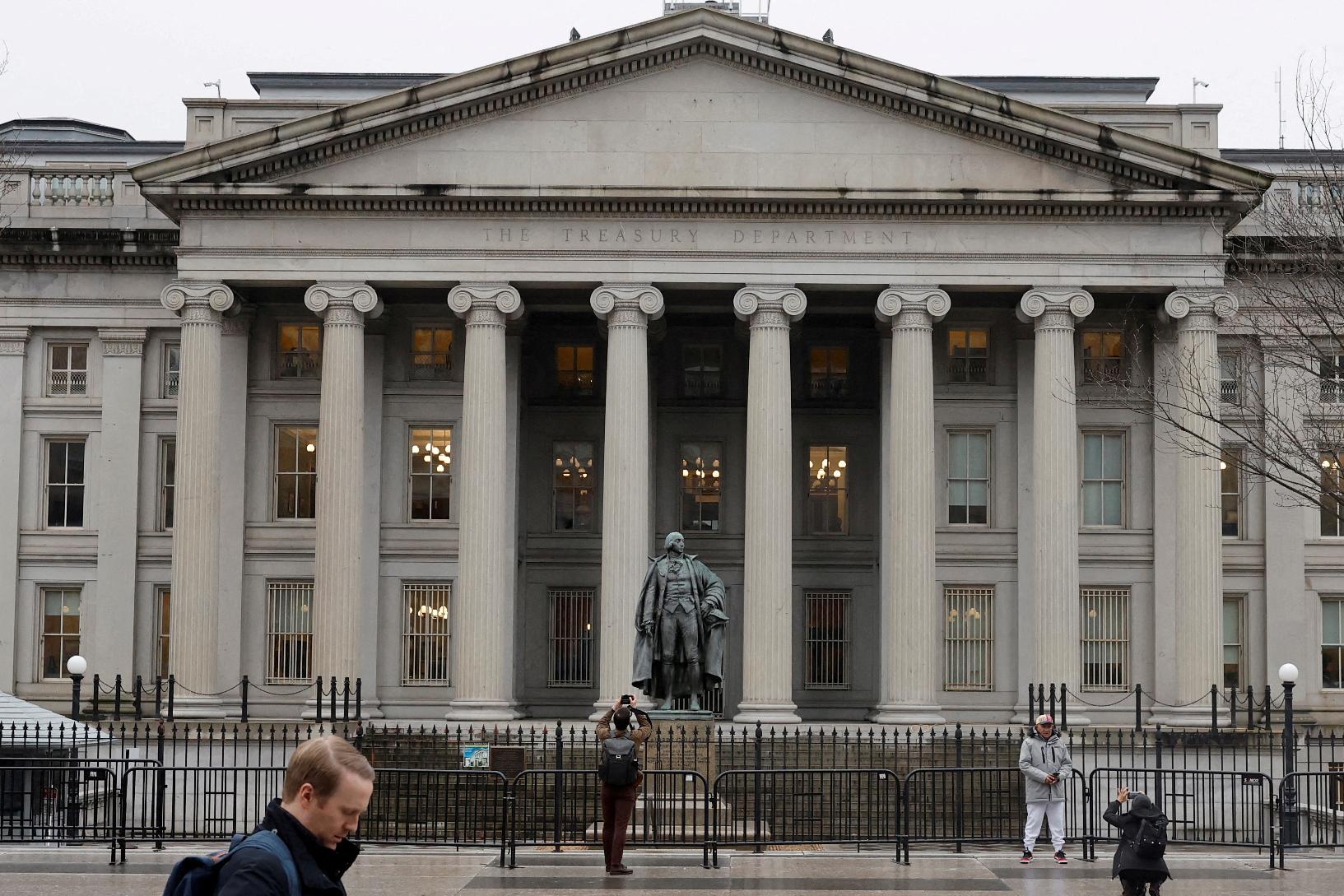
Nov 29 (Reuters) - In recent weeks top U.S. officials have raised concerns over a hedge fund trade that profits from tiny price differences in Treasuries, worried it could present a risk to financial stability. No one knows, though, how big that trade really is. Researchers from the U.S. Federal Reserve and the Office of Financial Research (OFR) in late August wrote there were signs that the so-called basis trade had increased this year amid rising interest rates, approaching levels last seen in 2019. The trade, inherently risky because hedge funds borrow heavily to juice their profits from it, is believed to have worsened market stress at the height of the pandemic in March 2020. To arrive at the conclusion that the basis trade had ballooned once again, the researchers had to rely on a series of imperfect proxies, rather than data that could directly provide them information about it. That data doesn't exist. Two market sources, one at a major bank and one at a hedge fund, said they didn't see the trade to be as big in their own books. Therein lies a problem that has plagued the bedrock of global finance: Some important segments of the $26 trillion Treasuries market operate in the shadows. The lack of visibility makes policymaking harder and more contentious, leaving regulators sometimes with imperfect understanding and blunt tools that many in the industry argue can create new problems. The problem is not lost on officials, who launched an extensive review of the market in 2021 to improve its resilience and transparency. Their efforts to collect more data are now starting to come together. The next major milestone is expected early next year, with the OFR planning to finalize a rule to collect data on the largest segment of the short-term financing markets that underpin Treasuries. They currently don't have data about such trading, which happens bilaterally, between brokers and their customers, like hedge funds, through repurchase agreements, or repos. Taken together with other steps, it will be a major advance in improving regulators' visibility into the market, but it will still leave some gaps. "It's an issue of degree of transparency," said Darrell Duffie, a Stanford University finance professor who has studied the market in depth. Duffie said more could be done, but added that the "official sector Treasury market datasets are far more comprehensive now than they were a few years ago." An industry executive who is familiar with these issues described the work as foundational, but added that "it doesn't solve all the problems." Officials would have more information about transactions, but won't have the motivations behind all the different types of trades. They would have much better estimates of the basis trade, for example, but they still wouldn't know exactly how big it is. A Treasury official said the authorities have a lot of data to assess the resilience of the Treasury market and inform policy, and are working toward getting more. The efforts to enhance the market's resilience are broad-based and long-term, not focused narrowly on specific positions, like the basis trade, the official added. BASIS TRADES To understand the progress as well as the limitations, take the case of basis trades. The trade involves hedge funds exploiting the difference between a Treasury security and its derivative in the futures market. The funds buy the Treasury bond in the secondary market, financing the purchase by borrowing in repo, where they use the bond as collateral. At the same time, they short the corresponding Treasury futures contract, effectively selling that bond in the future at a higher price than they paid to buy it. In their analysis, the Fed researchers used data vignettes from different legs of that trade, knitting together information from various regulatory agencies. The Commodity Futures Trading Commission (CFTC), for example, has data on hedge fund positions in futures markets. The OFR collects information about repo trading that's done through a third party, called central clearing. The data includes information about the type of collateral that is used, which can be a clue to whether the trade could be a basis trade. The data sources have limitations, which the researchers acknowledged. The CFTC data includes other trades that hedge funds enter into that involve shorting treasury futures, the two industry sources said. And centrally cleared trades are only a small fraction of such hedge fund borrowing, with most happening in the bilateral repo market. Thanks to their efforts, regulators will have more information in the coming months as these rules are finalized and implemented. The OFR data will provide valuable insights about the bilateral market. This includes the amount of debt, or leverage, hedge funds are using for trades and outstanding positions. The Securities and Exchange Commission is collecting more information about hedge fund positions as well. But the improvements will only go so far. Regulators will still not see the entirety of the trade, two of the industry sources said. For that, they will need to ask for more information from market participants that allows them to link the different transactions of multifaceted positions like basis trades. Meanwhile, some market participants worry policy could be flawed. Concerns about leverage has led to debate about proposals that hedge funds argue could lead to fewer intermediaries and raise the government’s debt costs. At a major Treasury market conference earlier this month, officials underscored the importance of good data. "'I can’t make bricks without clay,’” New York Fed President John Williams said at the conference, quoting from a Sherlock Holmes novel. "He understood that he first needed to compile the facts before building out the case." https://www.reuters.com/markets/us/market-regulators-look-pry-open-dark-corners-treasury-markets-2023-11-29/