2023-11-28 11:58
BEIJING, Nov 28 (Reuters) - Eleven people died in an accident at a coal mine in China's northeastern Heilongjiang province on Tuesday, state media outlet CCTV said. The accident occurred at 3 p.m. (0700 GMT) at the Shuangyang coal mine of Heilongjiang Longmei Shuangyashan Mining Co, and is initially believed to have been caused by a rock burst, the report said. The cause of the accident is under further investigation, CCTV added. Rock bursts happen when pent up energy stored in rock causes it to violently fracture. The report did not provide information on whether other people were still unaccounted for. China's coal mines have seen a string of deadly accidents this year despite repeated government calls for stricter enforcement of safety standards, as miners seek to step up coal output. https://www.reuters.com/world/china/eleven-killed-accident-northeast-china-coal-mine-cctv-2023-11-28/

2023-11-28 11:49
Nov 28 (Reuters) - Canadian oil and gas pipeline company TC Energy Corp (TRP.TO) said on Tuesday it expects adjusted core earnings for 2024 to be 5% to 7% higher than 2023. While global natural gas prices have slumped compared to last year, prices are still high enough for companies to produce profitably, boosting demand for pipelines. TC Energy's capital expenditure is expected to be between C$8 billion and C$8.5 billion ($6.26 billion) next year, lower than its estimated cost of C$12 billion to C$12.5 billion in 2023. It said it also expects comparable core profit in 2023 to be 8% higher than last year's C$9.90 billion. The company, best known for its Keystone oil pipeline, is undergoing an overhaul. In July, it said it would spin off its liquids business to focus on transporting natural gas, and sold a 40% interest in its Columbia Gas Transmission and Columbia Gulf Transmission pipelines for C$5.3 billion to Global Infrastructure Partners (GIP). Calgary, Alberta-based TC Energy had said in November it was open to joint ventures in Mexico and Canada as part of the pipeline operator's C$3 billion ($2.17 billion) divestiture program, looking to limit annual net capital expenditures to between C$6 billion and C$7 billion post-2024. ($1 = 1.3588 Canadian dollars) https://www.reuters.com/business/energy/canadas-tc-energy-forecasts-higher-adjusted-core-earnings-2024-2023-11-28/
2023-11-28 11:44
Nov 28 (Reuters) - A challenge to the U.S. Securities and Exchange Commission's powers to protect investors from fraud comes before the Supreme Court on Wednesday in another in a series of legal attacks against federal agencies that regulate financial markets. The justices are due to hear arguments in an appeal by President Joe Biden's administration of a lower court's ruling restricting the SEC's power to enforce securities laws through the agency's longstanding in-house tribunal system. The case involves hedge fund manager George Jarkesy, who the SEC fined and barred from the industry after determining he had committed securities fraud. Critics of the agency have argued that its in-house system gives it the unfair advantage of prosecuting cases before its own judges rather than before a jury in federal court. The New Orleans-based 5th U.S. Circuit Court of Appeals in 2022 ruled in favor of a legal challenge brought by Jarkesy. The 5th Circuit decided that the SEC's power to seek penalties through in-house enforcement proceedings violates the U.S. Constitution's Seventh Amendment right to a jury trial and infringes on presidential and congressional powers. The case could make it harder for the SEC weed out bad actors in the securities industry, legal experts said. The stakes are even higher because a separate challenge to an industry-financed "self-regulatory organization" called FINRA, the Financial Industry Regulatory Authority, is working its way through lower courts. The SEC and FINRA challenges are supported by conservative and business groups, which have complained about the regulatory reach of the federal "administrative state" in areas such as energy, the environment, climate policy, workplace safety and financial regulation. "The danger is that if you take away the ability of FINRA and the SEC to efficiently remove misconduct and miscreants, you're going to have misconduct linger a lot longer," University of Nevada, Las Vegas securities law professor Benjamin Edwards said. "Our financial system ultimately runs on trust, and you have to be able to trust that the people you're working with are operating honestly - and having a vigorous enforcement structure in place is pretty important," Edwards added. The SEC, which enforces various U.S. laws that protect investors, has faced a series of legal attacks even as the Supreme Court, with its 6-3 conservative majority, has signaled skepticism toward expansive federal regulatory power. The court in 2018 faulted the way the SEC selected its in-house judges, and in April made it easier for targets of agency actions to mount challenges in federal court. The justices also are set to decide in the coming months whether the Consumer Financial Protection Bureau's funding structure conforms with the U.S. Constitution and could overturn a decades-old precedent that helps federal agencies defend regulatory actions in court. BARRED FROM THE INDUSTRY The SEC in 2011 began investigating Jarkesy, who founded two hedge funds with his Houston-based investment advisory firm, Patriot28 LLC. The funds had about 120 investors and roughly $24 million in assets under management. The SEC charges against Jarkesy and his firm proceeded before an in-house judge. The agency upheld the judge's findings that Jarkesy and his firm violated the Securities Act of 1933 and other laws including by misrepresenting the identity of the funds' auditor and value of the holdings. The agency ordered them to pay a $300,000 civil penalty and Patriot28 to disgorge nearly $685,000 in ill-gotten gains, while barring Jarkesy from the securities industry. The 5th Circuit tossed the SEC's decision against Jarkesy. In addition to its conclusion about the right to a jury trial, the 5th Circuit found that the SEC wielded too much power in choosing whether to bring cases in-house or in federal court, and that job protections for its administrative judges make them too difficult to remove, infringing on presidential powers under the Constitution. The FINRA case - a constitutional challenge to its structure brought by Utah-based Alpine Securities Corp - is currently before another federal appellate court and eventually could come to the Supreme Court. Under federal law, securities brokers and dealers generally must become FINRA members and are subject to its rules and disciplinary measures. FINRA calls itself a "private, not-for-profit corporation." Alpine, facing a disciplinary proceeding that would expel it from the industry, claimed that FINRA wields government power and therefore must be subject to the Constitution's provisions, including presidential oversight of its officers. FINRA has said the suit poses an "existential threat" to the organization. UCLA School of Law corporate law expert James Park said frustration has grown in the business community as the SEC has routinely imposed fines on various defendants. "I think they think the SEC and, perhaps, FINRA to some extent have in a sense gotten too aggressive because ... there are very few checks on their discretion in the current system," Park said. https://www.reuters.com/markets/us/secs-in-house-enforcement-powers-risk-us-supreme-court-case-2023-11-28/
2023-11-28 11:37
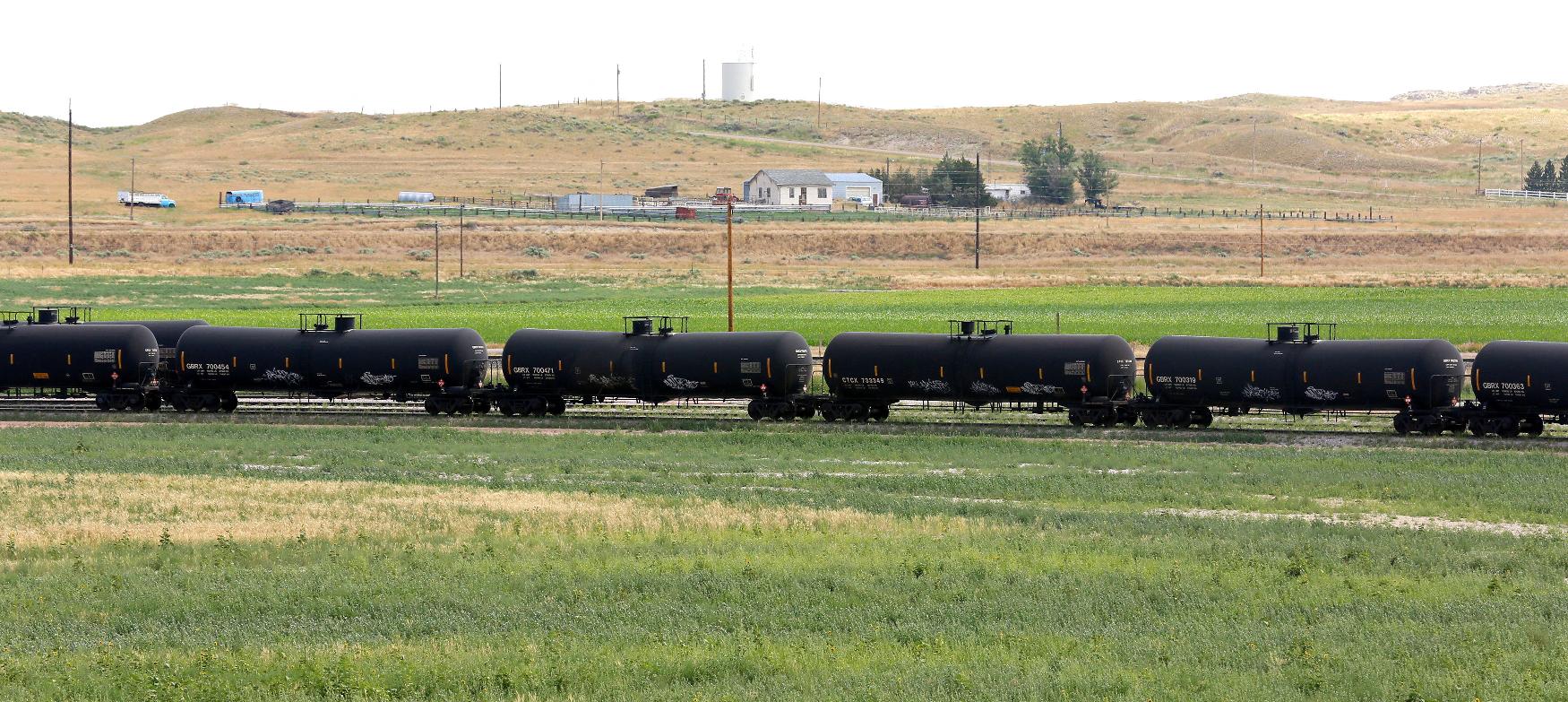
Nov 28 (Reuters) - The Biden administration on Tuesday said it raised $3.4 million from a sale of oil and gas drilling rights in Wyoming, the first in a series of such sales that will coincide with a United Nations' conference aimed at combating fossil fuel-driven climate change in Dubai. The Interior Department's U.S. Bureau of Land Management (BLM) offered 37 parcels on 35,000 acres (14,164 hectares) in Wyoming, with just 18 tracts on 21,500 acres receiving bids, the agency said in a statement. The sale was the largest of a BLM plan to offer 63 drilling parcels on nearly 44,000 acres (17,806 hectares) in six Western states over the next two weeks. A bid of $2.6 million for a 720-acre parcel in Converse County accounted for nearly 80% of the Wyoming auction's total high bids, according to a Reuters analysis of bidding on the online platform EnergyNet. Details on the winning bidders was not immediately available. BLM will also offer acreage in New Mexico, Oklahoma, Nevada, North Dakota and Utah on Nov. 30, Dec. 5 and Dec. 12. The UN's "Conference of the Parties" on climate, known as COP 28, will begin on Thursday and will take place over the same two weeks. Dozens of nations plan to push for the world's first deal to phase out carbon dioxide-emitting coal, oil and gas at the meeting. U.S. President Joe Biden is not expected to attend. An Interior spokesperson did not comment on the timing of the sales. Environmental groups were critical of the sales. "Instead of doing the necessary work to fight climate change, Biden continues to support the expansion of fossil fuels here in the U.S.," Nicole Ghio, senior fossil fuels program manager for Friends of the Earth, said in a statement. U.S. oil extraction policies have been a headache for President Biden, who promised on the campaign trail to end new leasing on federal lands and waters, but was blocked by courts from doing so. Biden's Inflation Reduction Act (IRA), a climate change law passed last year, made oil and gas auctions a prerequisite for renewable energy development. It also, however, requires higher royalty rates and minimum bids meant to boost taxpayer returns. Biden's Interior Department has issued far fewer new leases than previous administrations. The agency issued 527 leases in fiscal years 2021 and 2022 combined, compared with 2,740 in the previous two years, during the Trump administration, according to BLM data. https://www.reuters.com/business/energy/us-kicks-off-spate-oil-gas-auctions-just-cop28-gets-underway-2023-11-28/
2023-11-28 11:34
Chancellor addresses parliament after budget turmoil Signals support for key industries will continue No mention of suspending debt brake in 2024 in speech Opposition warns on risks to wider EU fiscal stability BERLIN, Nov 28 (Reuters) - Chancellor Olaf Scholz on Tuesday sought to reassure the German people and businesses that his government would modernise the economy and support vital industries like chip factories, despite a court ruling that tore a hole in the federal budget. Speaking to parliament, Scholz went into Germany's recent history of the COVID pandemic, the war in Ukraine and soaring energy prices to extend a suspension of self-imposed borrowing limits to tackle a crisis that has knocked his coalition. A constitutional court ruling nearly two weeks ago blocked the government's plans to reallocate unused pandemic funds towards green initiatives and industry support, raising fears Germany's economy could be further weakened. The verdict also called into question Germany's traditionally strict fiscal policy and sparked warnings that companies could be starved of support to keep them globally competitive against subsidies offered elsewhere. "It would be a grave and unforgivable mistake to neglect the modernisation of our country in the face of all these acute challenges," Scholz told the Bundestag in a 25-minute speech. The country's federal states had the greatest interest in securing investment in areas like semiconductors, climate-friendly steel production and battery plants, he said, addressing concerns of specific industries who fear losing out. Scholz said the government would end a scheme to cap energy prices by the end of this year but promised to act quickly if prices shot up again. However, he left open the question of whether the government would try to suspend Germany's constitutionally enshrined debt brakes again in 2024, which some in his coalition have called for but the opposition might challenge in court. SPENDING CURBS AN OPTION Scholz said his government was working with parliament to draw up a 2024 budget "as quickly as possible" that could include spending curbs. Scholz's assurances that his government would solve the budget crisis with care were met with jeers and laughter from the opposition Christian Democrats (CDU), whose lawsuit against the government had sparked the earlier court ruling. "I don't know how to interpret your laughing there," said Scholz, who in English invoked the song "You'll Never Walk Alone" to reassure Germans of the government's support through difficult times. He underscored support for Ukraine, after the recent budget turmoil raised questions over how much military aid Berlin was willing to commit. Scholz's government has pledged to double support to 8 billion euros ($8.76 billion) next year. "It is also clear that we must not let up in our support for Ukraine and in overcoming the energy crisis. That would not be responsible, that would endanger our future," he said. 'ROLE MODEL' CDU leader Friedrich Merz accused Scholz's government of a brazen attempt to circumvent borrowing rules and said its behaviour risked undermining the European Union's wider fiscal reforms in upcoming negotiations. "If the dams burst in Germany, they will also not hold in all other countries in the currency union," Merz said. "Germany has a function as a role model there and you need to realise that, whether you like it or not." Germany has by far the lowest debt in the G7 grouping of major economies, but memories of how frugality paved the way for postwar reconstruction and how costly it was to re-integrate indebted ex-communist East Germany have shaped a uniquely debt-averse political culture. In order to keep supporting industry, Finance Minister Christian Lindner has ruled out tax rises and said savings would have to be found elsewhere, backed up by welfare reforms. The debt brake, introduced after the global financial crisis of 2008-2009, was first suspended in 2020 to help the government support firms and health systems during the COVID pandemic. ($1 = 0.9134 euros) https://www.reuters.com/world/europe/germanys-scholz-vows-modernise-economy-back-ukraine-despite-budget-woes-2023-11-28/

2023-11-28 11:29
Nov 28 (Reuters) - In Texas, oil and gas producer Occidental Petroleum (OXY.N) is constructing a giant facility to suck 500,000 tonnes of carbon dioxide out of the atmosphere annually to keep it from warming the climate, a project backed by hundreds of millions of dollars from investment firm BlackRock (BLK.N). In Louisiana, a consortium of companies that includes Swiss firm Climeworks is teaming up to build a similar facility that can pull a million tonnes of the greenhouse gas out of the sky each year, boosted by hundreds of millions of dollars in grants from the U.S. government. The direct air capture (DAC) projects are in neighboring states, but the companies leading them are worlds away when it comes to their views on how carbon removal - an expensive and largely unproven family of technologies to fight or even reverse global warming - should be deployed in a climate-friendly future and the role oil and gas should play in its deployment. Occidental says some of its carbon would be injected into oil fields to ramp up pressure and raise crude production – a strategy it says that can cleanse the world’s future fossil fuel consumption of climate impact. Climeworks and its partner Heirloom, meanwhile, says its carbon will go straight into underground storage, and that the technology must go hand in hand with a transition to renewable energy. The clashing philosophies mirror a global debate underway over the role carbon removal technologies should play to keep the world from exceeding a 1.5 degree Celsius rise that will take center stage at the 28th United Nations climate change conference in Dubai on Nov. 30-Dec. 12. The COP28 conference's hosts, OPEC member the United Arab Emirates, is promoting the use of carbon removal - a family of technologies to keep excess CO2 out of the atmosphere - as a means of reducing emissions from fossil fuels, as opposed to eliminating the fossil fuels themselves. Scientists have said carbon removal is needed to keep climate goals alive. That approach has the backing of global producers seeking to continue profiting from fossil fuels, but draws skepticism among environmentalists and some governments who see it as a ploy to prolong the lifespan of oil and gas and who are pushing for tough language at COP28 to phase out fossil fuels completely. Underscoring the rift, the International Energy Agency (IEA) said last week that the oil and gas industry is over-relying on carbon capture to reduce emissions and called the approach "an illusion," sparking an angry response from OPEC which views the technology as a lifeline for future fossil fuel use. “We think that no amount of direct air capture as an industry should be used as any justification for prolonging of expanded fossil fuel production,” said Vikrum Aiyer, head of climate policy at Heirloom, which is a partner in the Louisiana facility called Project Cypress. The differing approaches also reflect an important financial dynamic in the carbon removal industry: In the near term, it is a lot easier to make money trapping carbon if it comes with a perk like higher oil production. Otherwise, the enormous price tag for world-scale carbon removal would need to fall to governments if there is any chance of these projects surviving. SAVIOR OR FIG LEAF? The IEA says DAC would have to capture as much as 1 billion tonnes annually by 2050 if the world is to hit its decarbonization targets, a massive scale-up from the 10,000 tonnes it removes currently. A major concern is that DAC technology is both expensive and unproven at scale. Capturing carbon using DAC costs somewhere between $600 and $1,000 for each tonne, mainly because of the huge amount of energy required to run the equipment. There are two commercial DAC facilities now in operation – a Climeworks project in Iceland that can capture just 4,000 tonnes of CO2 a year and Heirloom's project in California that can capture 1,000 tonnes annually, with the rest of the emissions removed by DAC attributed to small pilot projects. More than 100 other DAC projects are at various stages of development, but it is unclear how many will be completed or when, or how they would survive financially. More mature carbon capture and storage (CCS) technology, which traps emissions at a point source like a smokestack, also requires a rapid scale up to make a difference. There are 41 operational commercial CCS projects worldwide with the capacity to store 49 million metric tonnes annually, according to the Global CCS Institute - about one-thousandth of the world’s total energy and industry-related CO2 emissions. Most of those use the carbon for enhanced oil recovery (EOR) or are linked to ethanol plants seeking to generate low carbon credits, according to the institute. Incoming COP President Sultan al-Jaber has said that the technology to capture or remove carbon is needed in “any realistic scenario” to meet the world’s climate goals. The UAE’s national oil company ADNOC recently teamed up with Occidental to evaluate investment in DAC plants and CO2 sequestration hubs in the U.S. and the UAE. 'LICENSE TO CONTINUE' Occidental CEO Vicki Hollub has said DAC could give the oil industry “license to continue to operate for the next 60, 70, 80 years.” The company says its Stratos project in Texas would use removed carbon to recover oil, or otherwise to generate carbon credits that allow it to brand its oil as “net zero,” and the fuels refined from it as “low carbon.” “What we're saying is that there is a highly transparent, highly credible way of tackling the emissions from those barrels of oil," said Mike Avery, president of 1PointFive, an Occidental subsidiary developing its DAC projects. Occidental also has a separate DAC hub proposal in Texas that won half a billion dollars in federal grants. That project’s CO2 will be sequestered underground and have no link to oil and gas, the Department of Energy said. In Louisiana, the proponents of Climeworks and Heirloom's Project Cypress want to make it clear that the technology should have no role in prolonging the future of fossil fuels, even if it means committing to more limited revenue sources than rivals like Occidental. Their money will be made instead by marketing carbon removal credits to corporations not involved in fossil fuels that wish to offset unavoidable emissions, or to governments seeking to stay on track with climate targets. “If you use air capture to get more fuels out of the ground, you're taking away market potential for renewables," said Christoph Gebald, CEO of Climeworks. "This is not in alignment with the energy transition.” https://www.reuters.com/sustainability/climate-energy/two-us-projects-highlight-divide-over-carbon-removals-role-climate-fight-2023-11-28/