2023-11-28 10:31
COPENHAGEN, Nov 28 (Reuters) - Denmark's central bank said on Tuesday that the risk of further price drops in the commercial property market could be accelerated by Swedish real estate firms selling out of their Danish portfolios, which could hurt banks. Swedish property firms struggling to refinance their debt amid rising interest rates have begun selling their portfolios, which could have a spillover effect on the Danish property market by pushing down prices, the central bank said. "Due to the low level of transactions, a price correction related to divestment by the Swedish firms at this point in time would have a relatively great effect," the central bank said in a financial stability report on Tuesday, adding that the largest Swedish firms have properties in Denmark worth 99 billion Danish crowns ($14.5 billion). Any heavy divestment by Swedish firms would come amid a sharp drop in the number of commercial real estate deals in Denmark this year, which according to the central bank indicates that prices have not yet adjusted to the new interest rate level. The central bank warned that as commercial real estate prices fall, the collateral pledged by property firms for loans may not be sufficient to cover their full exposure to banks. "This may lead to losses for the institutions in the case of default of the loans," the bank said. Lending by Danish credit institutions to real estate firms has increased in recent years, amounting to 537 billion crowns or around 38% of their exposure to companies. The central bank also said Danish real estate firms do not face the same refinancing risks as their Swedish counterparts, because they mostly are financed by mortgage loans with long maturities. ($1 = 6.8090 Danish crowns) https://www.reuters.com/markets/europe/swedish-property-problems-could-accelerate-price-drops-denmark-central-bank-says-2023-11-28/

2023-11-28 10:02
NEW YORK, Nov 28 (Reuters) - Mid-sized U.S. businesses owned by minorities have untapped revenue potential worth $1.3 trillion annually, JPMorgan Chase (JPM.N) found in a study on a segment where major lenders are chasing growth. These minority-owned business enterprises represent roughly 30% of the middle market but generate only 20% of the total revenue and closing this gap could boost the economy, the study said. "Midsize businesses are critical to the health of our economy and communities and bridging this gap can be a big opportunity," Terry Hill, co-head of Emerging Middle Market, JPMorgan Chase Commercial Banking told Reuters. JPMorgan, the largest U.S. lender, has been looking at serving this segment by tapping expertise from its corporate and investment banking businesses, while Bank of America (BAC.N) plans to double its middle-market dealmaking team. The report identified diverse-owned businesses as those run by Blacks, Latinos, Asians, other people of color, women and veterans. "There are approximately 300,000 midsize businesses across the U.S. that generate $13 trillion in annual revenue and employ more than 40 million people," the report said. Some of these mid-size businesses have had challenges including difficulty in accessing capital, obtaining the right information compared to their counterparts, and creating suitable business plans, it said. The study was conducted by Next Street, an advisory firm which analyzed data from the middle market segment focusing on firms that generate an annual revenue of anywhere between $11 million to $500 million. JPMorgan has been beefing up its commercial and industrial banking business by expanding into new geographies and increasing its headcount. The bank's broader commercial bank has nearly 25,000 clients, including mid-sized businesses and corporations, government entities and non-profits and more than 33,000 real estate investors or owners. https://www.reuters.com/markets/us/us-minority-owned-businesses-have-13-trillion-growth-potential-jpmorgan-says-2023-11-28/
2023-11-28 09:50
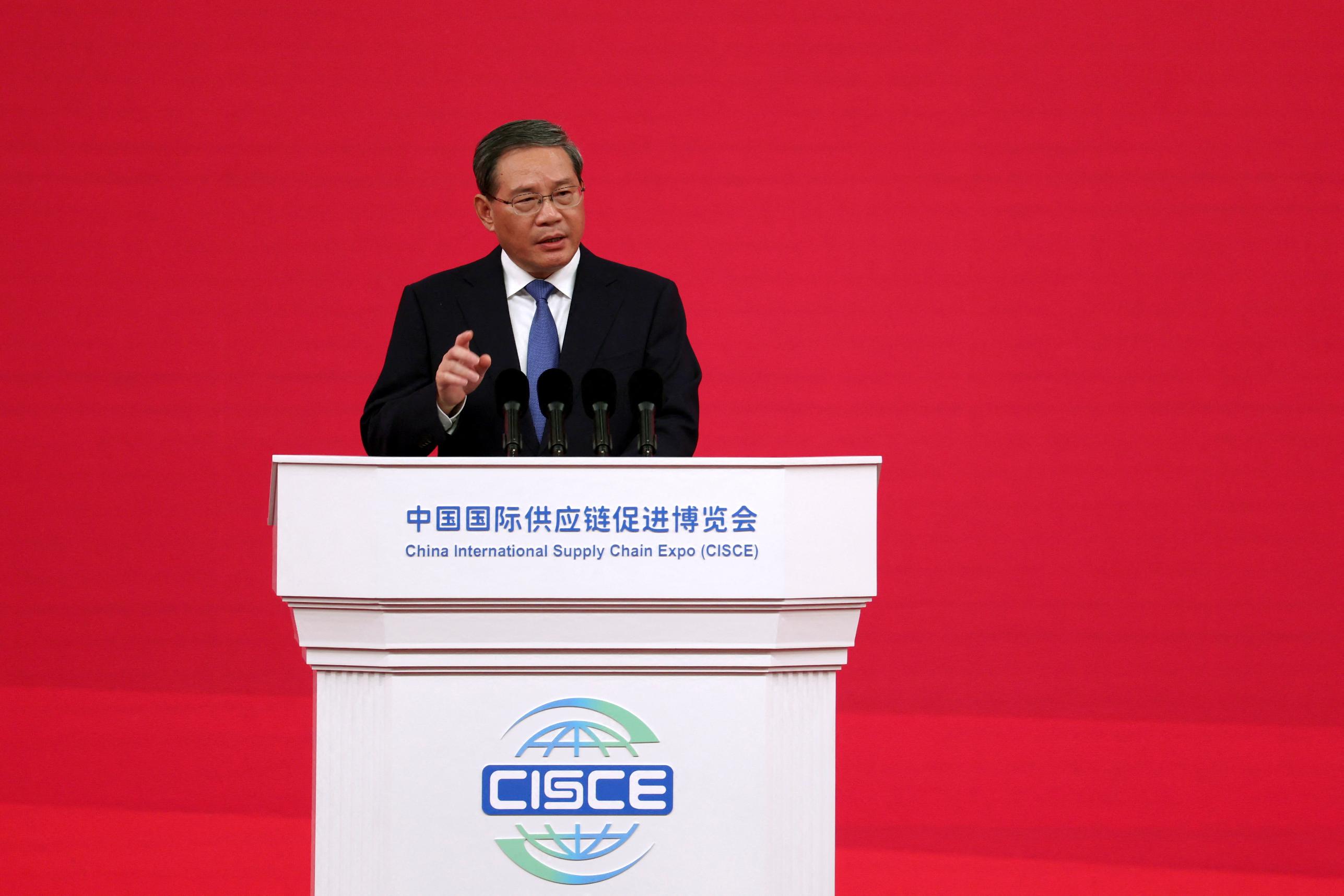
China warns protectionism, geopolitical tensions threaten supply chains China says wants closer supply chain ties with all US, EU greenfield investment into China dropped $100 billion between 2018-2022 - study US, EU 'de-risking' strategies overplay risk level - analysts BEIJING, Nov 28 (Reuters) - China opposes protectionism and wants to strengthen supply chains with all countries, Premier Li Qiang said on Tuesday, as a growing number of nations voice concern at how much their supply chains depend on the world's second largest economy. Li's comments comes amid calls over the past year from the United States and the European Union to reduce their dependence on China in certain sectors and "de-risk" their supply chains, as well as efforts to cut off Chinese enterprises from some advanced semiconductors. "We are willing to build closer production and industrial supply chain partnerships with all countries," Li told the first China International Supply Chain Expo (CISCE), adding that the international community needs to be "more wary of the challenges and risks brought about by protectionism and uncontrolled globalisation." Recent geopolitical tensions, from Russia's war in Ukraine to concerns over a future Chinese invasion of Taiwan, have led a growing number of foreign businesses to opt against expanding their supply chains in China, instead directing investment to countries including India, Mexico and Vietnam that enjoy better ties with the United States, a strategy known as China-plus-one. The expo, organised by the state-run China Council for the Promotion of International Trade (CCPIT), is Beijing's latest bid to increase foreign investment in China, which has dropped to historic lows. The value of announced U.S. and European greenfield investment into China dropped to less than $20 billion last year, from a peak of $120 billion in 2018, according to Rhodium Group, while investment into India shot up by some $65 billion or 400% between 2021 and 2022. Despite this decrease, China remains an attractive option: a survey conducted by HSBC bank at the China International Import Expo (CIIE) earlier this month showed 45% of firms expect to expand their supply chain in China over the next year. "I think there is a lot of hyperbole around this. And I'm not sure whether the (de-risking) measures the EU or U.S. are considering match the scale of the risk," said Dan Marks, research fellow for energy security at the Royal United Services think tank. An apparent improvement in U.S.-Sino ties, after Chinese President Xi Jinping recently met U.S. President Joe Biden and participated in the Asia-Pacific Economic Cooperation (APEC) Summit, should also help reinforce China's position as a key manufacturing hub. Zhang Shaogang, a CCPIT official who was part of the Chinese delegation at the APEC summit, said last week that 20% of the foreign firms exhibiting at the supply chain expo were U.S.-based, and included Amazon (AMZN.O), Apple (AAPL.O), Tesla (TSLA.O), and Intel (INTC.O). "We wholeheartedly hope U.S. businesses can...while actively realising their own development, also positively promote the healthy, stable, and long-term development of U.S.-China relations," Zhang said. https://www.reuters.com/world/china-says-against-supply-chain-decoupling-wants-closer-ties-with-all-2023-11-28/
2023-11-28 09:50
LONDON, Nov 28 (Reuters) - More measures may be needed to stop blow-ups at complex crypto firms like FTX from destabilising the wider financial system, the global Financial Stability Board (FSB) said on Tuesday. The FSB, which groups regulators, central banks and treasury officials from the G20 economies, said turmoil in crypto markets last year when FTX collapsed highlighted how "multifunction" crypto firms, that combine trading and other activities, can exacerbate vulnerabilities. The vulnerabilities are similar to those found in traditional finance, including leverage, liquidity mismatches, technology and operational vulnerabilities, the FSB said in a report. "These vulnerabilities are further amplified by a lack of effective controls and operational transparency, poor or no disclosures, and conflicts of interest," it said. Evidence suggests that the threat to wider financial stability and the economy is limited at present, it added. The FSB and IOSCO, a global body of securities watchdogs, have already published this year high level recommendations for supervising crypto activities. Regulators, however, should assess whether these measures adequately stop risks from crypto being amplified across the financial system, the report said. "Further work may be needed to enhance cross-border cooperation and information sharing and to address information gaps identified in the report," the FSB said. https://www.reuters.com/technology/global-regulators-assess-if-more-crypto-safeguards-needed-2023-11-28/

2023-11-28 08:48
NAPERVILLE, Illinois, Nov 27 (Reuters) - Speculators are building up big short positions in U.S. grain futures on plentiful global supplies, though a tighter oilseed market and weather concerns in South America have kept funds long the Chicago soy complex. In the week ended Nov. 21, money managers’ combined gross short positions across CBOT wheat, corn, Kansas City and Minneapolis wheat futures and options surged 8% to 645,074 contracts, the highest since May 2019, following a notoriously bearish time in the markets. Money managers’ net short in CBOT wheat futures and options rose to a 23-week high of 108,176 futures and options contracts as of Nov. 21 versus 89,271 a week earlier. That included the addition of nearly 20,000 gross shorts, the most for any week since early 2019. Funds added more than 20,000 gross shorts in CBOT corn futures and options through Nov. 21, the most in three weeks, resulting in a managed money net short of 185,502 contracts versus 163,486 in the prior week. That is funds’ most bearish corn stance since June 2020. Money managers added considerable gross shorts in Kansas City wheat futures and options through Nov. 21, pushing their net short to 47,513 contracts from 37,449 a week earlier. That is among funds’ all-time bearish K.C. views given the record of 58,866 contracts set in May 2019. Funds’ Minneapolis wheat views remain near record-bearish, though they were slight net buyers in the week ended Nov. 21. Slow U.S. wheat demand, cheap Black Sea wheat, a record U.S. corn crop and better prospects for Argentina’s upcoming corn harvest have all weighed on the grains in recent sessions. On Monday, the U.S. Department of Agriculture said 50% of the domestic winter wheat crop is in good or excellent condition, up substantially from 34% a year ago. In the week ended Nov. 21, CBOT March corn fell 1.1% and March wheat declined 2.5%, though they shed 2.8% and 3.7%, respectively, in the following three sessions. On Monday, CBOT corn and all U.S. hard and soft wheat futures hit contract lows during trading, including the lowest price for most-active corn since December 2020. OILSEEDS Unfavorable weather in top soybean exporter Brazil has lifted CBOT soybean futures this month, but a potential change in the weather pattern caused a fractional decline in January beans in the week ended Nov. 21. Money managers that week trimmed their net long in CBOT soybean futures and options to 81,587 contracts from 87,913 a week earlier, and the new stance is nearly identical to funds’ year-ago stance. It was also the first week in six where speculators cut gross bean longs. Funds’ bullish soymeal views rose for a sixth straight week through Nov. 21, to 137,803 futures and options contracts from 131,404 in the prior week, and the resulting net long is the largest since early March and by far largest for the date. Open interest in CBOT soybean meal futures and options surged 4% during the week to another record of 671,039 contracts. January futures fell 3% in that week but had notched a contract high on Nov. 15. Through Nov. 21, money managers cut their net short in CBOT soybean oil futures and options to a near-flat 2,831 contracts from 6,597 a week earlier, but soyoil futures shed more than 4% over the last three sessions. On Monday, soyoil was trading 30% lower than on the same date last year. Soybean meal eased 1.2% in the last three sessions while beans lost 3.4% after dry parts of Brazil received rain over the last few days. However, rainfall patterns in Brazil remain irregular and soybean planting pace is at an eight-year low. Karen Braun is a market analyst for Reuters. Views expressed above are her own. https://www.reuters.com/markets/us/funds-carve-out-most-bearish-cbot-corn-view-since-june-2020-2023-11-28/

2023-11-28 07:11
KYIV, Nov 28 (Reuters) - Nearly 2,500 people were rescued after a snowstorm in Ukraine's southern region of Odesa, local governor Oleh Kiper said, adding that 313 settlements in the region were without power as a result of the bad weather. Odesa region, which lies on the shore of the Black Sea, has been hit by severe snowstorms since Sunday, stranding vehicles and downing power lines. "849 vehicles have been towed out, including 24 buses and 17 ambulances," Kiper wrote on the Telegram app. He said all those trapped by the snow since the start of the snowstorm had now been rescued. https://www.reuters.com/world/europe/nearly-2500-rescued-after-snowstorm-ukraines-odesa-region-2023-11-28/