2024-08-23 21:41
BAMAKO, Aug 23 (Reuters) - Mali declared a state of national disaster on Friday over floods that have killed 30 people and affected over 47,000 others since the start of the rainy season, the council of ministers said in a statement. Most years, the West and Central Africa region sees floods of varying severity between June and September, when rains sweep through the Sahel belt of countries along the southern fringes of the Sahara desert. Flooding has affected over 716,000 people across the region so far this season, which is forecast to bring above-average cumulative rainfall, the U.N's humanitarian agency OCHA said in mid-August. Sign up here. https://www.reuters.com/world/africa/mali-declares-state-national-disaster-over-flooding-2024-08-23/

2024-08-23 21:29
NEW YORK, Aug 23 (Reuters) - Swiss chocolate maker Barry Callebaut (BARN.S) , opens new tab said on Friday it had halted operations at one of its plants in Mexico after tests found that production at that site did not meet the company's quality standards. A spokesperson for Barry Callebaut, which is also one of the world's largest cocoa processors, said in a statement to Reuters the company was putting in place some corrective measures to address the sub-standard production at the plant, without giving any details about what was the problem. Reuters had asked the company for a position about production in Mexico following information it had received from a source regarding delays on deliveries of chocolate by Barry Callebaut to some of its clients in the country. "As part of these routine controls, we identified a test case in one of our Mexican factories that did not meet our standards. As a precaution, we have proactively halted production at this site and already implemented corrective actions," said the company. The company said it was talking to clients to secure product delivery using other installations in North America. Sign up here. https://www.reuters.com/markets/commodities/chocolate-maker-barry-callebaut-halts-production-mexico-plant-2024-08-23/

2024-08-23 21:25
Sanctions target Chinese firms aiding Russia's military U.S. Treasury targets transnational networks aiding Russia China opposes U.S. sanctions, defends trade with Russia WASHINGTON, Aug 23 (Reuters) - The United States on Friday imposed sanctions on more than 400 entities and individuals for supporting Russia's war effort in Ukraine, the State Department said, including Chinese companies that U.S. officials believe are helping Moscow skirt Western sanctions and build up its military. Washington has repeatedly warned Beijing over its support for Russia's defense industrial base and has already issued hundreds of sanctions aimed at restricting Moscow's ability to exploit certain technologies for military purposes. Friday's sanctions include measures against companies in China involved in shipping machine tools and microelectronics to Russia, according to a State Department fact sheet outlining its sanctions against 190 targets. The U.S. Treasury Department said it was also targeting transnational networks involved in procuring ammunition and other materiel for Russia, helping Russian oligarchs and others evade sanctions and laundering gold for a sanctioned company. "Russia has turned its economy into a tool in service of the Kremlin's military industrial complex," Deputy Treasury Secretary Wally Adeyemo was quoted as saying in the statement. "Companies, financial institutions, and governments around the world need to ensure they are not supporting Russia's military-industrial supply chains." The Biden administration also added 123 entities to its U.S. export control list known as the Entity List that forces suppliers to obtain licenses before shipping to targeted companies. Those added on Friday included 63 entities in Russia and 42 in China, according to a notice published in the Federal Register. Ukrainian President Volodymyr Zelenskiy thanked the U.S. for the "additional strong sanctions" in a message , opens new tab on the X social media platform, saying they would further weaken Russia's ability to "wage an aggressive war against Ukraine." "Pressure on the aggressor must be maintained and increased constantly as long as Russia continues its aggression," Zelenskiy added. Russia's embassy in Washington did not immediately respond to a request for comment on the new sanctions. After seizing Crimea from Ukraine in 2014, Russia launched a full-scale invasion of its neighbor in February 2022, triggering a host of new U.S. economic sanctions on Moscow. The war escalated on Aug. 6 when Ukraine sent thousands of soldiers over the border into Russia's western Kursk region. Kyiv has since announced a string of battlefield successes, but Russian forces continue to steadily inch forward in eastern Ukraine. The U.S. Treasury said it was imposing sanctions on several Russian financial technology, securities, real estate lending and other financial firms, but it stopped short of imposing sanctions against foreign banks for aiding transactions that support Russia's war effort. The Treasury has warned banks since December that continued transactions in Russia's war economy could cut them off from the dollar-based financial system. CHINA TARGETS The State Department's sanctions include moves aimed at stifling Russia's energy sector and against companies in Turkey, the United Arab Emirates and Central Asian economies that the U.S. believes are helping Russia evade sanctions, the State Department said. "Today's actions hit Russia where it hurts - degrading its ability to generate revenue through its energy projects and disrupting its acquisition of materiel to supply its war machine," said Aaron Forsberg, the State Department's director for economic sanctions policy and implementation. Targets include the import-export arm of China's Dalian Machine Tool Group, which the State Department said had supplied $4 million of dual-use items to Russian companies. The Treasury also targeted more than 20 Hong Kong and China-based firms it said were supplying Russia's military industrial base. The spokesperson for China's embassy in Washington, Liu Pengyu, said Beijing "firmly opposes unilateral sanctions based on 'long-arm jurisdiction'" and added that "normal trade between China and Russia should not be undermined, still less turned into an instrument to smear and contain China." The latest U.S. sanctions include measures against firms supplying components used in the Orlan drones that Russia is using in Ukraine. Washington also sought with the sanctions to disrupt future energy projects in Russia and its shipment of liquefied natural gas. It targeted Russia's $21 billion Arctic LNG 2 project, which has already been hit by Western sanctions that have curbed its access to ice-class tankers, and other companies involved in future energy projects in Russia, according to the fact sheet. The sanctions also targeted companies involved in the shipments, like UAE-based White Fox Ship Management, which the U.S. says recently acquired four tankers to ship LNG. Sign up here. https://www.reuters.com/world/us-imposes-sanctions-400-more-targets-aiding-russias-war-effort-2024-08-23/

2024-08-23 21:22
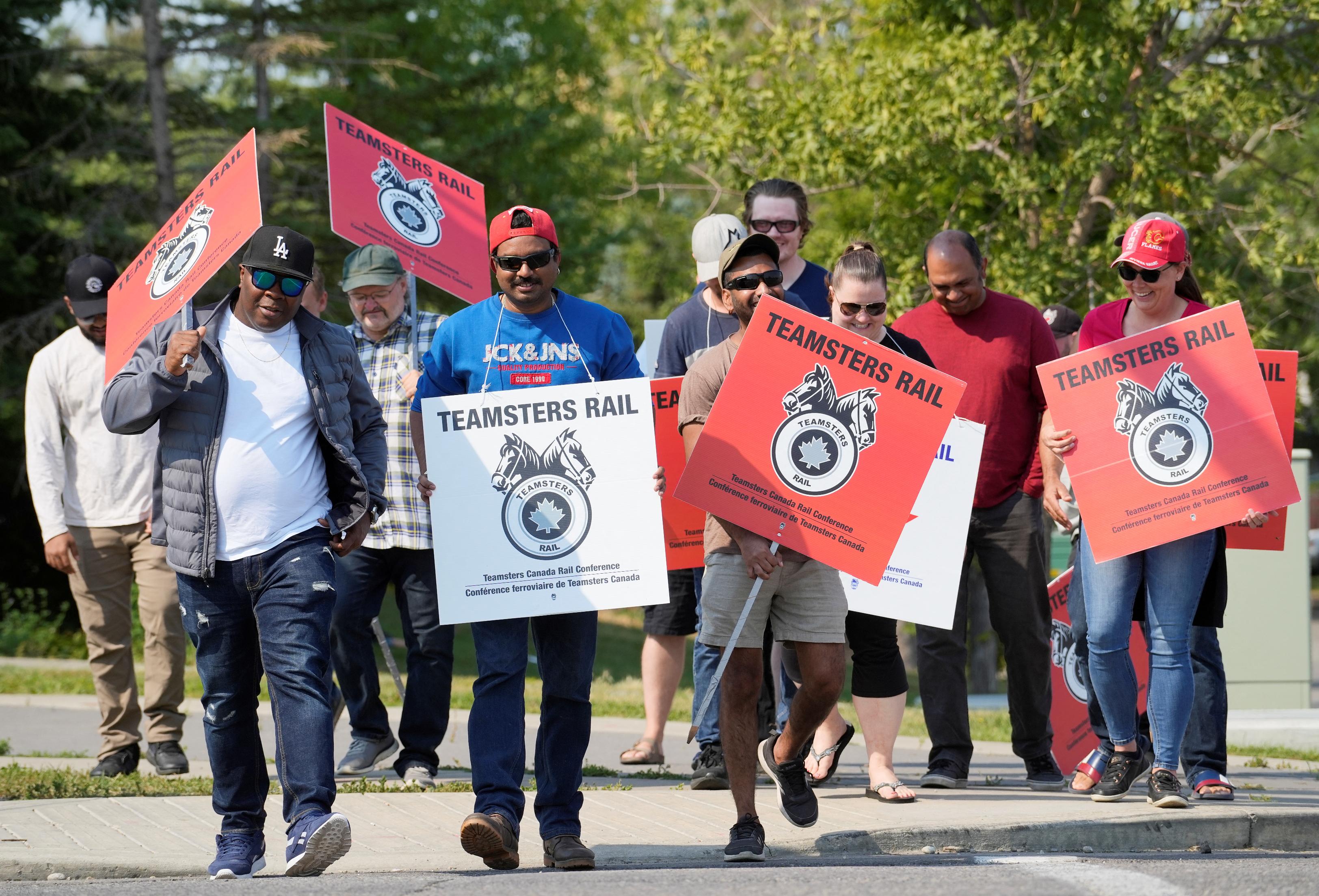
Teamsters union files strike notice for CN workers starting Monday CN says trains are resuming operations Labour Minister asks CIRB to issue back-to-work order MONTREAL/OTTAWA, Aug 23 (Reuters) - The union representing over 9,000 Canadian rail workers vowed on Friday to challenge the federal government's effort to mandate binding arbitration that would end an unprecedented rail stoppage at both of the country's main freight rail carriers. The Teamsters union also filed notice to strike on Monday at Canadian National Railway (CNR.TO) , opens new tab, Canada's largest railway. The union's moves are the latest twist in labor disputes at CN and Canadian Pacific Kansas City (CP.TO) , opens new tab, which locked out Teamsters members on Thursday, triggering a simultaneous rail stoppage that business groups said could inflict hundreds of millions of dollars in economic damage. They further complicate the task of the Canada Industrial Relations Board (CIRB), which was meeting for hours on Friday with union and railway representatives, after the government asked it to end the impasse. The Teamsters union on Friday night said the parties had concluded a day-long meeting, in which it argued that the government did not have absolute power to end the labor action. "The union will lawfully abide by any decision from the CIRB, and is prepared to file challenges in federal court if necessary," it said. Railroad CN in a statement said it would move forward with a recovery plan until a CIRB decision was issued. Labour Minister Steven MacKinnon, citing the risk to the economy, also asked the board to impose binding arbitration on talks between the union and companies, and for operations at both railways to resume immediately. Canada, the world's second-largest country by area, relies heavily on trains to transport a wide range of commodities and goods. The Canadian Chamber of Commerce said it was disappointed with the Teamsters' decision to challenge the government's directive. "This action will prolong the damage to our economy and jeopardize the wellbeing and livelihoods of Canadians, including union and non-union workers across multiple industries," the group said. LEGAL CHALLENGES Legal experts warned the Teamsters' challenge creates uncertainty and delays. If CIRB orders workers back on the job pending binding arbitration, the union could challenge that decision and ask for a judicial review, said University of Manitoba employment law professor Bruce Curran, adding that if the employees do not return to work while the hearing is pending, the railways could seek an injunction forcing them back. The federal government could also seek to pass back-to-work legislation, for which it would need the support of at least one other party because it does not control a majority of seats. The left-leaning New Democratic Party, which traditionally enjoyed strong union support and which props up Trudeau's government, has decried the government's intervention. The timeline for a CIRB decision is unclear, the union said on Friday afternoon in a statement. Earlier in the day, Francois Laporte, president of Teamsters Canada, denounced MacKinnon's decision. "We don't believe a third party (should) decide what are going to be our working conditions," he told reporters at a picket outside CPKC's Calgary headquarters. He said that in case of a back-to-work order, "our people will still be on strike. We will still be on the streets, so operations will not resume. It's not going to be business as usual for both companies". STRIKE NOTICE The union representing CN workers also served the company with a strike notice on Friday, shortly after saying its members would return to work in response to CN lifting its lockout. The union filed notice that conductors, locomotive engineers and other workers at Montreal-based CN would strike on Monday at 10 a.m. ET (1400 GMT). The Teamsters said they were prepared to negotiate with CN over the weekend and reach a deal despite disputes over scheduling, duration of shifts and availability of labor. The Canadian government and CPKC had no comment on Friday. CPKC said late on Thursday that it was preparing to restart operations in Canada and that further details on timing would be provided once it received CIRB's order. A CN spokesperson said on Friday trains were starting to run and that its plan to resume operations was under way. "We are focused on getting back to work," said Jonathan Abecassis, CN's spokesperson. "The Teamsters are focused on getting back to the picket line." A lockout at CPKC has not been lifted. The union had already served CPKC with a strike notice before the lockout began. MacKinnon had expressed confidence on Thursday that his move to refer the matter to CIRB and seek binding arbitration would survive a court challenge, given the broad power he has under the country's labor code. "We're very, very confident about the path that we've selected here." Sign up here. https://www.reuters.com/sustainability/boards-policy-regulation/canada-rail-workers-union-challenge-government-decision-refer-dispute-labor-2024-08-23/
2024-08-23 20:54
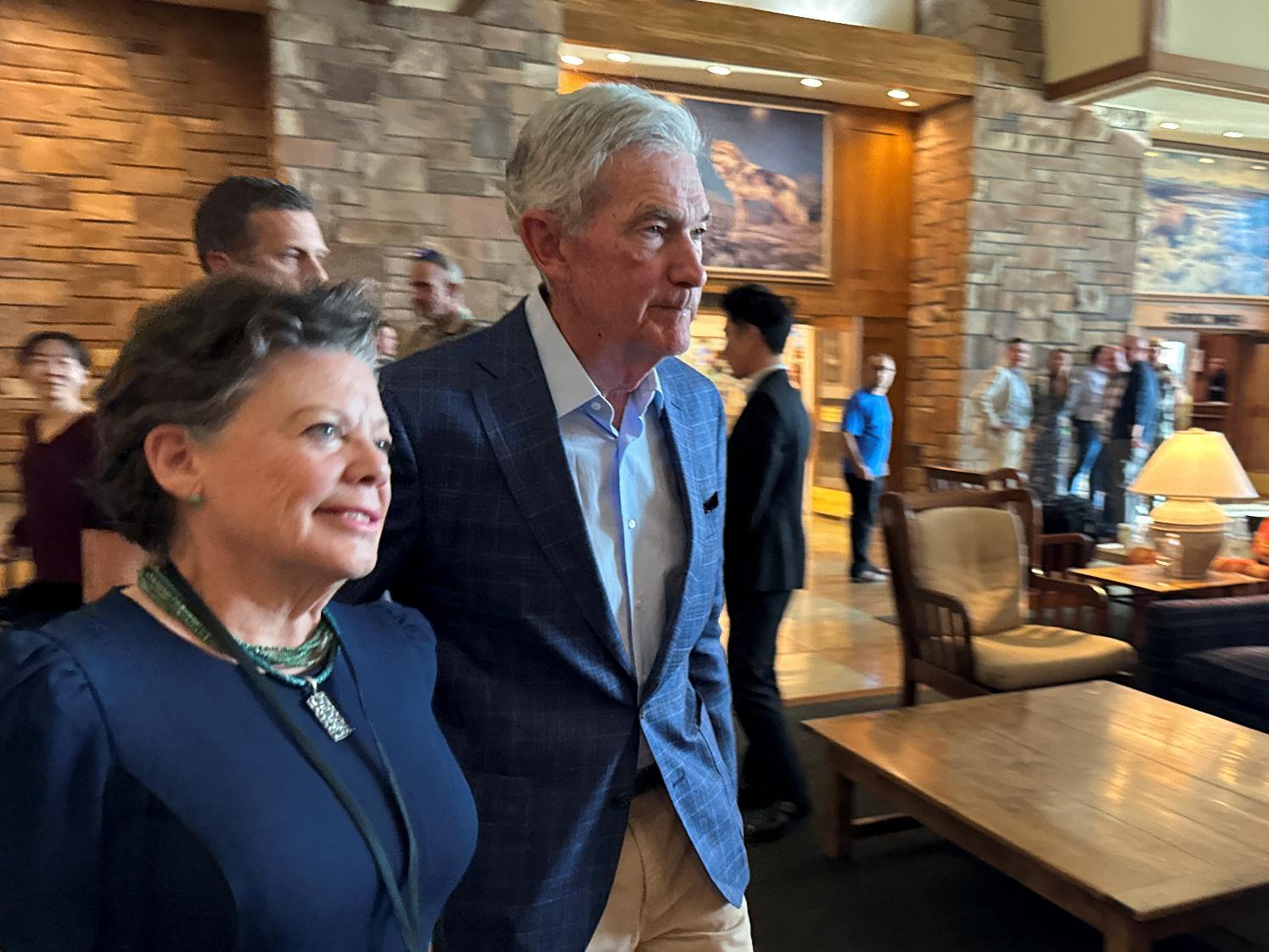
Fed chief says timing, pace of rate cuts depends on data Central bank expected to cut rates at September meeting How big a rate cut is now the key question for Fed JACKSON HOLE, Wyoming, Aug 23 (Reuters) - Federal Reserve Chair Jerome Powell on Friday endorsed an imminent start to interest rate cuts, saying further cooling in the job market would be unwelcome and expressing confidence that inflation is within reach of the U.S. central bank's 2% target. "The time has come for policy to adjust," Powell said in a highly anticipated speech to the Kansas City Fed's annual economic conference in Jackson Hole, Wyoming. "The direction of travel is clear, and the timing and pace of rate cuts will depend on incoming data, the evolving outlook, and the balance of risks." The emphatic pivot from a battle against inflation to a readiness to defend against job loss opens a new chapter for the central bank just as a consequential U.S. presidential election nears. Powell said his "confidence has grown that inflation is on a sustainable path back to 2%," after rising to about 7% during the COVID-19 pandemic, and the upside risks have diminished. Meanwhile, he said, a slowdown in the labor market is "unmistakable" and "the downside risks to employment have increased." And while slower hiring, rather than a more concerning rise in layoffs, has so far driven the rapid rise in the unemployment rate to 4.3%, Powell signaled the Fed would not countenance further erosion. "We do not seek or welcome further cooling in labor market conditions," he said. "We will do everything we can to support a strong labor market as we make further progress toward price stability." Analysts and financial markets had already widely expected the Fed to deliver its first rate cut at its Sept. 17-18 policy meeting, a view that was cemented after a readout of the central bank's July meeting said a "vast majority" of policymakers agreed the policy easing likely would begin next month. Most analysts have forecast the Fed will kick off its policy easing with a quarter-percentage-point rate reduction, the central bank's usual increment. Powell's new emphasis on protecting the job market raises the chance of a bigger cut, especially if the U.S. government's jobs report for August, due to be released on Sept. 6, shows further deterioration in what many policymakers have called a still-healthy job market. With its policy rate currently in the 5.25%-5.50% range, the Fed has "ample room" to reduce borrowing costs to cushion the economy, Powell said. After his remarks, traders moved to price in a better than one-in-three chance that the Fed will start its easing cycle with a half-percentage-point rate cut, and are fully confident of at least one super-sized cut before the end of this year. "Chair Powell's speech made it clear that there are likely a series of rate cuts on the way, and some could be of the 50-basis-point variety," wrote Omair Sharif, the president of Inflation Insights. "While some Fed officials may want to go in 25-basis-point increments, the Chair retained optionality ... i.e., 'we'll go 50 basis points if we feel like it is needed.'" Markets are betting the Fed's policy rate will be in the 3.00%-3.25% range by the end of 2025, more than 2 percentage points below where it is now. The impact of Powell's remarks is rippling to other central banks as well. U.S. stocks jumped after the release of Powell's remarks, with the benchmark S&P 500 (.SPX) , opens new tab index gaining about 1% and nearing a record high. U.S. Treasury yields dropped and the dollar weakened against a basket of currencies. 'SOFT LANDING' Chicago Fed Bank President Austan Goolsbee has for months signaled his support for a rate cut, and on Friday did so again, saying policy is currently too tight, especially with the labor market flashing warning lights. Other policymakers, including Atlanta Fed President Raphael Bostic, who has previously been more hesitant on rate cuts, also joined in to back the coming policy easing. For his part, Powell on Friday came as close as he is likely to in declaring victory over the outbreak of inflation that rattled the economy at the start of the pandemic. The fast rise in prices led the Fed to increase its benchmark policy rate from the near-zero level to the current range, which is the highest in a quarter of a century. It has been held there for more than a year even as the economy defied frequent predictions of recession, inflation fell, and economic growth continued - the makings of a textbook "soft landing," with the endgame of rate cuts now set to begin. "While the task is not complete, we have made a good deal of progress" toward restoring price stability, Powell said in his speech. The Fed defines price stability as 2% inflation, as measured by the personal consumption expenditures price index. The index is currently running at an annual rate of 2.5%. "With an appropriate dialing back of policy restraint, there is good reason to think that the economy will get back to 2% inflation while maintaining a strong labor market," he said. Powell spoke at the Jackson Lake Lodge in Wyoming's Grand Teton National Park to a gathering of central bankers and economists that has become a global platform for officials to shape views of monetary policy and the economy. Fed officials will provide updated economic projections at their meeting next month, including more details on how they expect the benchmark policy rate to evolve from here. Sign up here. https://www.reuters.com/markets/us/with-fed-pivot-hand-powell-may-opt-broad-brush-approach-jackson-hole-2024-08-23/
2024-08-23 20:26
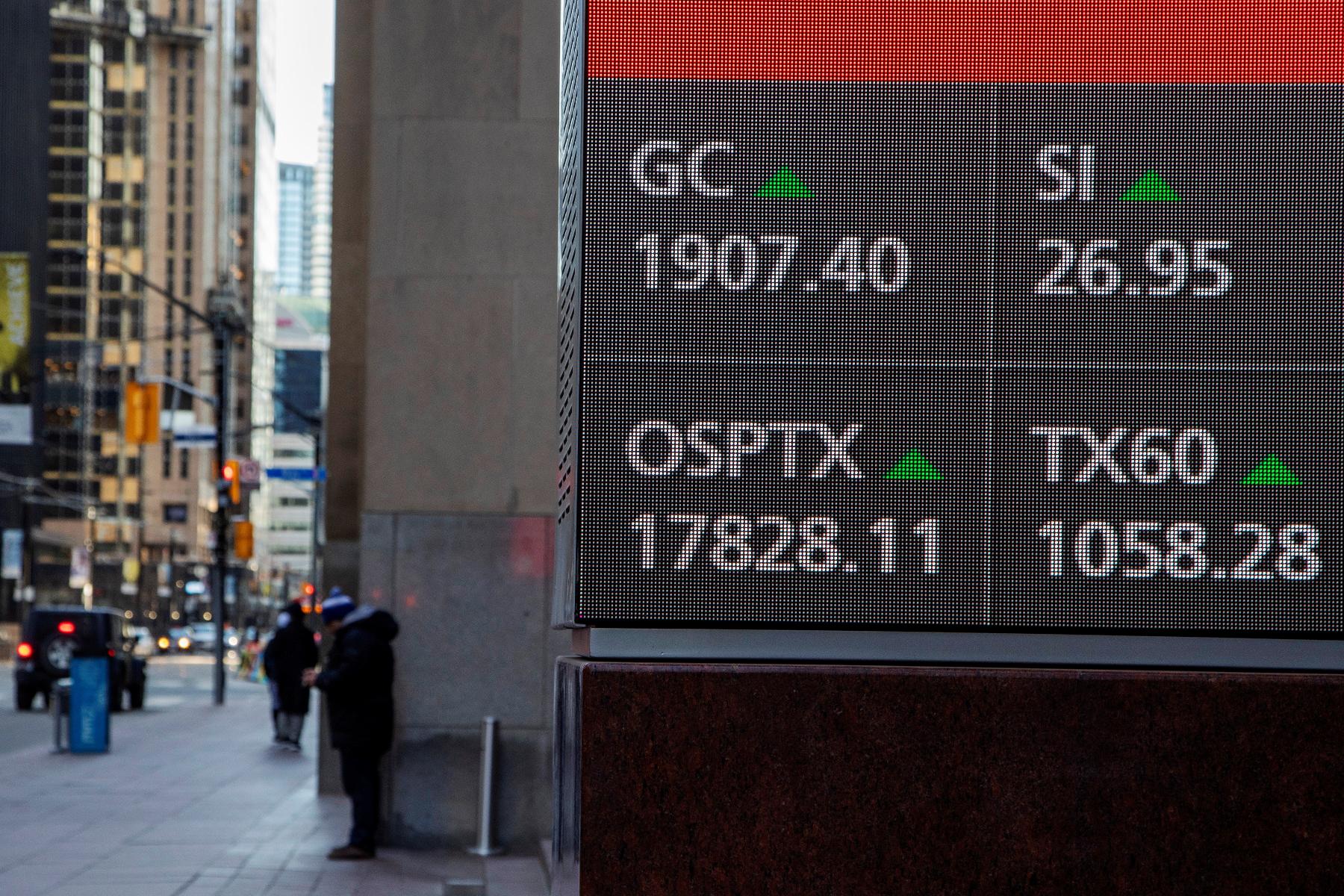
TSX ends up 1.1% at 23,286.08 Posts a record closing high Financials advance 1.2% Energy adds 1.1%; oil settles 2.5% higher Aug 23 (Reuters) - Canada's main stock index rose to a record high on Friday, with energy and financials contributing to broad-based gains as Federal Reserve Chair Jerome Powell endorsed the start of rate cuts, raising hopes the economy could avoid recession. The S&P/TSX composite index (.GSPTSE) , opens new tab ended up 248.61 points, or 1.1%, at 23,286.08, eclipsing Wednesday's record closing high. For the week, the TSX added 1%, its third straight week of gains. Wall Street's major indexes also rose after Powell said, "The time has come" to reduce interest rates. The Bank of Canada has already cut rates twice since June and is expected to continue easing over the coming year. "I would characterize it as a soft landing type trade," said Mike Archibald, a portfolio manager at AGF Investments. "You have huge moves in financials - they benefit from rates coming down and loan growth picking up." Financials, which account for 29% of the TSX's weighting, rose 1.2%, while energy was up 1.1% as the price of oil settled 2.5% higher at $74.83 a barrel. The materials group, which includes metal miners and fertilizer companies, advanced 1.2% as gold and copper prices rose. All 10 major sectors ended higher. Shares of Canadian National Railway (CNR.TO) , opens new tab gained 1.6% and Canadian Pacific Kansas City (CP.TO) , opens new tab shares were up 1.3%, one day after the Canadian government moved to end a work stoppage at Canada's two major railroads. The union representing workers at CN said the workers would strike on Monday after returning to work on Friday. A lockout at CPKC has yet to be officially lifted. It's challenging for the economy to have both railroads shut at the same time, Archibald said, adding "it was largely expected that the government would quickly move to address this issue." Sign up here. https://www.reuters.com/markets/tsx-futures-rise-fed-chair-powells-speech-anticipated-2024-08-23/