2024-08-16 06:49
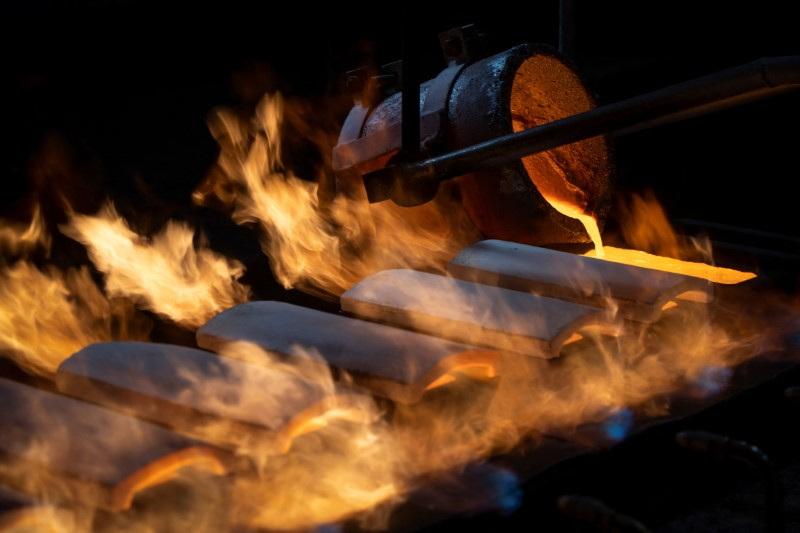
Silver, platinum, palladium log weekly gains Dollar down for fourth straight week Traders await Jackson Hole for more Fed cues Gold up 2.8% this week Aug 16 (Reuters) - Gold prices soared to an all-time high on Friday as the dollar weakened on growing expectations for an interest-rate cut from the Federal Reserve in September, and as tensions in the Middle East bolstered demand for bullion. Spot gold was up 1.7% to $2,498.72 per ounce by 02:27 p.m. EDT (1827 GMT), after hitting a record high of $2,500.99 earlier. U.S. gold futures settled 1.8% higher at $2,537.80. Bullion rose 2.8% this week. The dollar index fell 0.4% and posted a fourth week of losses, making gold more appealing for buyers overseas. "Gold surged to a fresh all-time high and breached $2,500 after two weeks of extremely choppy trading as bulls finally impose their will," Tai Wong, a New York-based independent metals trader, said. "Attention will now shift to focus on Jackson Hole and Fed Chair Powell's speech a week from today to provide a more detailed outlook on the shape of the upcoming rate cuts." U.S. Federal Reserve Chair Jerome Powell is scheduled to deliver remarks on the economic outlook next Friday, the first full day of the Kansas City Fed's annual economic symposium in Jackson Hole, Wyoming. The July releases of the producer price index and consumer price index this week indicated inflation was subsiding, which could keep the Fed on track for a 25-basis-point rate cut next month. Fed Bank of Chicago President Austan Goolsbee said the U.S. economy is not showing signs of overheating, so central-bank officials should be wary of keeping restrictive policy in place longer than necessary. "Ongoing geopolitical strife and potential escalation that Iran could get involved, and the war in Ukraine, those factors all contribute to safe-haven demand for gold," said Everett Millman, chief market analyst with Gainesville Coins. Bullion is considered a hedge against geopolitical and economic uncertainties and tends to thrive in a low-interest-rate environment. Silver rose 1.4% to $28.81 per ounce and platinum fell 0.2% at $950.76. Palladium fell 0.1% to$943.25. All metals posted weekly gains. Sign up here. https://www.reuters.com/markets/commodities/gold-eyes-weekly-gain-us-rate-cut-bets-2024-08-16/
2024-08-16 06:23
ANKARA, Aug 16 (Reuters) - A forest fire in Turkey's western coastal province of Izmir, fanned by strong winds, is near residential areas, forcing some people to be evacuated, the local governor said on Friday, as firefighters also tried to contain other wildfires in the north. The fire in Izmir started late on Thursday in the Karsiyaka district for unknown reasons, as firefighters already worked to contain three separate fires in northwestern Turkey. Izmir Governor Suleyman Elban said the fire in Karsiyaka continued in between four and five different areas despite efforts to contain it using planes, helicopters, and other vehicles, adding that a village had been evacuated. "The intervention is becoming difficult as it is very close to residential areas. There is no loss of life until now," Elban said. "We have information that some houses burned. Since there are winds of up to 80 kilometers (49.71 miles) per hour now, we often have to stop the aerial intervention," he said, adding efforts would intensify if winds eased. Footage on local broadcasters showed flames engulfing tracts of land, approaching apartment buildings and roads in Karsiyaka, with black smoke billowing above forests and the city. The fires in northwestern Turkey are in the Eceabat district of Canakkale province, the Goynuk district of Bolu province, and in Manisa province's Gordes district. Earlier on Friday, Agriculture and Forestry Minister Ibrahim Yumakli said the fire in Canakkale - sparked by a roadside electricity pole - had been contained and the Manisa blaze was partially contained. Efforts continued to douse the fire in Bolu. He warned of a high risk of wildfires in the next three days due to high temperatures, low humidity, and strong winds. The governors of Canakkale and Bolu provinces said several neighbourhoods or villages had been evacuated as a precaution, but that there was no immediate threat to residential areas. Turkey's coastal regions in particular have in recent years been ravaged by wildfires, as summers have become hotter and drier, which scientists relate to climate change. Sign up here. https://www.reuters.com/world/middle-east/firefighters-battle-contain-three-wildfires-western-turkey-2024-08-16/

2024-08-16 06:10
Aug 16 (Reuters) - Australia's Whitehaven (WHC.AX) , opens new tab will cut 192 jobs at the Daunia and Blackwater coking coal mines it took over from global miner BHP Group (BHP.AX) , opens new tab, its spokesperson told Reuters on Friday, adding to a slew of roles lost in the resources sector this year. Whitehaven had announced plans in October to buy out BHP's Blackwater and Daunia mines in a $4.1 billion deal. It completed the acquisition in April this year. "This proposed new structure will remove duplication of roles, consolidate teams where logical, minimise unnecessary layers of complexity, and support a clear delineation of roles and responsibilities between site and functional teams," a spokesperson for the country's largest independent coal miner said in an email to Reuters. Whitehaven will cut 91 roles across the Daunia and Blackwater operations while reducing 101 contractor and labour hire roles, the spokesperson added. The job cuts are likely to impact the relationship between Whitehaven and the workers it transferred over from BHP during the acquisition. In November, the workers had accused the company of not providing them with benefits after the transition, the Australian Financial Review reported. BHP had nearly 3,000 roles affected after it decided to temporarily suspend the Western Australia nickel business recently. Miner Alcoa (AA.N) , opens new tab also cut more than 1,000 jobs after it decided to shut down Kwinana alumina refinery earlier in the year. The firm is currently in the process of selling down a 20% stake in the Blackwater mine. Reuters reported in February that India's JSW Steel (JSTL.NS) , opens new tab is interested in the deal. Whitehaven shares, which surged as much as 2.9% to A$7.54 during the day, pared some of its gains to close the session 1.8% higher at A$7.46. Sign up here. https://www.reuters.com/markets/whitehaven-coal-cut-192-jobs-mines-it-bought-bhp-2024-08-16/

2024-08-16 06:07
LITTLETON, Colorado, Aug 16 (Reuters) - Utilities in Portugal have cut the proportion of electricity production from fossil fuels to just 10% so far in 2024, leap-frogging neighbour Spain to emerge as western Europe's second-cleanest large power sector behind France. Total clean electricity generation through the first seven months of 2024 jumped 32% from the same months in 2023 to a record 21.76 terawatt hours (TWh), data from energy think tank Ember shows. Record output from solar and wind farms plus the highest hydro generation total since 2016 have been the main drivers of the clean power surge, which allowed generators to slash natural gas-fired output by 60% from the January to July period in 2023. Portugal's power firms have also lifted total electricity generation by 7% to the highest since 2021, demonstrating that a multi-pronged approach to boosting clean generation can trigger rapid progress against energy transition targets. TURNAROUND The deployment of some of Europe's largest new hydro dams and solar parks this year has been instrumental in accelerating the cuts to fossil fuel use in Portugal's generation mix. Both the 1,158 megawatt (MW) capacity Tamega dam and the 202 MW capacity Cerca solar farm commenced operations this year, which allowed power firms to cut total fossil fuel-generated electricity to just 2.53 TWh so far this year through July. That fossil-fired total is down 59% from the same period in 2023, and is the lowest on record. Total power sector emissions have dropped sharply as a result, to 2.12 million metric tons of carbon dioxide for the first seven months, which is 45% less than the same months in 2023 and a new record. HYDRO HELP Both the new Tamega facility plus higher precipitation levels have helped steer Portugal's hydro generation higher this year. Through the first seven months of 2024, pumped storage output was up 67% to 172,758 megawatt hours (MWh), while run-of-river generation was 70% higher at 259,415 MWh, according to LSEG. Reservoir-based hydro generation was 76% up at 117,024 MWh. All told, the cumulative gains in Portugal's hydro generation allowed hydropower's share of the electricity generation mix to average 35.3% so far this year, compared to 20.7% during the same period in 2023, Ember's data shows. Solar and wind assets have also seen their shares of the utility generation mix climb. Solar power generated an average share of 13.3% of Portugal's electricity so far this year, up from 10.6% in 2023, while wind farms accounted for an average share of 33.1%, up from 32.6% in January-July 2023. And clean power's share of the generation mix looks set to keep growing, following new proposals by Portugal's government to increase the weight of renewables in power production. As part of goals to become carbon neutral by 2045, renewables will generate 51% of the country's final energy needs by 2030, the government said last month. Innovative deployments of renewable assets on existing energy projects look set to help achieve those goals. The award-winning Alqueva floating solar park , opens new tab integrates hydro power, floating solar and battery storage that can generate 7.5 gigawatt hours (GWh) of clean energy annually. And a planned 274 MW capacity wind farm incorporated into the Tamega dam project will generate enough clean power to meet the annual energy needs of 128,000 homes, according to developer Iberdrola. Further expansions in Portugal's solar capacity is also expected following a planned project with The Nature Conservancy to identify optimal solar farm sites, and the country is also exploring offshore wind site suitability alongside upgrades at existing onshore farms. In combination, this mix of current momentum and planned growth looks set to push Portugal even higher up the list of Europe's clean power champions, and help the country establish itself as a global energy transition leader. Sign up here. https://www.reuters.com/business/energy/europes-savvy-new-clean-energy-champion-maguire-2024-08-16/

2024-08-16 06:02
MUMBAI, Aug 16 (Reuters) - The Indian central bank has told banks that deal with the United Arab Emirates (UAE) to settle at least a part of their trade payments directly using the rupee and dirham, according to five banking sources. The Reserve Bank of India (RBI) hasn't given banks a specific target but has asked them to report the extent of such payments to it on a regular basis, the sources said. The sources declined to be identified as they are not authorised to speak to the media. The advice goes beyond a 2023 nudge to banks to facilitate such payments after Prime Minister Narendra Modi's visit to the UAE. An email sent to the RBI seeking comment was not answered. The move is part of India’s attempt to increase trade settlement in the rupee and reduce reliance on the dollar, an ambition that has evaded most nations. Approximately half of world trade is denominated in dollars, according to the Bank of International Settlements. In addition to pushing for rupee-dirham settlements, the Indian central bank has renewed discussions to set a mechanism to expand local currency trade with Russia, Reuters reported earlier. Reuters also reported last year that Indian refiners have begun paying for most of their Russian oil purchased via Dubai-based traders in dirhams instead of dollars. To encourage the development of a rupee-dirham market, the RBI has said banks should first seek "a matching flow" in dirham from another bank when payments are to be made to UAE, said one of the sources. Operationally, this would mean that banks would seek a rate for the dirham-rupee pair from another bank, while avoiding going to the market to first convert rupees to dollars and then dollars to dirhams. The UAE is India's third largest trading partner with annual trade of about $83 billion in the 2023-24 financial year ending March, according to government data. The trade includes over $17 billion in oil and related imports by India. India had a merchandise trade deficit of $12.4 billion with the UAE in 2023-24. Settling trade in local currencies would help reduce dollar outflows on account of the trade deficit. The RBI has not instructed banks to shift all dirham payments to this channel but instead is taking steps to encourage the development of an rupee-dirham market, a second source directly familiar with the matter said. Following the central bank's communication, banks would "perhaps be more inclined to seek a matching (dirham) flow" instead of directly converting the dirham to dollars, which is currently the dominant practice, the second source said. While banks and clients appear open to adopting the mechanism, the process in a "nascent stage," a third source, also a senior banker, said. Sign up here. https://www.reuters.com/markets/rates-bonds/india-central-bank-asks-banks-push-direct-rupee-dirham-settlement-sources-say-2024-08-16/
2024-08-16 06:00
LONDON, Aug 16 (Reuters) - If Japan's government is thinking ahead, it may be planning to rein in its errant yen rather than propping it up. A two year cat-and-mouse game between speculators and Japan's authorities - involving mounting bets against the yen on yawning interest rate gaps with other G7 economies - ended this month with the cat licking its lips, even while suffering some indigestion. The yen's slide to near four-decade lows, which played no small part in the exit of another Japanese prime minister this week, drew months of government warnings and then eventually periodic bouts of yen-buying intervention by the Bank of Japan. But when the BOJ finally lifted interest rates again on July 31 and warned of more to come, it popped the "carry-trade" bubble and the currency turned violently - sparking an eye-watering but brief spasm of stock market volatility in Tokyo and around the world. Job done? There's a body of opinion that thinks it may end up working a little too well. Harking back to long stretches of recent history in which the BOJ was either buying or selling yen every two to three years to corral its moves, there's every chance the currency quickly overshoots again on the strong side. No less than Nomura, Japan's biggest brokerage, raised the very prospect before last week's blowup. "We may need to start considering potential FX interventions by the MOF (Ministry of Finance) to limit the yen strength rather than weakness," its macro research team told clients on Aug. 2, adding that wasn't yet its "base case." "Intervention history tells us that after the yen buying interventions, there followed yen selling interventions to limit the yen strengthening too much." TENDENCY TO OVERSHOOT And until about 10 years ago at least, that was indeed the routine pendulum swing. The most celebrated currency intervention episodes were the collective G5 and G7 forays in 1985 and 1987 - with the former Plaza Accord to weaken the dollar followed two years later by the Louvre Accord to shore up the greenback. Dollar/yen was at the heart of those swings. But yen-specific interventions by Japanese authorities alternately saw official buying and selling of yen at extremes between 150 and 75 per dollar every few years for the two decades after the property bust of the 1990s. The extremes of Japan's low interest rates since that crash and the resulting inflation and deflation of speculative carry trades paved the way for the volatility and overshoots in both directions during that period. The routine "ebb" was yen weakness and the "flow" was exaggerated snapbacks in times of stress or volatility as carry trades were popped, or Japanese investors fled repatriated overseas investments. And that was a key reason the yen behaved as a "haven" during any market shocks of that period - something that compounded the moves into the mix. But after the 2007-2008 Great Financial Crisis a decade ensued where interest rates in virtually all the Group of Seven members gravitated close to Japan's zero level - smothering carry-trade temptations and allowing a relatively stable yen exchange rate to effectively sideline the BOJ's hyperactive currency desk. In fact, there was no confirmed intervention between the extraordinary earthquake and tsunami shock of 2011 and 2022 - when the post-pandemic, post-Ukraine invasion interest rate spikes elsewhere isolated Japan back at the zero level once again - refiring the carry trade into the bargain. The wild swings of the past few weeks are just a reminder of the currency's inherent tendency to overshoot. NORMALIZED YIELD GAPS? Spin ahead, and it's not hard to see where a burst of yen strength might come from here. As U.S. and other G7 policy rates finally tumble and the carry trade clears out, Japan may feel emboldened to "normalize" further - increasingly confident its decades of post-1990 deflation are over. Even though markets now think Tokyo may be even more wary of raising interest rates again for fear of upending the stock market as happened earlier this month, the latest GDP update may be encouraging, a new prime minister will be in town soon and the U.S. Federal Reserve will likely start cutting rates next month anyhow. Two-year benchmark Japanese bond yields have recoiled back below 30 basis points from 15-year highs close to 50 bps at the start of the month. Given that alone, any suggestion of higher rates will warrant a significant repricing. But the yield gap with the rest of the G7 already has been waning. Two-year spreads versus U.S. Treasuries have fallen by 1.1 percentage points in just over three months, with the dollar/yen only reacting with a three-month lag to that turnaround. It would take another 1.7 point squeeze of that spread to get back to a 10-year average - and that could happen relatively quickly if it's coming from both sides. Fear of Donald Trump's broad trade tariff pledges if the Republican former U.S. president wins the Nov. 5 election could be another reason for Japan to hold fire for a bit. But Trump is no longer the favorite in either opinion polls or betting markets. While another move to hike rates could be partly self-defeating if yen strength hits exporters and the wider Japanese economy, the flipside of currency strength is lower import prices that allow more significant real wage rises to deliver the holy grail of domestic consumption growth. But if yen strength goes too far too fast - then there's always intervention to calm it down. The opinions expressed here are those of the author, a columnist for Reuters. Sign up here. https://www.reuters.com/markets/currencies/next-bank-japan-intervention-may-be-sell-yen-mike-dolan-2024-08-16/