2024-08-09 10:31
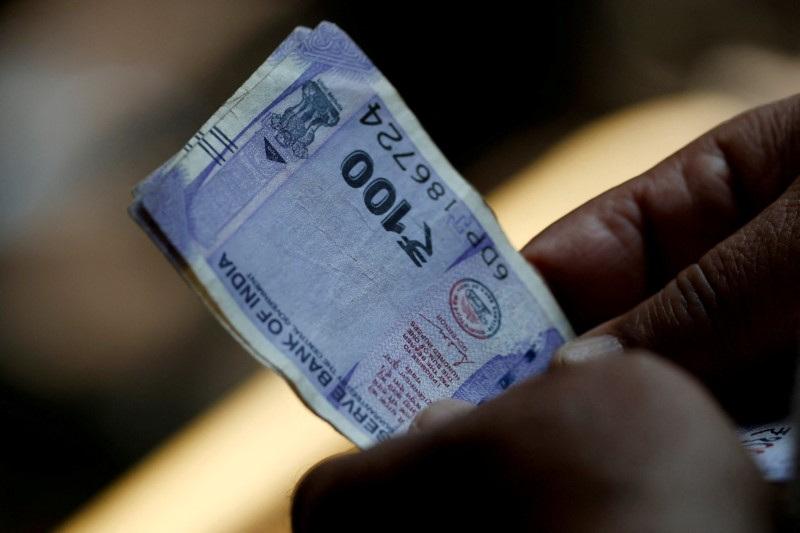
MUMBAI, Aug 9 (Reuters) - The Indian rupee logged its sixth straight weekly fall but ended little changed on Friday, as corporate dollar demand offset the impact of a rebound in regional currencies and bets of central bank intervention. The rupee closed at 83.9550 to the U.S. dollar, slightly up from its previous close of 83.9625. The currency fell 0.2% week-on-week, its worst weekly fall in more than two months. "The Reserve Bank of India (RBI) has been very watchful of the rupee's movement and has intervened in the spot market to ensure it stays near 84," Jigar Trivedi, senior analyst at Reliance Securities said. Trivedi pegs the rupee in a 83.70-84.10 range in the near term, with a downward bias. The Indian currency hit a record low of 83.9725 on Wednesday, pressured by weakness in the Japanese yen and risk assets, but stayed above the key psychological mark of 84 on dollar sales by state-run banks, likely on behalf of the RBI. The RBI aims to keep volatility of the Indian unit in check. The central bank, in addition to intervening in the spot, non-deliverable forward and futures market, has directed large banks not to make aggressive bets against the rupee. Meanwhile, Asian shares and currencies rose after U.S. jobless claims came in lower than expected, allaying concerns about a U.S. economic downturn. ING said in a note that markets "likely overreacted" to some lower-than-expected jobless claims, and that focus has now shifted to the U.S. consumer inflation data next week to gauge the outlook for interest rates. The odds of a 50 basis points Federal Reserve rate cut in September have retreated to 53% from 100% earlier this week, at the peak of worries over the Japanese markets. The RBI on Thursday held its repo rate steady at 6.50% and maintained its 'withdrawal of accommodation' stance for a ninth consecutive time. Sign up here. https://www.reuters.com/markets/currencies/rupee-ends-little-changed-despite-asia-rebound-logs-sixth-weekly-fall-2024-08-09/
2024-08-09 10:27
Aug 9 (Reuters) - The death toll in a Russian artillery strike on a supermarket in the Ukrainian town of Kostiantynivka has risen to four, President Volodymyr Zelenskiy said on Friday, with at least 24 people injured. "There are people under the rubble. A rescue operation is underway and everything will be done to save them," he said on X. Sign up here. https://www.reuters.com/world/europe/death-toll-russian-strike-ukraines-kostiantynivka-up-four-24-injured-2024-08-09/

2024-08-09 10:01
A look at the day ahead in U.S. and global markets from Mike Dolan The first reality check on July's jarring U.S. employment report suggests rising recession fears were overstated, allowing stocks to claw back nearly all the week's withering losses and volatility gauges to subside to more normal levels. It's been a hair-raising ride, but Thursday's 2.3% jump in the S&P500 (.SPX) , opens new tab marked its best single day in more than 18 months and brought the losses for the week so far to a modest 0.5%. While that would still mark the longest weekly losing streak in almost a year, Friday has yet to play out. Villains of the week's piece, the VIX (.VIX) , opens new tab fear gauge of stock volatility and Japan's yen both calmed down - the former to within 4 points of its 30-year mean and the latter to settle just above 147 per dollar. But the unexpectedly large drop in weekly U.S. jobless claims was the clear trigger for Thursday's rally. And that now biases the debate about July's worrying unemployment rate rise toward rising labour force participation and weather-related quirks, rather than outsize job shedding per se. With a thin diary on Friday and next week's U.S. July inflation report now on the radar, futures market have turned more equivocal about whether next month's expected Federal Reserve rate cut will be a quarter or a half point. Some 38 basis points of easing are now priced for September, with 100 bps over the remainder of the year. Ten and 30-year Treasuries shrugged off the week's weak auctions and yields on both slipped again on Friday, the 10 year subsiding back below 4%. Fed policymakers seem increasingly confident that inflation is cooling enough to allow rate cuts ahead. "All the elements of inflation seem to be settling down," said Richmond Fed boss Thomas Barkin. "I'm relatively hopeful based on the conversations I'm having that that's going to continue." Futures on Wall Street's main stock indexes , , were all up between 0.5% and 1% before Friday's open. Despite some wild single stock moves through the bumpy earnings season, LSEG data shows annual profit growth for the S&P500 tracking 13.8% for the second quarter - two points higher that pre-season estimates. Eli Lilly (LLY.N) , opens new tab was the standout on Thursday. Its shares jumped almost 10% after the drugmaker raised its annual profit forecast as sales of its popular weight-loss drug Zepbound crossed $1 billion for the first time in a quarter. As eyes drift back to the inflation picture, China's deflation scare eased somewhat as consumer prices stayed positive at an above-forecast 0.5% last month. But to the extent that Chinese producer prices matter more for inflation around the world, the continued annual deflation in factory gate prices may be more significant. In the slipstream of Wall Street's surge on Thursday, stocks in Europe (.STOXXE) , opens new tab and Japan (.N225) , opens new tab gained ground today too - the latter closing the week down just over 2% after an eye-watering 10%-plus round-trip on Monday and Tuesday. China's mainland benchmark (.CSI300) , opens new tab underperformed and closed slightly in the red. In deals, British investment platform Hargreaves Lansdown (HRGV.L) , opens new tab agreed to a 5.44 billion pound ($6.94 billion) takeover by an international consortium, which is betting on grabbing market share in the increasingly competitive UK wealth market. Elsewhere U.S. politics continued to throw a shade on the remainder of the year. Republican candidate Donald Trump said on Thursday that U.S. presidents should have a say over Fed decisions, the most explicit indication so far of his interest in infringing on the central bank's independence should he regain the White House. "I made a lot of money, I was very successful, and I think I have a better instinct than in many cases, people that would be on the Federal Reserve or the chairman." And yet opinion polls and betting markets suggest he may not get the chance to act that out after November's election. Democrat Kamala Harris leads Trump 42% to 37% nationwide, according to an Ipsos poll published on Thursday. And she is two points ahead in the seven closest swing states, which are among a handful of states likely to decide the election, according to another poll. The PredictIt betting market site now puts the chances of Vice President Kamala Harris beating Trump in November at about 57% - 11 points clear of the former president. The first televised debate between the two is scheduled for September 10. Key developments that should provide more direction to U.S. markets later on Friday: * Canada July employment report, June industrial output * US corporate earnings: AMC Networks, Evergy, EchoStar, Trade Desk, Nikola etc Sign up here. https://www.reuters.com/markets/us/global-markets-view-usa-pix-2024-08-09/
2024-08-09 07:56
LONDON, Aug 12 (Reuters) - Global markets are having a torrid time of late as U.S. recession fears creep back in and the effects of the yen's sudden surge ripple out. U.S. inflation numbers, the latest Japanese economic data and a slew of UK data could give investors a fresh steer. Here's your guide to the week ahead in financial markets from Ira Iosebashvili in New York, Rae Wee in Singapore and Dhara Ranasinghe, Samuel Indyk and Amanda Cooper in London. 1/ SUMMER CHILL, NO WAY Investors should have learned by now that there's no such thing as a "quiet" summer in markets. A year ago, Treasury yields rose sharply on worries about the U.S. fiscal outlook. The summer before, inflation and rate hike fears jolted markets. Last Monday's meltdown saw Japan's second-biggest stock crash and the largest ever intraday jump in Wall Street's most-watched gauge of investor anxiety, the VIX (.VIX) , opens new tab. That means the coming days will be tinged with nervousness, even if there are nascent signs of recovery. Focus is on just how much more of an unwinding of so-called yen carry trades, seen as one reason behind the rout, is left and whether the pricing-in of aggressive U.S. rate cuts are justified by upcoming data. And with concerns about a broader Middle East conflict and a U.S. election looming, volatility is unlikely to disappear soon. 2/ READY FOR MORE? Investors are now bracing for Wednesday's U.S. consumer price data for a read on how inflation is faring in the world’s largest economy amid recent signs that growth is wobbling. Market hopes of an economic soft landing have been shaken by recent weak data, including news of a rapid down-shift in the jobs market. The slowdown fears have coalesced with the unwinding of a global carry trade to deliver markets a wallop. Some analysts believe recession worries are premature. Economists polled by Reuters expect both headline and core consumer prices rose 0.2% in July from a month earlier. A number that shows only modest cooling could allay fears that the Federal Reserve has sent the economy into a tailspin by leaving rates elevated for too long. But a weak report could bolster recession worries, potentially sparking fresh market volatility. 3/ DISENCHANTMENT Japan reports preliminary second-quarter growth figures on Thursday, at a time where some analysts have critiqued the Bank of Japan's (BOJ) recent rate hike as a policy misstep that triggered the brutal selloff in stocks. To be sure, the connection isn't quite so straightforward. The BOJ's hike sparked a resurgence in the yen and extended an unwinding of the hugely popular yen carry trade, which in turn sent investors de-leveraging and shedding their stock holdings to cut losses. So should Thursday's data point to a brighter outlook, Japanese policymakers can finally breathe a sigh of relief. A downside miss and they'd have to find more reasons to justify July's hike. It's yet another busy week in Asia-Pacific, with a New Zealand rate decision due on Wednesday, alongside a slew of data from China. 4/ DELICATE BALANCE After July's finely balanced decision to cut UK rates to 5.0%, the Bank of England will have a new set of data points to go through that might help determine what the coming few months look like for monetary policy. Consumer inflation, including for the still-hot services sector, as well as second-quarter GDP and retail sales, are all in the mix. Right now, markets expect rates to fall by a percentage point over the coming nine months . But given how close July's decision was, UK assets are likely to be extra sensitive to anything that might suggest the BoE has to deviate from that expected path. Sterling is looking fragile and UK equities have seen nothing but weekly outflows for four straight months, according to LSEG/Lipper data. 5/ EUROPE'S SILVER LINING There's a silver lining for European shares, down roughly 5% so far this month, and that's corporate profits, with earnings set to grow for the first time in five quarters. According to LSEG I/B/E/S data, Q2 earnings are expected to have increased 3.8% from the same period last year, the first quarterly rise since the first quarter of 2021. Almost 56% of companies have reported results that beat analyst estimates. For sure, there are more tests ahead. Switzerland's largest bank UBS (UBSG.S) , opens new tab reports earnings on Wednesday, while it's a big week for the insurance sector, with Hannover Re, Aviva, NN Group and Admiral set to report. Overall, the Q2 earnings season suggests signs of a consumer slowdown, but strong growth in financials, energy and utilities sectors have helped offset weakness elsewhere. Sign up here. https://www.reuters.com/business/take-five/global-markets-themes-graphic-2024-08-09/
2024-08-09 07:42
FTSE 100 up 0.3%, FTSE 250 adds 0.2% Industrial metal miners lead broad gains Hargreaves Landsdown agrees to takeover deal, shares rise Aug 9 (Reuters) - London's FTSE 100 inched higher on Friday, as better-than-expected U.S. jobs data allayed fears of recession in the world's top economy, while industrial metal miners further boosted recovery. The blue-chip FTSE 100 index (.FTSE) , opens new tab was up 0.3%, while the mid-cap FTSE 250 (.FTMC) , opens new tab rose 0.2% by 0709 GMT. However, both indexes are set to post weekly declines for a second straight week. Data showed on Thursday that weekly U.S. jobless claims fell more-than-expected, suggesting that fears of an unravelling labor market were overblown and allayed some fears of a potential U.S. recession. Weak economic data last week spurring recession fears in the U.S. and the unwinding of Japan's yen carry trade triggered a battering sell-off across stock markets on Monday. On Friday, industrial metal miners (.FTNMX551020) , opens new tab led gains in London, rising 1.9% rise, as copper prices rebounded and base metals rose supported by rate-cut hopes and better-than-expected U.S. data. Rate sensitive real estate investment trusts (.FTNMX351020) , opens new tab and real estate sectors (.FTUB3510) , opens new tab also moved up 1%, each. Energy (.FTNMX601010) , opens new tab and precious metal miners (.FTNMX551030) , opens new tab also gained 0.4% and 0.8%, respectively, as oil prices rose and gold stabilized. On the flip side, personal care, drugs and grocery stocks (.FTNMX452010) , opens new tab led declines, down 0.4%. Investors are looking forward to next week, packed with inflation data both in the U.S. and the UK, alongside Britain's gross domestic product numbers. Among other stocks, Hargreaves Lansdown (HRGV.L) , opens new tab gained 1.8%after the investment platform agreed to a 5.44 billion pound ($6.94 billion) takeover by a consortium. Beazly (BEZG.L) , opens new tab was the top gainer on the FTSE 100 for a second session in a row, rising 2.3%, after jumping more than 10% on Thursday. Sign up here. https://www.reuters.com/markets/europe/ftse-100-inches-higher-miners-gain-us-jobs-data-allays-recession-fears-2024-08-09/
2024-08-09 07:06
HOUSTON, Aug 9 (Reuters) - Oil prices settled higher on Friday and notched over 3.5% in weekly gains as positive economic data and signals from Fed policymakers that they could cut interest rates as early as September eased demand concerns, while fears of a widening Middle East conflict continue to raise supply risks. Brent crude futures settled 50 cents up, or 0.6%, at $79.66 a barrel, while U.S. West Texas Intermediate crude futures rose 65 cents, or 0.9%, to $76.84. both benchmarks. Brent gained more than 3.5% in the week, while WTI rose more than 4%. "Crude is in a recovery mode ... as geopolitical tensions still seem to be a positive factor, and on-again off-again recession fears have calmed a bit, at least for now," said Dennis Kissler, senior vice president of trading at BOK Financial. A trio of Federal Reserve policymakers indicated on Thursday that they were more confident that inflation is cooling enough to cut rates. A bigger-than-expected fall in U.S. jobless claims data also helped to underpin the recovery. The number of Americans filing new applications for unemployment benefits fell more than expected last week, suggesting that fears the labor market is unraveling were overblown and that the gradual softening in the labor market remains intact. Also offering support was China's consumer price index, which rose last month at a slightly faster than expected rate, statistics bureau data showed. "Positive momentum was further reinforced by Chinese inflation numbers that exceeded expectations. In this context, it wouldn't be surprising to see the price per barrel testing the $80 level," said Pierre Veyret, Technical Analyst at ActivTrades. "The price per barrel has benefited from rising geopolitical tensions in the Middle East, which have fuelled fears of a potential conflict that could disrupt the region's output and reduce the global supply of crude," Veyret added. Israeli forces stepped up airstrikes across the Gaza Strip on Thursday, killing at least 40 people, Palestinian medics said, in further battles with Hamas-led militants. The killing last week of senior members of militant groups Hamas and Hezbollah had raised the possibility of retaliatory strikes by Iran against Israel, stoking concerns over oil supply from the world's largest producing region. Iran-aligned Houthi militants have also continued attacks on international shipping near Yemen in solidarity with Palestinians in the war between Israel and Hamas. Leaders of the United States, Egypt and Qatar on Thursday called on Israel and Hamas to meet for negotiations on Aug. 15 in order to finalize a Gaza ceasefire and hostage release deal. The Russia-Ukraine conflict also continued as Moscow moved extra tanks, artillery and rocket systems to its southern Kursk region on Friday as it battled for the fourth straight day to end a shock incursion by Ukrainian forces. Meanwhile, the dollar index , which measures the currency against six others, was down 0.136% at 103.14 following three days of gains. A weaker greenback helps demand as oil becomes cheaper for foreign buyers. Lending further support to prices, Libya's National Oil Corp declared force majeure at its Sharara oilfield from Wednesday, adding that it had gradually reduced the field's output because of protests. However, U.S. oil rigs, an indicator of future production, rose by three to 485 this week. Money managers cut their net long U.S. crude futures and options positions in the week to August 6, the U.S. Commodity Futures Trading Commission (CFTC) said. Sign up here. https://www.reuters.com/markets/commodities/oil-set-3-weekly-gain-rising-mideast-tensions-better-us-outlook-2024-08-09/