2024-08-09 05:05
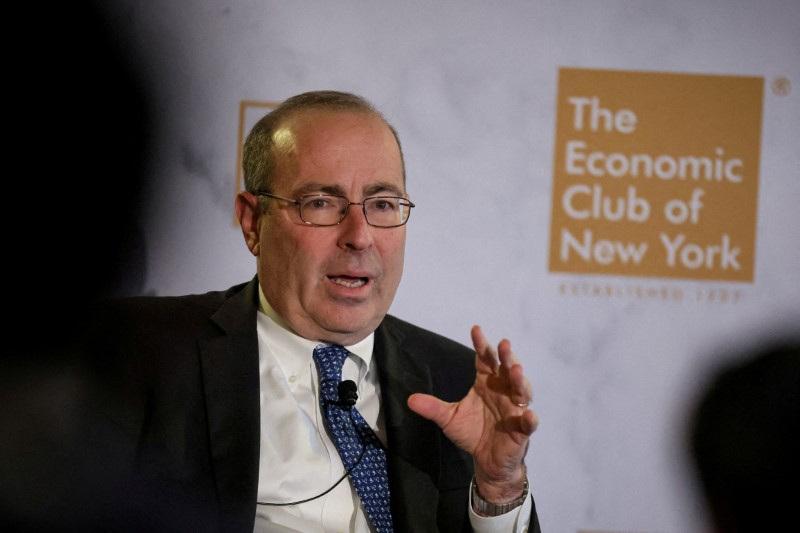
Aug 9 (Reuters) - Disappointing U.S. jobs data has shaken confidence in a soft landing for the world's largest economy, sending global equity markets tumbling and bets on interest rate cuts surging. But investors abandoning a popular yen carry trade has played a big role in the selloff, complicating the message from asset prices on the economic outlook. The likelihood of a recession is anyone's guess. Goldman Sachs has raised its odds of a U.S. recession to 25%. JPMorgan sees a 35% chance of one starting before year-end. Here is what five closely-watched market indicators say about global recession risks: 1/ DATA PUZZLE The U.S. unemployment rate jumped near a three-year high of 4.3% in July amid a significant slowdown in hiring. It fanned recession fears by reaching a trigger point of the "Sahm rule", which has shown historically a recession is underway when the three-month rolling average unemployment rate rises half a percentage point above the low of the prior 12 months. Still, many economists reckon the reaction to the data was overblown given the numbers may be skewed by immigration and Hurricane Beryl. Better-than-expected jobless claims data on Thursday also supported that view, sending stocks rallying. "Payrolls are still growing. If you started to see payrolls turn negative, that would make me much more concerned that a genuine recession is starting," said Dario Perkins, managing director, global macro at consultancy TS Lombard. The U.S. economy grew 2.8% in the second quarter on an annualised basis, double the first quarter rate and on par with the pre-pandemic average. Services activity also points to growth continuing. Beyond the United States, however, business activity indicators point to faltering euro zone growth, while China's recovery remains fragile. Global economic data is delivering negative surprises near the highest rate since mid-2022, Citi's surprise index shows (.CESIGL) , opens new tab. 2/ CORPORATE ROUT MSCI's global stocks index (.MIWD00000PUS) , opens new tab is down more than 6% from July's record highs, while the U.S. S&P 500 has lost over 4% so far in August (.SPX) , opens new tab. Yet analysts reckon stocks, which are still up around 7% globally this year, are far from signalling a recession. Goldman Sachs estimates that every further 10% selloff in U.S. equities would reduce growth over the next year by just under half a percentage point. Credit conditions could prove more important, analysts say. They note that although the risk premium corporate bonds pay over government bonds has widened in Europe and the United States, it was correcting from historically tight levels and moves were not yet pronounced enough to suggested recession risks were high. Recession expectations implied by the gap between U.S. investment grade bond and Treasury yields are about half as high as they were in 2022-2023, according to BofA. 3/ CUT AWAY Spurred on by the U.S. jobs data and a dovish-sounding Federal Reserve, traders now price in around 100 basis points of cuts in U.S. rates by year-end. That is down from over 130 bps earlier this week, but double the roughly 50 bps anticipated on July 29. Markets also price in more than a 50% chance of a hefty 50 bps September cut. Major banks have also added to the Fed cuts they expect this year. Steve Ryder, portfolio manager at Aviva Investors, said the Fed was likely to cut rates three times this year, but given uncertainty around how economic data evolves, it was understandable that markets were pricing the probability that it would have to cut more. Elsewhere, traders see a high chance of three more European Central Bank rate cuts this year, having seen less than a full chance of a second cut in mid-July. 4/ YIELD CURVE Rate cut bets have sent shorter-dated U.S. Treasury yields tumbling and the closely-watched part of the yield curve that tracks the gap between 10-year and 2-year Treasury yields turned positive for the first time since July 2022 on Monday. While a yield curve inversion has historically been seen as a good predictor of a recession on the horizon, the curve tends to revert back to normal as the recession nears. However, with the curve inverted for a record time this cycle with no recession materialising, a majority of strategists Reuters polled earlier this year no longer see it as a reliable recession indicator. The curve has inverted back since, standing at minus 5 basis points on Thursday. 5/ DR COPPER Known as "Dr Copper" for its track record as a boom-bust indicator, the metal's fall to 4-1/2 month lows this week puts it firmly on the recession watch list. Trading at around $8,750 a metric ton, three-month London Metal Exchange copper prices have slumped roughly 20% from a record high scaled in May, reflecting pessimism about the global economic outlook. Oil prices , another barometer of the health of global demand, are near multi-month lows. But their fall has been limited by worries that Middle East tensions could squeeze supplies from the largest oil producing region. Sign up here. https://www.reuters.com/markets/us/global-markets-recession-graphic-2024-08-09/
2024-08-09 05:01
There is lot of pent-up demand in the market - Indian dealer China central bank holds back again on buying gold in July China sees increased interest in gold bars - analyst Aug 9 (Reuters) - Gold demand in India crept up this week due to a correction in prices, although volatility in the market prompted some buyers to postpone purchases, while premiums in China firmed on some safe-haven buying. "There is a lot of pent-up demand in the market. Buyers were desperately waiting for a price correction. Since prices have corrected, they are coming forward," said a Mumbai-based bullion dealer. "However, large swings in prices are also confusing buyers." Domestic prices in India were around 69,600 rupees per 10 grams on Friday, after hitting a four-month low of 67,400 rupees on July 25. Dealers charged a premium of up to $9 an ounce over official domestic prices, inclusive of 6% import and 3% sales levies, compared with last week's $7 premium. Prices have corrected just before the start of the festival season this month, and the industry is expecting good orders during the ongoing India International Jewellery Show in Mumbai, said a New Delhi-based dealer. Dealers in China sold gold at par to $18 premium versus last week's $2 discount to $8 premium. Retail sales of gold jewellery in China remain subdued but there's an increased interest in gold bars as a safe-haven asset, said Bernard Sin, regional director of Greater China at MKS PAMP. China's central bank held back on buying gold for a third straight month in July. Most analysts believe there will be a resumption in purchases, but a few expect the pause to continue for a few more months. Japanese dealers sold gold at premiums of $0.25 to $1. Earlier this week when Japanese stocks fell sharply, people sold gold to get cash to hedge other assets and then came back when prices dropped, dealers said. In Singapore, bullion was sold at par to $1.25 premium per ounce , while in Hong Kong, it was sold between a $0.5 discount and a $2 premium . Sign up here. https://www.reuters.com/markets/commodities/asia-gold-premiums-firm-top-hubs-demand-trickles-2024-08-09/

2024-08-09 04:39
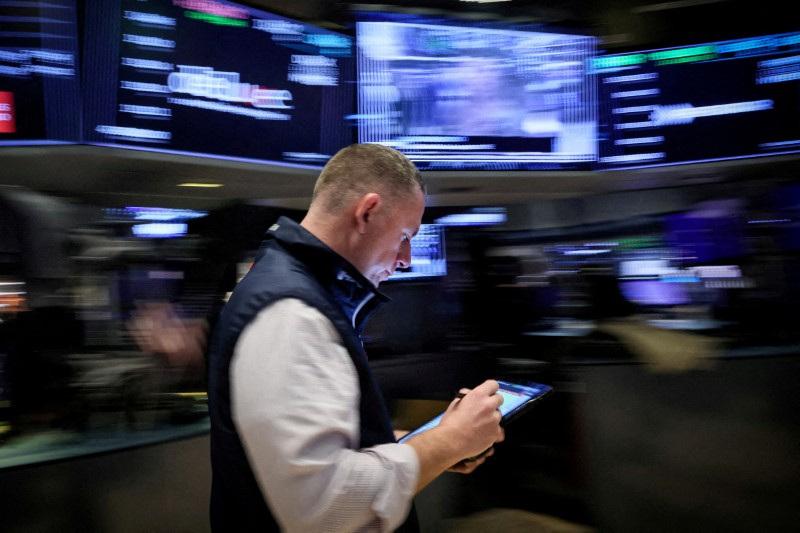
A look at the day ahead in European and global markets from Stella Qiu. No one could have guessed how this turbulent week in the markets would end, but remarkably it's only taken one weekly U.S. jobless claims report to undo most of the damage after fears of a looming U.S. recession had sent investors into panic. On Friday, Asia's share markets rallied across the board, tracking a strong rebound on Wall Street. Japan's Nikkei gained 1.6% and has erased most of Monday's 13% loss, for a likely weekly drop of just 1.5%. As it stands now, the yen is set to finish down about 0.5% against the dollar this week, after surging to a seven-month peak on Monday that spurred the unravelling of yen carry trades, a driving force in the recent global market rout. The carry trade is far from dead, though, with JPMorgan estimating this popular trade had reached perhaps $4 trillion. Even the much-feared China slowdown story is turning around a bit. Consumer inflation data on Friday showed prices rose by more than expected in July, following trade data on Wednesday that showed a surprising pick-up in import growth. This suggested there is less risk of the world's second-largest economy sliding into outright deflation. All of that should make for a stronger open for Europe, with no major economic data releases, earnings announcements or Fed speakers on the agenda for Friday. Both EUROSTOXX 50 futures and FTSE futures added 0.3%. A decent day would help the FTSE to reverse its weekly losses and the DAX to build on its gains. With money matters less of a headache, investors can perhaps turn one eye to the climactic final days of the world's biggest sporting event, as the Olympic Games in Paris head to their conclusion on Sunday. Host country France is now ranked fourth in the gold medal tally, after the U.S., China and Australia. And it has good chances at winning in basketball, volleyball and men's boxing. Key developments that could influence markets on Friday: -- CFTC commitment of traders positioning data, which will indicate how many yen shorts have come out of the market -- Germany final CPI data -- France ILO unemployment rate for Q2 Sign up here. https://www.reuters.com/markets/europe/global-markets-view-europe-2024-08-09/
2024-08-09 04:35
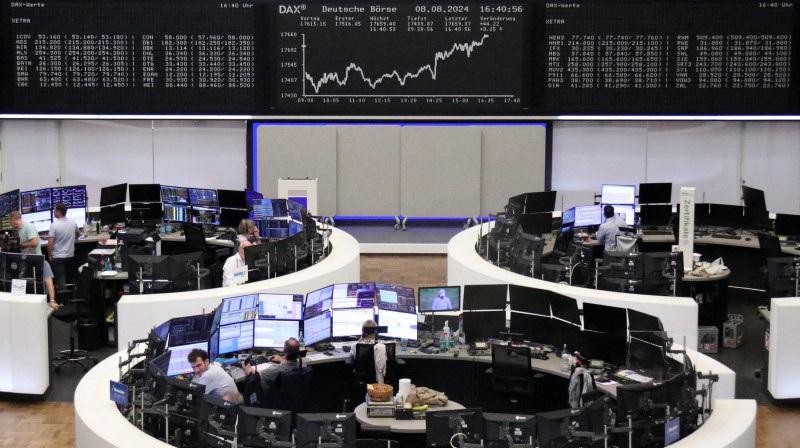
Bullion on track for its biggest weekly decline since June 7 Silver, platinum head for weekly losses U.S. consumer price index due next week Aug 9 (Reuters) - Gold eased on Friday as the latest jobs data eased concerns on U.S. recession, with prices set for a weekly decline after a global sell-off earlier in the week led to big losses in bullion, while traders awaited further clues on U.S. rate cuts. Spot gold was down 0.1% to $2,425.34 per ounce, as of 1155 GMT. U.S. gold futures rose 0.1% at $2,464.60. Bullion was on track for its biggest weekly decline since June 7. Prices fell as much as 3% on Monday after investors liquidated positions in tandem with a broader equities sell-off. "A resurgence in risk appetite following the release of positive U.S. labor figures and higher-than-expected Chinese inflation numbers helped to strengthen the dollar and demand for risk-related assets, in a dynamic that penalizes the non-yielding precious metal," said Ricardo Evangelista, senior analyst at ActivTrades. U.S. Treasury yields rose after data on Thursday showed U.S. jobless claims fell more than expected last week, suggesting fears the labour market is unravelling were overblown. The dollar hovered close to a one-week high, making bullion more expensive. "There is increasing expectations that the Fed will cut interest rates at their September meeting and one senses some frustration in the markets that the higher-for-longer narrative is long beyond its sell-by date," said independent analyst Ross Norman. Markets see a 100% chance of a U.S. cut rate in September, according to the CME FedWatch Tool. Investor focus shifts to the U.S. consumer price index (CPI) due next week for further insights into the Fed's policy path. "We assume that gold will remain in demand against the backdrop of the Middle East tensions," Commerzbank said in a note. Spot silver was down 0.3% to $27.49 per ounce and platinum fell 0.4% to $927.05. Both metals were poised for weekly losses. Palladium gained 0.1% to $923.83, set for a weekly gain despite hitting 2017 lows earlier this week. Sign up here. https://www.reuters.com/markets/commodities/gold-prices-set-weekly-drop-with-focus-fed-cues-2024-08-09/

2024-08-09 00:47
SAO PAULO/RIO DE JANEIRO, Aug 8 (Reuters) - Brazilian state-run oil giant Petrobras (PETR4.SA) , opens new tab on Thursday posted a net loss of 2.6 billion reais ($470 million) for the second quarter of 2024, the firm said as it announced lower-than-expected results and a reduction in investment estimates. Despite the results, the firm's board approved a 13.57 billion-real ($2.45 billion) payout to shareholders in dividends and interest on equity, equivalent to 1.05 reais per share. The payout will be made using 6.4 billion reais out of funds from 2023 extraordinary dividends that were withheld by the board in March, Petrobras said in a securities filing, leaving the fund with around 15.5 billion reais. The net loss - the firm's first since the third quarter of 2020 - was a result of a one-off 11.9 billion reais tax charge and the devaluation of the real, among other non-recurring items, said the firm. The tax payments should help the Brazilian government to balance its budget as the administration of President Luiz Inacio Lula da Silva seeks new sources of revenue to meet its fiscal targets for this year and 2025. This is the first quarter under new Petrobras Chief Executive Magda Chambriard, who was put in charge by Lula with the mission to speed up investments, in order to boost Brazil's economy and generate local jobs. The company's net recurring profit fell 46.5% in the second quarter to 15.7 billion reais, missing analysts' expectations of 22.3 billion reais, according to LSEG data. Adjusted earnings before interest, taxes, depreciation and amortization (EBITDA) fell 12.3% in the period, to 49.7 billion reais, below an LSEG poll estimate of 63.3 billion reais. Petrobras also lowered its planned investments for this year to between $13.5 billion and $14.5 billion, from a planned $18.5 billion for 2024. Its new forecasts include an estimated $11.1 billion to $12.1 billion earmarked for the exploration and production segment. The fresh forecast will not impact its oil and gas production curve, the firm said. Despite the lower-than-expected financial results, the firm's net revenue showed an increase of 7.4%, to 122.26 billion reais. ($1 = 5.5473 reais) Sign up here. https://www.reuters.com/markets/commodities/brazils-petrobras-approves-245-billion-payout-shareholders-2024-08-09/
2024-08-08 23:27
Aug 8 (Reuters) - Federal Reserve policymakers are increasingly confident that inflation is cooling enough to allow interest-rate cuts ahead, and they will take their cues on the size and timing of those rate cuts not from stock-market turmoil but from the economic data. That was the shared message of three U.S. central bankers speaking on Thursday who otherwise had slightly different takes on exactly where the economy stands a week and a day after they decided to hold the policy rate steady but signaled a reduction as soon as next month. A jump in the July U.S. unemployment rate reported on Friday helped spark a global stock market rout that continued into Monday before equities partially recovered, as investors and analysts worried the U.S. was headed for a recession and the Fed would need to react aggressively. "It's hard to make the case that something has just happened that is monumental on the equity side," Richmond Federal Reserve Bank President Thomas Barkin said on Thursday, noting major U.S. stock-market indices are still up from the start of the year. More to the point on policy, he said at a virtual event put on by the National Association for Business Economics, is "all the elements of inflation seem to be settling down (and) I'm relatively hopeful based on the conversations I'm having that that's going to continue." Those same conversations with business leaders also suggest the cooling in the U.S. labor market is coming from slower hiring rather than a rise in layoffs, he said. "I think you've got some time in a healthy economy to figure out whether this is an economy that's gently moving into a normalizing state that will allow you to, in a steady deliberate way, normalize rates or ... is this one where you really do have to lean into it." Kansas City Fed President Jeff Schmid, one of the U.S. central bank's more hawkish policymakers, also took note of the recently roiled financial markets. "Financial conditions can both reveal important information on the trajectory of the economy and can also spillover to impact the real economy," he said in remarks prepared for delivery to the Kansas Bankers Association's annual meeting in Colorado Springs, Colorado. "However, the Fed has to remain focused on achieving its dual mandate" of full employment and price stability. On that score, he said, recent "encouraging" data showing inflation around 2.5% gives him more confidence inflation is headed to the Fed's 2% goal. "If inflation continues to come in low, my confidence will grow that we are on track to meet the price stability part of our mandate, and it will be appropriate to adjust the stance of policy," he said. Schmid described the economy as resilient, consumer demand as strong, and the labor market as noticeably cooling but still "quite healthy," and said he views the current policy stance as "not that restrictive." "With the tremendous shocks that the economy has endured so far this decade, I would not want to assume any particular path or endpoint for the policy rate," he said. Chicago Fed President Austan Goolsbee on Thursday reiterated his view the central bank's policy is tight, and that to leave borrowing costs where they are even as inflation falls is to make it even tighter, risking harm to the labor market. But like his more hawkish counterparts, Goolsbee said the stock market, and the upcoming presidential election, would not determine Fed policy. "The Fed's out of the election business. The Fed is in the economic business," Goolsbee said in an interview on Fox News. "We're not in the business of responding to the stock market. We're in the business of maximizing employment and stabilizing prices." Sign up here. https://www.reuters.com/markets/us/feds-barkin-sees-inflation-coming-down-time-assess-policy-2024-08-08/