2024-08-01 06:29
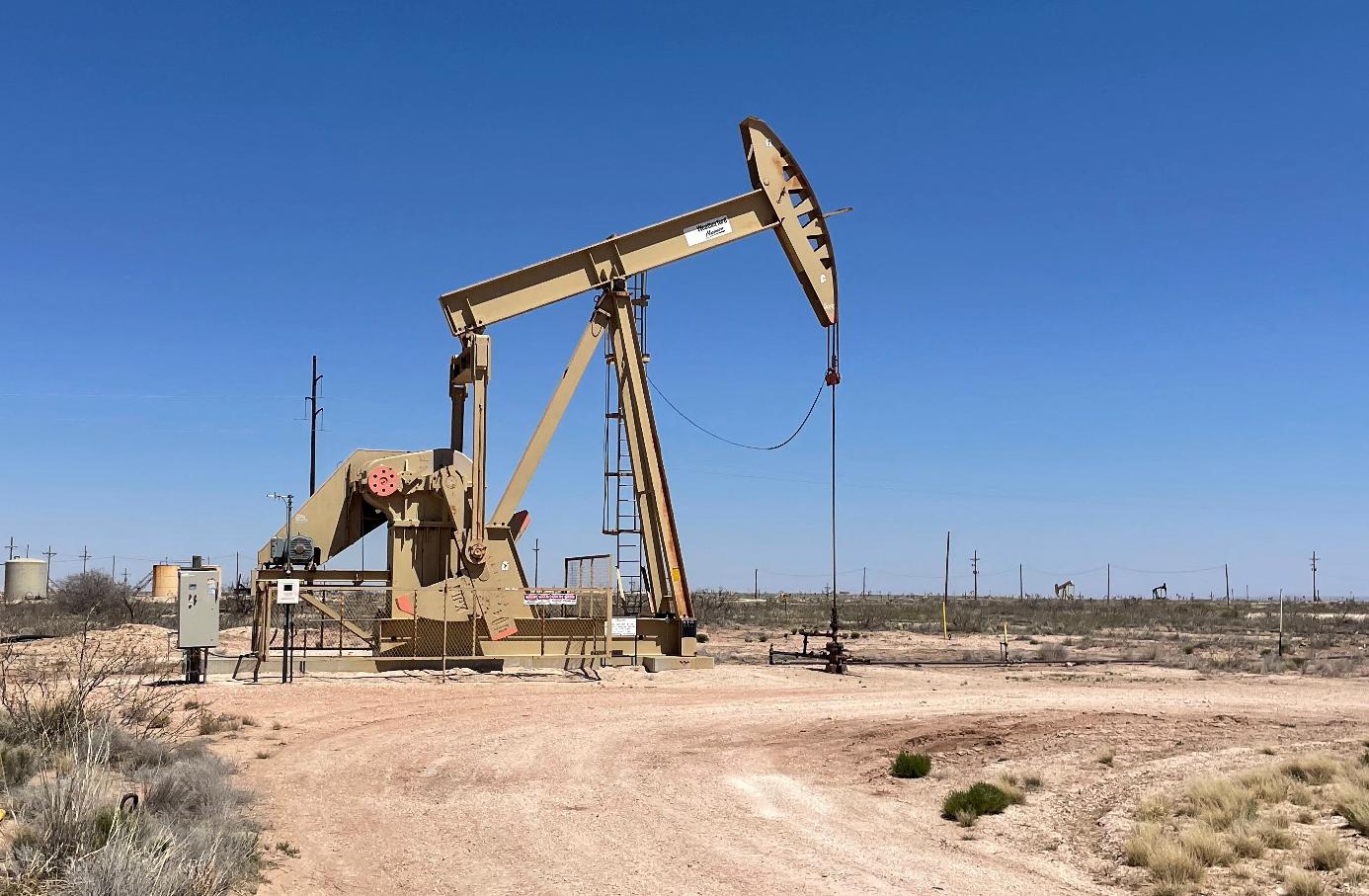
LONDON, Aug 1 (Reuters) - Oil prices extended gains on Thursday after the killing of a Hamas leader in Iran raised the threat of a wider Middle East conflict and concern over its impact on oil. Global benchmark Brent crude futures rose 71 cents, or 0.9%, to $81.55 a barrel by 1124 GMT. U.S. West Texas Intermediate crude gained 72 cents, also 0.9%, to $78.63. The most active contracts on both benchmarks jumped about 4% in the previous session. Hamas leader Ismail Haniyeh was killed in the Iranian capital Tehran on Wednesday. With Israel's killing less than 24 hours earlier of Hezbollah's most senior military commander in Beirut, concerns rose that the 10-month war in Gaza between Israel and Hamas is turning into wider conflict that could disrupt oil supply from the region. "Oil markets are justifiably worried that the assassination of Haniyeh will bring Iran more directly into the war with Israel. And that could put at risk Iran's oil supply and related infrastructure," Commonwealth Bank of Australia analyst Vivek Dhar wrote in a client note. Dhar said markets will be worried about Iran's ability to escalate tension via its control of the Strait of Hormuz. Also pushing up prices was data from the U.S. Energy Information Administration (EIA) on Wednesday showing robust export demand pushed U.S. crude oil stockpiles down by 3.4 million barrels in the week ended July 26. The U.S. dollar index extended losses on Thursday from the previous session after the Federal Reserve held interest rates but left the door open for a cut in September. A weaker dollar can boost oil demand from investors holding other currencies. Meanwhile, the Bank of England cut interest rates from a 16-year high on Thursday after a narrow vote in favour from policymakers divided over whether inflationary pressures had eased sufficiently. OPEC+ ministers also meet on Thursday to decide output policy, with sources believing they are unlikely to make any changes to existing production cuts and will start unwinding some of those from October despite recent declines in oil prices. In the longer term, however, investors are not confident of Chinese demand, said Phillip Nova analyst Priyanka Sachdeva, adding that this concern will continue to limit the upside in oil prices. Official data from China on Wednesday showed that manufacturing activity slipped to a five-month low in July as factories grappled with falling new orders and low prices. A private sector survey on Thursday also showed China's manufacturing activity in July had shrunk for the first time in nine months as new orders declined. Sign up here. https://www.reuters.com/business/energy/oil-rises-risk-broadening-middle-east-conflict-2024-08-01/
2024-08-01 06:22
Boosts annual profit f'cast by Y40 bln Dialogue with 700 stakeholders fostered deal understanding Sees former U.S. Secretary of State Pompeo as a strong advisor TOKYO, Aug 1 (Reuters) - (This Aug. 1 story has been corrected to say Nippon Steel's commitment is 'until' the current agreement expires, not 'even after', in paragraph 9) Japan's biggest steelmaker Nippon Steel (5401.T) , opens new tab on Thursday raised its full-year profit forecast amid improving margins in the steel business, and reiterated its confidence in closing its proposed acquisition of U.S. Steel (X.N) , opens new tab by year-end. Net profit in April-June, its first quarter, fell 11% from a year earlier to 157.6 billion yen ($1 billion), but exceeded analyst expectations of 108.7 billion yen as per LSEG data. The world's fourth-biggest steelmaker increased its net profit forecast for the year ending in March 2025 to 340 billion yen from 300 billion yen, expecting its steel business to improve. Still, the revised figure fell short of analysts' estimate of 372.6 billion yen. "We face an unprecedented slump in steel demand, but our efforts have borne fruit," Vice Chairman Takahiro Mori said, noting its restructuring including shutting down steel plants. Nippon Steel, which clinched the $14.9 billion deal to buy U.S. Steel last December, said on Thursday it received a second request for information and data from the U.S. Department of Justice as part of the U.S. government's review of the deal. "We are confident that we can close the deal by the end of this year," Mori said, citing his repeated visits to the U.S. and dialogue with some 700 stakeholders, including employees of the U.S. Steel, have helped to foster a better understanding of the deal. Both steelmakers have received all regulatory approvals outside of the United States for the deal, but face political opposition, U.S. regulatory scrutiny and objections from the powerful United Steelworkers (USW) union, which fears the deal could lead to job losses. "The union has not explicitly changed its position, but the right understanding has been disseminated around it," Mori said. As a part of its bid, which has faced resistance from both Democrats and Republicans, Nippon Steel said it has committed to no job cuts, job or production transfer overseas or plant closures until the current agreement between USW and U.S. Steel expires in September 2026. Last month, Nippon Steel said it hired former U.S. Secretary of State Mike Pompeo to help seal the deal. "Pompeo will become a strong advisor to us as he is well respected by both Republicans and Democrats," Mori said, adding the deal is expected to receive understanding regardless of who becomes the next U.S. president since it would be good for the U.S. economy. ($1 = 149.6100 yen) Sign up here. https://www.reuters.com/markets/commodities/japans-nippon-steel-q1-net-profit-down-11-beats-estimates-2024-08-01/
2024-08-01 06:15
MOSCOW/LONDON, Aug 1 (Reuters) - A meeting of top OPEC+ ministers has kept oil output policy unchanged, two OPEC+ sources said while the meeting was under way, despite recent sharp declines in oil prices. Top ministers from the Organization of the Petroleum Exporting Countries and allies led by Russia, or OPEC+ as the group is known, started an online joint ministerial monitoring committee meeting (JMMC) earlier on Thursday. The meeting will cover plans for some members to compensate for earlier overproduction, two sources said. The chair of the meeting was insisting that members show commitment to the compensation plan, one of them added. Oil prices have fallen from a 2024 high above $92 a barrel in April to below $82, pressured by concern about the strength of demand but finding support this week from increasing tensions in the Middle East. OPEC+ is currently cutting output by 5.86 million barrels per day (bpd), or about 5.7% of global demand, in a series of steps agreed since late 2022. At its last meeting in June, the group agreed to extend cuts of 3.66 million bpd by a year until the end of 2025 and to prolong the most recent layer of cuts - a 2.2 million bpd cut by eight members - by three months until the end of September 2024. The current plan also calls for OPEC+ to gradually phase out the cuts of 2.2 million bpd over the course of a year from October 2024 to September 2025. The JMMC, which groups the oil ministers of Saudi Arabia, Russia and other leading producers, usually meets every two months and can make recommendations to the wider OPEC+ group. Sign up here. https://www.reuters.com/business/energy/opec-likely-stick-output-policy-meeting-sources-say-2024-08-01/
2024-08-01 06:04
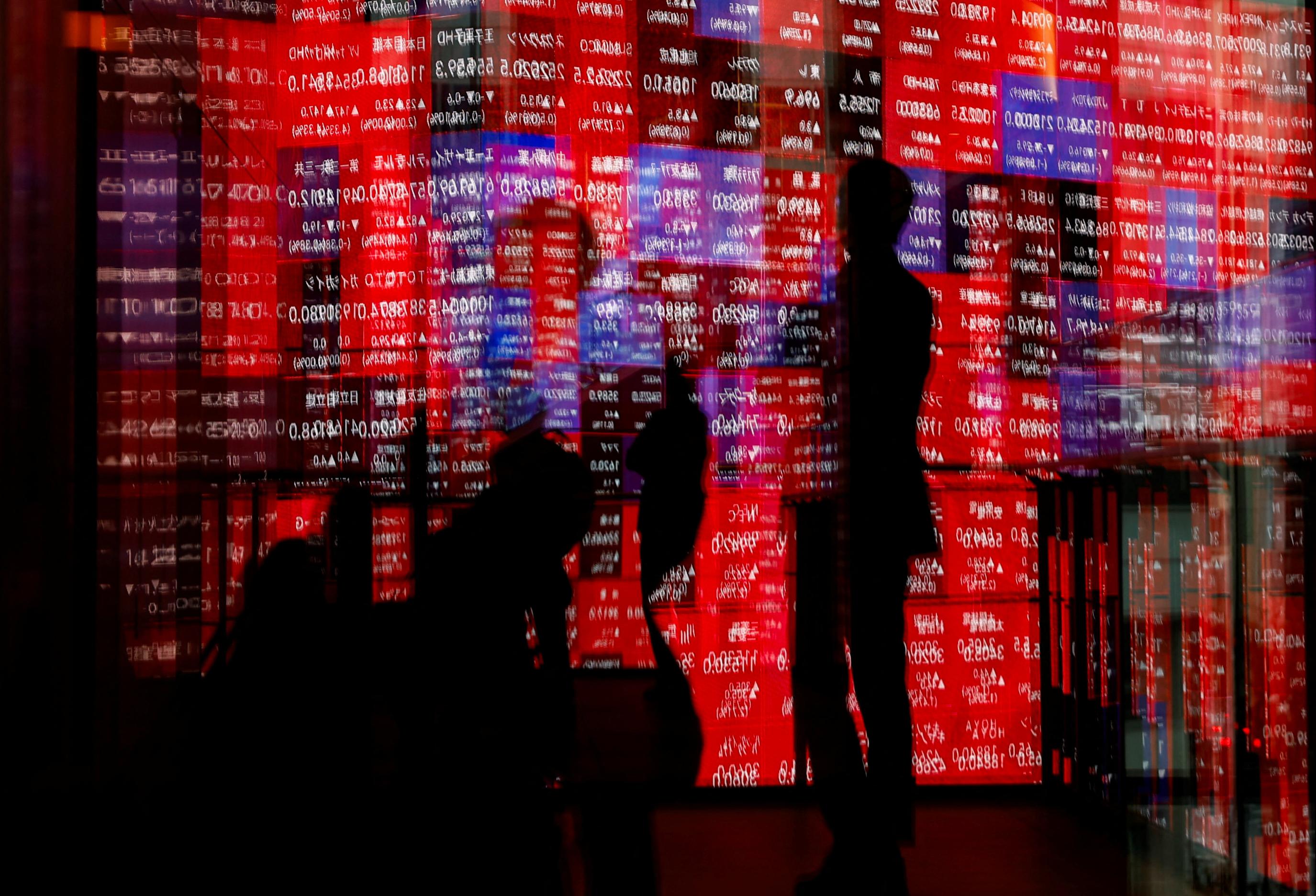
NEW YORK/LONDON, Aug 1 (Reuters) - Global equities dropped on Thursday, with Wall Street's major indexes selling off as U.S. data sparked economic worries and financial stocks in Europe saw their biggest one-day rout since March 2023. Treasury yields plunged following the weak data, with the U.S. two-year to 10-year note yields dropping to six-month lows, below 4%. Oil futures finished lower as global supply seemed largely unaffected by worries of a broadening Middle East crisis. The Federal Reserve held interest rates steady on Wednesday but opened the door to a cut in September. The Bank of England stole a march on the U.S. central bank on Thursday by lowering borrowing costs by a quarter-point in a narrow 5-4 vote. The U.S. Institute for Supply Management's (ISM) manufacturing PMI dropped to its lowest since November, below a key level that indicates contraction in a sector that accounts for more than 10% of the economy. The number of Americans filing new applications for unemployment benefits increased to an 11-month high last week, suggesting some softening in the labor market, although seasonal factors also played a role, other data showed. "Today's selloff isn't about earnings. It's about whether the Fed sees what the data is saying," said Quincy Krosby, chief global strategist for LPL Financial in Charlotte, North Carolina. "If tomorrow's payroll report sees the unemployment rate rising despite an increase in the participation rate, the Fed is going to have a lot of explaining to do," said Quincy Krosby, Chief Global Strategist for LPL Financial in Charlotte, North Carolina. On Wall Street, the Dow Jones Industrial Average (.DJI) , opens new tab fell 494.82 points, or 1.21%, to 40,347.97, the S&P 500 (.SPX) , opens new tab lost 75.62 points, or 1.37%, to 5,446.68 and the Nasdaq Composite (.IXIC) , opens new tab lost 405.25 points, or 2.30%, to 17,194.15 MSCI's gauge of stocks across the globe (.MIWD00000PUS) , opens new tab fell 11.11 points, or 1.36%, to 803.05. Europe's STOXX 600 (.STOXX) , opens new tab index closed more than 1% lower with the banking sector (.SX7P) , opens new tab seeing its largest one-day decline since March 2023. "The fact that some heavyweights are cutting guidance does not bode well going forward and might well explain why European markets are underperforming," said Stephane Ekolo, equity strategist at TFS Derivatives. "Disappointing set of results, slowing growth for industrials, Chinese consumers no longer there to rescue demand and a possible resurgence of inflation. You have a not so pleasant cocktail." Britain's FTSE 100 (.FTSE) , opens new tab bucked the trend. "If you look at the headlines that (BoE Governor Andrew) Bailey produced: caution on cutting too quickly or by too much, it implies to me that they're looking at a steady quarterly pace of reductions," said Colin Asher, economist at Mizuho. "I would say that makes a cut in the next meeting in September unlikely. The start of lower interest rates is underway, but reasonably gradually." Emerging market stocks (.MSCIEF) , opens new tab held onto gains, or 0.10%, to 1,085.84. MSCI's broadest index of Asia-Pacific shares outside Japan (.MIAPJ0000PUS) , opens new tab closed 0.54% higher at 568.59. Japan's Nikkei (.N225) , opens new tab, however, tumbled 2.5% as a sharp jump in the yen clouded the outlook for exporters . The Japanese yen rallied against the dollar to its strongest level since March, a day after the Bank of Japan raised interest rates for the second time in 17 years and signalled more tightening to come. FED SIGNALS SEPTEMBER CUT Eyes remained on the U.S. monetary policy outlook after Fed Chair Jerome Powell said policymakers had a "real discussion" about cutting at the July meeting. The central bank also said the risks to employment were now on a par with those of rising prices. "The statement was notable in that they removed the tightening bias and replaced it with a more neutral bias," said Jan von Gerich, chief analyst at Nordea. "It's early but the fact we haven't really seen the rally continue suggests that markets may be trying to catch some breath before tomorrow's (U.S.) payrolls report." The yield on benchmark U.S. 10-year notes fell 13.3 basis points to 3.972%, from 4.105% late on Wednesday. Yields move inversely to prices. After falling 0.4% on Wednesday, the dollar index which measures the greenback against a basket of currencies including the yen and the euro, gained 0.34% at 104.40 The euro fell 0.35% at $1.0787. In commodity markets, global benchmark Brent crude futures closed $1.32, or 1.6%, lower at $79.52 a barrel, while U.S. West Texas Intermediate crude fell $1.60, or 2.1%, to $76.31. Spot gold lost 0.21% to $2,442.90 an ounce, after touching its highest since July 18. U.S. gold futures settled 0.3% higher at $2,480.8. S (This story has been refiled to remove the extraneous word 'about' in paragraph 1) Sign up here. https://www.reuters.com/markets/global-markets-wrapup-1-2024-08-01/
2024-08-01 05:34
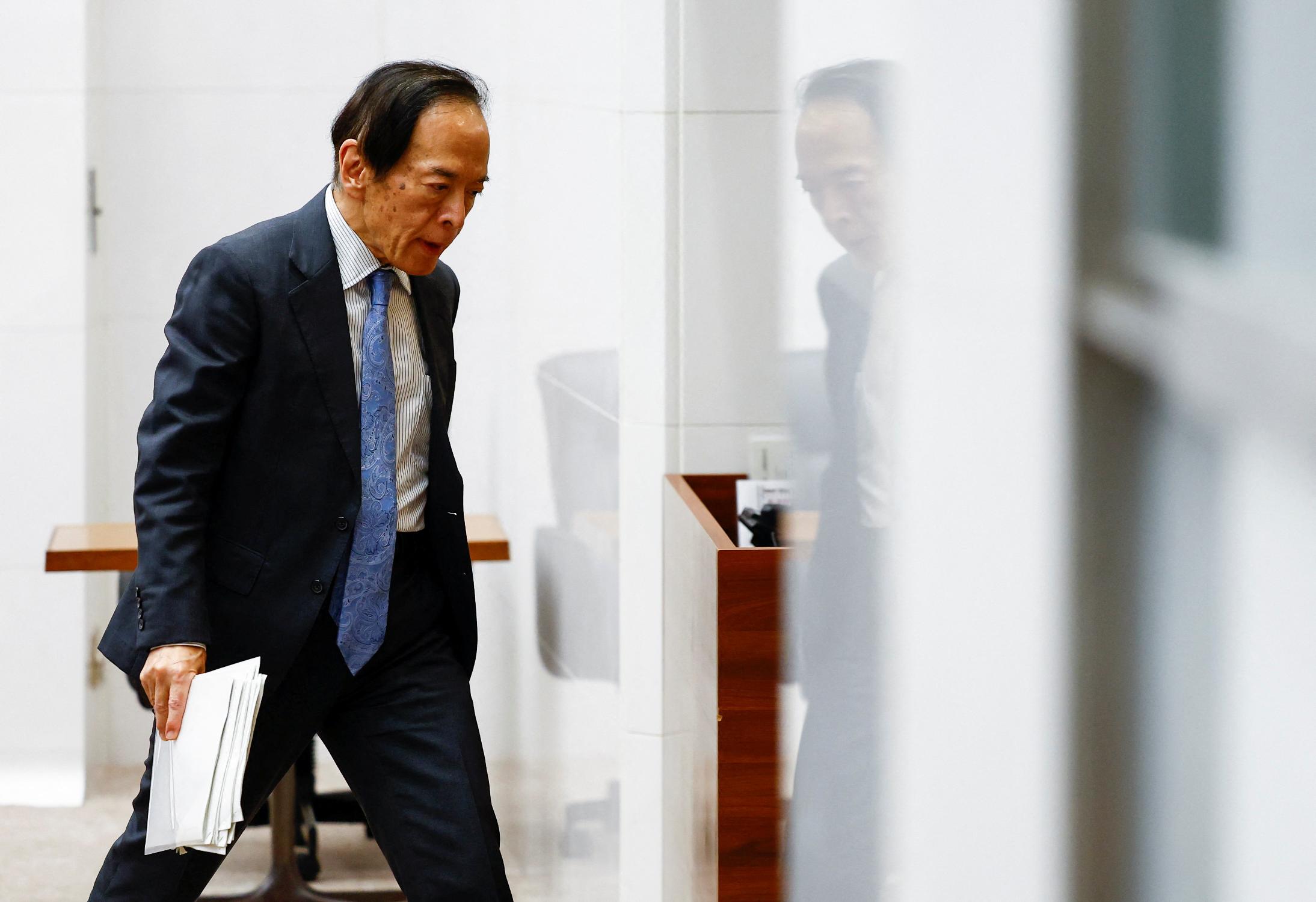
July rate hike came despite dissent, weak consumption data Rate hike to around 0.75% seen as removing excess stimulus Weak data won't keep BOJ from hiking until rates near neutral Some market players see chance of another hike this year TOKYO, Aug 1 (Reuters) - Once seen as a cautious policy dove, Bank of Japan Governor Kazuo Ueda is now presenting himself as a determined hawk who's not afraid to lift interest rates a few more times, even in the face of a weakening economy. A change in Ueda's commentary comes as the central bank grows more confident that steady wage gains will revive consumption, and reflects concerns that leaving rates low for too long could keep the yen weak and lead to a painful, unpopular inflation overshoot. Recent calls from politicians to combat yen falls with hawkish policy, including from Prime Minister Fumio Kishida, are also emboldening the BOJ to drop signs of future hikes, analysts say. Ueda's latest hawkish hints and Japan's still-low real interest rates mean the BOJ has its eyes set on hiking rates at least to around 0.75%, notwithstanding economic shocks, sources and analysts say. "Ueda's remarks suggest that even if the economy's momentum is somewhat weak, the BOJ will raise rates further unless its projection of an economic expansion is derailed," said Yoshimasa Maruyama, chief market economist at SMBC Nikko Securities. In a press conference explaining the BOJ's decision to raise short-term rates to 0.25% on Wednesday, Ueda said there was "still quite some distance" before its policy rate reaches a neutral level that neither cools nor overheats the economy. Ueda also said 0.5%, a level Japan has not seen since 2008, posed no barrier to rates going even higher. While he declined to specify Japan's neutral rate level, three sources familiar with the BOJ's thinking said the dominant view within the central bank is for it to be around 1-1.5%. That suggests the BOJ is pencilling in at least two more 25 basis point hikes to 0.75%. Hikes that big would help remove excessive monetary support but wouldn't create restrictive monetary conditions, and would only need inflation data to move roughly in line with BOJ forecasts. Only when short-term rates approach levels deemed neutral would the BOJ's policy decision become sensitive to more subtle signs of weakness in the economy, the sources said. "The March policy change was an extraordinary move. After that, it's business as usual," one of the sources said on how rates can follow a steady trajectory without much advance hints from the central bank on the specific timing of a change. MORE TO COME When the BOJ ended negative interest rates and other remnants of its massive stimulus in March, the focus of its communication was to avoid jolting markets with too-hawkish signs on the policy outlook. With markets having digested the impact of the March move, the BOJ is now shifting towards sending clearer signals on the prospect of a full-fledged rate hike cycle, the sources said. Underscoring the BOJ's hawkish bent, the BOJ said in a quarterly outlook report on Wednesday that it will "continue to raise its policy rate" as long as the economy and inflation move in line with its forecast. That compared with the previous report's language pledging to "keep financial conditions loose," even if the BOJ were to fine-tune the degree of monetary support. The BOJ's decision to hike rates on Wednesday also came despite recent weak signs in consumption, which led many economists to bet it will stand pat to gauge more data. Two dovish members of the board dissented to the rate decision. Ueda escalated his warning on the demerits of the weak yen, saying there was "quite a significant risk" the boost it gives to import costs may push up inflation more than expected. His remarks on Wednesday more explicitly linked the inflationary threat to the yen's declines than his previous comments on the currency's impact have. The BOJ's hawkish determination is finally getting across to markets. JPMorgan now expects the BOJ to hike rates to 0.5% in December, followed by two more hikes to 1% by end of 2025. Former BOJ board member Takahide Kiuchi, who is currently an economist at Nomura Research Institute, thinks the BOJ will aim to push up rates near 1% including through two hikes by early next year. "Ueda hiked rates this month on the view that inflation was on track to meeting the BOJ's projections," said former BOJ official Nobuyasu Atago, currently chief economist at Rakuten Securities Economic Research Institute. "Judging from the statement's language, one might need to guard against the possibility of another rate hike when the BOJ issues its next outlook report in October," he said. Sign up here. https://www.reuters.com/business/finance/boj-governors-hawkish-streak-signals-more-hikes-come-2024-08-01/
2024-08-01 05:00
TOKYO, Aug 1 (Reuters) - Tourists are flocking to Japan to scoop up high-end clothes and handbags at a discount thanks to the weak yen currency. Luxury goods companies like Louis Vuitton parent LVMH (LVMH.PA) , opens new tab would rather they stayed home and shopped. The yen's sell-off - it hit a 38-year low against the dollar last month before recovering ground - has sparked an unprecedented tourist boom, drawing savvy shoppers from Asia and elsewhere. Global luxury brands aren't cheering, because their goods, ranging from designer sneakers to whisky, now tend to be cheaper in dollar terms in Japan than elsewhere, denting profits. Some tourists, especially Chinese, are holding off on buying designer goods at home and splurging in Japan. The yen's volatility means companies can't easily hike prices to accurately reflect the currency, leaving them stuck with lower margins in Japan - at least while the yen stays weak. Zhang Lei, a 29-year-old DJ from the southern province of Hunan, was visiting Japan for the first time but said he already wanted to come again. "It's cheaper," said Zhang, who carried two Louis Vuitton shopping bags and one from sportswear brand Onitsuka Tiger on a recent Saturday in Tokyo's high-end Ginza district. Nearby, some 15 people queued up to enter the Louis Vuitton boutique, fanning themselves in the sweltering heat. Zhang said his purchases so far included shoes and a bag. He planned to pick up a watch next, he said, pointing to his wrist as he repeated "Rolex". The trend has taken French luxury giant LVMH, which also owns Dior and Fendi, by surprise. "We really have a big shift of business from Asia into Japan," Chief Financial Officer Jean-Jacques Guiony told a recent earnings call. It was having a "deflationary" impact on LVMH's China business as customers held off on shopping at home, putting significant pressure on margins, he said. He also mentioned the difficulty posed by currency volatility, as currencies can undo moves "pretty quickly". That was put in sharp relief this week as the yen surged after the Bank of Japan raised interest rates on Wednesday. DIOR, CHANEL, MOUNT FUJI Louis Vuitton's popular Alma BB handbag goes for 14,800 yuan in China, the equivalent of $2,050. In Japan it sells for 279,400 yen, or $1,875. Last month it would have been available for as low as $1,725 when the yen was at its weakest. The yen would have to strengthen to around 136 to the dollar to put the bag's Japanese price at parity with China. The currency was at 149.30 on Thursday, not far off its strongest in 4-1/2 months. Chinese tourists were also helping fuel Japanese sales of luxury spirits, drinks maker Remy Cointreau (RCOP.PA) , opens new tab said. Japan generated strong sales growth, boosted by tourism and the weak yen, Remy Cointreau CFO Luca Marotta said on the company's first-quarter sales call, adding the sales were lower margin. Swiss luxury group Richemont (CFR.S) , opens new tab, which owns the Cartier brand, saw Japan sales increase almost 60% in the first quarter, helped by Chinese, Southeast Asian and American tourists, it said. "Shopping, shopping, shopping," said Fumiko Annisa, who was visiting from Indonesia, about her itinerary. "High-end brands are cheap here," she said. "We are going to buy Dior but we are going to Chanel first." She also planned to visit the western city of Osaka and Gotemba near Mount Fuji, home to a sprawling outlet mall that sells brands from outdoor clothing maker Arc'teryx to Italian fashion house Zegna. Japan had a record 3.1 million foreign visitors in June, official data showed last month, putting it on track to beat an annual record of almost 32 million foreign arrivals set in 2019, before the pandemic brought global travel to a standstill. Spending by tourists is expected to reach 8 trillion yen ($54.74 billion) this year, according to the government, which sees tourism as a rare growth driver in an economy long hobbled by an ageing population. New Yorker Yadwinder Singh said he hadn't expected to do much shopping until he saw prices in fast-fashion retailer Zara and other stores that were much cheaper than at home. The 26-year-old said he was buying plenty. "Clothes, jewelry, shoes - the whole outfit." ($1 = 7.2171 Chinese yuan renminbi) ($1 = 148.8700 yen) Sign up here. https://www.reuters.com/world/japan/tourist-splurge-japan-creates-new-headache-luxury-brands-2024-08-01/